
Why a Bible-Based Couples Retreat Can Renew Your Connection
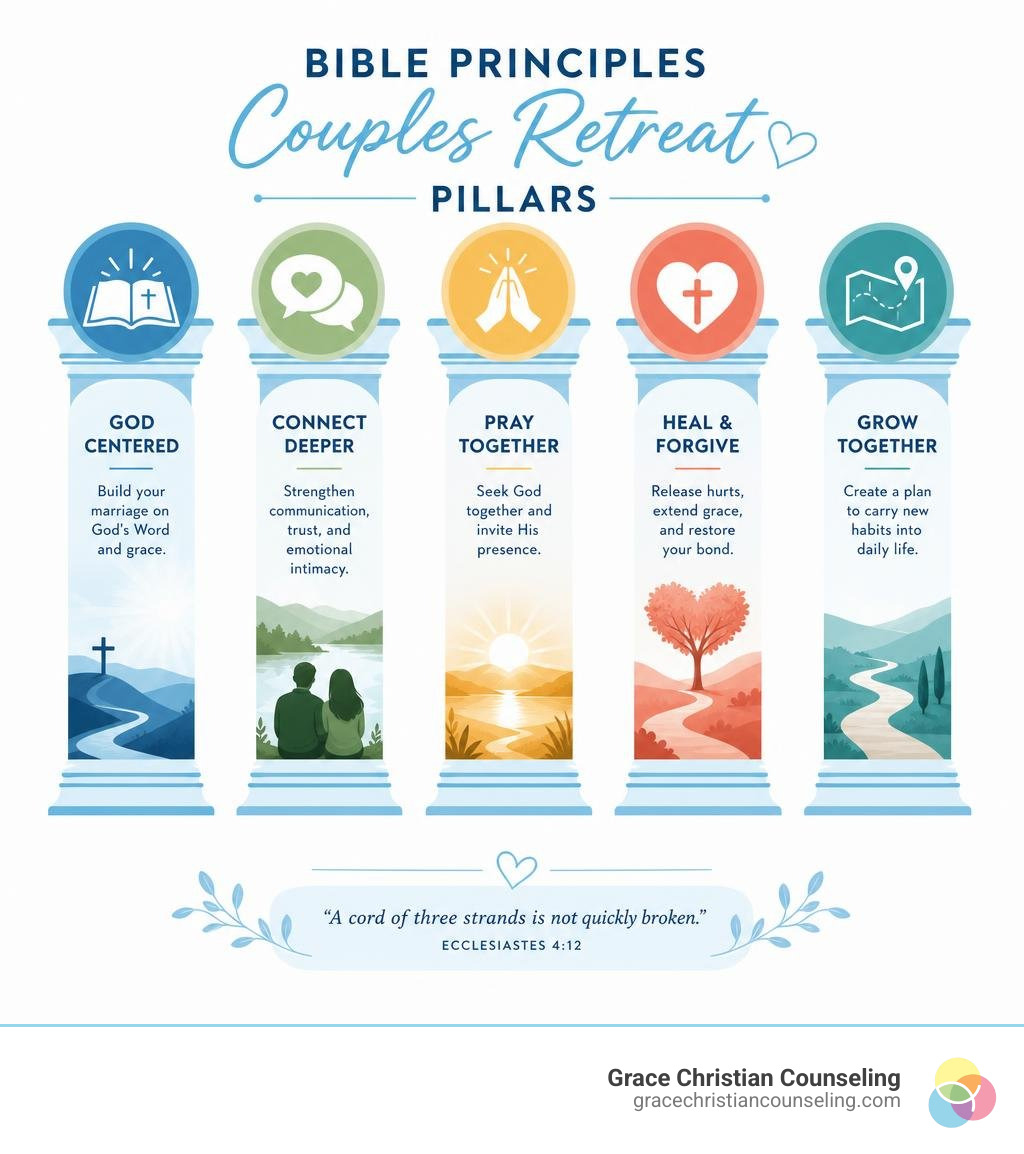
A couples retreat grounded in biblical principles is a focused time away for a husband and wife to reconnect with God and each other through Scripture, prayer, honest conversation, rest, and shared joy. Unlike a typical trip, the goal is not simply to get away. It is to step back from daily noise and give your marriage intentional care.
The strongest Christ-centered retreats usually include:
- Biblical teaching on covenant, grace, forgiveness, and serving one another.
- Private time for prayer, conversation, fun, and emotional connection.
- Practical tools for healthier communication and conflict repair.
- A safe setting to discuss unresolved hurts or intimacy concerns, with counseling support when needed.
- A follow-up plan that helps couples carry new habits into daily life.
A retreat cannot solve every problem in a weekend, but it can create needed space to listen, reflect, and begin again with purpose. For couples facing relationship strain alongside anxiety, depression, trauma, or the pressure of family life, professional support may also be important. At Grace Christian Counseling, our licensed counselors, including LAPCs and LSWs, offer Christ-centered, evidence-based counseling for couples and families throughout Western Pennsylvania, including Pittsburgh, North Huntingdon, Penn Hills, Uniontown, Bethel Park, Sewickley, and Mt. Lebanon, as well as through online counseling.
1. Core Biblical Foundations for Marriage Getaways
At the heart of any transformative Christian couples retreat is a theological foundation grounded in God’s Word. Marriage is not merely a legal contract or a convenient social arrangement; it is a sacred covenant design established by God. When couples step away from their routine to reflect on scripture, they return to the original architecture of their union.
Understanding covenant theology changes how spouses view their obligations to one another. Unlike consumer contracts that depend on equal performance, a biblical covenant is a unconditional commitment to love and cherish one another as Christ loves the Church (Ephesians 5:25-33). A retreat provides space to examine where personal pride or self-centeredness may have crept into the relationship, inviting the Holy Spirit to renew your commitment.
Sanctification, the ongoing process of becoming more like Christ, is another vital foundation. Marriage serves as a primary mirror reflecting areas where we need growth in humility, patience, and kindness. During a retreat, spouses learn to view marital conflicts not as mere annoyances, but as divine invitations to practice gospel grace and mutual forgiveness (Colossians 3:12-14).
Taking time away for spiritual renewal is not a modern innovation; it reflects the biblical pattern of rest and Sabbath woven throughout Scripture. From the beginning, God modeled holy rest after the work of creation, and He later called His people to set apart regular time to stop, remember, and delight in Him (Genesis 2:2-3; Exodus 20:8-11). These sacred pauses help couples step away from constant productivity, recalibrate their priorities before the Lord, and receive rest as a gift rather than a reward for having everything finished.
When you participate in a structured getaway focused on Starting Your Marriage on a Firm Foundation of Faith, you align with this historical pattern of stepping back to move forward in grace.
2. Why Choose a Faith-Based Marriage Retreat Over a Standard Vacation

Many couples assume that booking a standard vacation, such as a beach trip or weekend resort stay, will deliver the relational refresh they desperately need. While vacations are wonderful for relaxation, they often lack the intentionality required to heal deeper marital divides or nurture spiritual unity.
The fundamental difference between a trip and a retreat comes down to intention. A vacation centers on external sightseeing, entertainment, and relaxation, which can sometimes introduce new logistics stress or financial friction. A Bible-guided couples retreat, by contrast, focuses inward on Christ and your relational connection. It deliberately removes daily distractions, such as work emails, domestic chores, and household management, to create an environment where meaningful, unhurried dialogue can occur.
To maximize the benefits of a retreat, couples benefit from setting explicit boundaries during their time away:
- Implement a topic moratorium: Agree to put conversations regarding routine household finances, career stress, and parenting scheduling conflicts on hold until after the retreat ends.
- Prioritize work-free play: Rekindle joy by engaging in recreational activities together without the shadow of professional obligations.
- Engage in joint devotionals: Spend dedicated time reading scripture and praying out loud together each morning or evening.
- Practice intentional conversation: Use guided reflection prompts to ask about your spouse’s hopes, spiritual journey, and emotional health.
Integrating clinical insights alongside biblical wisdom creates a dynamic environment for growth. Research frameworks such as John Gottman’s 7 Principles for Making Marriage Work emphasize building deep friendship, expressing explicit appreciation, and turning toward one another instead of turning away. When combined with gospel truth, these evidence-based principles reinforce The Power of Togetherness, allowing couples to enjoy genuine playfulness while rooted in Christ.
3. Key Elements of a Scripture-Guided Couples Retreat
An effective retreat integrates structured teaching with intimate personal reflection. Rather than sitting through endless lectures, participants benefit from experiential workshops that encourage active engagement, mutual sharing, and practical skill development.
Key components that make a Christian marriage retreat powerful include:
- Gospel-Centered Teaching: Sound biblical exposition that connects the gospel to daily marital interaction, communication, and forgiveness.
- Confidential Small Groups: Safe, capped settings (often limiting overall group size to 12 couples or fewer) where partners can process real struggles without fear of judgment.
- Experiential Learning: Interactive exercises that engage physical senses and emotional awareness, moving key lessons from head knowledge to heart application.
- Dedicated Couple Time: Extended gaps in the schedule designed specifically for husband and wife to walk, talk, pray, and process teachings privately.
- Access to Professional Support: On-site guidance from pastoral leaders or licensed mental health professionals for couples requiring deeper care.
Recent reporting from event gatherings shows that interactive appreciation exercises, workbook journaling, and group prayer significantly enhance long-term outcomes. Creating spaces where spouses explicitly write out and speak words of affirmation helps dismantle years of accumulated neglect.
Applying Biblical Retreat Principles to Daily Communication
Communication breakdowns are among the most common reasons couples seek help. A retreat environment allows partners to break unhealthy communication loops by learning how scripture speaks directly to our speech habits.
Scripture instructs believers to let no unwholesome word proceed out of their mouths, but only what is good for building up others (Ephesians 4:29). In couples work, we combine this biblical imperative with cognitive behavioral therapy (CBT) tools, helping partners identify negative thought distortions and reactive speech patterns.
Key communication strategies applied during retreats include:
- Active Listening: Focusing completely on understanding your spouse’s perspective before formulating a rebuttal.
- Non-Confrontational Framing: Expressing personal feelings using “I” statements rather than issuing accusatory “You” attacks.
- Rapid Conflict Resolution: Addressing anger promptly and gently before resentment takes root.
- Rock-Salted Speech: Speaking truth wrapped in grace, validating your partner’s emotional experience even during disagreements.
By integrating these practices, partners shift From Conflict to Covenant, turning potential battlegrounds into sacred spaces for mutual understanding.
Navigating Intimacy and Healing Through a Christ-Centered Retreat
True intimacy encompasses spiritual, emotional, intellectual, and physical connection. However, past hurts, emotional betrayal, or unresolved domestic friction can severely rupture these bonds.
A retreat offers a safe, grace-filled sanctuary where partners can address hidden pain without shame. Under the guidance of scripture and evidence-based trauma-informed care principles, couples learn to rebuild trust gradually. Trauma-informed approaches recognize how past painful experiences affect current nervous system responses, emphasizing safety, transparency, and patient pacing.
When couples create space to express vulnerability, discuss physical intimacy concerns without embarrassment, and extend gospel-centered forgiveness, deep emotional healing occurs. For relationships carrying heavy baggage, attending a retreat can be the pivotal first step in Restoring the Pieces with Christian Therapy for Broken Marriages.
4. How to Overcome Common Objections to Attending a Retreat
Despite the profound benefits of an intentional getaway, many couples talk themselves out of attending. Addressing these common hesitations with clarity and faith helps prioritize marital health over temporary inconvenience.
Here is how to navigate the most frequent objections:
Objection 1: “We can’t afford the cost.”
Financial constraints are a valid concern, with formal Christian retreats typically ranging from $250 to $600+ per couple depending on lodging, meals, and duration. However, it helps to frame this expense as an essential long-term investment in your family’s future rather than a discretionary leisure cost. Consider that proactive marital care is far less costly, financially, emotionally, and spiritually, than addressing a catastrophic relational breakdown later. Many churches and retreat organizers also offer confidential scholarship funds or flexible deposit structures.
Objection 2: “We can’t leave our kids or step away from our busy schedules.”
Parents often feel guilty about leaving their children for a weekend. Yet, giving your children the gift of a stable, loving, and Christ-centered marriage is one of the greatest investments you can make in their emotional well-being. Arranging care with trusted family members, friends, or church families models for your children that marriage requires dedicated nurture.
Objection 3: “Our marriage is fine, so we don’t need a retreat.”
Think of a retreat as routine vehicle maintenance. Whether you are driving an older economy car or a brand-new luxury vehicle, the oil must be changed regularly to prevent engine failure. Waiting for a major crisis before investing in your marriage is a risky strategy. Every marriage benefits from preventative care, fresh vision, and focused spiritual renewal.
A Note on Underlying Clinical Challenges
It is also important to note that when partners express apathy, reluctance, or persistent fatigue regarding relational investment, underlying mental health factors may be involved. From a clinical perspective, symptoms of anxiety or depression can frequently present as persistent fatigue, irritability, concentration difficulties, physical aches, or hidden relational impairment. Recognizing these signs highlights why a thorough clinical assessment with a licensed counselor is so vital alongside spiritual retreats.
For couples navigating complex life seasons, reading The Ultimate Guide to Christian Therapy for Couples and Why It Works offers additional clarity on combining mental health care with faith.
5. Actionable Steps to Maintain Retreat Growth Long After It Ends
The true test of a Scripture-centered couples retreat is not how emotional you feel on Sunday afternoon, but how you treat each other on Tuesday morning. Without a deliberate post-retreat action plan, weekend insights can quickly fade under the weight of daily routines.
To ensure lasting transformation, couples should establish structured follow-up habits immediately after returning home. Research highlights that programs incorporating follow-up accountability over a 6-month post-retreat window demonstrate significantly higher rates of sustained marital satisfaction.
| Area of Growth | Temporary Retreat Enthusiasm | Sustained Post-Retreat Habit |
|---|---|---|
| Spiritual Connection | Praying together during retreat sessions | Maintaining a daily 5-minute prayer and joint Bible reading routine |
| Communication | Expressing deep emotions during weekend workshops | Scheduling a weekly 30-minute “Marriage Check-in” without screens |
| Emotional Intimacy | Writing a single emotional love letter at the retreat | Verbally sharing one explicit statement of gratitude every day |
| Community Support | Enjoying weekend fellowship with Christian couples | Remaining actively plugged into a local church small group |
| Conflict Resolution | Resolving a past hurt during a facilitated exercise | Applying non-confrontational CBT framing and quick forgiveness during daily disputes |
Implementing these habits step-by-step transforms brief inspiration into permanent character growth. When ongoing self-management and biblical accountability are integrated into your home life, you safeguard your relationship against drift. For further insights on long-term sustainability, read How Professional Christian Marriage Counseling Saves Relationships.
Frequently Asked Questions about Couples Retreats
How much does a typical faith-based marriage retreat cost?
Costs vary based on venue, location, and programming. All-inclusive weekend retreat packages generally cost between $250 and $600 per couple, covering private lodging, speaker fees, program materials, and several meals. DIY getaways using an affordable rental property can lower costs further. Considering the immense value of a strong covenant, investing a few hundred dollars in your marriage is a wise and worthwhile steward decision.
What is the difference between marital therapy and a weekend retreat?
A marriage retreat focuses primarily on preventative enrichment, spiritual renewal, skill building, and rest in a group or semi-private setting. Marital therapy, by contrast, is a specialized clinical intervention facilitated by licensed mental health professionals (such as LSWs or LAPCs). Therapy addresses severe crisis, deep-seated trauma, clinical depression, anxiety, infidelity, or long-standing toxic behavioral patterns through tailored assessment and evidence-based psychological treatments.
How can churches effectively host or promote a marriage retreat?
Churches can successfully host retreats by:
- Pastoral leaders modeling participation and sharing openly about the value of marital investment.
- Capping participant numbers (e.g., 10 to 12 couples) to maintain intimacy, safety, and confidentiality.
- Offering tiered lodging and meal pricing options to make the event accessible to families of all financial backgrounds.
- Incorporating split-gender breakout sessions where husbands and wives can discuss targeted intimacy or communication topics candidly.
- Establishing post-retreat follow-up small groups to foster long-term accountability.
Bringing Retreat Renewal Back Home
A couples retreat shaped by biblical principles offers a sacred, intentional pause, a dedicated time to step away from daily responsibilities, lean into God’s Word, and rebuild emotional and spiritual connection with your spouse. By grounding your union in biblical covenant, developing gracious communication habits, and prioritizing regular connection, you equip your home to withstand life’s heavy storms.
However, a retreat weekend is just one tool in God’s toolbox. If your relationship is struggling with complex communication barriers, past betrayals, severe anxiety, depression, or lingering trauma, ongoing professional guidance can provide the structured support you need.
At Grace Christian Counseling, our team of dedicated licensed counselor blends evidence-based psychology, such as Cognitive Behavioral Therapy and trauma-informed care, with timeless biblical truth and the guiding direction of the Holy Spirit. We are privileged to walk alongside couples, individuals, and families throughout Western Pennsylvania, including Pittsburgh, North Huntingdon, Penn Hills, Uniontown, Bethel Park, Sewickley, and Mt. Lebanon, as well as clients across the region through convenient online Christian counseling.
If you are ready to take the next step toward healing, restoration, and renewed strength in your marriage, we invite you to explore our specialized Christian Marriage Intensive program or connect with our compassionate care team today.
This guide is for educational and spiritual encouragement and is not a substitute for personalized professional counseling. If you are in crisis, please reach out for immediate help.


