

When Marriage Feels Broken: What Biblical Conflict Resolution Counseling Can Actually Do
Biblical conflict resolution counseling is a faith-based approach that helps couples identify the root causes of their conflict, take personal responsibility, and pursue genuine reconciliation using Scripture as the guide.
Here is a quick summary of what this process involves:
- Identifying the root: Most conflict starts inside us, not between us. James 4:1-2 points to selfish desires and unmet expectations as the core source of quarrels.
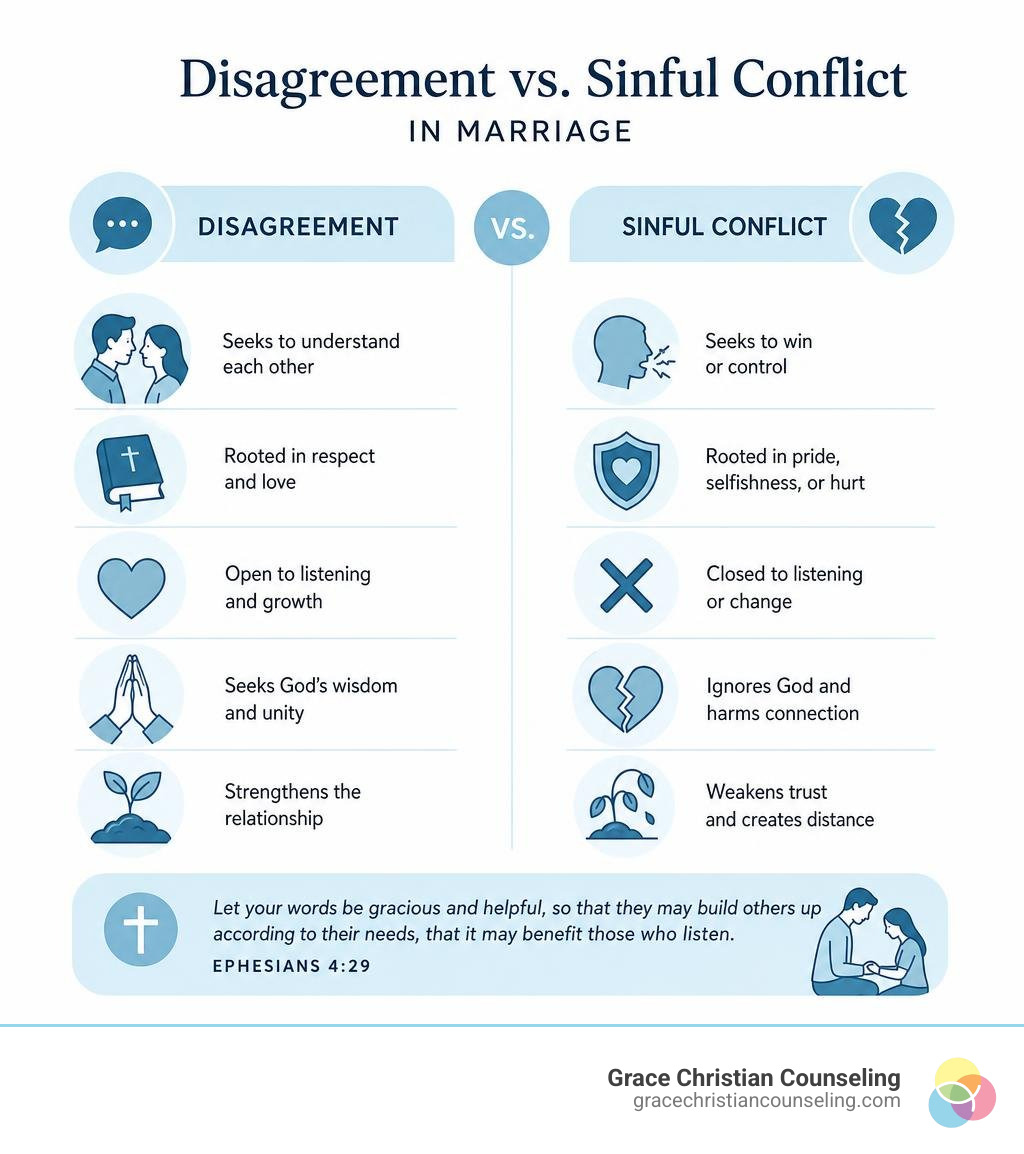
- Distinguishing disagreement from conflict: A disagreement is a difference of opinion. A conflict begins when pride, selfishness, and an unwillingness to yield cause people to sin against one another.
- Applying biblical steps: Scripture gives a clear process, including self-examination, humble confrontation, confession, forgiveness, and, where needed, outside mediation.
- Managing emotions: Counselors help couples slow down, regulate their physical stress responses, and respond with care rather than react in anger.
- Pursuing real reconciliation: The goal is not just to stop fighting. It is to restore the relationship and honor God in the process.
Many couples who walk into a counseling office believe their marriage is too far gone. They have tried talking. They have tried distance. Nothing seems to work. But conflict, as painful as it is, does not have to be the end of the story.
The truth is that conflict is inevitable. As one way of putting it, we are fallen sinners living with fallen sinners in a fallen world. Every marriage will face real friction. The question is not whether conflict will come, but whether couples have the tools, and the willingness, to work through it in a way that actually heals rather than hardens.
Research on marriage consistently shows that conflict itself is not the strongest predictor of relationship failure. Instead, the way couples handle conflict plays a significant role in long-term relationship health. The Gottman Institute’s long-term couple research identified four destructive communication patterns, often called the “Four Horsemen”: criticism, contempt, defensiveness, and stonewalling. In Gottman’s published research summary, one early study reported that researcher predictions about which couples would divorce reached 93.6% accuracy based on observed interaction patterns. This is why biblical conflict resolution counseling focuses not only on solving individual disagreements but also on transforming the patterns that happen underneath them.
At Grace Christian Counseling, our licensed counselors work with couples across Western Pennsylvania, including Pittsburgh and surrounding communities, as well as online, to do exactly that. We blend clinical approaches with biblical truth to help couples move from gridlock toward genuine restoration.
In our work with couples, we often see that the argument itself is only the surface issue. A disagreement about finances, parenting, communication, or household responsibilities may actually reveal deeper wounds involving feeling unseen, disrespected, unsafe, or unimportant. Effective counseling helps couples slow down enough to identify these deeper patterns so they can address the real source of disconnection instead of repeating the same argument in different forms.
For example, when a couple argues about spending, the surface problem may be a budget decision, but the deeper counseling work often uncovers fear about security, shame around past mistakes, or a longing to feel respected. In one common counseling exercise, each spouse names one specific “brick” they have added to the wall between them, such as sarcasm, withdrawal, blame, or avoidance, and then practices a concrete confession rather than a general apology. That kind of original, session-level analysis helps turn biblical principles into measurable relational steps couples can actually practice between appointments.
Understanding the Root of Marital Friction
When we are in the heat of an argument, it is easy to point fingers at our spouse. We blame their tone, their habits, or their lack of understanding. However, scripture directs us to look inward to find the true source of our relational battles.
According to James 4:1-2, quarrels and fights among us do not start from external circumstances; they stem from the passions and desires that war within our own hearts. We covet, we desire, and when we do not get what we want, we fight.
This internal war of unmet expectations and selfish desires is the foundational root of marital friction. When we demand that our spouse satisfy a desire that only God can fulfill, we set our marriage up for failure. Our pride convinces us that our way is the only right way, blinding us to our own contributions to the division. To find true healing, we must learn How to Improve Communication in Marriage by first examining what is ruling our hearts.
Disagreement vs. Sinful Conflict
It is vital to understand that not every difference of opinion is a sin. Disagreements are a natural, expected part of any relationship. God created us with unique personalities, backgrounds, and perspectives, meaning we will naturally view things differently from time to time.
A healthy disagreement becomes a sinful conflict when we add the emotional elements of pride, selfishness, and an unwillingness to yield. In a simple disagreement, two people can discuss differing preferences with mutual respect.
In a sinful conflict, however, the goal shifts from understanding to winning. We begin to use our words as weapons, harboring resentment, and intentionally sinning against one another to get our way. The moment we prioritize being right over loving our spouse, we cross the line into destructive conflict.

The Escalation of Heart Idols
How does a good desire turn into a destructive conflict? The transition is driven by the subtle escalation of heart desires into demanding idols. In biblical counseling, we often reference a classic four-stage progression of heart idolatry:
- I Want: It starts with a good, natural desire, such as wanting appreciation, order, or financial security.
- I Need: The desire escalates. We begin to believe we cannot be happy or at peace without this specific thing.
- I Deserve: We feel entitled to have our need met, viewing our spouse as obligated to fulfill it.
- You Must Give It to Me or I Will Punish You: If our spouse fails to deliver, we react in anger, withdrawal, or criticism.
When a desire becomes an idol, we will sin to get it, and we will sin if we are denied it. We must learn to identify these idols and surrender them to God before we can successfully move toward our spouse. Psalm 139:23-24 gives us a helpful prayer for this work: asking God to search our hearts, expose any grievous way within us, and lead us in the way everlasting. As we invite the Lord to reveal what is ruling us, we become better able to repent honestly, speak humbly, and pursue reconciliation without demanding that our spouse satisfy what only God can heal.
The Core Principles of Biblical Conflict Resolution Counseling
At Grace Christian Counseling, we do not view conflict as a sign that a marriage is over. Instead, we see it as an assignment from God for spiritual growth and deeper relational unity.

When a husband and wife sit down with one of our licensed counselors, we guide them to see each other through the lens of spiritual siblinghood. If you are both believers, you are first and foremost brother and sister in Christ, joint heirs of God’s grace. This perspective changes how you treat each other.
In 1 Peter 3:8-9, we are commanded to have unity of mind, sympathy, brotherly love, a tender heart, and a humble mind. We are called not to return evil for evil or reviling for reviling, but on the contrary, to bless. Applying these principles is what helps couples move From the Brink of Separation to Restoration: Biblical Counseling for Struggling Couples.
Overlooking Offenses vs. Direct Confrontation
A common question in counseling is whether we should speak up every time our spouse upsets us. Scripture tells us that “love covers a multitude of sins” in 1 Peter 4:8. This means many minor, daily offenses can and should be overlooked in love, allowing grace to absorb the slight without harboring bitterness.
However, some offenses cannot be easily overlooked. If an issue is continually breaking your fellowship, creating a persistent barrier, or involving ongoing unrepentant sin, it requires loving confrontation.
Our counselors help couples distinguish between what can be covered in love and what requires direct, gentle discussion. In cases where safety is a concern, such as domestic abuse, standard conflict steps are set aside in favor of immediate safety planning and clinical protocols.
The Role of Humility and Active Listening
True reconciliation is impossible without humility. We must be willing to accept that we do not have all the answers and that our own perception of the conflict may be flawed. This is why active, humble listening is a cornerstone of our counseling process.
James 1:19-20 provides a simple yet profound communication framework: be quick to hear, slow to speak, and slow to anger. When we slow down, we give ourselves the space to understand our spouse’s heart rather than just formulating our next defense.
To help with this, we encourage couples to utilize external support systems and resources like NuWellonline.com, which offer additional tools for cultivating emotional health and relational maturity.
Practical Steps for Reconciliation in Marriage
To help couples understand their typical responses to conflict, we often map out their behaviors on a spectrum. Most people default to one of three categories when tension rises:
| Conflict Style | Typical Behaviors | Heart Motivation | Relational Outcome |
|---|---|---|---|
| Peace-Faking | Denial, flight, withdrawal, superficial appeasement | Fear of confrontation, desire for comfort | Unresolved issues go underground and turn into bitterness |
| Peace-Breaking | Blame, verbal attacks, gossip, manipulation | Pride, desire to control or win | Escalation of anger, broken trust, and deep emotional wounds |
| Peacemaking | Honest confession, active listening, loving confrontation | Humility, love for God, desire for reconciliation | Genuine healing, restored trust, and spiritual maturity |
When conflict occurs, the biblical process outlined in Matthew 18:15-20 calls us to move away from faking or breaking peace, and instead take active, direct steps toward one another. This involves honest confession of our own sins, granting biblical forgiveness, and working together toward full restoration. For those struggling with hot tempers during this process, learning about Cooling the Fire: Biblical Anger Management can provide essential relief.
The Brick Wall Illustration in Biblical Conflict Resolution Counseling
One of the most powerful visual tools we use in biblical conflict resolution counseling is the “brick wall” illustration. Imagine that every unconfessed sin, harsh word, and unresolved grievance between you and your spouse is a physical brick. Over years of marriage, these bricks stack up, forming a massive wall that blocks intimacy, communication, and warmth.
To dismantle this wall, both spouses must be willing to identify and confess their own “bricks.” We guide couples to list their specific contributions to the conflict, no matter how small they might seem compared to the other’s actions.
As each person owns their behavior, confesses it, and asks for forgiveness, the bricks are systematically removed. This hands-on, humble process of drawing near to one another is described beautifully in resources like Helping Spouses Move Toward Each Other in Conflict, showing that reconciliation is a series of intentional, humble steps.
Navigating Unrepentance or Unbelief
What happens when you are willing to work on the marriage, but your spouse is unrepentant or does not share your faith? This is one of the most painful situations a spouse can experience. In these moments, we point couples to the comforting command of Romans 12:18: “If possible, so far as it depends on you, live peaceably with all.”
This scripture reminds us that we are only responsible for our own faithfulness, not our spouse’s response. When a partner is unrepentant, we help the willing spouse establish healthy, biblical boundaries to protect their emotional and spiritual well-being while continuing to offer Christ-like love.
Even in difficult family dynamics, there are ways to pursue peace and wisdom, as discussed in our guide on How to Resolve Conflict in Family.
Managing the Emotional and Physiological Toll of Conflict
Ongoing marital tension is not just a spiritual or mental burden; it takes a literal physical toll on our bodies. When we are locked in conflict, our nervous system goes into overdrive, releasing adrenaline and cortisol. This physiological arousal causes our heart rate to spike, our muscles to tense, and our breathing to become shallow.
When we are in this “fight-or-flight” state, the rational part of our brain shuts down, making constructive communication almost impossible. This is why we teach couples the importance of taking strategic pauses. The impact of relationship distress is significant. According to the American Psychological Association, chronic stress can affect sleep, immune function, mood, and overall health. Because unresolved marital conflict can become a repeated source of stress, counseling often addresses both communication patterns and emotional regulation skills.
If you feel your chest tightening or your anger rising, it is a built-in alarm system telling you to pause the conversation. Take 15 to 20 minutes to calm your body, cast your anxieties on God as modeled in 1 Peter 5:7, and return to the discussion when you can speak with gentleness. For families navigating these heavy emotional waters, our resources on Faith & Family Counseling: A Guide for Pennsylvania Households offer practical support.
The Counseling Blueprint for Emotional Regulation
To help couples navigate these intense emotional moments, we utilize our Counseling Blueprint. This four-stage healing journey is designed to guide you from surface-level reactivity to deep, lasting heart transformation:
- Take Off the Mask: We build rapport and establish a safe space where you can drop your defenses and share your honest struggles without fear of judgment.
- Heal the Wounds: We explore the emotional, physiological, and relational hurts that are driving your defensive reactions.
- Remove the Toxins: We identify unhelpful beliefs, cognitive distortions, and lingering lies that fuel your anger and anxiety.
- Replace with Truth: We install empowering, accurate perspectives based on God’s truth about yourself, your spouse, and the world.
By integrating these clinical steps with cognitive behavioral techniques, we help you regulate your emotions so you can respond to your spouse with clarity and grace.
A simple way to make this practical is to track three numbers after a conflict: how long it took to pause, how long it took for your body to calm, and how long it took to return for a repair conversation. A couple might begin by needing 45 minutes to de-escalate and several hours to reconnect, then work toward a shorter pause and a same-day repair. A practical counseling goal might be to move from a 45-minute cooldown to a 20-minute pause followed by one same-day repair conversation. These are not abstract goals; they are observable markers that help couples and counselors evaluate whether new communication habits are actually taking root.
Seeking Professional Biblical Conflict Resolution Counseling
You do not have to carry the weight of a struggling marriage alone. Sometimes, the patterns of conflict are so deeply entrenched that you need a neutral, wise guide to help you find your way out.
Our team of licensed counselors, including Licensed Social Workers (LSW) and Licensed Associate Professional Counselors (LAPC), are trained to provide this exact care. We serve communities throughout Western Pennsylvania, including Pittsburgh, Penn Hills, Sewickley, Uniontown, Bethel Park, Ligonier, Belle Vernon, Punxsutawney, and North Huntingdon, as well as clients statewide through online therapy.
Frequently Asked Questions about Biblical Conflict Resolution
What is the difference between a disagreement and a conflict?
A disagreement is a simple difference of opinion or preference, which is a natural part of being human. A conflict occurs when we add sinful reactions, pride, and selfishness to that disagreement, turning a simple discussion into a battle to win at the other person’s expense.
How do we know when to overlook an offense?
According to 1 Peter 4:8, we should overlook minor, daily slights that do not damage our overall fellowship with our spouse. However, if the offense creates a lasting barrier, leads to ongoing bitterness, or involves unrepentant sin, it must be addressed through loving, gentle confrontation.
Can biblical conflict resolution work if only one spouse is willing?
Yes. While full reconciliation requires both parties, Romans 12:18 calls us to do everything we can on our end to pursue peace. A willing spouse can still experience personal healing, learn to set healthy boundaries, and witness to their partner through consistent, Christ-like love.
Rebuilding Peace One Step at a Time
No matter how distant you and your spouse feel today, there is hope. Conflict is a painful reality of living in a fallen world, but in the hands of the Redeemer, it can become the very tool that reshapes your marriage into a source of deep joy, safety, and mutual encouragement.
At Grace Christian Counseling, we are dedicated to walking alongside you through every step of this journey. Whether you prefer to meet in person at one of our Western PA locations, such as Pittsburgh, Penn Hills, Sewickley, Uniontown, Bethel Park, or North Huntingdon, or connect with us virtually from anywhere in Pennsylvania, Georgia, Florida, or West Virginia, our compassionate, licensed professionals are ready to help.
Take the first step toward healing today. Schedule a Marriage Counseling Session with us and let us help you rebuild your relationship on a foundation of biblical truth and lasting peace.
This guide is for educational and spiritual encouragement and is not a substitute for personalized professional counseling. If you are in crisis, please reach out for immediate help.
Navigating Marriage Challenges


