

When You’re Struggling, Scripture Has Something to Say
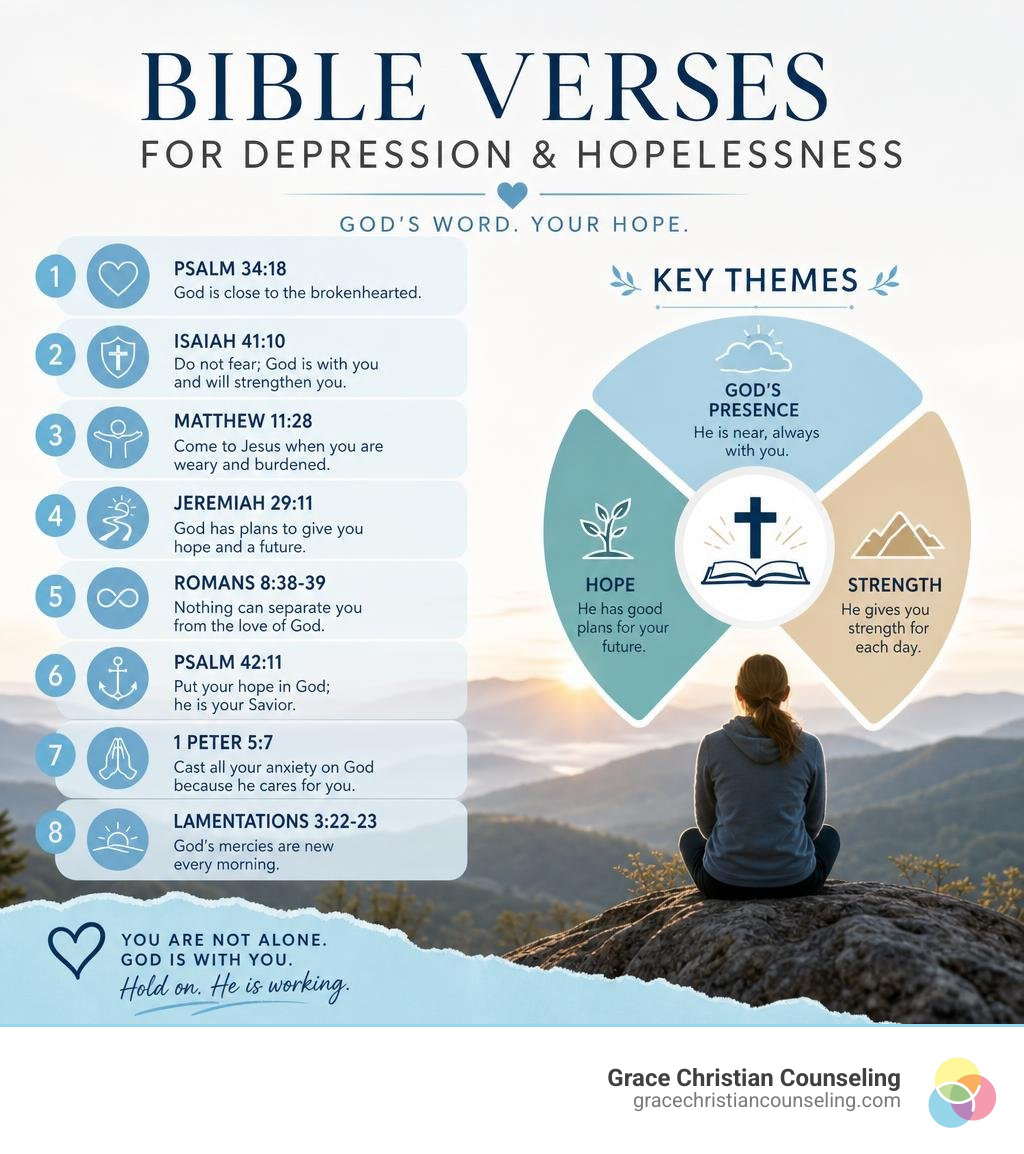
If you’re looking for bible verses for depression and hopelessness, here are some of the most comforting passages to start with:
| Scripture | Key Message |
|---|---|
| Psalm 34:18 | God is close to the brokenhearted |
| Isaiah 41:10 | Do not fear; God is with you and will strengthen you |
| Matthew 11:28 | Come to Jesus when you are weary and burdened |
| Jeremiah 29:11 | God has plans to give you hope and a future |
| Romans 8:38-39 | Nothing can separate you from the love of God |
| Psalm 42:11 | Put your hope in God; he is your Savior |
| 1 Peter 5:7 | Cast all your anxiety on God because he cares for you |
| Lamentations 3:22-23 | God’s mercies are new every morning |
Depression is real. It is heavy, disorienting, and isolating. It can make even small tasks feel impossible. And if you are a Christian walking through it, you may also feel confused, ashamed, or spiritually alone. You are not alone, and you are not without hope.
God does not promise a pain-free life. But He does promise to be near, especially to those who are hurting and brokenhearted. According to the World Health Organization (WHO), an estimated 280 million people worldwide live with depression, making it one of the leading causes of disability globally. In the United States, the Substance Abuse and Mental Health Services Administration (SAMHSA) reports that approximately 1 in 5 adults experience a mental illness each year, highlighting the widespread need for accessible mental health care and support. Many who are going through such depression and mental illness are also people of deep faith.
In this guide, we will walk through some of the most meaningful Bible verses for depression and hopelessness, explain what they mean, and show you how to apply them in everyday life. We will also talk honestly about when combining faith with professional support (like the Christ-centered, evidence-based counseling we offer at Grace Christian Counseling) is the wisest and most loving step you can take.
Understanding Depression and Hopelessness Through a Biblical Lens
When the heavy fog of depression rolls into your life, it is incredibly easy to feel like you have failed spiritually. You might think, If only my faith were stronger, I wouldn’t feel this way. However, the Bible paints a completely different picture. Scripture does not hide the emotional struggles of God’s people; instead, it puts them on full display.
Some of the most faithful men and women in Scripture experienced and expressed deep emotional pain:
- Elijah: After a mountain-top spiritual victory, the prophet Elijah was so exhausted, fearful, and overwhelmed that he ran into the wilderness, sat under a broom tree, and prayed that he might die.
- David: The man after God’s own heart wrote countless psalms from dark caves and places of intense isolation, frequently asking God why He felt so far away.
- Job: After suffering unimaginable loss, Job cursed the day of his birth and openly grieved his broken life.
According to clinical studies, 1 in 5 U.S. adults experience mental illness each year, and depression remains a leading cause of disability worldwide. Believing that mental health struggles are simply “spiritual weakness” is not only biblically inaccurate, but it is also clinically false. Depression is a complex condition affecting the mind, body, and emotions.
When we experience a mental health crisis, we are experiencing a very human vulnerability. Recognizing this helps us move away from spiritual shame and toward the healing grace of Christ. If you are currently navigating this dark valley, we encourage you to read about Finding Hope in Christ During Depression, which explores how God meets us in our lowest moments without judgment.
Finding Light in the Darkness: Bible Verses for Depression and Hopelessness

When you are in the depths of emotional exhaustion, reading long passages of Scripture can feel overwhelming. During these times, focusing on short, powerful truths can bring immense comfort. God’s Word acts as a lamp to our feet, gently guiding us when we cannot see the path ahead.
Old Testament Bible Verses for Depression and Hopelessness
The Old Testament contains beautiful, grounding declarations of God’s character. When your circumstances say you are abandoned, these verses declare that you are fiercely protected.
- Isaiah 41:10: “So do not fear, for I am with you; do not be dismayed, for I am your God. I will strengthen you and help you; I will uphold you with my righteous right hand.”
- The Truth: You do not have to manufacture courage or push through depression by sheer willpower; God meets you in your weakness. When you feel like you cannot stand, remember that He is with you. He promises to strengthen you, help you, and hold you steady, one small step at a time.
- Deuteronomy 31:8: “The Lord himself goes before you and will be with you; he will never leave you nor forsake you. Do not be afraid; do not be discouraged.”
- The Truth: God is already in your tomorrow. The future may feel uncertain, heavy, or impossible to face right now, but you are not walking into it alone. His presence goes before you, His grace will meet you there, and His strength can carry what feels too heavy today.
- Jeremiah 29:11: “For I know the plans I have for you,” declares the Lord, “plans to prosper you and not to harm you, plans to give you hope and a future.”
- The Truth: Your current pain is not the end of your story. God still has a good and purposeful future marked out for you. There is real hope. You can put your trust in the Lord. He really is good, and He loves you!
- Lamentations 3:22-23: “Because of the Lord’s great love we are not consumed, for his mercies never fail. They are new every morning; great is your faithfulness.”
- The Truth: God’s mercy is not a one-time gift you have to stretch across a lifetime. It is renewed for you each morning, meeting you in today’s weakness, grief, fear, or exhaustion. You do not have to carry tomorrow yet; God gives grace for the struggle in front of you right now.
For those moments when the darkness feels absolute, keeping a list of these promises nearby can make a world of difference. You can find more encouragement in another comprehensive list of Bible Verses for Mental Health to help steady your mind.
New Testament Bible Verses for Depression and Hopelessness
In the New Testament, we learn the heart of Jesus, who intimately understands human suffering. He does not stand far off; He steps directly into our pain.
- Matthew 11:28: “Come to me, all you who are weary and burdened, and I will give you rest.”
- The Truth: Jesus does not demand that you get your life together before you come to Him; He invites you to bring your heavy, messy burdens directly to His feet. Christ welcomes the exhausted, the overwhelmed, and the emotionally worn down. His rest is not just physical sleep, it is the deep soul-rest of knowing you are not carrying your suffering alone.
- Romans 8:38-39: “For I am convinced that neither death nor life, neither angels nor demons, neither the present nor the future, nor any powers, neither height nor depth, nor anything else in all creation, will be able to separate us from the love of God that is in Christ Jesus our Lord.”
- The Truth: Depression can make you feel completely cut off from God, but absolutely nothing can sever His love for you. Feelings of numbness, guilt, fear, or spiritual distance may be very real, but they are not stronger than God’s covenant love. This passage gives language for the moments when your emotions tell you, “God must be far away.” The Scripture is clear… nothing in creation, including your darkest thoughts or hardest season, has the power to separate you from the love of God.
- Philippians 4:13: “I can do all this through him who gives me strength.”
- The Truth: When your emotional battery is at zero, Christ provides the strength you need to take the very next step. This verse is not a promise that life will suddenly feel easy, or that depression will disappear overnight. It is a reminder that God can sustain you in weakness and that, in all situations, it is possible to endure with the strength God provides. Sometimes that strength looks like getting out of bed, making a phone call, eating a meal, asking for help, or praying one honest sentence. Christ meets you in the small steps, not just big victories.
- 1 Peter 5:7: “Cast all your anxiety on him because he cares for you.”
- The Truth: Your worries and fears are not a bother to God; He invites you to throw them onto His shoulders because He deeply loves you. Many people try to manage anxiety by holding it in, minimizing it, or pretending it is not there. Scripture gives a different path. You can name your fears honestly before God, again and again, because His care is personal. He is not annoyed by repeated prayers, racing thoughts, or tearful nights. He is a Father who carries what is too heavy for you to hold.
- 2 Corinthians 1:3-4: “Praise be to the God and Father of our Lord Jesus Christ, the Father of compassion and the God of all comfort, who comforts us in all our troubles, so that we can comfort those in any trouble with the comfort we ourselves receive from God.”
- The Truth: God is the ultimate source of comfort, and He can use your journey of healing to shine a light for others. This does not mean your pain is good, or that you have to rush to find a purpose in it. It means your suffering is not wasted in God’s hands. As He comforts you through Scripture, prayer, safe relationships, and wise support, He also grows compassion in you. Over time, the comfort you receive may become the very comfort you are able to offer someone else who feels alone in their suffering.
If you are currently in the middle of an intense mental health battle, you can find more encouragement in these 10 Healing Scriptures for Mental Health Recovery.
Comfort in the Psalms: Crying Out to God in Despair

The Book of Psalms is unique because it serves as a divine song book that gives us permission to lament and express the authors’ words that so precisely put into words many things we can identify with in our preset day lives. In many modern spaces, we are taught to hide our sadness, but the psalmists did the exact opposite. They wept, questioned God, and laid bare their deepest anguish with honesty while still remembering the truth of who God is and how He loves.
Consider the raw self-dialogue found in Psalm 42:5, Psalm 42:11, and Psalms 43:5:
“Why, my soul, are you downcast? Why so disturbed within me? Put your hope in God, for I will yet praise him, my Savior and my God.”
This repeating chorus shows a healthy, five-step spiritual process. The writer does not deny his sadness; instead, he names his feelings, probes his anxiety, redirects his hope to God, commits to praise Him before circumstances change, and anchors his identity in God as Savior. This shows that we can feel deeply depressed while simultaneously choosing to place our hope in God. You can read a deeper commentary on the Scriptures or study and compare translations using different online Bible study tools.
Perhaps the most comforting psalm for clinical depression is Psalm 88. Unlike almost every other psalm, Psalm 88 has no happy ending, ending instead with the line, “darkness is my closest friend.” Why would God include a song of unresolved despair in His holy book? Because He wants us to know that He hears us even when our prayers feel unanswered and our darkness remains. If you are praying through a season of deep despair, we highly recommend reading Yes, God Does Care: Praying Through Despair With Psalm 88. It is a beautiful reminder that our honest grief is fully accepted by our Creator. For those navigating these complex emotional waters, finding dedicated Christian Support for Depression and Anxiety can provide a safe, grace-filled harbor.
What We Hear Most Often From Clients Struggling With Depression
What We Commonly Hear in Counseling
Based on recurring themes reported by clients seeking support for depression:
- “I feel far from God even though I’m still praying.”
- “I know the Bible verses, but they don’t feel real right now.”
- “I feel guilty for struggling this much.”
- “I don’t want people at church to know.”
- “I’m exhausted all the time.”
Counselor Insight
In our counseling work, we have noticed that many Christians struggling with depression are often battling two burdens at the same time. The first is the depression itself, including exhaustion, hopelessness, loss of motivation, difficulty concentrating, and emotional numbness. The second is the belief that they should not be struggling this way if their faith were stronger.
While every person’s story is unique, several themes appear consistently in conversations with clients. Many describe feeling disconnected from God even while continuing to pray, attend church, or read Scripture. Others carry guilt because Bible verses that once brought comfort feel harder to connect with during a season of depression. Some worry that asking for counseling or medical support reflects a spiritual failure.
One pattern we frequently observe is that depression often leads people to isolate, both from others and from sources of support that previously helped them. As isolation increases, feelings of shame and hopelessness often grow stronger. In contrast, many clients begin experiencing meaningful progress when they stop viewing depression as a personal or spiritual failure and start approaching it as a struggle that affects the whole person: mind, body, emotions, relationships, and spiritual life.
These observations reflect common themes we see in clinical practice, not because everyone experiences depression the same way, but because many people silently carry similar fears, questions, and misconceptions. Scripture itself includes faithful individuals who experienced profound grief, discouragement, and despair. For many people, healing begins when they allow trusted support, compassionate care, and hope to become part of their story rather than continuing to carry the burden alone.
Practical Ways to Apply Scripture to Manage Depression and Anxiety
Knowing the verses is a wonderful first step, but learning how to practically apply them to our daily routines is where real transformation happens. When you are depressed, your brain can get stuck in negative, repetitive loops. Scripture can act as a gentle tool to interrupt those thoughts.
Here are several practical, small disciplines you can build into your day:
- Scripture-Based Affirmations: Take a verse and turn it into a personal declaration. For example, using Isaiah 41:10, you can say aloud: “I am not alone today because God is with me. He is strengthening me, and He will hold me up.”
- Journaling with Scripture: Write down a verse at the top of a page, then write out your honest thoughts, fears, and prayers directly beneath it. Do not feel the need to filter your emotions; God can handle your raw honesty.
- Audio Scripture and Worship: When reading feels like too much physical or mental effort, let others carry the weight. Play audio recordings of the Bible or listen to peaceful, scripture-filled worship music while resting.
- Breath Prayers: Combine simple breathing with a short phrase of Scripture. Inhale while thinking, “The Lord is my shepherd,” and exhale while thinking, “I lack nothing.”
By taking these small steps, we allow the Holy Spirit to steady our bodies and minds. If you would like to explore how to combine biblical truths with practical emotional coping strategies, consider learning more about our approach to Biblical Counseling for Depression.
When Faith and Professional Mental Health Support Work Together
A common misconception in some Christian circles is that seeking professional therapy means you lack faith in God. But this could not be further from the truth. Just as we would seek a medical doctor for a broken bone or a physical illness, seeking a licensed counselor for mental health support is a practical, wise step toward stewardship of the mind God gave us.
At Grace Christian Counseling, we believe that faith and professional mental health support work beautifully together. Our licensed counselors, use evidence-based psychological techniques such as Cognitive Behavioral Therapy (CBT) and trauma-informed care, all while grounding our practice in Biblical truth.
CBT helps us identify and change negative thought patterns, which aligns perfectly with the biblical call to “take every thought captive.” Working with a professional therapist allows you to address the biological, psychological, and spiritual facets of depression simultaneously.
If you are ready to take a step toward professional support, we invite you to explore Christian Depression Counseling and learn about our Faith-Based Therapy for Overcoming Depression. You can also visit NuWellonline.com to explore additional virtual pastoral counseling resources for mental health and wellness if you live outside of PA, WV, GA, and FL.
Frequently Asked Questions About Faith and Mental Health
Does experiencing depression mean I lack faith?
No, absolutely not. Feeling depressed is a human experience, not a spiritual failure. As we explored earlier, many of the most faithful figures in the Bible, including David, Elijah, and Job, experienced profound seasons of darkness and grief. God did not shame them for their struggles; instead, He met them with gentle care, physical nourishment, and quiet comfort. Your depression is a medical and emotional reality, not a measure of your salvation or love for God.
How can prayer and Scripture help with clinical depression?
While prayer and Scripture may not instantly cure clinical depression, they serve as powerful anchors. From a psychological standpoint, meditating on God’s love and promises can assist with cognitive reframing, helping to break negative thought patterns. Spiritually, it reminds us of our ultimate identity and provides deep comfort, assuring us that we have a loving, divine companion walking with us through the dark.
When should a Christian seek professional counseling for depression?
You should consider seeking professional support when feelings of sadness, anxiety, or hopelessness begin to interfere with your daily life, such as your ability to work, care for your family, or maintain relationships.
Additionally, if you are experiencing persistent thoughts of self-harm or suicide, it is crucial to reach out for professional help immediately. Please know that you are deeply valued, and there is no shame in asking for help. We offer specialized support through Christian Therapy for Suicidal Thoughts and encourage you to read our resource on how to Survive Suicide as a Christian. If your life has been touched by tragedy, we also offer compassionate guidance for Losing a Loved One Due to Suicide.
Holding Onto Hope in Christ
Depression can make you feel as though you are trapped in a long, dark winter with no end in sight. But even in the quietest, heaviest seasons, God is actively working in the hidden places, helping your roots grow deep into His love and grace.
At Grace Christian Counseling, we are dedicated to walking alongside you on your journey toward healing. If you are feeling depressed, hopeless, spiritually dry, or emotionally exhausted, you do not have to carry it alone. Our counselors offer compassionate, Christ-centered, and evidence-based care that respects both your faith and your mental health needs.
To get started, book a free discovery call and take the first step toward reclaiming your peace and hope. Together, we can help you process pain, find practical coping tools, reconnect with hope, and remember that God’s presence is still near, even in the darkest seasons.
This guide is for educational and spiritual encouragement and is not a substitute for personalized professional counseling. If you are in crisis, please reach out for immediate help.
A Biblical Perspective on Depression and Counseling: Finding Hope and Healing


