

The Bible uses its own language for experiences we might now describe as depression or anxiety, with words and images of despair, fear, heaviness, a downcast soul, and overwhelming sorrow. It acknowledges the deep emotional turmoil and suffering that individuals face, revealing a God who is intimately acquainted with our sorrows and offers solace. Scripture consistently shows us that feelings of despair, fear, and overwhelming sadness are part of the human condition, even for those with strong faith.
The Bible provides numerous accounts of individuals wrestling with intense emotional pain, demonstrating that such struggles are not a sign of spiritual failure but a shared aspect of human experience. It offers comfort by showing God’s presence and intervention in these difficult times, guiding us towards hope and healing.
Biblical Figures and Their Struggles
Millions of people throughout history have labored under the dark cloud of depression, including many “heroes” in the Bible. These figures, whose faith we often admire, were not immune to intense emotional distress. Their stories provide powerful examples that we are not alone in our struggles and that God understands our pain.
Consider Elijah, a mighty prophet who, after a great spiritual victory on Mount Carmel, fled in fear from Jezebel’s threats. He collapsed under a broom tree, praying for death, illustrating profound emotional exhaustion and hopelessness (1 Kings 19). His experience highlights the reality that even after significant spiritual triumphs, individuals can still face deep despair. God’s response to Elijah was not condemnation, but gentle care, providing food, rest, and a quiet whisper of His presence.
David, the beloved king and psalmist, frequently poured out his heartbroken state to God in the Psalms. He often questioned his “downcast soul” and sought divine intervention, articulating feelings of loneliness, fear, and deep sadness (e.g., Psalm 42, Psalm 55). His raw honesty in prayer serves as a model for us, showing that we can bring our unfiltered emotions to God.
Moses, who led the Israelites out of slavery, at one point felt so overwhelmed by the burdens of leadership that he asked God to kill him (Numbers 11:15). Jeremiah, known as the “weeping prophet,” expressed profound grief and anguish over the state of his people and his own suffering (Jeremiah 20). These examples remind us that even the most devout individuals can experience periods of deep darkness, and their stories are included in Scripture to show us God’s compassion and faithfulness through such trials.
Which Bible Verses Offer Comfort for Depression?
When the weight of depression feels heavy, these verses provide a beacon of hope, reminding us of God’s unwavering presence and promises even in the darkest valleys. They offer reassurance that God sees our pain, hears our cries, and is intimately involved in our journey toward healing.
1. Psalm 42:11 (NLT)
“Why am I discouraged? Why is my heart so sad? I will put my hope in God! I will praise him again—my Savior and my God!” Psalm 42:11 (NLT)
This verse models a powerful form of self-talk, challenging despair and actively redirecting focus to God as the ultimate source of hope and salvation. It encourages us to make a conscious choice to hope and praise, even when our emotions are overwhelming and our heart is heavy. It’s a reminder that our feelings, while valid, do not have the final say; our hope in God does.
2. Matthew 11:28
“Come to me, all you who are weary and burdened, and I will give you rest.” Matthew 11:28 (NIV)
Jesus’ invitation to those feeling heavy-laden is a direct call to find spiritual and emotional respite in Him. This promise extends beyond physical tiredness to the deep weariness of the soul that often accompanies depression. It assures us that in Him, we can find genuine rest, a profound peace that transcends our difficult circumstances and offers relief from our burdens.
3. Jeremiah 29:11
“For I know the plans I have for you,” declares the Lord, “plans to prosper you and not to harm you, plans to give you hope and a future.” Jeremiah 29:11 (NIV)
This powerful promise from God assures us of His good intentions and a future filled with hope, even when our present feels bleak and uncertain. It reminds us that our struggles are not the end of our story, and that God has a purpose and a plan for our lives that includes well-being and a hopeful future. This verse can be a lifeline when hopelessness threatens to consume us.
4. Psalm 34:17-18
“The Lord hears the righteous cry for help; he delivers them from all their troubles. The Lord is close to the brokenhearted and saves those who are crushed in spirit.” Psalm 34:17-18 (NIV)
This Scripture provides immense comfort, assuring us that God is not distant in our pain. He is intimately near to those who are hurting and broken, hearing our cries and promising deliverance. For those with a crushed spirit, this verse offers the profound truth that God is a rescuer, actively involved in saving us from our despair and drawing close to us in our most vulnerable moments.
5. Revelation 21:4
“He will wipe every tear from their eyes. There will be no more death or mourning or crying or pain, for the old order of things has passed away.” Revelation 21:4 (NIV)
This verse offers a glimpse into an eternal future free from all suffering, providing ultimate hope and perspective for our present trials. It assures us that our current pain is temporary and will one day be completely eradicated by God Himself. This promise of a future without sorrow can provide strength and endurance, reminding us that our present suffering is not the final chapter.
Which Bible Verses Provide Peace for Anxiety?
When anxiety threatens to overwhelm, these Scriptures offer profound peace, guiding us to cast our worries on God and trust in His sovereign care. God’s Word reminds us that He is bigger than our fears and that His peace is available to guard our hearts and minds.
6. Philippians 4:6-7 (ESV)
“Do not be anxious about anything, but in everything by prayer and supplication with thanksgiving let your requests be made known to God. And the peace of God, which surpasses all understanding, will guard your hearts and your minds in Christ Jesus.” Philippians 4:6-7 (ESV)
This passage provides a clear directive to replace anxiety with prayer, gratitude, and trust in God’s peace. It promises a supernatural peace that transcends human comprehension and actively protects our inner being: our thoughts, feelings, and intentions. By bringing our worries to God with a thankful heart, we open ourselves to receiving this divine peace that guards our hearts and minds in Christ Jesus.
7. 1 Peter 5:7
“Cast all your anxiety on him because he cares for you.” 1 Peter 5:7 (NIV)
The Greek word for “cast” here implies a forceful throwing off of anxiety, not a gentle handoff. It’s an invitation to release our burdens entirely and intentionally to God, knowing with certainty that He genuinely cares for us. This verse empowers us to actively surrender our worries, trusting that God is capable and willing to carry them.
8. Isaiah 41:10
“So do not fear, for I am with you; do not be dismayed, for I am your God. I will strengthen you and help you; I will uphold you with my righteous right hand.” Isaiah 41:10 (NIV)
This powerful verse is a direct command not to fear, coupled with multiple, comforting assurances of God’s constant presence, divine strength, unfailing help, and unwavering support. It reminds us that we are never alone in our struggles, and that God’s mighty hand is always there to uphold us, providing the courage and resilience we need to face our fears.
9. John 14:27
“Peace I leave with you; my peace I give you. I do not give to you as the world gives. Do not let your hearts be troubled and do not be afraid.” John 14:27 (NIV)
Jesus offers a unique, lasting peace that is fundamentally different from the temporary calm the world might offer. This peace is a divine gift, intended to calm troubled hearts and dispel fear, regardless of external circumstances. It is an inner tranquility that comes from His presence within us, providing stability even amidst chaos.
10. Matthew 6:34
“Therefore do not worry about tomorrow, for tomorrow will worry about itself. Each day has enough trouble of its own.” Matthew 6:34 (NIV)
This verse encourages us to live in the present moment, trusting God for today’s needs and releasing anxieties about the future. It promotes a focus on daily reliance on God’s provision, reminding us that dwelling on future uncertainties only adds to today’s burdens. By focusing on the present, we can better manage our anxieties and trust God for one day at a time.
How Can We Practically Apply These Verses in Daily Life?
Engaging with Scripture is not merely reading words; it’s an active process of meditation, prayer, and integration into our lives. For those grappling with depression and anxiety, this active engagement can transform how we experience and respond to our emotional struggles.

Meditating on Scripture
To truly benefit from these verses, we encourage you to make them an active part of your daily routine. Read them, save them, write them down, and revisit these Bible verses throughout the day, especially during moments of distress. Memorize key verses so you can recall them instantly when anxiety or sadness strikes. Journal about how these verses speak to your specific struggles, reflecting on their meaning and personal application to your life. Consider using structured Bible reading plans that focus on peace and anxiety, such as those found on platforms like YouVersion, to guide your daily devotion and provide a consistent rhythm of engaging with God’s Word. This intentional meditation helps to renew your mind and anchor your thoughts in truth.
The Power of Prayer and Thanksgiving
Prayer is a vital component in overcoming anxiety and finding comfort in depression. Pour your heart out to God in honest prayer, presenting your requests with thanksgiving, as Philippians 4:6-7 instructs. This is not just about asking for things; it’s about communicating openly with your Heavenly Father, who deeply cares for you. Prayer is a direct line to God, allowing us to cast our anxieties on Him and experience His peace. Furthermore, consciously practicing thanksgiving shifts our focus from our problems to God’s goodness and faithfulness, fostering a spirit of hope and gratitude even amidst difficulties. This act of gratitude can powerfully counteract negative thought patterns often associated with depression and anxiety.
Worship and Community Support
Beyond personal meditation and prayer, engaging in worship can be incredibly transformative. Listen to or sing worship music, which has a unique ability to shift your focus from your challenging circumstances to the majesty and sovereignty of Jesus. Worship reminds us of God’s power and love, making earthly troubles “grow strangely dim” as our perspective aligns with His eternal truth.
Additionally, seeking out Christian community for support is crucial. Remember the instruction to carry each other’s burdens, as Galatians 6:2 encourages. Sharing your struggles with trusted friends, a small group, or a church family can provide immense comfort, practical help, and accountability. You don’t have to navigate these struggles alone; God designed us for community, and His body, the church, is a powerful source of healing and encouragement.
Should Christians Seek Professional Help Alongside Scripture?
Absolutely, seeking professional help is a sign of strength, not weakness, and is entirely consistent with a Christian worldview. God often uses various means for healing, including medical and psychological professionals, to bring wholeness to His children. Mental health conditions like depression and anxiety can have biological, chemical, and situational components that benefit significantly from clinical intervention. In the United States, these struggles are also very common: the National Institute of Mental Health reports that major depression is one of the most common mental disorders, and a 2024 National Center for Health Statistics report found that, in 2022, about 18.2% of U.S. adults experienced anxiety symptoms and 21.4% experienced depression symptoms.

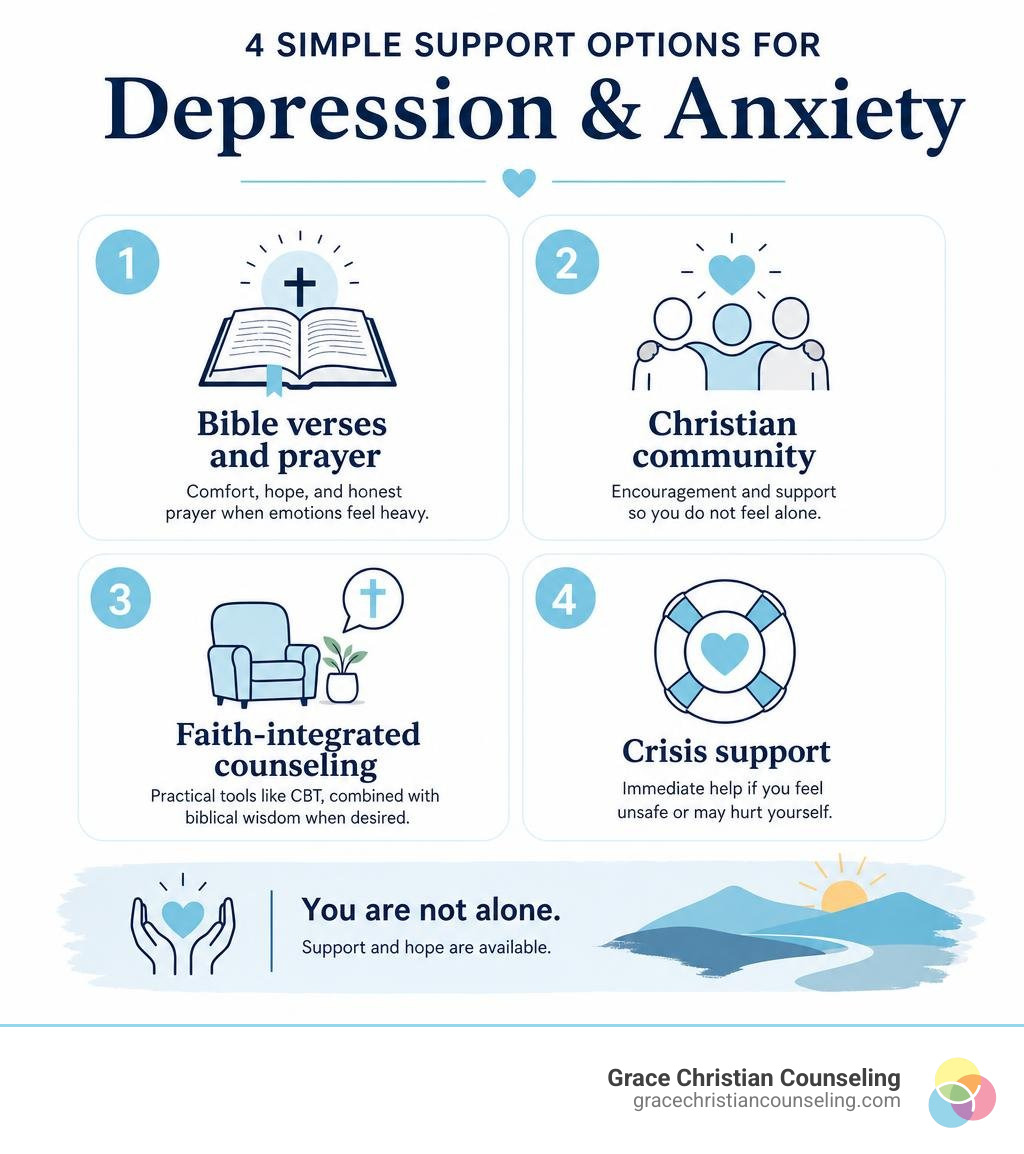
Scripture and Counseling: Simple Support Options
| Support | What it helps with | Simple next step |
|---|---|---|
| Bible verses and prayer | Comfort, hope, and honest prayer when emotions feel heavy | Choose one verse to read, write down, or pray through today |
| Christian community | Encouragement and support so you do not feel alone | Talk with a trusted pastor, mentor, small group leader, or Christian friend |
| Faith-integrated counseling | Practical tools like CBT, combined with biblical wisdom when desired | Meet with a Christian counselor for support with both faith and mental health |
| Crisis support | Immediate help if you are in crisis, feel unsafe, or may hurt yourself | Call or text 988 right away |
Integrating Faith and Clinical Care
At Grace Christian Counseling, we provide in-person and online Christian counseling in Pennsylvania, blending evidence-based psychology with biblical principles. Our licensed counselors (LAPC, LSW) offer Christ-centered care, recognizing that true healing often involves addressing both spiritual and psychological aspects of well-being. We believe that integrating clinical practices, such as Cognitive Behavioral Therapy (CBT) and trauma-informed care, with Biblical truth and the guidance of the Holy Spirit, offers a holistic path to recovery.
Research on faith-adapted psychological therapies suggests that integrating a client’s religious beliefs into evidence-based treatment can be clinically meaningful. A systematic review and meta-analysis of faith-adapted psychological therapies found that religiously adapted therapies showed beneficial effects for depression and anxiety, with some evidence that faith-adapted CBT performed better than standard CBT or control conditions, while also noting that the available studies had methodological limitations. Another systematic review of religiously adapted CBT reviewed randomized and quasi-experimental studies across depressive disorders, generalized anxiety disorder, and schizophrenia, showing that this approach has been studied across multiple clinical concerns rather than only in general pastoral-care settings.
For readers, the takeaway is balanced: Scripture is not a replacement for professional care, and therapy does not require leaving faith at the door. Faith-integrated counseling can combine CBT skills—such as identifying unhelpful thought patterns, practicing coping strategies, and building healthier responses—with prayer, biblical reflection, and Christian values when desired by the client. This integrated approach allows us to address the whole person—mind, body, and spirit—in their journey toward healing and wholeness. We understand that depression can be a complex issue, and our approach to Biblical Counseling For Depression is designed to provide comprehensive support. For more information on how we offer Christian Support For Depression And Anxiety, please visit our website.
When to Seek Immediate Help
It is crucial to recognize when immediate professional intervention is needed. If you are considering harming yourself, please call the National Suicide Prevention Lifeline at 1-800-273-8255. You can also call or text 988 for immediate support from the crisis and suicide lifeline, available 24 hours a day. These resources are vital for urgent situations and provide immediate, life-saving assistance. Please do not hesitate to reach out if you are in crisis.
Finding Support in Pennsylvania
Grace Christian Counseling serves individuals, couples, and families in Western Pennsylvania, including Pittsburgh, North Huntingdon, Penn Hills, Uniontown, Bethel Park, Sewickley, Mt. Lebanon, and surrounding areas. We also offer online Christian counseling for residents across the state, ensuring accessible support for those seeking faith-based therapy for overcoming depression and anxiety. Our goal is to provide compassionate, expert care that honors both your faith and your mental health needs. Learn more about our Christian Depression Counseling In Pennsylvania and our Online Christian Counseling PA options.
Frequently Asked Questions About Bible Verses for Depression and Anxiety
Can reading Bible verses cure depression or anxiety?
While Bible verses offer profound comfort, hope, and guidance, and are a powerful tool for spiritual and emotional well-being, they are not a substitute for professional medical or psychological treatment. Clinical depression and anxiety often have complex biological, psychological, and social roots that require a multi-faceted approach. This typically includes therapy, and sometimes medication, alongside faith practices. Scripture can provide immense spiritual strength and a framework for hope, but it’s important to seek comprehensive care for these conditions.
How do I choose the right Bible translation for these verses?
Many Bible translations offer clarity and comfort, and the “right” one is often the one that resonates most with you and is easiest to understand. The NIV (New International Version), NLT (New Living Translation), and ESV (English Standard Version) are popular choices for their readability and accuracy in conveying the original meaning. We encourage you to compare different versions of a particular verse on platforms like Bible Gateway to find the one that speaks most powerfully to your heart and mind. The goal is understanding and connection, so choose the translation that best facilitates that for you.
What if I don’t feel better immediately after reading these verses?
Healing from depression and anxiety is often a process, not an instant event. It’s completely normal not to feel immediate relief or a sudden “cure” after reading Bible verses. Emotional and mental health journeys take time, patience, and consistent effort. We encourage you to continue to meditate on the verses, pray, and seek support from both your community and professional counselors. God is with you in every step of the process, and His peace can guard your heart and mind even when circumstances haven’t changed or when the feelings of distress persist. Trust in His faithfulness and the gradual work of healing.
Lasting Comfort and Peace in God’s Word
In May 2026, as in every season, the Word of God remains a steadfast source of comfort and strength for those battling depression and anxiety. These ten Bible verses are powerful reminders of God’s constant presence, His enduring promises, and His unwavering love for you. They offer a foundation of hope and peace that can sustain you through difficult times.
While Scripture provides foundational hope and spiritual guidance, seeking professional Christian counseling can offer additional tools and support for your journey toward healing and wholeness. At Grace Christian Counseling, we are dedicated to walking alongside you, integrating faith with evidence-based therapeutic approaches to provide comprehensive care. We invite you to explore how our Christian Counseling for Depression services can support you in finding lasting peace and renewed hope.
This guide is for educational and spiritual encouragement and is not a substitute for personalized professional counseling. If you are in crisis, please reach out for immediate help.
Mind Over Matter: Encouraging Scriptures for Mental Strength


