

Why Biblical Principles Parenting Advice Matters More Than You Think
Biblical principles parenting advice gives Christian parents a foundation that goes far deeper than tips, tricks, or techniques. It anchors the whole parenting journey in God’s grace, His Word, and the goal of raising children who know and follow Jesus.
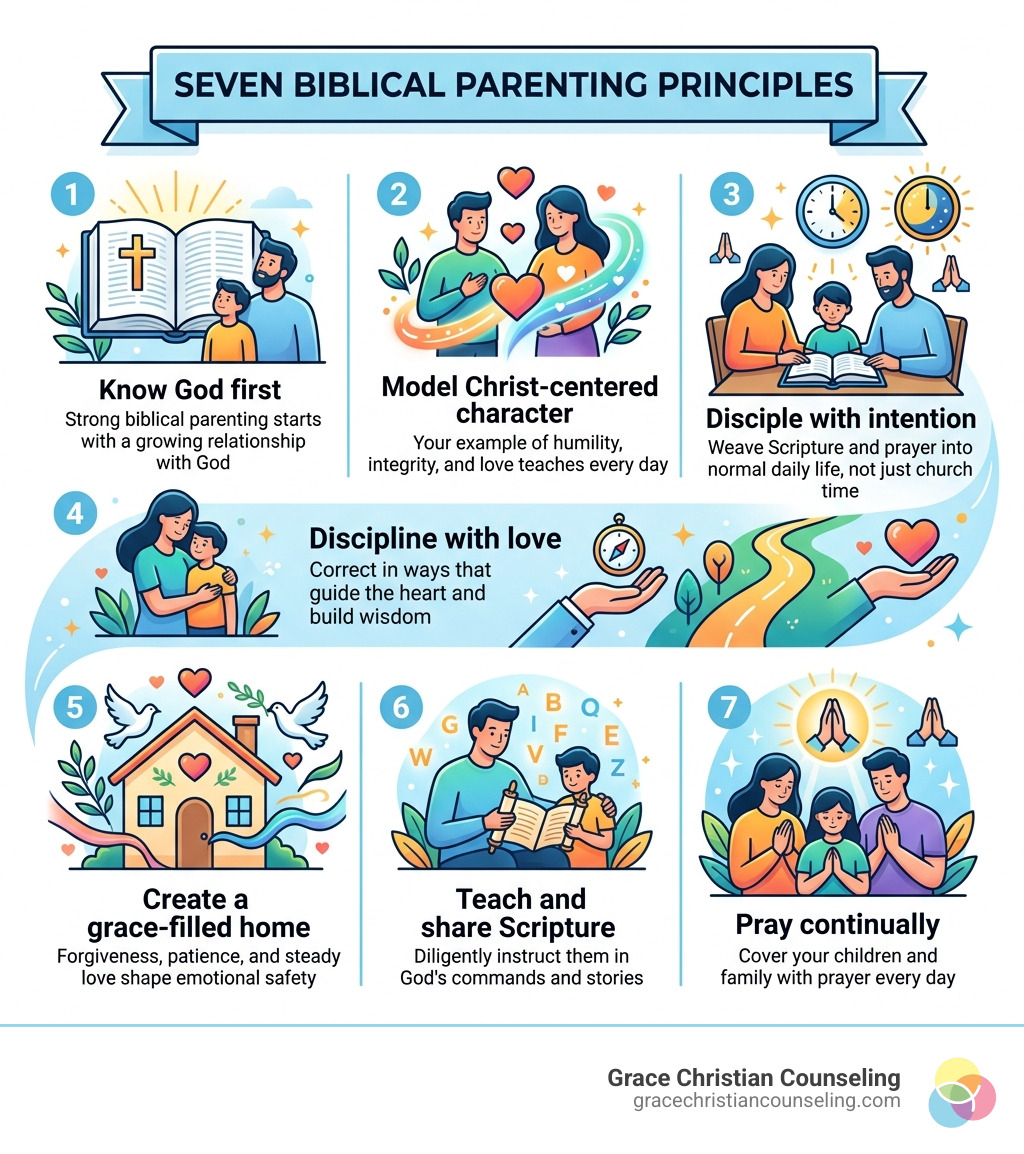
Here are the core biblical principles at a glance:
- Know God first – Biblical parenting is rooted in your own ongoing relationship with God, because spiritual growth in parents shapes the tone, priorities, and health of the home.
- Model Christ-centered character – Children learn through observation, so your humility, honesty, repentance, self-control, and love become part of their everyday formation.
- Disciple with intention – Bring Scripture, prayer, and gospel conversations into ordinary routines, so faith is practiced consistently and not treated as a Sunday-only activity.
- Discipline with love – Use correction to teach wisdom, responsibility, and heart-level change, not merely to control behavior in the moment.
- Create a grace-filled home – Forgiveness, patience, and dependable love help build emotional safety, secure attachment, and an environment where children can grow honestly.
- Strengthen your marriage – A stable, respectful, and sacrificial marriage often gives children a stronger sense of security, predictability, and relational trust.
- Use biblical discernment – Evaluate parenting advice and cultural trends through the lens of Scripture, wisdom, and a clear understanding of your child’s actual needs.
Most parents want to do right by their kids. But between school runs, sibling arguments, and the pressure to raise “good children,” it is easy to lose sight of what parenting is really for. The daily chaos can crowd out the bigger picture that parenting is a sacred calling, not just a set of responsibilities.
The good news? You do not need a perfect formula. You need a God-centered perspective and practical, biblical wisdom to back it up.
The Foundation of Biblical Principles Parenting Advice: Knowing God

At its heart, Good Parenting Begins with Knowing God. We cannot give our children what we do not possess ourselves. If we want our children to drink from the well of living water, we must be frequenting that well ourselves. Biblical parenting isn’t about mastering a set of “how-to” steps; it is about the overflow of a parent’s personal relationship with the Creator.
The Bible presents God as the divine archetype for fatherhood. In Ephesians 3:14–15, Paul writes that every family in heaven and on earth derives its name from the Father. Although there is no such thing as a perfect parent, our role as parents is to be a father or mother who reflects the Heavenly Father. When we understand how God treats us (with patience, presence, affirmation, and delight) we find the blueprint for how to treat our children. Christian Parenting is, at its core, the work of imitating God’s character and relational style.
Modeling Christ-Centered Character
Children notice far more than we think, but they do not always have the maturity to interpret what they see accurately. That is why a parent’s character matters so much. Our daily habits, emotional regulation, and integrity shape a child’s understanding of faith in real time. If we talk about patience but react with anger in everyday moments, our children are likely to absorb the behavior more deeply than the lesson.
Modeling Christ-like character involves displaying the fruits of the Spirit: love, joy, peace, patience, kindness, goodness, faithfulness, gentleness, and self-control (Galatians 5:22-23). It also requires a high degree of humility. When we mess up (and we will) biblical principles suggest we shouldn’t hide it. Instead, we should model confession and repentance. Asking a child for forgiveness when we’ve been harsh is one of the most profound ways to How to Resolve Family Conflict and show them that we, too, are under the authority of Christ.
The Righteousness of Marriage as a Foundation
A part of biblical principles parenting advice that many families miss is the strength of the parents’ marriage. Scripture presents marriage as a primary covenant, not something that becomes secondary once children arrive. When that relationship is marked by love, faithfulness, repentance, and respect, children see a lived example of the gospel in everyday life.
When a husband and wife relate with Christlike love, respect, and humility, children usually experience more emotional security and consistency at home. A healthy marriage does not create a perfect family, but it often gives kids a steady place to learn commitment, and repair after conflict. Prioritizing your marriage is not taking something away from your children; in many cases, it helps build the stable foundation they need to grow. A healthy marriage gives children one of the clearest pictures of biblical love they will ever see.
Putting your marriage first is not ignoring your children; it is strengthening the foundation they live on every day. That foundation matters in measurable ways too. Research consistently shows that children in homes with high parental conflict face greater emotional and behavioral challenges, while warm, stable parental relationships are linked with better adjustment over time.
For example, the Centers for Disease Control and Prevention notes that adverse childhood experiences, including household dysfunction, are associated with higher risks for later mental and physical health problems. In one major review, exposure to destructive interparental conflict was associated with worse outcomes for children across emotional, social, academic, and behavioral domains.
Biblical marriage is not about perfection; it is about building a home where faithfulness, humility, and peace shape daily family life.
Discipling the Heart through Scripture and Prayer

Biblical parenting aims for more than outward compliance. The deeper goal is the formation of a child’s heart, character, and relationship with God. In practical terms, that means parents are not only trying to shape behavior, but they also nurture discipleship. Deuteronomy 6:6-9 gives this picture clearly, calling parents to weave God’s truth into everyday life so it reaches the heart, not just the child’s actions.
This requires prayerful dependence. We must recognize that we cannot “produce” faith in our children; only the Holy Spirit can change a heart. Our job is to plant and water, trusting God for the growth. This shifts the pressure off our shoulders and onto God’s grace.
Integrating Biblical Principles Parenting Advice into Daily Life
Discipleship does not need to feel like a lecture or another class period. Children often internalize faith best when it is woven into everyday routines, conversations, and responses to real-life situations.
Consider these practical steps for intentionality:
- Morning Rhythms: Start the day by praying for each child’s specific needs or challenges.
- Mealtime Conversations: Use dinner as a time to discuss where you saw God working during the day.
- Bedtime Blessings: Make it a habit to speak words of affirmation and truth over your children before they sleep.
- “As You Walk” Moments: Whether driving through Uniontown or walking in a park, use daily sights and situations to point back to biblical truths.
Fostering a Home of Grace and Forgiveness
In a Christ-centered home, a child should have the emotional safety to make mistakes, tell the truth, and be corrected without fear. When the home feels rigid, highly critical, or unpredictable, children often become anxious and guarded, which can distort their understanding of God’s grace.
Parenting Advice rooted in the gospel emphasizes that while sin has consequences, our love is unconditional. We foster emotional safety when we prioritize relationship over rules. This doesn’t mean there are no boundaries, of course. It means the boundaries are wrapped in a dominant tone of delight and mutual respect.
Biblical Discipline: Training with Love and Purpose
Discipline is often the most misunderstood part of biblical principles parenting advice. Many see it as purely punitive (punishing a child for a wrong act). However, the biblical concept of paideia (instruction/training) is formative. It is about shaping a child’s desires and character toward righteousness.
According to these 5 Principles for Disciplining Your Children, discipline should always be administered in love, never in anger. The goal is reconciliation and restoration. When we discipline, we are helping our children see the “foolishness” in their hearts (Proverbs 22:15) and pointing them toward the wisdom of God’s ways. For younger children, this might involve Counseling for Kids or play-based correction, while older children require more dialogue and logical consequences.
Avoiding Provocation and Exasperation
Scripture explicitly warns parents: “Do not embitter your children, or they will become discouraged” (Colossians 3:21) and “do not provoke your children to anger” (Ephesians 6:4). We provoke our children when we:
- Have unrealistic, perfectionist expectations.
- Are inconsistent with our rules.
- Use harsh, demeaning language.
- Fail to listen to their side of the story.
Parenting Teenagers requires a shift toward authoritative leadership: being firm on core values but flexible on non-essentials, always maintaining an empathetic connection. A “gentle answer” really does turn away wrath, even in a heated argument about curfew.
Applying Biblical Principles Parenting Advice for Behavioral Struggles
When children face extreme behavioral struggles, parents often feel defeated. In these moments, we must lean into persistent prayer and the “rescuing grace” of God. It is helpful to remember that behavior is often a “check engine light” for the heart.
If you are wondering How to Help a Teenager with Anxiety or behavioral outbursts, start with clear boundaries and consistent consequences, but saturate the process in patience. Celebrate progress over perfection. Sometimes, professional help from a licensed Christian counselor can provide the “toolbox” needed to navigate these deeper waters while keeping faith at the center.
Navigating Cultural Challenges with a Biblical Worldview
Parents today face a barrage of cultural fads that often contradict biblical wisdom. The “self-esteem movement,” for example, often prioritizes self-centeredness over the biblical virtue of humility. Similarly, some modern “gentle parenting” trends remove the concept of authority altogether, which can lead to anxiety and a lack of boundaries for the child.
Comparing Parenting Styles
To understand where biblical parenting fits, it helps to look at the four common styles identified by developmental psychology, viewed through a faith lens:
| Style | Characteristics | Biblical Perspective |
|---|---|---|
| Authoritarian | High demands, low emotional responsiveness; obedience is expected with little discussion. | This approach can increase frustration and resentment in children, and it can slide into the kind of harshness Scripture warns against. |
| Permissive | High warmth, low structure; children receive affection but few consistent limits. | Love matters, but children also need guidance, correction, and steady training in wisdom. |
| Uninvolved | Low warmth, low guidance; parents are emotionally or practically disengaged. | This falls short of the biblical call to nurture, teach, and care for children with faithful attention. |
| Authoritative | High warmth, high structure; clear expectations are paired with empathy, consistency, and relationship. | The biblical model: loving authority that reflects both truth and grace, helping shape the heart, not just control behavior. |
Understanding Teenage Identity Development helps us see why children and teens need a healthy blend of warmth, structure, and steady guidance. In clinically accurate terms, this kind of authoritative parenting supports healthy emotional regulation, secure attachment, and identity formation. In biblical terms, it gives children a stable place to grow, so they can develop a secure sense of who they are in Christ.
Protecting the Home Environment
Biblical stewardship extends to the environment we create in our homes. This involves media discernment and protecting our children from premature exposure to adult themes. Concerns about entertainment fit into a bigger conversation about body image, identity, and the values shaping a child’s heart and mind.
Media shapes beliefs and behavior more than many parents realize. For example, Common Sense Media reports that teens average more than 8.5 hours of entertainment screen media each day, not counting school or homework use, which shows how powerful daily exposure can be. The American Psychological Association has also noted links between sexualized media exposure and concerns about body image, self-worth, and identity development in children and teens.
In other words, entertainment choices are part of a bigger discipleship conversation about what is shaping a child’s heart and mind. We must be intentional, not just in what we forbid, but in what we model. Protecting the home isn’t about living in a bubble; it’s about building a strong foundation so that when children eventually step into the world, they have the discernment to navigate it.
The Ultimate Goal: Raising Followers of Jesus
What is the real “win” in parenting? It is not a scholarship, career success, or merely well-mannered kids. The true goal is raising followers of Jesus who love God and others, while fostering strong and healthy family connection together. Healthy families help form healthy churches, communities, and societies.
As we engage in Parenting Teens, the goal is not just short-term compliance, but long-term discipleship. We want our teens to leave home with an internalized faith, growing spiritual maturity, and a clear understanding of God’s purpose for their lives. In biblical parenting, we are not simply managing behavior, we are helping form young adults who can follow Jesus and live as faithful members of His Church that changes the world.
Frequently Asked Questions about Biblical Parenting
What is the overarching biblical perspective on parenting?
The overarching perspective is that parenting is a mission of shepherding a child’s heart toward God’s grace. It moves beyond mere behavioral modification techniques and focuses on the parent’s role as a steward of a soul entrusted to them by God.
How do I avoid provoking my children to anger?
You can avoid provocation by balancing firm, clear boundaries with deep, visible affection. It involves avoiding legalism, being willing to admit when you are wrong, and modeling the same forgiveness to your children that you receive from Christ.
Is Proverbs 22:6 a guarantee that my child will never stray?
Proverbs are general principles of wisdom, not absolute, “if-then” promises. While intentional training is the most effective way to set a child on the right path, every child is an individual with free will who must eventually make their own choices to follow the Lord.
A Grace-Filled Path Forward
Parenting is one of the most challenging and rewarding journeys you will ever take. While the world offers endless “hacks” and “strategies,” biblical principles parenting advice offers something better: a relationship with the Living God that transforms both parent and child.
At Grace Christian Counseling, we understand that the journey isn’t always easy. Whether you are dealing with the daily stresses of toddlers, navigating the complexities of the teenage years, or facing deep-seated family conflict, you don’t have to walk alone. We provide a compassionate blend of evidence-based psychology and biblical truth to help families across Western Pennsylvania and beyond find real healing and restoration.
If you’re feeling overwhelmed or just want to grow in your parenting journey, our team of licensed counselors is here to support you. We offer in-person sessions at our various locations and convenient online Christian counseling for anyone in Pennsylvania.
Let us help you build a home rooted in grace, guided by truth, and filled with the hope of Christ. Contact us today to start your journey toward a more vibrant, gospel-centered family life.
This guide is for educational and spiritual encouragement and is not a substitute for personalized professional counseling. If you are in crisis, please reach out for immediate help.
Healing the Heart with the Word
Faith Based Family Counseling: A Guide for Struggling Households


