

When Life Feels Heavy: What Anxiety Depression Counseling Can Do for You
Anxiety depression counseling is professional therapy that helps you manage the overlapping symptoms of anxiety and depression, so you can function better, feel more like yourself, and find lasting relief.
What to expect from anxiety depression counseling:
- Assessment: A licensed counselor evaluates your symptoms, history, and goals
- Personalized treatment plan: Using evidence-based approaches like CBT, trauma-informed care, or somatic therapy
- Regular sessions: Weekly or bi-weekly, typically 50-60 minutes each
- Measurable progress: Most people notice meaningful improvement within 2-4 months
- Faith integration (optional): At Grace Christian Counseling, biblical truth and prayer can be woven into your care
If you live in Western Pennsylvania, including Pittsburgh, North Huntingdon, Penn Hills, Uniontown, or surrounding communities, or anywhere online, Grace Christian Counseling offers Christ-centered, evidence-based counseling for exactly this.
For readers who prefer face-to-face support, Grace also offers in-person counseling in Westmoreland County through its Irwin/North Huntingdon and Ligonier locations.
You may already know something feels off. Maybe you lie awake at night with racing thoughts, then wake up too exhausted to face the day. Maybe you feel numb, disconnected, or like you’re just going through the motions. Or maybe you’re holding it all together on the outside while quietly falling apart on the inside.
You are not alone. CDC data suggests nearly 1 in 5 U.S. adults has been diagnosed with depression at some point, and research shows anxiety and depression commonly overlap, with some studies finding anxiety symptoms or disorders in more than half of people with depression.
The good news is that both are treatable. With the right support, real healing is possible, spiritually, emotionally, and practically.
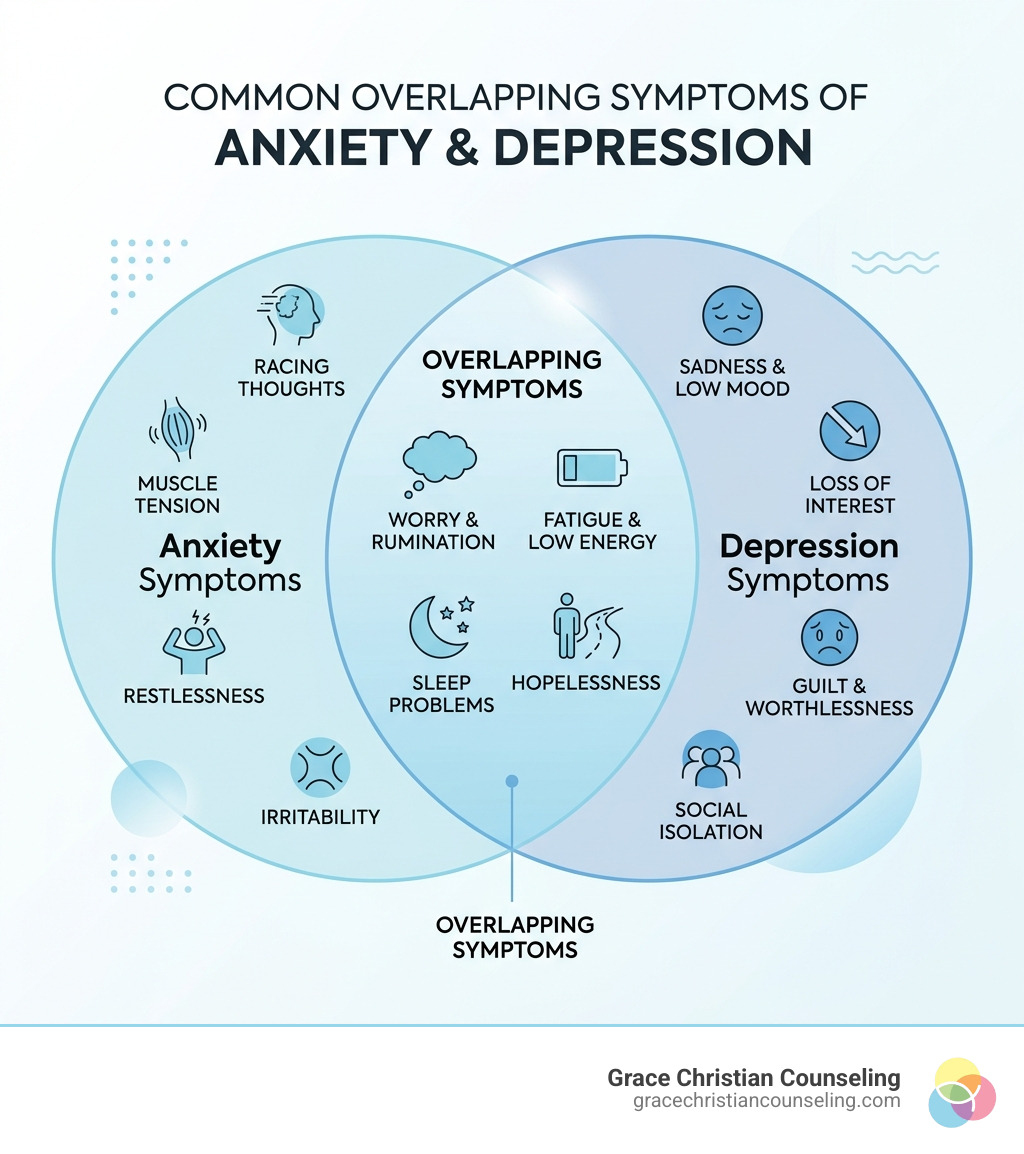
Symptoms and the Cycle of Anxious Depression
When we talk about anxiety depression counseling, we are often addressing a complex cycle. It is rarely as simple as just feeling “sad” or “nervous.” For many of our clients in Pennsylvania, these conditions feed into one another. Anxiety creates a state of high alert that eventually exhausts the body and mind, leading to the “shutdown” phase we recognize as depression.

Common symptoms include:
- Persistent Sadness: A heavy, lingering “cloud” that doesn’t lift, even when good things happen.
- Racing Thoughts: Constant “what-if” scenarios that make it impossible to quiet the mind.
- Physical Fatigue: Feeling like you are moving through molasses or pushing a heavy rock up a hill.
- Loss of Interest: Things that used to bring you joy, like spending time with your church family or hiking in Western PA, now feel like chores.
According to data from the Substance Abuse and Mental Health Services Administration (SAMHSA), depression affects roughly 16 million American adults every year. Because these conditions so often co-occur, treating one without addressing the other is like trying to fix a leaky pipe while ignoring the water damage in the floor.
Distinguishing Between Anxiety and Depression
While they are often two sides of the same coin, they do have distinct characteristics. Anxiety is typically future-oriented; it is the dread of what might happen. Depression is often past or present-oriented; it is the weight of what is or what was.
- Anxiety Symptoms: Physical tension, irritability, heart palpitations, and sleep disturbances (usually trouble falling asleep because of a racing mind).
- Depression Symptoms: Appetite changes, low energy, feelings of worthlessness, and sleep disturbances (often waking up too early or wanting to sleep all day).
If you are struggling to tell where one ends and the other begins, you might find comfort in our resources for Christian Support For Depression And Anxiety, which help clarify these feelings through a biblical lens.
Why Anxiety and Depression Often Co-occur
Why do they show up together so often? It is often a mix of biological factors, genetics, and environmental stressors. In high-pressure environments, like those faced by professionals in Pittsburgh or busy families in Sewickley, we often see the “exhausted worrier” profile.
This person spends so much nervous energy trying to keep everything perfect (anxiety) that their system eventually crashes into a state of hopelessness (depression). Chronic worry depletes your emotional resources. When you’ve spent all day fighting off panic, you have nothing left to fight off despair. This is why integrated anxiety depression counseling is so vital; it addresses the “wired and tired” state simultaneously.
Evidence-Based Approaches in Anxiety Depression Counseling
We believe in using the best tools available. This means combining clinical excellence with spiritual truth. Our licensed counselors (LAPC, LSW) use several proven methods to help you retrain your brain and find steady ground.
| Feature | Individual Therapy | Group Therapy |
|---|---|---|
| Focus | Highly personalized to your specific story | Focused on shared experiences and peer support |
| Pace | Moves at your specific comfort level | Follows a structured curriculum or group flow |
| Benefit | Deep dive into root causes and trauma | Realizing you are not alone; practicing social skills |
| Best For | Acute crisis or deep-seated personal issues | Building community and learning coping tools |
The Role of Cognitive Behavioral Therapy (CBT)
CBT is often considered the “gold standard” for anxiety depression counseling. It works by identifying “thought distortions,” those lies we tell ourselves that fuel our misery. For example, if you think, “I’m a failure because I missed one deadline,” CBT helps you challenge that thought with evidence and replace it with a balanced truth.
We also focus on behavioral activation. When you are depressed, you wait to “feel like” doing something before you do it. CBT flips this: you do the healthy activity first, and the feelings follow. This is a key part of Overcoming Anxiety Through Christian Counseling, as it aligns with the biblical principle of renewing the mind.
The Effectiveness of Online Anxiety Depression Counseling
In 2026, we understand that life is busier than ever. You might be a parent in Uniontown who can’t find childcare, or a professional in Mt. Lebanon who can’t leave the office during the day.
Online therapy has been shown to be just as effective as in-person sessions for both anxiety and depression. We provide a secure, HIPAA-compliant virtual safe space for residents across Pennsylvania, Georgia, West Virginia and Florida. This allows you to receive high-quality care from the comfort of your own home, making it easier to stay consistent with your appointments. If you’ve wondered How To Deal With Anxiety As A Christian while managing a hectic schedule, telehealth is often the answer.
How Long Does Anxiety Depression Counseling Take to Work?
One of the most common questions we hear is: “When will I feel better?” While every person’s journey is unique, research on a 12-week therapist-supported CBT-based program suggests many people can experience meaningful improvement over about 12 weeks, especially when they stay engaged in treatment.
Most of our clients notice a shift in their perspective or a slight lifting of the “heaviness” within the first 2 to 4 months of weekly sessions. Healing is not a straight line, but with consistency, you can move from a state of “crisis management” to “thriving.” For more guidance on this process, see our guide on Finding The Right Depression And Anxiety Counseling Near You.

Integrating Faith with Clinical Mental Health Care
At Grace Christian Counseling, we don’t believe you have to choose between your faith in Jesus and therapy. We offer both. Our approach integrates evidence-based psychology with a biblical worldview, acknowledging that we are spiritual, emotional, and physical beings.
Scripture as a Tool for Healing
God’s Word is full of people who struggled with deep darkness. In Psalm 102, the writer describes feelings that sound exactly like clinical depression: “My heart is blighted and withered like grass; I forget to eat my food.”
We use Scripture not as a “band-aid,” but as a foundation for truth. Philippians 4:6-7 encourages us: “Do not be anxious about anything, but in every situation, by prayer and petition, with thanksgiving, present your requests to God. And the peace of God, which transcends all understanding, will guard your hearts and your minds in Christ Jesus.”
Our Biblical Counseling For Depression focuses on this promise: God can guard your mind even when your feelings are screaming otherwise. We help you move toward renewing the mind by replacing toxic, anxious thoughts with the steady promises of Christ.
Support Systems and Lifestyle Changes
Counseling is a powerful engine, but it needs the right fuel. We often discuss lifestyle changes that support your mental health:
- Sleep Hygiene: Anxiety and depression both wreck sleep. We work on routines to help your body rest.
- Exercise: Moving your body releases natural chemicals that fight depression.
- Church Community: Isolation is the enemy of recovery. We encourage staying connected to your local church in places like Penn Hills or Bethel Park.
- Family Support: Often, the way we interact with those closest to us affects our mental health. Learning How To Resolve Family Conflict can remove a major source of daily anxiety.
Frequently Asked Questions about Anxiety Depression Counseling
When should I seek professional counseling for anxiety or depression?
If your symptoms are interfering with your daily life, like your ability to work, parent, or maintain relationships, it is time to seek help. If you find yourself isolating from friends, or if you feel a persistent sense of hopelessness that won’t go away, don’t wait. Seeking help is a sign of strength and stewardship over the life God has given you.
What is the difference between a licensed counselor and a psychiatrist?
A licensed counselor focuses on “talk therapy.” We help you process emotions, change behaviors, and develop coping skills. A psychiatrist is a medical doctor who primarily focuses on medication management. Many people find that a combination of both is the most effective way to treat severe symptoms. We are happy to collaborate with your medical providers to ensure you have a “team” approach to your care.
How can I support a loved one undergoing counseling?
The best thing you can do is offer a non-judgmental, listening ear. Avoid “fixing” them with simple platitudes like “just pray harder.” Instead, encourage their attendance in therapy and be patient. Healing takes time. Simply saying, “I see you’re struggling, and I’m here for you,” can be incredibly healing.
Begin Your Journey Toward Peace and Healing Today
At Grace Christian Counseling, we are committed to walking with you through the valley. Whether you are in Pittsburgh, North Huntingdon, Penn Hills, Uniontown, Bethel Park, Sewickley, or Mt. Lebanon, we offer a safe, Christ-centered place to land.
You don’t have to carry the weight of anxious depression alone. Our licensed counselors are ready to help you integrate clinical tools with biblical wisdom to find the peace that God intends for you. If you’re ready to take the first step toward a lighter, more hopeful life, we invite you to explore our Anxiety Depression Counseling/ services today. There is hope, and there is help. Let’s start the journey toward healing together.
This article was researched with AI and heavily edited by Bekah McCrorey for accuracy and relevance.
Bekah McCrorey is a counselor at Grace Christian Counseling. She holds a Master’s degree in Counseling from Dallas Theological Seminary and a Bachelor’s degree in Christian Ministry from Chesapeake Bible College and Seminary. She is a provisionally licensed counselor working under supervision toward full licensure as a Licensed Professional Counselor (LPC) in Pennsylvania.
With over 12 years of full-time ministry experience supporting individuals, families, ministry leaders, and churches nationally and internationally, Bekah brings a deep understanding of emotional and spiritual struggles. As a counselor, she uses a client-centered, trauma-informed, and evidence-based approach. She is Level 1 trained in Restoration Therapy and is passionate about helping clients navigate anxiety, depression, grief, trauma, life transitions, and relational difficulties while integrating emotional and spiritual well-being.
This guide is for educational and spiritual encouragement and is not a substitute for personalized professional counseling. If you are in crisis, please reach out for immediate help.
Beginner’s Guide to Christian Counseling for Depression


