Loneliness Is More Common Than You Think, And the Gospel Has an Answer

Biblical counseling for loneliness offers real, lasting hope rooted in Scripture, community, and a relationship with Christ, not just temporary comfort.
Here’s a quick overview of how it works:
- Understand the root: Loneliness is a spiritual and relational issue, not just an emotional one
- Turn to God first: Pour out your pain to Him honestly, as David did in Psalm 142
- Engage the church: The “one another” commands in Scripture call believers to actively pursue and love each other
- Counter false saviors: Identify unhealthy coping habits, such as media or relationship idolatry, and replace them with gospel truth
- Serve others: Shifting focus outward breaks the cycle of isolation and self-focus
- Build real relationships: Take small, intentional steps from surface-level to deeper connection
Loneliness is everywhere right now. In 2023, the U.S. Surgeon General described loneliness and social isolation as a national public health concern, noting that about half of U.S. adults had recently experienced measurable loneliness. Research from Harvard’s Making Caring Common Project also found that 36% of Americans reported serious loneliness, including 61% of young adults. The CDC has linked social isolation and loneliness with increased risks for serious health concerns, including heart disease, stroke, dementia, depression, and anxiety. And yet, in many churches, the loneliest people are sitting in the pews every Sunday, present, faithful, and invisible.
Young adults who feel disconnected while friendships, work, and church life change may also benefit from support for young adults building connection and a steadier sense of belonging.
It can feel like a quiet ache that no amount of social media, busyness, or even church attendance can touch. One moment from a biblical counseling classroom captures it well: when a professor gently asked a student why they felt lonely, other students began quietly admitting they did too. Nobody was shocked. Everybody related.
Loneliness isn’t a sign of weak faith. It’s a signal, one that points to something deep in how we were made, and something even deeper about what we need.
This article walks you through what the Bible actually says about loneliness, how it differs from healthy solitude, and what practical, gospel-centered steps can bring lasting relief, not just a temporary lift.
Understanding the Biblical Definition of Loneliness
To find a way out of the fog, we first have to define what we are feeling. In secular circles, loneliness is often described as a gap between the social connections we have and the ones we want. But in a biblical context, loneliness is much deeper. It is a “soul-thirst” that stems from our very design.
We are made in the Imago Dei, the image of God. Our God is a relational God, existing eternally as the Trinity (Father, Son, and Holy Spirit). Because we are made in His image, we are hardwired for connection. Loneliness is a sense of separation that often brings with it feelings of rejection or self-pity. It’s the “not-good-ness” mentioned in Genesis 2:18: “It is not good that the man should be alone.”
This relational hunger isn’t a defect; it’s a feature of being human. However, the heart is complex. You can be in a room full of people, even your own family in Pittsburgh or North Huntingdon, and still feel a crushing weight of isolation. This is because loneliness isn’t just about the number of people around you; it’s about the quality of the connection and the state of your soul.

Distinguishing Aloneness from Solitude
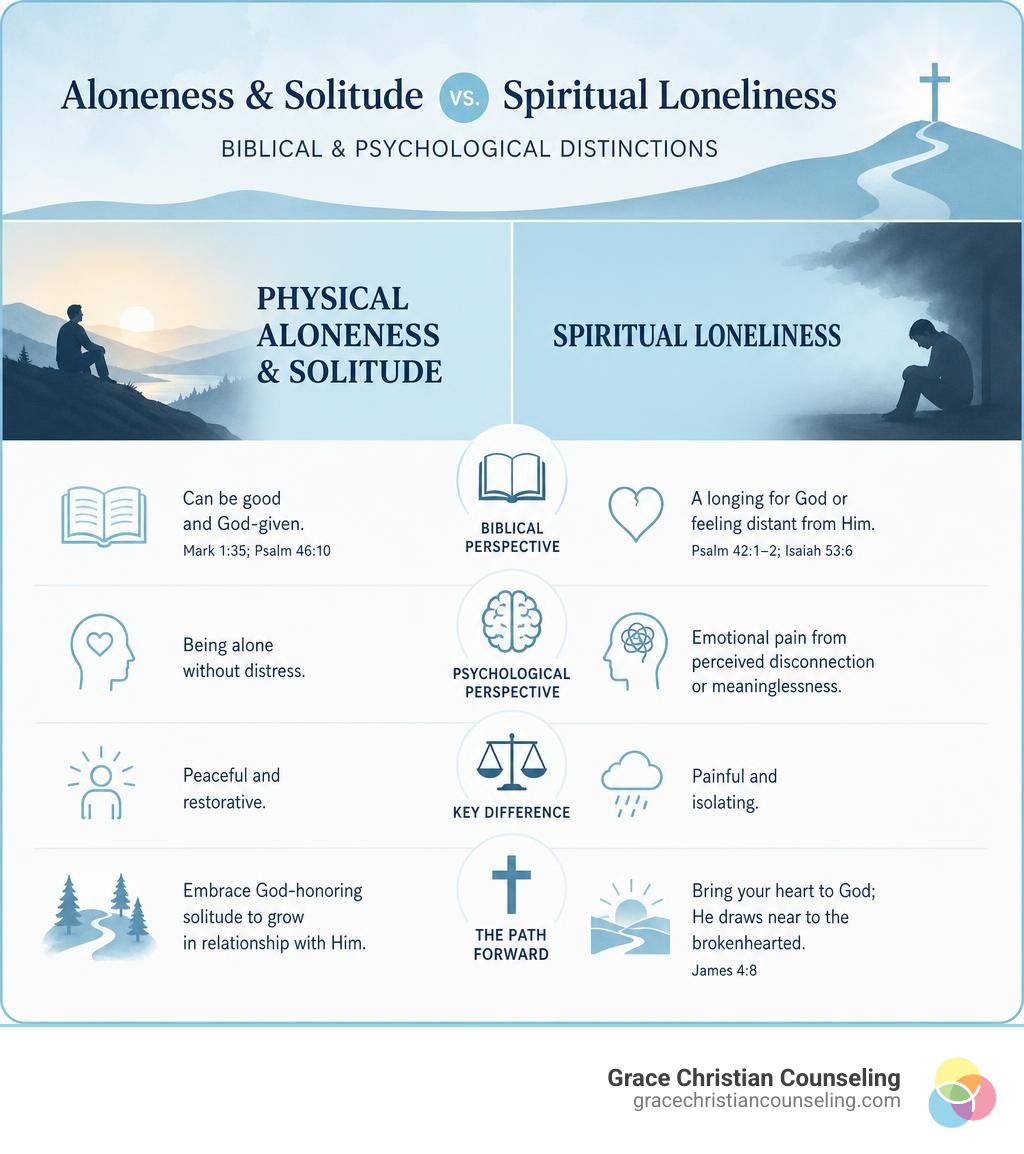
In Biblical counseling for loneliness, we often help people distinguish between being alone and being lonely. Aloneness is a physical state; solitude is a spiritual discipline.
Solitude is intentional. It is the practice of withdrawing for spiritual renewal, emotional processing, and prayer. We see this modeled perfectly by Jesus. Luke 5:16 tells us that Jesus “would withdraw to desolate places and pray.” He wasn’t lonely in those moments; He was connecting deeply with His Father.
Healthy solitude allows us to engage in The Importance Of Self Acceptance as we see ourselves through God’s eyes. It is a “sacred space” where we can recharge. Loneliness, on the other hand, is a painful disconnection that we didn’t necessarily choose and don’t know how to fix.
The Pain of Harmful Isolation
While solitude heals, isolation harms. Proverbs 18:1 warns, “Whoever isolates himself seeks his own desire; he breaks out against all sound judgment.”
Harmful isolation often starts as a protective measure. Maybe you’ve been hurt by a church member in Sewickley or a friend in Uniontown, so you pull back to stay safe. But that withdrawal quickly turns into a spiritual wilderness. It creates an echo chamber where self-pity and rejection grow loud. This type of isolation is often a key component in Biblical Counseling For Depression, as it cuts us off from the very community God designed to help carry our burdens.
The Roots of Isolation: Creation, the Fall, and Sin
Why is loneliness so painful? Because it wasn’t part of the original plan. In Eden, there was perfect vertical connection (with God) and perfect horizontal connection (between Adam and Eve). There was no shame, no hiding, and no “invisible” people.
The Fall changed everything. Sin entered the world, and the first thing Adam and Eve did was hide. They felt a new, terrifying alienation. This brokenness is the root of all loneliness. We are now born with a vertical disconnection from our Creator and a natural tendency toward horizontal strife with others. When we discuss a Biblical Perspective On Depression And Counseling, we must acknowledge that our “soul-ache” is often a longing for the wholeness we lost in the Garden.
How Sin Exacerbates the Echo Chamber of Loneliness
While loneliness itself isn’t a sin, sin certainly loves to use loneliness as a playground. When we are lonely, we are vulnerable. We become like a lone sheep that has wandered from the flock, making us an easy target for the enemy (1 Peter 5:8).
Loneliness creates an echo chamber for:
- Negative self-talk: “Nobody cares about me,” or “I’m too broken to be loved.”
- Fear of man: Answering the question of What Does God Say About Loving Yourself with insecurity rather than identity in Christ.
- Distorted thinking: We start to believe our isolation is permanent or that we are uniquely “different” from everyone else in the church.
As James 1 suggests, these distorted thoughts can lead us toward temptation. We might justify sinful behaviors because we feel “entitled” to some form of comfort in our pain.
Identifying False Saviors and Destructive Coping
When the ache of loneliness becomes too much, we often reach for “false saviors” to numb the pain. In our modern world, this often looks like:
- Media Numbing: Scrolling through social media for hours or binge-watching shows to drown out the silence.
- Relationship Idolatry: Demanding that a spouse, a boyfriend, or a best friend meet every emotional need, a burden no human can carry.
- Social Media Amplification: Ironically, the tools meant to connect us often make us feel more excluded as we watch “highlight reels” of events we weren’t invited to.
As the Biblical Counseling Coalition | Loneliness with Christ points out, these coping mechanisms are like drinking salt water to quench thirst. They might provide a momentary distraction, but they leave us more dehydrated than before.
How Biblical Counseling for Loneliness Identifies Root Causes
At Grace Christian Counseling, we don’t just want to give you a “to-do” list. We want to help you explore the heart motives behind your loneliness. In a safe, confidential environment, whether in our Bethel Park office or through online sessions, we walk through a discovery process.
We look at:
- Heart Motives: Are you seeking relationships for God’s glory or to validate your own worth?
- Providential Circumstances: Is God using this season of “manna” (daily reliance) to draw you closer to Him?
- Time Stewardship: How are you using your “alone time”? Is it spent in edifying ways or in envying others?
Through Healing The Heart Through Christian Counseling, we help you identify the specific fears, such as the fear of being unlovable or the fear of dying alone, that keep you trapped in isolation.

The Double Pivot: Turning Inward and Outward
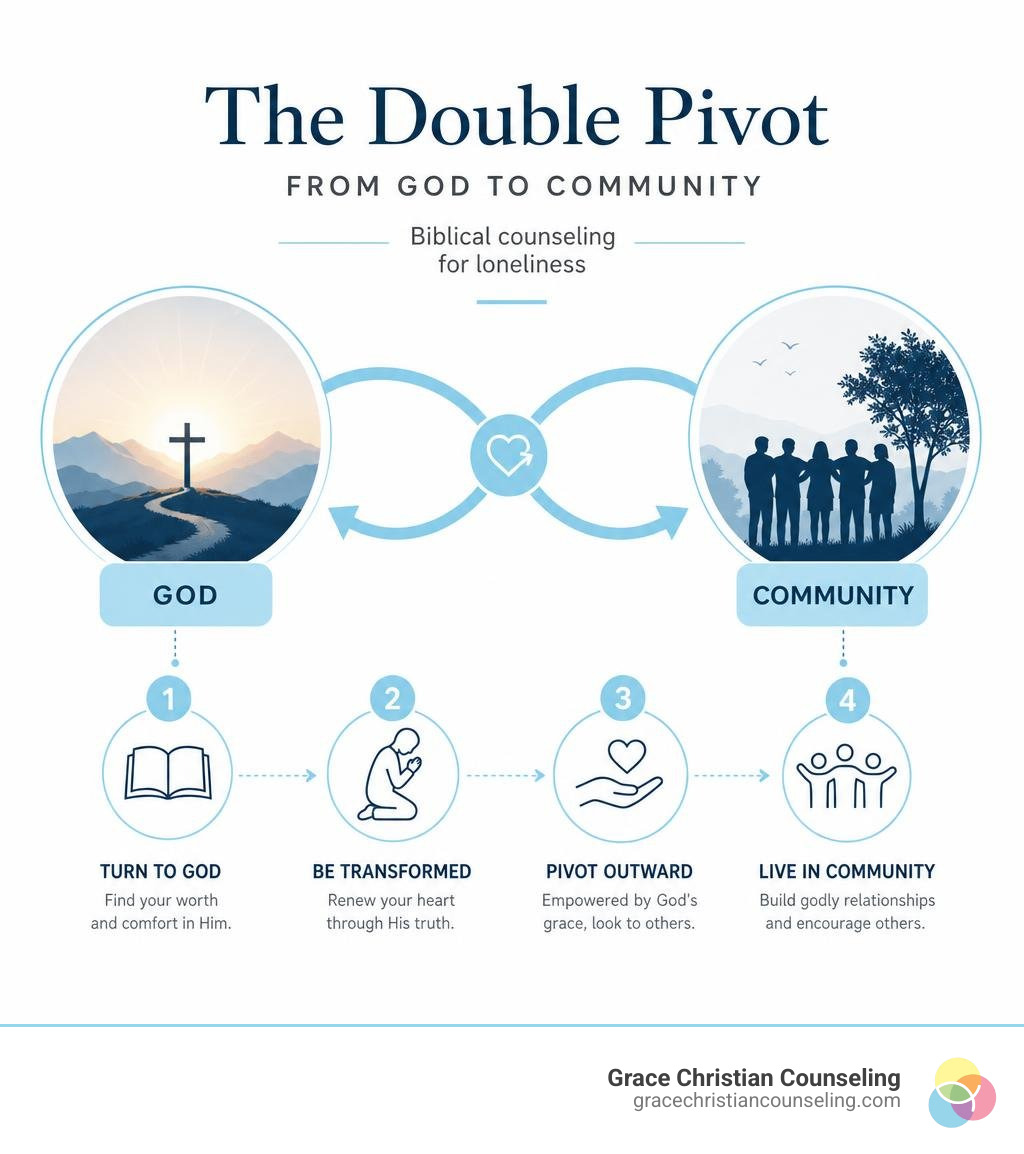
A core strategy in Biblical counseling for loneliness is what we call the “Double Pivot.”
- Pivot to the Lord (Vertical): Before running to people, we run to God. Like David in Psalm 142, we “pour out our complaint” before Him. We find comfort in the fact that He hears us and stays with us.
- Pivot to Others (Horizontal): Once we are anchored in God’s comfort, we move outward. We move from “Who is loving me?” to “Who can I love?” This self-forgetfulness is where true joy is often found.
[TABLE] Comparing Solitude for Renewal vs. Harmful Isolation
| Feature | Solitude for Renewal | Harmful Isolation |
|---|---|---|
| Purpose | To connect with God and self | To hide or protect oneself |
| Choice | Intentional and disciplined | Often reactive or forced by fear |
| Outcome | Peace, clarity, and strength | Sadness, self-pity, and vulnerability |
| Biblical Example | Jesus praying in the wilderness | Elijah hiding in the cave (initially) |
| Focus | Vertical (God-centered) | Inward (Self-centered) |
Practical Steps to Overcome Loneliness Through the Gospel
If you are feeling the weight of loneliness today, there is a path forward. The gospel doesn’t just promise us a future home in heaven; it promises us a present Shepherd.
- Abide in Christ: Take Matthew 11:28-30 seriously. “Come to me, all who labor and are heavy laden, and I will give you rest.” Abiding isn’t a one-time event; it’s a daily rhythm of prayer and Scripture meditation.
- Practice Gratitude: Loneliness focuses on what is missing. Gratitude focuses on what is present. Start a daily list of God’s mercies, no matter how small.
- Serve Others: This is perhaps the most practical antidote. Whether it’s volunteering at a food bank in Penn Hills or simply sending an encouraging text to someone in your small group, serving breaks the cycle of self-focus.
The Role of the Church in Biblical Counseling for Loneliness
The church is not a social club; it is a family. God “sets the lonely in families” (Psalm 68:6), and for many, that family is the local body of believers.
Scripture is full of “one-another” commands: love one another, pray for one another, bear one another’s burdens. In Biblical Counseling, we encourage intentional, compassionate care. This means not waiting for the lonely person to reach out, because they often won’t, but actively pursuing those on the margins.
If you’re the one feeling lonely, try taking a “small step” this Sunday. Instead of rushing out after the service, stay for five minutes. Ask one person a “personal” question rather than just a “factual” one. Hebrews 10:24-25 reminds us to “stir up one another to love and good works… not neglecting to meet together.”
Finding Intimacy with Christ through Biblical Counseling for Loneliness
Ultimate relief from loneliness is found in the person of Jesus Christ. Why? Because Jesus is the only person who truly understands the ultimate depths of isolation.
On the cross, Jesus cried out, “My God, my God, why have you forsaken me?” (Matthew 27:46). He experienced the total abandonment of God so that we would never have to. Because of His sacrifice, we have the promise of Hebrews 13:5: “I will never leave you nor forsake you.”
In Biblical counseling for loneliness, we often point to the biblical imagery of Christ as the Bridegroom and the Church as His beloved bride. Scripture presents this relationship as personal, covenantal, and deeply faithful. Ephesians 5:25-27 describes Christ giving Himself for the Church, not standing at a distance from her pain. Revelation 19:7 also points forward to the marriage supper of the Lamb, a picture of ultimate belonging, joy, and restored fellowship.
That matters when loneliness feels like proof that you are unwanted or forgotten. The gospel gives a better word. Christ does not merely tolerate His people, He pursues, cleanses, comforts, and keeps them. For the lonely believer, this does not replace the need for embodied Christian community, but it does provide a steady foundation beneath it. You are invited to seek connection with others from a place of being already loved by Christ, not from the desperate fear that you must earn your place.
Frequently Asked Questions about Loneliness
Is feeling lonely a sin?
No. Loneliness is a valid human response to God’s design for community. Even before the Fall, God noted that it was “not good” for man to be alone. Think of loneliness like physical hunger; it’s a signal that you need nourishment. It can be an “agent of grace” that drives you to seek intimacy with God and others.
How can I help someone in my church who seems lonely?
Start by “noticing the invisible.” Look for the woman who sits alone every week or the young professional who slips out early. Practice intentional love and care by reaching out persistently via text, call, or an invitation to coffee. Share your own struggles with isolation to break the ice. Your unconditional love is a reflection of Jesus’ love for them.
What are the best Bible verses for loneliness?
- Psalm 68:6: “God settles the solitary in a home…”
- Psalm 25:16: “Turn to me and be gracious to me, for I am lonely and afflicted.”
- Matthew 28:20: “…And behold, I am with you always, to the end of the age.”
- Romans 8:31-39: The famous promise that nothing, not even isolation, can separate us from the love of God.
You Don’t Have to Carry Loneliness Alone
Loneliness can feel like a silent ache, but you don’t have to carry it alone. At Grace Christian Counseling, we are dedicated to providing compassionate, Christ-centered care for those navigating the “spiritual wilderness” of isolation.
Our licensed professional counselors blend evidence-based psychology with the timeless truths of the Bible to help you find real healing. Whether you are in Pittsburgh, Ligonier, Belle Vernon, or anywhere across Pennsylvania, we offer both in-person and virtual options to meet you where you are.
You were made for connection, with your Creator and with His people. Let us walk with you as you rediscover the joy of being known and loved by God.
Find relief through online Christian counseling or contact us today to schedule an appointment at one of our Western Pennsylvania locations. There is hope, and the Gospel has the final word on your loneliness.
This guide is for educational and spiritual encouragement and is not a substitute for personalized professional counseling. If you are in crisis, please reach out for immediate help.
From Peter to You: Finding Emotional Recovery in Christ