

When Worry Won’t Let Go: What the Bible Says About Anxiety Relief
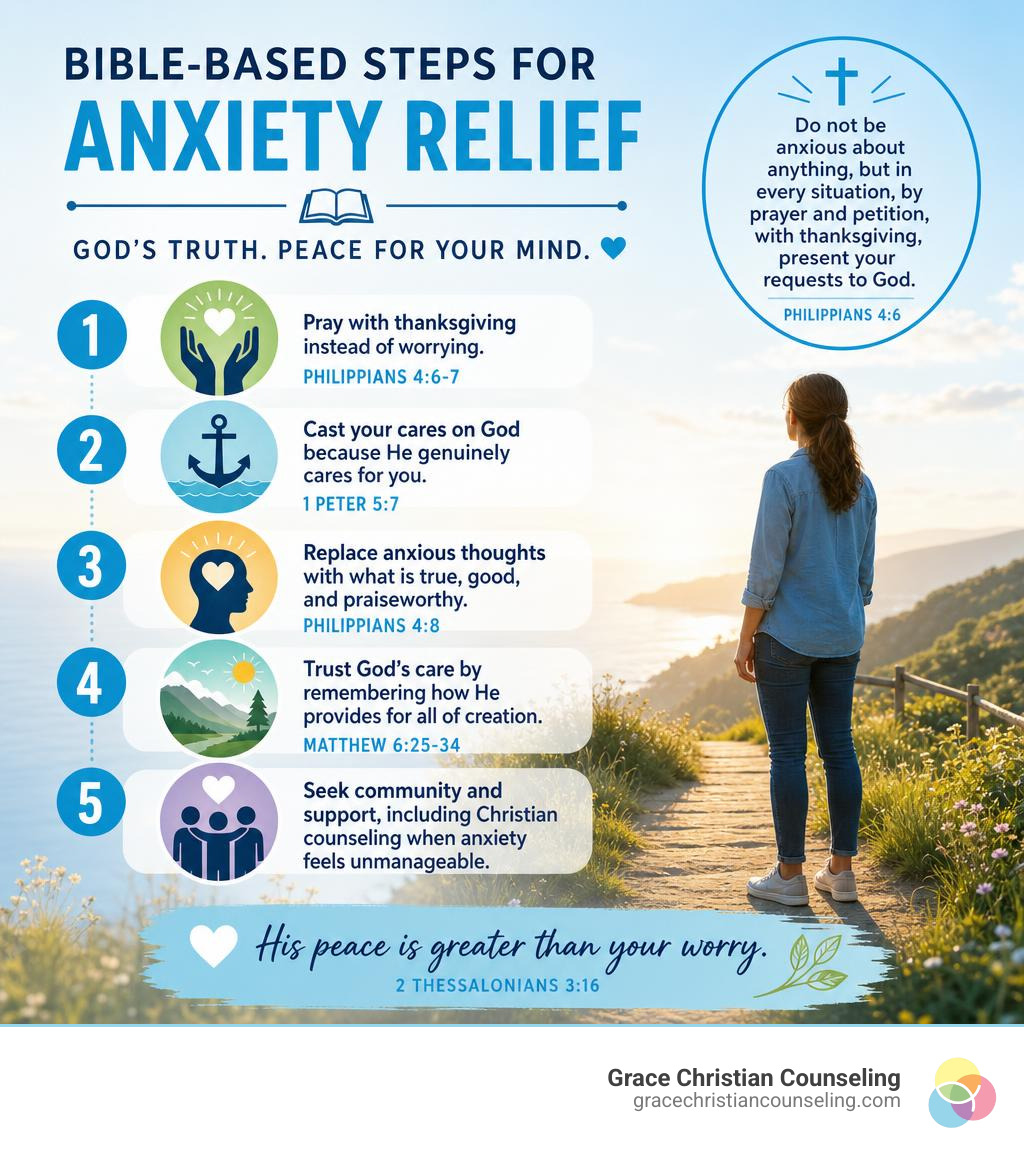
Bible focused anxiety relief is possible, and Scripture gives us practical, concrete steps to get there. Here is a quick overview:
How the Bible helps with anxiety:
- Pray with thanksgiving instead of worrying (Philippians 4:6-7)
- Cast your cares on God because He genuinely cares for you (1 Peter 5:7)
- Replace anxious thoughts with what is true, good, and praiseworthy (Philippians 4:8)
- Trust God’s care by remembering how He provides for all of creation (Matthew 6:25-34)
- Seek community and support including Christian counseling when anxiety feels unmanageable
Anxiety disorders are common, affecting an estimated 19.1% of U.S. adults in a given year, according to the National Institute of Mental Health. Anxiety can affect daily life, relationships, work, and school, and Christians may sometimes carry an additional layer of shame, wondering whether feeling anxious means their faith is not strong enough.
It does not. Faithful people in Scripture, including David, Elijah, and even Jesus in the Garden of Gethsemane, experienced deep fear and anguish. The Bible does not pretend anxiety away. Instead, it gives us a clear path through it.
At Grace Christian Counseling, we work with individuals, couples, teens, and families across Western Pennsylvania, including Pittsburgh, North Huntingdon, Penn Hills, Uniontown, Bethel Park, Sewickley, Mt. Lebanon, and surrounding communities, as well as online. Our licensed counselors, including clinicians with credentials such as LAPC and LSW, integrate biblical truth with evidence-based care, including clinical practices like CBT and trauma-informed counseling, because we believe God made both His Word and the human mind, and both matter in your healing.
This guide will walk you through what Scripture actually teaches about anxiety, why it works, and how to put it into practice today.
The Root of Anxiety: Faith Under Pressure and the Windshield of Grace
To effectively battle anxiety, we must first understand what it is and where it comes from. Many Christians quietly suffer under the heavy burden of shame, believing that their anxiety is a sign of spiritual failure. However, a deeper look at Scripture reveals a far more compassionate and nuanced reality.
In theological discussions, anxiety is often described as a struggle of the heart, a moment where our faith is actively under pressure. In his classic teaching, The Root of Anxiety and How to Fight It | Crossway, John Piper explains that anxiety can involve a temporary struggle to believe in God’s promises of future grace.
This does not mean that you lack saving faith or that you are a bad Christian. Think of your faith like driving a car through a muddy track. Mud will occasionally splash onto your windshield, temporarily blocking your view of the road ahead. The mud represents the sudden onset of anxious thoughts, fears, or physical panic. When this happens, it does not mean your car has stopped moving or that you have abandoned the journey. It simply means you need to turn on the windshield wipers, which represent the Word of God, and use the washer fluid, which represents the comforting power of the Holy Spirit, to clear your vision.
Understanding that anxiety is a battleground of faith can actually be good news. In medical terms, if you are experiencing severe stomach pain, receiving an accurate diagnosis is the first step toward healing. Similarly, recognizing that anxiety can challenge our trust in God’s future grace allows us to respond with the specific promises of Scripture, prayer, wise support, and appropriate clinical care.
When worry takes root, it can lead to other struggles, such as irritability, withdrawal, or trying to control every outcome in our own strength. By identifying what is happening in our minds, bodies, and spirits, we can begin to apply How to Deal with Anxiety as a Christian in a way that respects both our spiritual lives and our physical bodies.
Scriptural Case Studies: Faithful Believers Who Faced Deep Anxiety
One of the most comforting aspects of the Bible is its raw honesty. God did not fill His Word with perfect, unemotional superheroes. Instead, He populated Scripture with real people who experienced profound emotional distress. If you are struggling today, you are in excellent company.
Elijah: Exhaustion, Fear, and the Gentle Whisper
The prophet Elijah is a remarkable biblical example of how anxiety impacts the whole person, mind, body, and spirit. Immediately after his dramatic spiritual victory on Mount Carmel, Elijah received a death threat from Queen Jezebel. Overwhelmed by fear and physical exhaustion, he fled into the wilderness, sat under a broom tree, and prayed that he might die.
Elijah’s experience includes several things that people struggling with emotional distress may recognize: fear, exhaustion, isolation, and hopelessness. We cannot retrospectively diagnose a biblical figure, but the passage gives us a compassionate picture of someone who had reached a point of deep physical and emotional exhaustion. How did God respond to Elijah?
- God did not lecture or condemn him.
- God first addressed his physical needs, sending an angel to provide food, water, and rest.
- God then met him not in a powerful wind or an earthquake, but in a gentle whisper.
This beautiful narrative shows us that God understands our physical limitations. Proper nutrition, sleep, and gentle moments of quiet are also holy, necessary tools for healing. Our physical and emotional needs matter. Rest, nourishment, supportive relationships, and quiet can be important parts of caring for ourselves during stressful seasons, alongside prayer, Scripture, and professional support when needed.
King David: Overwhelmed but Trusting
In the Psalms, David frequently poured out his heart to God, describing physical and emotional symptoms of anxiety that many of us recognize today. In Psalm 55:4, he writes that his heart is in anguish within him. Yet, David’s model was always to voice his fears honestly and then actively redirect his focus to God’s character. You can read more about this model of emotional honesty in our guide on Overcoming Anxiety and Fear.
Jesus in Gethsemane: Human Sorrow and Divine Submission
Perhaps the most powerful proof that anxiety is not a sin is Jesus Himself in the Garden of Gethsemane. Jesus shows that experiencing profound emotional distress is not the same thing as lacking faith. On the night before His crucifixion, Jesus experienced overwhelming sorrow and distress, to the point of sweating drops of blood. He did not ignore His physical distress; instead, He sought the support of His closest friends, poured His heart out to His Father, and submitted His future to God’s ultimate plan.
Practical Applications of Scripture: Philippians 4 and Matthew 6
Knowing that Scripture offers comfort is one thing; knowing how to apply it during a 2:00 AM panic attack is another. Let us look at two of the most powerful passages on anxiety and how to practically apply them to your daily life.
Philippians 4:6-8: The Divine Exchange
The Apostle Paul wrote some of his most encouraging words about peace while chained in a cold Roman prison. In Philippians 4:6-7, he instructs:
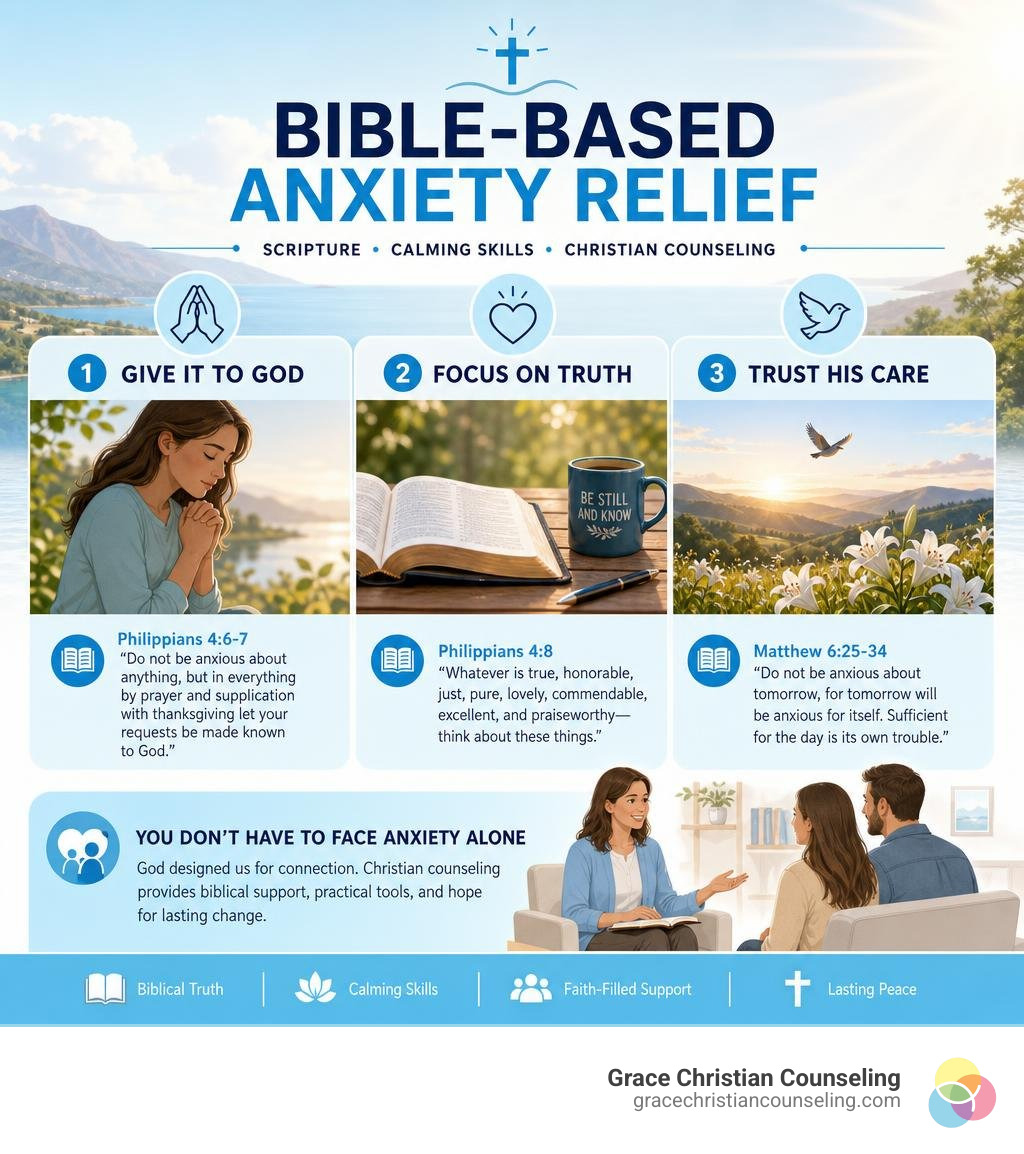
“Do not be anxious about anything, but in everything by prayer and supplication with thanksgiving let your requests be made known to God. And the peace of God, which surpasses all understanding, will guard your hearts and your minds in Christ Jesus.”
This passage outlines a practical, three-step mental exchange:
- Identify and Stop: Acknowledge the anxious thought without shame.
- Present with Thanksgiving: Bring the specific worry to God, but pair it with thanksgiving. Thanking God for past faithfulness, even when the present feels chaotic, shifts our perspective.
- Protect Your Mind: Direct your attention toward what is true. Paul follows this in verse 8 by encouraging believers to think about what is true, honorable, just, pure, lovely, commendable, excellent, and praiseworthy… intentionally returning the focus to what is true.
Matthew 6:25-34: The Sermon on the Mount
In His Sermon on the Mount, Jesus provides a brilliant antidote to worry, using nature as His teaching tool. He points to the birds of the air and the lilies of the field, noting that they do not store up food or spin thread, yet their heavenly Father feeds and clothes them beautifully.
Mathematically speaking, a person who lives to be 75 years old will spend approximately 657,000 hours on this earth. Not a single one of those hours can be added or improved by worrying. When we worry, we may begin to feel as if everything depends on our own strength and wisdom. Instead of shaming us, Jesus gently calls us back to the present moment, reminding us that our heavenly Father knows exactly what we need today.
The Role of Prayer, Thanksgiving, and God’s Character
When anxiety strikes, our natural survival instincts often trigger a physiological cascade. This is known as our “fight-or-flight” response, which increases our heart rate and floods our bodies with stress hormones. To explore this physical connection further, you can read our articles on Understanding Fight or Flight Response and the Fight or Flight Stress Response Explained.
Because anxiety has a powerful physical component, our spiritual practices should engage both our minds and our bodies.
The Power of Thanksgiving
Thanksgiving is not about denying fear or pretending anxiety is easy to overcome. Scripture invites us to bring our honest concerns to God while also remembering His faithfulness. When prayer becomes only a rehearsal of everything that might go wrong, our bodies and minds can remain stuck in a state of alarm. But when we pair prayer with intentional thanksgiving, our focus can begin to shift from the size of our problems to the steady care and presence of God.
Philippians 4:6-7 connects prayer with thanksgiving for this very reason. Gratitude does not minimize pain or pretend anxiety has disappeared. Instead, it creates space to notice what is still good, true, and steady, even in a difficult season.
Even on the night He was betrayed, Jesus took time to give thanks before breaking bread. If Jesus could practice gratitude on the eve of His crucifixion, we can practice finding small, daily blessings to thank God for, even in our darkest seasons.
Breath Prayers and Scriptural Meditation
When clinical anxiety makes long, structured prayers feel impossible, simple spiritual disciplines can help steady your nervous system. Many believers find comfort in “breath prayers.” This practice involves inhaling slowly while focusing on a comforting truth, then exhaling while releasing a worry.
- Inhale: “The Lord is my shepherd…” (Psalm 23:1)
- Exhale: “…I shall not want.”
- Inhale: “When I am afraid…” (Psalm 56:3)
- Exhale: “…I will trust in You.”
Singing or listening to worship music also has a documented physiological benefit, stimulating the vagus nerve to help calm a pounding heart and slow rapid breathing. Singing or listening to worship music can also be a meaningful way to slow down, focus attention on God, and find comfort during anxious moments. Research on singing has found potential benefits for anxiety and well-being. For Christians, worship can be both a spiritual practice and a comforting part of caring for themselves during stressful seasons. This integration of physical care and spiritual focus is a beautiful way to experience Bible focused anxiety relief.
How to Fight Anxiety: Daily Habits and Spiritual Disciplines
Sustained relief from chronic anxiety requires building healthy daily habits that protect your mental, physical, and spiritual well-being. Here are five practical, evidence-based habits rooted in Scripture that you can begin practicing today:
| Daily Habit | Biblical Foundation | Practical Step |
|---|---|---|
| Scripture Meditation | Joshua 1:9, Psalm 119:11 | Memorize a verse like Isaiah 41:10. Write it on a note card and place it where you will see it daily. |
| The 5-Minute Worry Cast | 1 Peter 5:7 | Set a timer for five minutes each morning. Write down every worry on a piece of paper, pray over them, and physically throw the paper away or close the journal, visualizing handing them to Jesus. |
| Physical Self-Care | 1 Corinthians 6:19-20 | Prioritize eight hours of sleep, simple nutrition, and daily movement. God provided physical rest to Elijah before addressing his spiritual distress. |
| Christian Community | Hebrews 10:24-25 | Join a local Bible study, small group, or reach out to a trusted Christian friend. Sharing your burdens reduces isolation. |
| Watchfulness | Colossians 4:2, 1 Peter 1:13 | Practice active spiritual attentiveness. When an anxious thought arises, evaluate it against God’s truth rather than passively letting it run wild. |
For a comprehensive collection of comforting passages, explore our list of Bible Verses for Mental Health.
Integrating Faith and Therapy: When to Seek Professional Support
A common misconception in some Christian circles is that seeking professional therapy or using medication is a sign of weak faith. However, this perspective overlooks how God created the human body and mind.
Anxiety is not merely a spiritual issue. It can involve real physical responses, such as a pounding heart, muscle tension, racing thoughts, fatigue, irritability, concentration difficulties, physical aches, or hidden impairment that others may not easily see. Because symptoms can have emotional, spiritual, relational, and physical dimensions, a thorough clinical assessment can be an important step toward understanding what is happening and choosing the right kind of support.
Just as we would not tell a diabetic Christian to simply have more faith instead of taking insulin, we should not shame a believer who benefits from professional mental health treatment or prescribed medication. Faithful care can include prayer, Scripture, wise Christian community, evidence-based counseling, and medical support when appropriate.
At Grace Christian Counseling, we believe that faith-based strategies combined with clinical techniques treat the whole person. Our licensed counselors, including clinicians with credentials such as LAPC and LSW, provide Christ-centered care for individuals, couples, teens, and families across Western Pennsylvania and online. We often utilize evidence-based approaches, such as Cognitive Behavioral Therapy (CBT), Acceptance and Commitment Therapy (ACT), and trauma-informed care, which can beautifully parallel biblical principles:
- Cognitive Defusion: In ACT, cognitive defusion helps people notice thoughts as thoughts rather than automatically treating every thought as a fact or command. Christian clients may find that this skill complements their practice of examining thoughts in light of Scripture, including the principle of taking thoughts captive in 2 Corinthians 10:5.
- Acceptance and Surrender: Rather than wasting energy fighting the physical sensation of anxiety, we can accept our current feelings, surrender our need for control to God, and commit to taking small steps forward in faith.
If you are looking for professional, Christ-centered support in your area, we invite you to explore Overcoming Anxiety Through Christian Counseling or discover How to Access Christ-Centered Anxiety Help Across Western PA. We also provide localized resources, such as our dedicated page on Uniontown Anxiety Relief Rooted in the Word, as well as Christian Support for Depression and Anxiety across our Pennsylvania locations.
For general mental health resources, you can also visit NuWellonline.com.
Take the Next Step Toward Peace with God
Anxiety can feel like a relentless storm, but you do not have to navigate it alone or in your own strength. God’s desire for you is not a life of paralyzing worry, but a life anchored in His perfect peace. By anchoring your heart in Scripture, practicing daily habits of surrender, and reaching out for professional support when needed, you can begin to experience steadier hope and practical support for the calm you crave.
If you are ready to take the next step toward healing, our team of licensed Christian counselors is here to walk alongside you. Whether you prefer to meet in person in Western Pennsylvania, including Pittsburgh, North Huntingdon, Penn Hills, Uniontown, Bethel Park, Sewickley, Mt. Lebanon, and surrounding areas, or virtually from the comfort of your home, we are committed to providing compassionate, Christ-centered care.
To learn more about counseling support for anxiety, start with Overcoming Anxiety Through Christian Counseling and contact Grace Christian Counseling when you are ready to schedule a consultation.
This article was researched with AI and heavily edited by Bekah McCrorey for accuracy and relevance.
Bekah McCrorey is a counselor at Grace Christian Counseling. She holds a Master’s degree in Counseling from Dallas Theological Seminary and a Bachelor’s degree in Christian Ministry from Chesapeake Bible College and Seminary. She is a provisionally licensed counselor working under supervision toward full licensure as a Licensed Professional Counselor (LPC) in Pennsylvania.
With over 12 years of full-time ministry experience supporting individuals, families, ministry leaders, and churches nationally and internationally, Bekah brings a deep understanding of emotional and spiritual struggles. As a counselor, she uses a client-centered, trauma-informed, and evidence-based approach. She is Level 1 trained in Restoration Therapy and is passionate about helping clients navigate anxiety, depression, grief, trauma, life transitions, and relational difficulties while integrating emotional and spiritual well-being.
This guide is for educational and spiritual encouragement and is not a substitute for personalized professional counseling. If you are in crisis, please reach out for immediate help.
Christian Counseling for High-Functioning Anxiety in PA


