

What Your Body Is Doing When Stress Takes Over
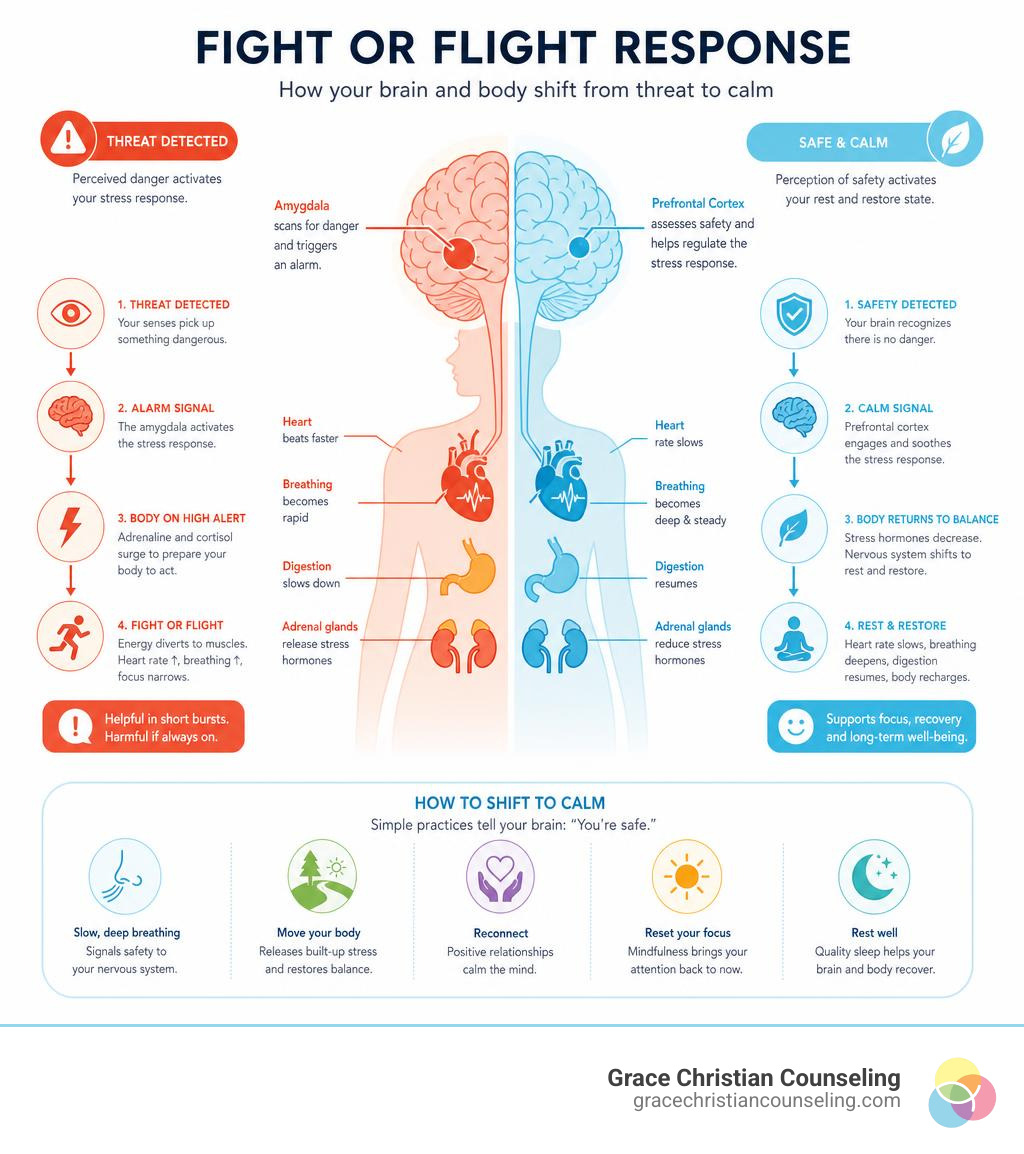
The fight or flight response stress reaction is your body’s built-in alarm system, designed to protect you from danger. When your brain senses a threat, real or not, it floods your body with hormones like adrenaline and cortisol. Your heart speeds up. Your breathing quickens. Your muscles tense. All of this happens in seconds, before you even have a chance to think.
Here is a quick summary of what the fight-or-flight stress response is and how it works:
- What it is: An automatic survival reaction triggered by your brain when it detects danger
- What starts it: The amygdala signals the hypothalamus, which activates the sympathetic nervous system and releases adrenaline and cortisol
- What you feel: Racing heart, rapid breathing, tense muscles, sweating, heightened alertness
- How long it lasts: Typically 20 to 30 minutes after the threat passes, though it can linger for hours
- When it becomes a problem: When it fires repeatedly in response to everyday stress like work, relationships, or worry, rather than actual physical danger
Physiologist Walter Cannon first described this response in the early 1900s, and it can be understood as part of God’s protective design for the body. When your brain senses danger, it quickly prepares you to protect yourself, often before you have time to think it through. That same alarm system may turn on during conflict, deadlines, public speaking, chronic worry, or trauma reminders, even when you are not in physical danger. When that alarm pattern becomes recurring and begins limiting daily life, counseling for recurring panic attacks can help West Virginia readers evaluate next steps.
For many people, especially those carrying anxiety, trauma, or chronic stress, this biological “alarm system” can feel like it never fully turns off. And that takes a real toll on the body and the mind.
This guide explains how the stress response works, what it looks like, and what you can do to find relief, including how faith-centered support can play a meaningful role in healing.
What Is the Fight or Flight Response Stress Reaction?
The fight-or-flight response is an acute stress reaction. In plain language, it is the body’s rapid response to a perceived threat. That threat may be physical, such as a near car accident, or psychological, such as public speaking, conflict, or a trauma reminder.
This is the alarm stage of stress. Your system is not waiting for an internal “committee meeting.” It is making a split-second call about safety.
What the fight-or-flight response actually means
The phrase “fight or flight” describes two common survival options:
- Fight is when your body prepares to confront the threat.
- Flight is when your body prepares to escape the threat.
Today, clinicians also talk about freeze and fawn, which we will cover below.
The key point is that this reaction is automatic. It starts before conscious thought catches up. Your brain’s threat detector, especially the amygdala, can send distress signals before you have fully evaluated what is happening. That is why people can jump back from an oncoming car before they have “thought it through.”
Sometimes the alarm fits the situation. Sometimes it is a false alarm. Anxiety disorders, trauma, and chronic stress can make the body respond to ordinary situations as if they are emergencies.
Why fight or flight response stress still happens in everyday life
It’s like our bodies are running primal survival software in a modern world full of non-lion problems, including:
- Work deadlines
- Relationship conflict
- Financial pressure
- Social rejection
- Phobias
- Chronic worry
- Traumatic memories
A spreadsheet cannot bite you, for example, but your nervous system may still respond like it can.
For a broader overview of the biology, symptoms, and everyday triggers behind this survival reaction, see What Is the Fight-or-Flight Response?.
How the Body Creates the Fight or Flight Response Stress Pattern
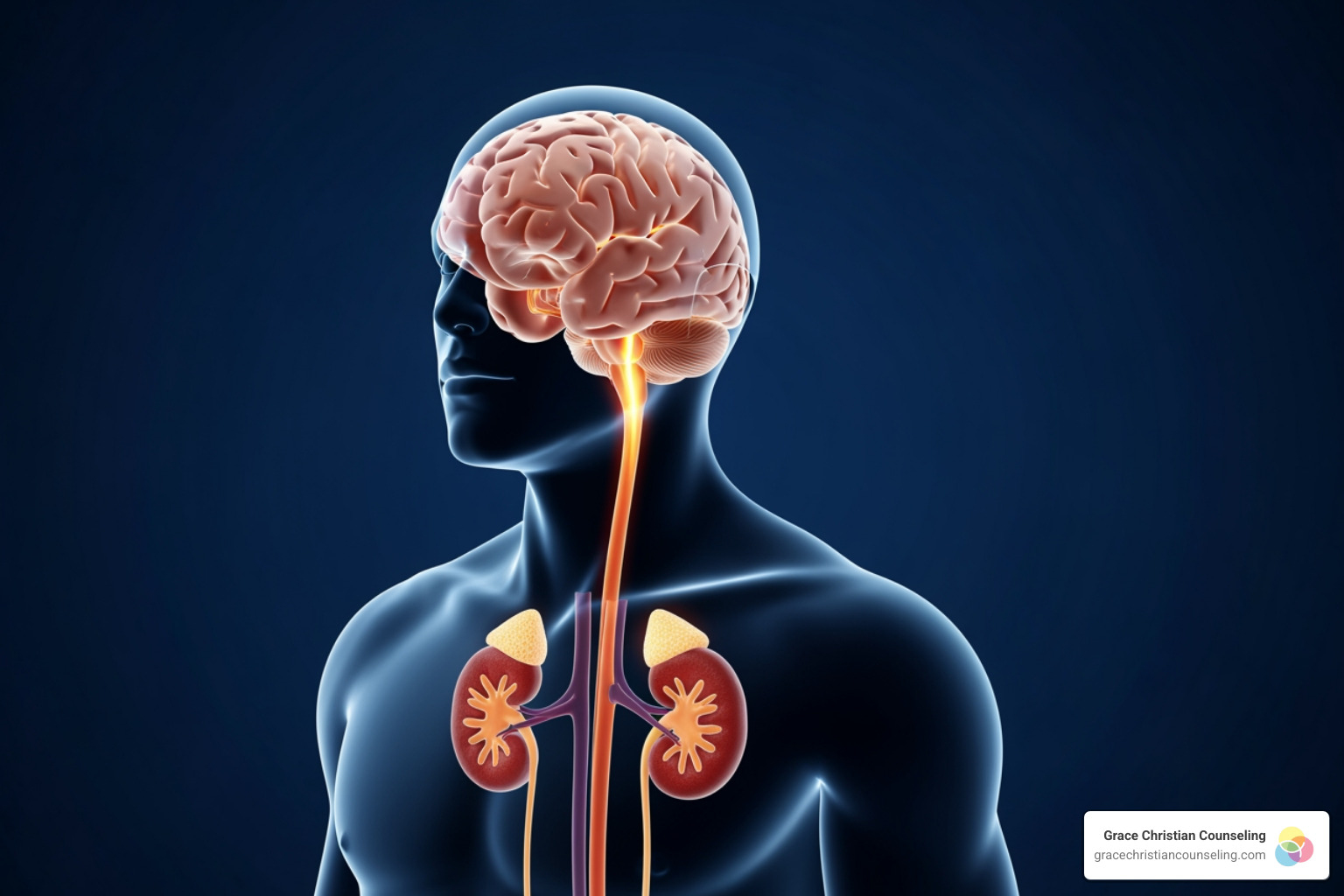
The stress response is mainly driven by the autonomic nervous system and two linked pathways: the fast sympathetic response and the slower HPA axis response.
You can read more in Scientific research on the stress response.
The fast pathway, sympathetic nervous system and adrenaline
Think of the sympathetic nervous system as the gas pedal.
When the amygdala senses danger, it signals the hypothalamus. The hypothalamus then activates the sympathetic nervous system, which tells the adrenal glands to release adrenaline, also called epinephrine, and norepinephrine.
This fast pathway is sometimes called the SAM axis, short for sympathetic-adreno-medullary system.
Adrenaline quickly causes:
- Faster heart rate
- Increased blood pressure
- Faster breathing
- Opening of the small airways in the lungs
- Dilated pupils
- Increased blood flow to muscles
- Reduced blood flow to the skin and digestive tract
That is why you may feel shaky, wide-eyed, sweaty, or become pale.
The slower pathway, HPA axis and cortisol
If the brain still thinks the threat continues, it activates a second system: the HPA axis. HPA stands for hypothalamus, pituitary gland, and adrenal glands.
The hypothalamus releases CRH, the pituitary releases ACTH, and the adrenal glands release cortisol. Cortisol helps the body stay ready by:
- Increasing glucose availability for energy
- Keeping the body on alert
- Affecting appetite
- Encouraging storage of unused nutrients as fat when stress is prolonged
This slower pathway is useful short term, but prolonged cortisol exposure is one reason chronic stress affects mood, sleep, weight, immunity, and overall health.
What happens in the body during a stress surge
During a stress surge, you may notice:
- Rapid breathing
- Racing heart
- Sweating
- Trembling
- Tight jaw or muscles
- Butterflies or nausea
- Dry mouth
- Pale or flushed skin
- Slower digestion
- Sudden urge to run, argue, hide, or please
- Reduced pain awareness in the moment
- Memory changes, either vivid recall or blanks
The body may stay activated for minutes to hours after the threat ends. Typically, it takes about 20 to 30 minutes to begin returning to a calmer baseline.
The 4 Main Stress Responses, Fight, Flight, Freeze, and Fawn
The old phrase “fight or flight” is helpful, but incomplete. Many people also experience freeze or fawn.
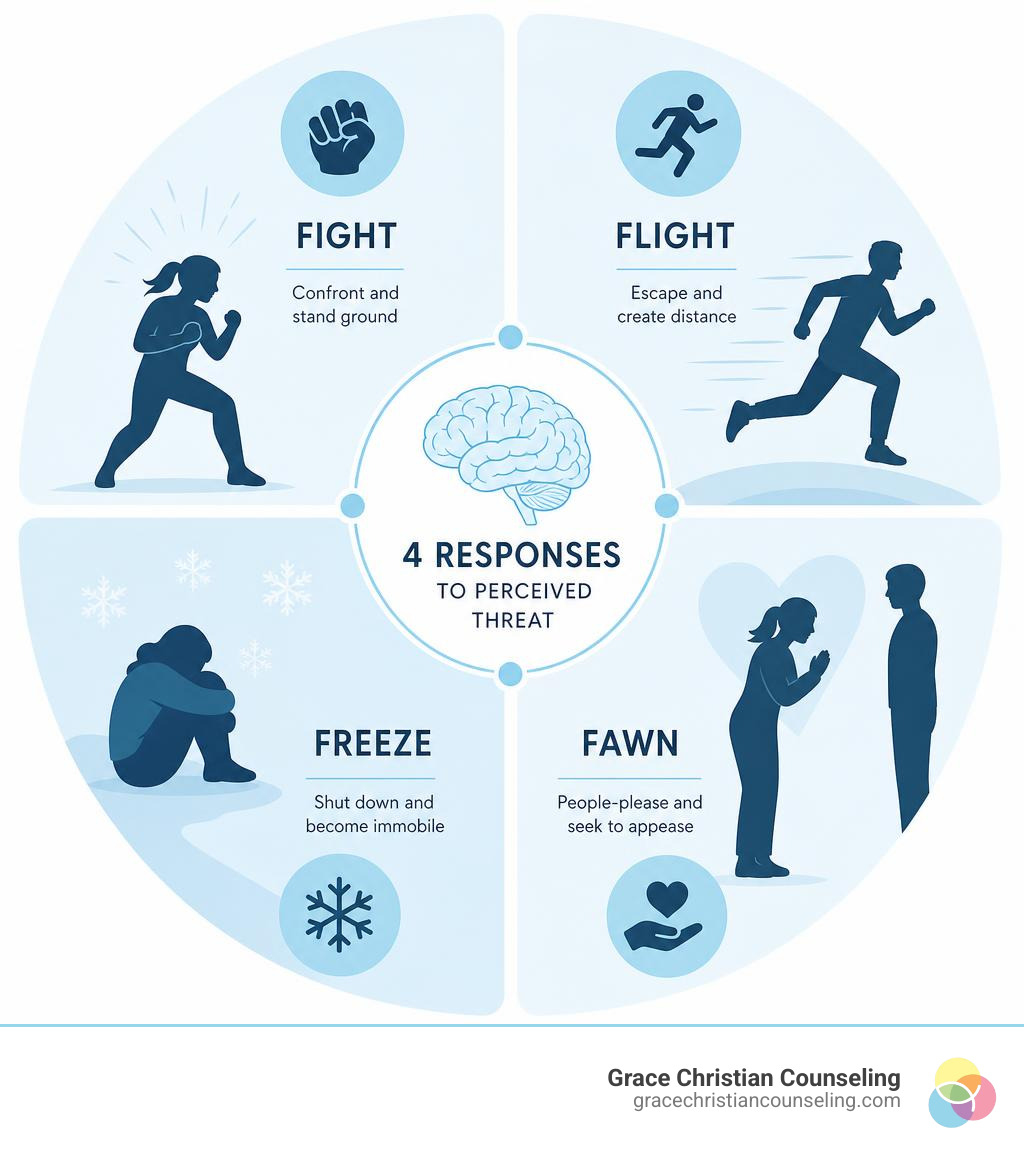
| Stress response | Common pattern | Physical signs | Psychological signs |
|---|---|---|---|
| Fight | Confront, control, push back | clenched jaw, tension, heat, adrenaline surge | anger, irritability, defensiveness |
| Flight | Escape, avoid, overwork | restlessness, rapid breathing, pacing | panic, worry, avoidance, perfectionism |
| Freeze | Shut down, go still | numbness, heaviness, immobility | blank mind, dissociation, stuck feeling |
| Fawn | Appease to stay safe | tense smile, collapse of boundaries | people pleasing, over-apologizing, fear of conflict |
Fight response signs and examples
The fight response tries to defeat or overpower a threat.
It can look like:
- Anger
- Snapping
- Arguing
- Aggression
- Controlling behavior
- Clenched fists or jaw
- Feeling “ready to explode”
Sometimes fight is obvious. Sometimes it hides under irritability, sarcasm, or being unusually reactive.
If anger is becoming hard to manage, our resources on Healing from Anger and Aggression and Anger Management Counseling may help.
Flight response signs and examples
The flight response tries to create safety through escape.
It can show up as:
- Leaving the room
- Avoiding people or tasks
- Panic
- Restlessness
- Doom scrolling
- Overworking
- Overplanning
- Perfectionism
- Staying busy so you do not have to feel
In modern life, flight is often less about literal running and more about emotional or mental escape.
For anxiety-related patterns, see Overcoming Anxiety and Fear.
Freeze and fawn response signs and examples
Freeze happens when neither fighting nor fleeing feels possible. The body becomes still or shut down.
Common freeze signs include:
- Numbness
- Spacing out
- Inability to speak
- Feeling disconnected from your body
- Feeling trapped
- Tonic immobility in severe fear
Fawn is a trauma-linked response in which a person tries to stay safe by appeasing the threat.
Common fawn signs include:
- People pleasing
- Over-apologizing
- Difficulty saying no
- Smoothing over conflict at any cost
- Ignoring your own needs
- Feeling responsible for everyone else’s emotions
Fawn is often associated with histories of childhood abuse, controlling family systems, or repeated relational trauma. It is not weakness. It is a learned survival strategy.
For more on these patterns, visit Understanding Fight or Flight Response.
When the Stress Response Helps, and When It Becomes Harmful
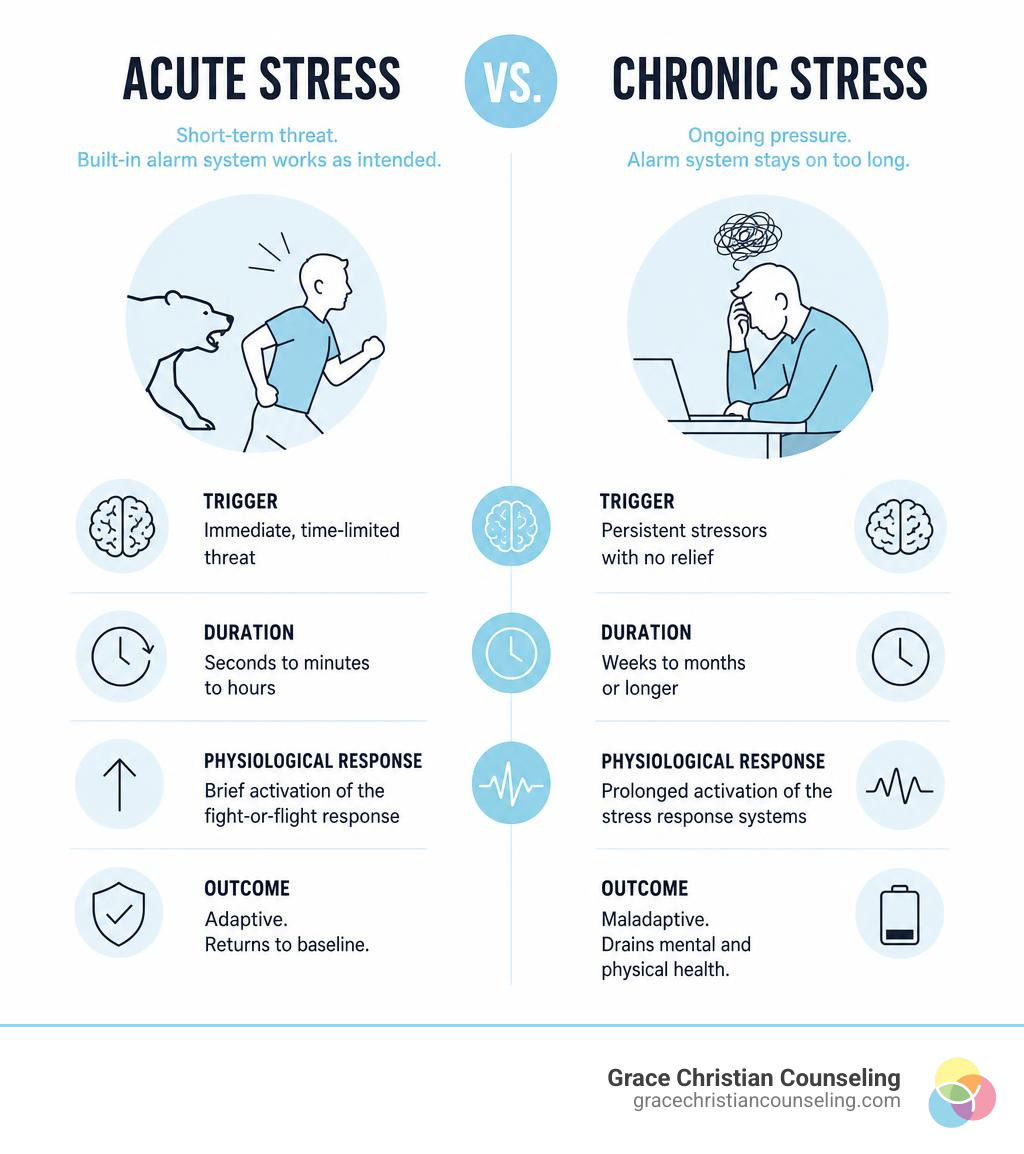
The stress response is not the enemy. Chronic activation is.
Why the stress response is adaptive in the short term
In the short term, this system is brilliant.
It can help you:
- React quickly
- Focus attention
- Access extra energy
- Protect yourself or others
- Perform under pressure
This is why some stress can even be positive. That is called eustress, a helpful type of stress that can sharpen performance and motivation. Distress, by contrast, is stress that overwhelms or harms us.
It also helps to distinguish:
- Acute stress, short-term activation in response to an immediate challenge
- Chronic stress, ongoing activation over time
- Eustress, positive, manageable stress
- Distress, negative, draining stress
What chronic fight-or-flight does to your health
When the stress response keeps firing over and over, the body pays a price.
Research summarized in major medical sources shows that chronic stress can contribute to:
- High blood pressure
- Artery-clogging changes
- Greater risk of heart attack and stroke
- Metabolic problems, including diabetes and obesity
- Immune suppression
- Gastrointestinal problems
- Headaches
- Breathing problems
- Chronic fatigue
- Anxiety and depression
- Brain changes linked to mood problems and addiction
Coronary artery disease, stroke, and hypertension occur more often in people with stress-related psychological disorders. Chronic cortisol elevation can also increase appetite and fat storage.
A randomized clinical trial of 122 older adults with hypertension found that, after eight weeks of relaxation response training, more than half of participants in that group lowered systolic blood pressure by more than 5 mm Hg.
Differences in stress responses by age, gender, and background
Stress responses are universal, but they are not identical. They can vary based on:
- Age
- Developmental stage
- Gender socialization
- Family culture
- Trauma history
- Sense of safety
- Learned coping patterns
For example:
- Children may show stress through clinginess, irritability, stomachaches, or shutting down
- Teens may show it through mood swings, avoidance, perfectionism, or anger
- Adults may look “functional” on the outside while living in constant internal overdrive
- Men are often socialized to hide vulnerability, so stress may show up more as irritability or numbness
- Women may be socially conditioned toward appeasing or over-functioning, though this varies widely
- Trauma survivors may react faster and more because their nervous systems have learned to scan for danger
Background matters. So does grace. We never want to label a response without understanding the story behind it.
How to Recognize and Calm Your Fight or Flight Response
Recognizing the pattern is often the first step toward changing it.
Signs you may be in fight or flight mode
You may be in fight-or-flight mode if you notice:
- Racing heart
- Shallow or fast breathing
- Chest tightness
- Dizziness
- Nausea
- Sweating
- Trembling
- Hypervigilance
- Irritability
- Feeling like something bad is about to happen
- Trouble sleeping
- Urge to escape or lash out
It helps to track your personal early warning signs. For some people it is jaw tension. For others it is stomach upset, overthinking, or suddenly becoming very “helpful” to keep the peace.
Techniques that calm the nervous system in the moment
The goal is not to shame your body. It is to send it cues of safety.
Helpful tools include:
-
Paced breathing
- Inhale gently through your nose
- Exhale a little longer than you inhale
- Longer exhales help engage the parasympathetic nervous system, the body’s brake pedal
-
Grounding with the five senses
- Name 5 things you see
- 4 things you feel
- 3 things you hear
- 2 things you smell
- 1 thing you taste
-
Cold water or cool stimulation
- Splash cool water on your face
- Hold a cool object
- This can help interrupt spiraling
-
Muscle release
- Tense and relax muscle groups
- Unclench your jaw
- Drop your shoulders
-
Movement
- Take a brisk walk
- Stretch
- Let the body complete some of the energy cycle
-
Reassuring self-talk
- “I am safe right now”
- “My body is alarmed, but I am not in immediate danger”
-
Safe place imagery
- Picture a place where you feel secure and settled
These strategies align with guidance from Scientific research on calming the fight-or-flight response.
Long-term ways to lower your stress baseline
Short-term tools matter, but long-term regulation matters too.
Helpful habits include:
- Consistent sleep
- Regular exercise
- Healthy routines
- Clear boundaries
- Journaling
- Supportive relationships
- Time outside
- Less caffeine if you are highly reactive
- Therapy for anxiety or trauma
- Prayer and Scripture meditation
As Christians, we also remember that peace is not just a technique, but a gift we learn to receive and practice. Philippians 4:6 to 7 reminds us to bring our anxieties to God in prayer and to receive His peace, which guards heart and mind.
For faith-based support, see How to Deal with Anxiety as a Christian.
Trauma, Anxiety Disorders, and Why Some People Get Stuck in Survival Mode
For some people, the stress response resets fairly well. For others, it gets sticky.
How trauma changes stress responses
Trauma can make the amygdala more sensitive and the nervous system more reactive. A harmless cue, a tone of voice, a smell, a location, can trigger the body as though the past is happening again.
This can lead to:
- Hypervigilance
- Trigger stacking
- Body memories
- Rapid fight or flight
- Freeze or shutdown
- Fawn responses in relationships
- Narrower “window of tolerance”
The window of tolerance is the zone where we can stay present without becoming overwhelmed or shut down. Trauma often shrinks that window.
Anxiety and panic versus true danger
Anxiety and panic can feel life-threatening, even when they are not.
Common panic symptoms include:
- Racing heart
- Dizziness
- Chest discomfort
- Shortness of breath
- Fear of dying
- Fear of losing control
- Feeling unreal or detached
One reason panic becomes so frightening is that people often misread the body’s alarm signals as proof that something catastrophic is happening. A racing heart gets interpreted as a heart attack. Dizziness gets interpreted as passing out or “going crazy.” That interpretation can intensify the cycle.
This does not mean symptoms are imaginary. They are very real. It means the body is sounding an alarm that may not match the actual level of danger.
When to seek support for persistent stress symptoms
Please seek support if stress symptoms are:
- Interfering with daily life
- Hurting your relationships
- Causing burnout
- Triggering intrusive memories
- Leading to avoidance
- Contributing to depression
- Affecting sleep, appetite, or work
- Leaving you stuck in fear or shutdown
Readers working in clinical settings may also consider online support for West Virginia nurses when recurring stress begins affecting sleep, relationships, or life away from work.
Pennsylvania veterans who recognize these patterns can also explore support for veterans adjusting after service, including faith, relationship, and transition concerns.
Medical evaluation is also important when symptoms could reflect a physical condition.
If you need more support, visit Anxiety Depression Counseling or Christian Support for Depression and Anxiety.
Frequently Asked Questions about Fight or Flight Response Stress
How long does the fight-or-flight response last?
The initial surge happens within seconds. After the threat passes, many people begin calming within 20 to 30 minutes, but the effects can last longer, sometimes minutes to hours, depending on the intensity of the trigger and how quickly the parasympathetic nervous system helps the body recover.
Is anxiety the same as the fight-or-flight response?
Not exactly. Anxiety often involves ongoing anticipation of danger, while the fight-or-flight response is the body’s immediate alarm reaction. But they overlap a lot. Anxiety can repeatedly trigger the same stress hormones and physical symptoms, even without an actual emergency.
Can prayer and counseling help calm chronic stress?
Yes. Prayer can support calm, perspective, surrender, and hope. Counseling can help you identify triggers, learn coping skills, process trauma, challenge false alarms, and regulate your nervous system. Together, faith and evidence-based care can be a powerful combination.
If you want an additional broad overview, here’s another deep-dive resource that may help: What Happens During Fight-or-Flight Response?
Moving From Survival Mode to Calm
The fight-or-flight response is a God-designed survival system, but in a fallen and stressful world, it can begin firing too often and too strongly. When that happens, you may feel exhausted, anxious, irritable, numb, or stuck in patterns that no longer serve you.
The good news is that healing is possible. With insight, practical tools, supportive relationships, prayer, and trauma-informed counseling, your body can learn safety again.
At Grace Christian Counseling, we offer Christ-centered, evidence-based counseling for individuals and families across Western Pennsylvania and through online counseling in Pennsylvania. Our licensed counselors help people work through anxiety, trauma, chronic stress, anger, and relationship struggles with both clinical wisdom and biblical hope.
When you are ready, you can connect with us and take a simple next step toward healing. We will help you find the right counselor, with care that is rooted in faith and grounded in clinical excellence.
This guide is for educational and spiritual encouragement and is not a substitute for personalized professional counseling. If you are in crisis, please reach out for immediate help.
Letting Go Of Past Traumas
How to Help a Teenager with Anxiety: A Parent’s Guide
