

When Your Soul Needs Healing: What the Bible Says
The most searched bible verses for spiritual healing are listed below, so you can find comfort quickly:
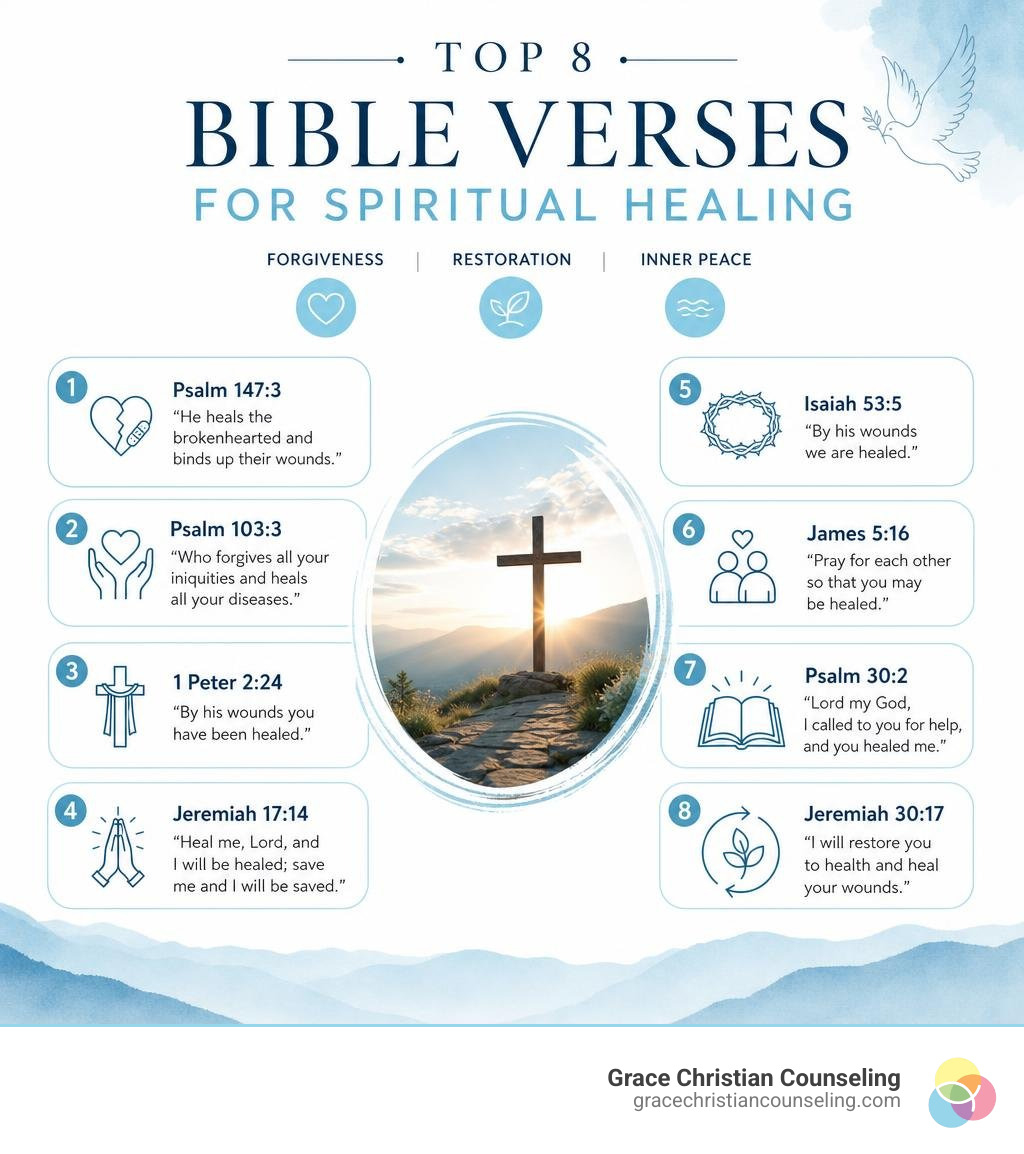
- Psalm 147:3; “He heals the brokenhearted and binds up their wounds.”
- Psalm 103:3; “Who forgives all your iniquities and heals all your diseases.”
- 1/1 Peter 2:24; “By his wounds you have been healed.”
- Jeremiah 17:14; “Heal me, Lord, and I will be healed; save me and I will be saved.”
- Isaiah 53:5; “By his wounds we are healed.”
- James 5:16; “Pray for each other so that you may be healed.”
- Psalm 30:2; “Lord my God, I called to you for help, and you healed me.”
- Jeremiah 30:17; “I will restore you to health and heal your wounds.”
There are moments when the pain goes deeper than the body. Grief, anxiety, trauma, broken relationships, and spiritual emptiness can leave wounds that no prescription can fully reach. That is when many believers turn to Scripture, not as a last resort, but as a first source of truth and comfort.
The Bible speaks often about healing, restoration, comfort, forgiveness, and God’s presence in suffering. These scriptures have encouraged believers for centuries, and they remain meaningful for families in Western Pennsylvania and beyond who are walking through grief, anxiety, trauma, broken relationships, and other difficult seasons.
At Grace Christian Counseling, we see this every day. People come in carrying wounds they cannot quite name, looking for something that addresses the soul, not just the symptoms. Scripture is central to that process, but so is the work of licensed counselors who understand how faith and clinical care work together.
Faith can also be meaningfully incorporated into professional mental health care when it is important to the client. A meta-analysis of 97 studies involving 7,181 participants found that psychotherapy tailored to clients’ religious or spiritual beliefs was effective for psychological and spiritual outcomes. The findings also suggest that spiritually integrated care should respond to each client’s individual beliefs and needs rather than assuming faith affects everyone in the same way. You can review the research through the Journal of Clinical Psychology
This article walks through the most powerful Bible verses for spiritual healing, explains what they mean, and shows you how to apply them in real life.
Understanding Spiritual Healing vs. Physical Healing in Scripture
We often divide our health into neat, isolated compartments. We see a doctor for the body, a therapist for the mind, and a pastor for the soul. However, the biblical perspective of humanity is far more integrated. Scripture views us as a unified whole; made of body, soul, and spirit.
When we talk about bible verses for spiritual healing, we are looking beyond physical recovery to the ways Scripture speaks about forgiveness, restoration, hope, peace, and our relationship with God. Emotional healing may be part of that journey, but spiritual and emotional health are not exactly the same thing. Someone can have a strong faith and still experience anxiety, depression, grief, trauma symptoms, or other mental health concerns that deserve compassionate professional care.
It is entirely possible to have a perfectly healthy physical body while being deeply broken on the inside. Conversely, we can experience profound spiritual peace and emotional health even when facing physical illness. This is because emotional health and spiritual health are intimately connected. As we explore in our guide on Healing the Heart through Christian Counseling, when our spirit is restored, it brings a sense of deep peace that aligns our entire being.
In our clinical practice at Grace Christian Counseling, we utilize a structured approach called the Counseling Blueprint to help clients navigate this journey. This blueprint consists of four stages:
- Take Off the Mask: Building genuine rapport and trust where you can honestly admit where it hurts.
- Heal the Wounds: Exploring emotional and relational hurts under the guidance of the Holy Spirit.
- Remove the Toxins: Identifying unhelpful beliefs, relational patterns, and lingering lies.
- Replace with Truth: Installing empowering, accurate perspectives about yourself, others, and the world based on God’s Word.
Through this process, we see that spiritual healing is not about pretending everything is fine. It is about bringing our deep, hidden wounds into the light of Christ to receive His restoration.
Foundational Bible Verses for Spiritual Healing and Inner Peace
Throughout the Old and New Testaments, God reveals Himself as a healer. Whether you are dealing with anxiety, depression, trauma, or spiritual burnout, anchoring your mind on scripture is a powerful way to quiet the noise of the world.
Scripture offers many passages about God’s healing and restorative work. Psalm 147:3 describes God as healing the brokenhearted and binding their wounds, while Psalm 30:2 records David calling to God for help and experiencing His healing.
For those looking for a broader list of scriptures to study, you can explore external resources like 50+ Bible Verses for Healing; Powerful Scripture Quotes , 10 Key Bible Verses on Healing | Crossway , and 25 Bible Verses About Healing to Bring You Hope; Compassion . Additionally, we have compiled a list of 10 Healing Scriptures for Mental Health Recovery to help you focus specifically on mental and emotional restoration.
To help you understand how God’s healing message flows through the entire Bible, here is a quick comparison of Old and New Testament healing themes:
| Old Testament Healing Themes | New Testament Healing Themes |
|---|---|
| Focuses on God’s covenant name (Jehovah Rapha: The Lord Who Heals) | Focuses on the finished work of Jesus Christ on the cross |
| Often connects physical health with obedience and spiritual alignment | Demonstrates grace-filled healing available to all through faith |
| Emphasizes restoration of the community, land, and temple | Emphasizes personal restoration, the indwelling Holy Spirit, and the church |
| Looks forward to the suffering servant who carries our pains | Celebrates the fulfillment of prophecy and the victory over sin and death |
Old Testament Promises: Bible Verses for Spiritual Healing and Restoration
The Old Testament is rich with promises of God’s restorative power. In these scriptures, we see a God who does not stand distant from our pain, but actively moves toward us to bind up our wounds.
- Psalm 103:3; “Who forgives all your iniquities and heals all your diseases.” This verse is a beautiful declaration of God’s comprehensive redemption. It addresses both the root of our spiritual brokenness (sin) and the symptoms of our earthly decay (disease). You can read more translations of this comforting verse at Psalm 103:3 and study its theological depth here: Psalm 103:3 He who forgives all your iniquities and heals all your diseases.
- Jeremiah 17:14; “Heal me, Lord, and I will be healed; save me and I will be saved, for you are the one I praise.” This is a raw, personal cry for help. It acknowledges that true, lasting spiritual healing can only come from God Himself.
- Isaiah 53:5; “But he was pierced for our transgressions, he was crushed for our iniquities; the punishment that brought us peace was on him, and by his wounds we are healed.” This prophetic verse points directly to Jesus. It reminds us that our inner peace and spiritual restoration were paid for at a great cost.
- Psalm 34:17-18; “The righteous cry out, and the Lord hears them; he delivers them from all their troubles. The Lord is close to the brokenhearted and saves those who are crushed in spirit.” If you feel crushed by life’s circumstances, this verse promises that God’s presence is closest to you right now.
- Psalm 23:1-4; “The Lord is my shepherd, I lack nothing… He restores my soul.” In the midst of the darkest valleys of anxiety or grief, the Good Shepherd is actively working to restore your inner being.
New Testament Grace: Bible Verses for Spiritual Healing and Deliverance
In the New Testament, we see the physical manifestation of God’s healing love in the person of Jesus Christ. Jesus’ ministry was defined by healing, not just opening blind eyes, but restoring outcast souls to community and faith.
- Matthew 10:8; “Heal the sick, raise the dead, cleanse those who have leprosy, drive out demons. Freely you have received; freely give.” Jesus commissioned His disciples to carry His healing ministry into the world. You can view this commission in context at Matthew 10:8; Bible Gateway or find commentaries at Matthew 10:8; Heal the sick, raise the dead, cleanse those who h… | Bible Study Tools .
- James 5:14-15; “Is anyone among you sick? Let them call the elders of the church to pray over them and anoint them with oil in the name of the Lord. And the prayer offered in faith will make the sick person well; the Lord will raise them up.” This passage shows the practical, communal nature of healing in the early church. You can read the passage in various translations at James 5:15; Bible Gateway .
- 1 Peter 2:24; “He himself bore our sins in his body on the cross, so that we might die to sins and live for righteousness; by his wounds you have been healed.” Peter looks back at Isaiah’s prophecy and confirms that through Christ’s sacrifice, our spiritual restoration is already accomplished.
- Romans 8:26; “In the same way, the Spirit helps us in our weakness. We do not know what we ought to pray for, but the Spirit himself intercedes for us through wordless groans.” When the pain is too deep for words, the Holy Spirit prays on our behalf.
- John 10:10; “The thief comes only to steal and kill and destroy; I have come that they may have life, and have it to the full.” Spiritual healing leads to the abundant life Jesus promised; one marked by inner peace, joy, and purpose.
The Connection Between Forgiveness, Sin, and Inner Restoration
One of the most vital,, aspects of spiritual healing is the connection between forgiveness, sin, and inner peace. In the biblical context, sin is not just a list of bad behaviors; it is a state of relational brokenness with God and others. When we carry unconfessed sin, bitterness, or resentment, it acts like a spiritual toxin in our souls.
James 5:16 tells us, “Therefore confess your sins to each other and pray for each other so that you may be healed.” Notice that healing is directly linked to confession and community. When we keep our struggles hidden, they grow in the dark. Confession brings them into the light where healing can begin.
Similarly, refusing to forgive others can block our own emotional recovery. Holding onto a grudge is like drinking poison and waiting for the other person to get sick. It keeps us bound to the trauma of our past.

In our Counseling Blueprint, this is where we focus on Removing the Toxins and Replacing with Truth. We work with clients to identify lingering lies, such as “I am beyond forgiveness” or “I have to protect myself by holding onto this anger”, and replace them with God’s truth. Forgiveness is not about condoning what was done to you; it is about releasing that person to God so that you can walk in freedom. For a deeper look at this process, see our article on Healing the Heart with the Word.
How to Apply Bible Verses for Spiritual Healing in Daily Life
Knowing bible verses for spiritual healing can be a meaningful starting point, and Scripture is meant to shape how we live, not simply give us words to memorize. Prayer, reflection, and time in God’s Word can help Christians bring fear, grief, confusion, and other struggles honestly before Him while remembering His character and promises.
If you are a parent in Western Pennsylvania helping your teen navigate identity struggles, or if you are personally dealing with anxiety, depression, or trauma, here are some practical ways our licensed counselors (such as our Licensed Associate Professional Counselors, LAPCs, or Licensed Social Workers, LSWs) recommend integrating scripture into your mental health journey:
- Daily Declarations: Speak God’s Word out loud over your life. Instead of letting anxious thoughts run wild, interrupt them with truth. For example, if you feel overwhelmed, declare: “The Lord is my shepherd; I shall not want. He restores my soul.”
- Scriptural Meditation: Take one verse, like Psalm 147:3, and quiet your mind around it. Breathe deeply, repeating the words and letting their meaning sink into your subconscious.
- Gratitude and Reflection: Write down things you are thankful for as well as thoughts or emotions you are struggling with. In counseling, cognitive behavioral strategies may also help you examine whether a thought is accurate, helpful, or shaped by patterns such as catastrophizing or excessive self-blame. For Christian clients, this process can include reflecting on Scripture without treating every difficult thought or emotion as a spiritual failure.
- Professional Integration: Combine your faith practices with professional clinical support. You can find specialized strategies in our articles on Scripture-Based Anxiety Relief: A Christian Guide and Finding Hope in Christ During Depression.
Additionally, if you are looking for evidence-based mental health resources that complement Christian counseling, organizations like NuWell offer online pastoral counseling and coaching that integrates biblical truth with whole-person support for emotional, spiritual, and relational needs.
What to Do When Spiritual Healing Feels Delayed
What happens when you pray, read your Bible, declare scriptures, and still feel broken, anxious, or depressed?
First, know that you are not alone, and a delay in healing is not a sign of weak faith or God’s abandonment. In the Bible, healing is presented as both an immediate miracle and a lifelong process. Sometimes, God uses our seasons of waiting to produce deeper spiritual maturity.
James 1:2-4 reminds us to “consider it pure joy… whenever you face trials of many kinds, because you know that the testing of your faith produces perseverance.” Apostle Paul also wrote about his “thorn in the flesh” in 2 Corinthians 12:7-9. He pleaded with God three times to take it away, but God responded, “My grace is sufficient for you, for my power is made perfect in weakness.”

Sometimes, the “healing” God does during our pain is teaching us to rely completely on Him. If you are walking through a season of deep trauma or chronic emotional distress, we encourage you to seek out Faith-Based Trauma Healing: Find Peace with God. A professional Christian counselor can walk with you through the storm, helping you process your pain without shame.
Frequently Asked Questions about Spiritual Healing
Navigating the intersection of faith and mental health can raise many questions. Here are some of the most common questions we hear from clients seeking spiritual restoration:
What is the difference between physical and spiritual healing in the Bible?
Physical healing focuses on the restoration of the biological body from sickness, injury, or disease (such as Jesus healing leprosy or a fever). Spiritual healing focuses on the restoration of the soul and spirit, reconciling our relationship with God, finding freedom from the weight of sin, and experiencing inner peace that transcends physical circumstances.
How can I use scripture to pray for emotional and spiritual restoration?
You can use scriptural prayer by turning Bible verses directly into personal prayers. For example, pray Jeremiah 17:14 by saying: “Lord, heal my broken heart, and I will be truly healed. Save me from these anxious thoughts, and I will be saved, for you are the one I praise.” Meditating on these truths daily helps align your mind with God’s peace.
What role does the local church play in supporting someone seeking healing?
The local church provides a supportive community of fellowship, prayer, and accountability. According to James 5:14-15, the church is called to pray over the sick and anoint them with oil. Through small groups, pastoral care, and corporate worship, the church helps carry your burdens so you do not have to walk through your healing journey alone.
Begin Your Healing Journey with Scripture and Support
Spiritual healing is not an overnight event; it is a gentle, transformative journey of bringing our deepest hurts to the feet of Jesus. Whether you are dealing with childhood wounds, marital conflict, or the heavy fog of depression, God’s Word remains a steady anchor for your soul.
At Grace Christian Counseling, our licensed counselors are dedicated to walking alongside families across Pennsylvania and West Virginia. We provide compassionate, evidence-based therapy integrated with biblical truth in Western PA communities, including Pittsburgh, North Huntingdon, Penn Hills, Uniontown, Bethel Park, Sewickley, Mt. Lebanon, and surrounding areas.
If you are ready to take off the mask, heal your emotional wounds, and replace the lingering lies in your life with God’s truth, we are here for you. We offer both in-person sessions at our local offices and convenient, secure online Christian counseling in PA.
Reach out to us today to schedule a session and begin your unique journey through the Counseling Blueprint toward lasting wholeness.
This article was researched with AI and heavily edited by Bekah McCrorey for accuracy and relevance.
Bekah McCrorey is a counselor at Grace Christian Counseling. She holds a Master’s degree in Counseling from Dallas Theological Seminary and a Bachelor’s degree in Christian Ministry from Chesapeake Bible College and Seminary. She is a provisionally licensed counselor working under supervision toward full licensure as a Licensed Professional Counselor (LPC) in Pennsylvania.
With over 12 years of full-time ministry experience supporting individuals, families, ministry leaders, and churches nationally and internationally, Bekah brings a deep understanding of emotional and spiritual struggles. As a counselor, she uses a client-centered, trauma-informed, and evidence-based approach. She is Level 1 trained in Restoration Therapy and is passionate about helping clients navigate anxiety, depression, grief, trauma, life transitions, and relational difficulties while integrating emotional and spiritual well-being.
This guide is for educational and spiritual encouragement and is not a substitute for personalized professional counseling. If you are in crisis, please reach out for immediate help.


