

What Is Online Christian Counseling and How Does It Differ From Secular Therapy?
Online Christian counseling is secure virtual therapy that combines evidence-based clinical care with client-led biblical faith, prayer, and spiritual support, while secular therapy generally addresses emotional and relational concerns without intentionally integrating Scripture or a Christian worldview.
If you are wondering whether talking with a counselor through a screen can really feel as meaningful or effective as sitting together in an office, that is a reasonable question. Research is encouraging. The American Psychological Association reports that teletherapy can produce outcomes comparable to in-person therapy for a range of mental health concerns.
What matters most is finding a format that helps you feel comfortable engaging honestly in the counseling process. For some people, meeting from home removes the stress of travel and makes counseling easier to fit into everyday life. For others, being physically present with a counselor may feel more supportive. Your counselor can help you determine which setting makes the most sense for your needs.
For people managing early-career schedules, moves, or changing routines, online support for Pennsylvania young adults can make consistent care easier to consider.
The role of Scripture, prayer, and the gentle guidance of the Holy Spirit are vital components of our sessions; however, we believe these faith-based elements must always be client-led. We never force or impose religious practices on anyone. Instead, we follow your lead, meeting you exactly where you are on your spiritual journey.
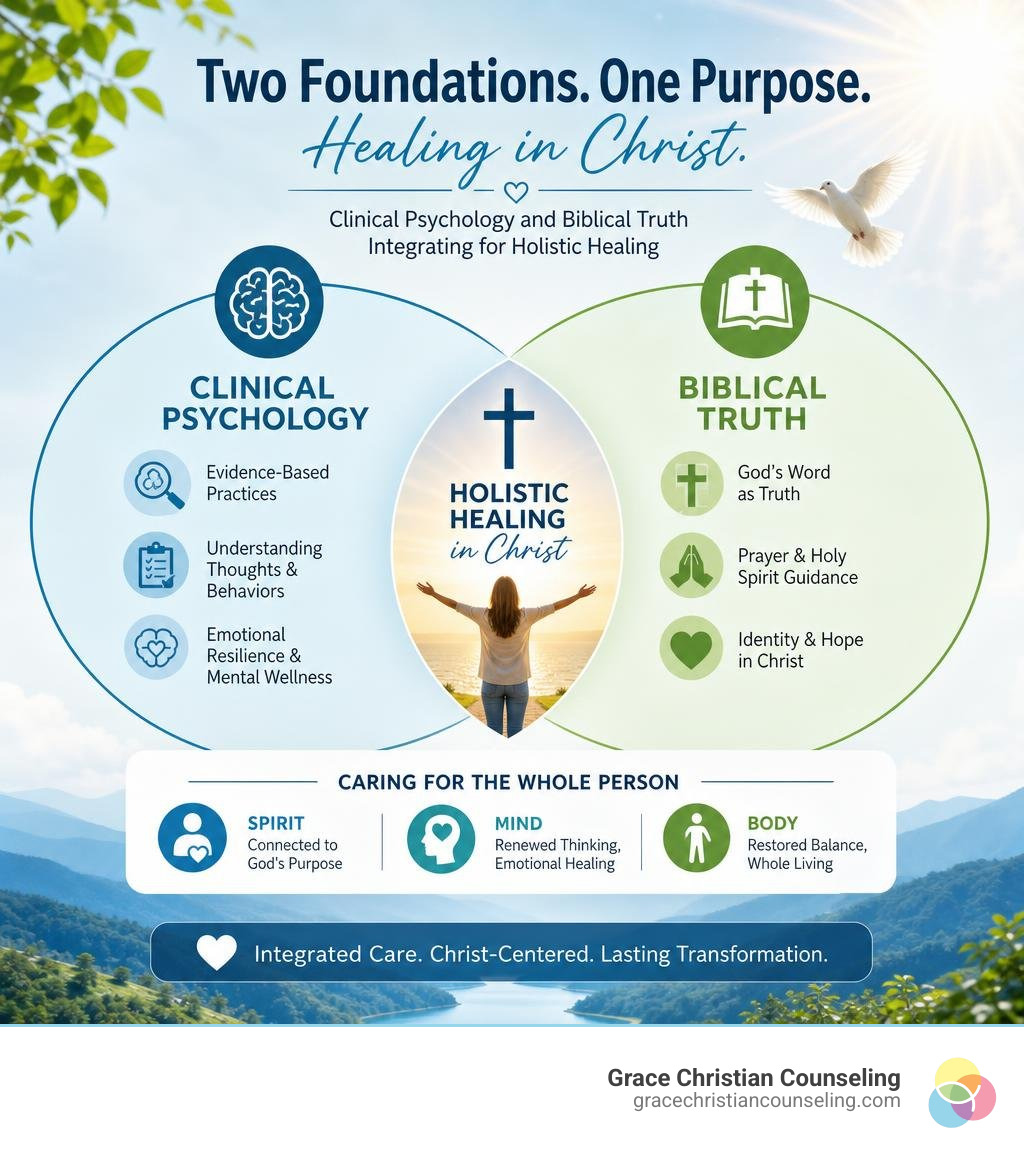
At Grace Christian Counseling, our compassionate, clinical, and biblical approach is designed to help you “take off the mask” and find genuine healing. We believe that God designed your mind, body, and spirit to work in harmony, and our virtual sessions are structured to care for all three.
Understanding the Integration of Faith and Psychology
Some people wonder if clinical psychology and Christian theology can truly work together. We believe they can, provided that Scripture remains the ultimate authority for truth. Our licensed counselors, including Licensed Associate Professional Counselors (LAPCs) and Licensed Social Workers (LSWs), are highly trained to blend rigorous, evidence-based clinical practices with sound biblical theology.
True healing is holistic; it must address the spirit, the mind, and the body. When we use clinical modalities like Cognitive Behavioral Therapy (CBT) to help you identify negative thought patterns, we are simultaneously helping you take “every thought captive,” as scripture encourages. By understanding how God designed the human brain and nervous system, we can apply clinical wisdom to emotional wounds while anchoring your ultimate hope in Christ.
If you want to explore this integration further, we encourage you to read our Online Christian Therapy Complete Guide or browse through An Essential Guide to Christian Counseling for a deeper look at our therapeutic philosophy.
Is Online Christian Counseling Really as Effective as In-Person Therapy?
A common question many clients ask is whether meeting through a screen can provide the same depth of healing as sitting in a traditional counseling office. Fortunately, extensive scientific research consistently demonstrates that online therapy is just as effective as face-to-face treatment for many common concerns, including anxiety, depression, relationship issues, and chronic stress.
In fact, academic clinical studies have shown that online treatment outcomes for major depressive disorder are entirely equivalent to traditional, in-person therapy. Furthermore, research conducted with veterans utilizing video conferencing revealed a 25% reduction in psychiatric-related hospitalizations, proving that virtual care is not only convenient but highly impactful.
There are also distinct clinical benefits to receiving therapy in a familiar, comfortable environment. Sitting on your own couch, holding your favorite mug, or sitting in your quiet bedroom can significantly reduce the physiological barriers to vulnerability, allowing you to open up and process deep emotions much more quickly.
Additionally, online counseling eases the post-session transition. Instead of immediately having to gather yourself, walk through a public waiting room, navigate elevators, and drive through stressful Western Pennsylvania traffic, you can simply close your laptop. This allows you to sit quietly in your own space, pray, and digest the insights from your session before returning to your daily routine.
At Grace Christian Counseling, we utilize a cutting-edge, highly effective approach known as Neuroscience Informed Christian Counseling® (NICC).
Why Comfort and Familiarity Accelerate Emotional Healing
When you participate in therapy from your own home, your nervous system naturally feels safer. In clinical terms, a regulated nervous system is essential for processing trauma and emotional pain. When you are in a space where you feel secure, your brain is less likely to go into a defensive “fight, flight, or freeze” response, making it easier to access and heal deep relational hurts.
This virtual format allows us to apply the clinical science of attachment and nervous system regulation directly to your life, regardless of your physical location. Whether you are seeking virtual care in Pennsylvania, West Virginia, Georgia, or Florida, online therapy bridges the geographical gap to connect you with highly specialized, faith-aligned care. For more information on how we structure these virtual sessions, explore our main page on Online Christian Counseling.
What Mental Health and Spiritual Issues Can Online Christian Counseling Address?

Many people assume that online therapy is only suitable for minor life transitions or mild stress; however, virtual Christian counseling is equipped to address a wide range of complex clinical and spiritual struggles.
- Clinical Anxiety and Depression: We use evidence-based cognitive behavioral tools to help you manage racing thoughts, panic, and heavy sadness, while grounding your daily walk in biblical hope and the peace of God.
- Trauma and Abuse: Trauma can affect much more than your memories of what happened. You may notice changes in sleep, concentration, relationships, your sense of safety, or the way your body responds to stress. Our trauma-informed counselors provide compassionate, structured support to help you understand these responses and work toward healing at a pace that respects your needs.
- Grief and Loss: When you lose a loved one, the initial wave of community support (calls, visits, and meals) often fades after a few weeks, leaving you to navigate intense loneliness. We walk with you through the long, quiet seasons of grief.
- Marriage and Family Relationships: We offer virtual couples, premarital, and family counseling to help you rebuild trust, improve communication, and restore broken dynamics.
- Teens and Young Women: We provide specialized virtual support for adolescents and young women navigating identity, self-esteem, body image, and peer pressure.
- Sexual Addiction and Pornography: We offer a compassionate, strictly confidential, and non-judgmental space to help individuals find freedom from addictive cycles.
In all of these struggles, we are reminded of the comforting words in Philippians 4:6-7: “Do not be anxious about anything, but in everything by prayer and supplication with thanksgiving let your requests be made known to God. And the peace of God, which surpasses all understanding, will guard your hearts and your minds in Christ Jesus.”
Healing from Spiritual Abuse and Church Hurt
In addition to traditional mental health concerns, online Christian counseling is uniquely suited to address spiritual pain, including doubt, spiritual warfare, and church hurt. Experiencing spiritual abuse or a breach of trust by spiritual leaders can leave you feeling deeply isolated, confused, and disconnected from God.
Working with a counselor who understands both psychological trauma and theological nuances is essential for healing. We help you untangle the painful actions of flawed human systems from the true, loving character of God, allowing you to regain clarity about your identity and rebuild trust in the body of Christ at your own pace. If you are ready to begin this journey of restoration, you can learn more about our specialized support through our Christian Counseling Services Find Hope Healing page.
How Do Online Christian Counseling Sessions Work and What Technology Do You Need?
If you have never participated in telemental health, the process might feel a bit unfamiliar; however, we make it as simple, secure, and seamless as possible. A standard virtual session lasts between 45 and 60 minutes, mirroring the structure of an in-person office visit. Depending on your personal comfort level and internet capabilities, you can choose to meet with your counselor via video or phone.
To participate in an online session, you will need the following basic equipment:
- A smartphone, tablet, laptop, or desktop computer with a working camera and microphone.
- A stable, high-speed internet connection.
- A secure, supported web browser (such as Google Chrome, Mozilla Firefox, or Safari).
To protect your privacy, we conduct all virtual sessions using fully encrypted, HIPAA-compliant video platforms. This means your personal information and conversations are legally protected and completely secure.
We understand that finding a completely quiet, private space in a busy household can sometimes be a challenge. We encourage our clients to get creative. Many clients find excellent privacy by wearing headphones, using a white noise machine outside their room, or even joining their secure video session from a parked car in a quiet driveway. If technology ever fails or your internet connection drops during a session, there is no need to panic; your counselor will immediately switch to a standard phone call to keep your session on track without interruption.
Setting Up Your Sacred Space for Therapy
To get the most out of your online therapy, we recommend treating your physical space as a “sacred” environment dedicated to your healing. Before your session begins, take a few minutes to minimize distractions: turn off household television screens, silence phone notifications, and let others in your home know that you cannot be disturbed for the next hour.
We also suggest bringing a notepad, a pen, a warm beverage, and your Bible to each session. Writing down key insights, scriptures, or prayer points during your call can help you process and apply these truths throughout the week. If you are located in the Sunshine State and want to learn more about our virtual options, please visit our Florida Online Christian Counseling page.
How Much Does Online Christian Counseling Cost and Is It Covered by Insurance?
If you are wondering whether online Christian counseling will fit your budget, the answer depends on several factors, including your therapist, insurance benefits, deductible, and whether you choose to self-pay. Therapy fees can vary considerably, so the amount you pay may be very different from the full session fee. Before your first appointment, it is worth asking both the counseling practice and your insurance company what you can expect to pay.
To help you understand the options available for funding your care, here is a simple comparison of common payment options:
| Payment option | How it may help | What to confirm before starting |
|---|---|---|
| In-network insurance | May reduce your out-of-pocket cost when your counselor is covered by your plan. | Confirm your benefits, copay, deductible, and whether teletherapy is included. |
| Out-of-network reimbursement | A superbill may help you request partial reimbursement from your insurance company. | Ask your insurer whether out-of-network mental health benefits apply. |
| HSA or FSA funds | Allows you to use pre-tax dollars for eligible counseling expenses. | Check your account rules and keep receipts for documentation. |
| Self-pay counseling | Can offer privacy and flexibility when insurance is not the best fit. | Confirm the session fee, payment schedule, and any available financial assistance. |
| Scholarship or reduced-fee support | May make counseling more accessible for eligible ministry leaders, missionaries, and foster or adoptive families. | Ask about eligibility requirements and available openings. |
Many insurance plans include benefits for mental health telehealth services, but your exact coverage depends on your individual plan. Grace Christian Counseling works with several major insurers, including Aetna, Blue Cross Blue Shield, and UnitedHealthcare. Before beginning care, confirm whether your counselor is in-network, what your copay or deductible may be, and whether your plan covers online sessions. If your counselor is out-of-network, you may be able to submit a superbill to your insurance company for partial reimbursement. HSA or FSA funds may also be an option for eligible counseling expenses.
Some Christian counselors operate on a self-pay or out-of-network basis. For clients, self-pay may offer greater flexibility because treatment decisions are made directly between the client and counselor rather than being tied to an insurance plan’s coverage requirements. The tradeoff is that you may be responsible for more of the cost yourself. For a detailed breakdown of how these options work in our practice, please read our guide: Is Christian Counseling Covered by Insurance.
Bridging the Financial Gap for Ministry Leaders and Foster Families
We recognize that spiritual leaders, missionaries, and foster or adoptive parents carry unique, high-level chronic stressors. Pastors and ministry leaders are constantly pouring out their emotional and spiritual energy to care for others, often completely neglecting their own mental health and self-care.
Because we believe that financial limitations should never prevent those on the front lines of ministry from receiving care, we offer dedicated scholarship programs. These funds provide free or highly discounted counseling sessions to eligible pastors, missionaries, and foster families, helping to protect and restore the mental health of those who spend their lives serving others. To apply for financial aid or learn more about these subsidized options, visit our page on Affordable Online Christian Counseling.
How Do You Choose the Right Online Christian Counselor for Your Needs?
Choosing a therapist is a deeply personal decision, and finding the right “fit” is essential for your therapeutic success. When searching for an online Christian counselor, there are several key qualifications you should look for:
- Professional Licensure: Ensure your counselor holds a valid state license, such as a Licensed Professional Counselor (LPC) or a Licensed Clinical Social Worker (LCSW). This guarantees they have met rigorous clinical education and ethical standards.
- Theological Training: Look for a counselor who has formal theological training or a deep, demonstrated understanding of Scripture, rather than someone who merely offers “Christian-flavored” secular therapy.
- State-Line Regulations: Due to professional licensing laws, your counselor must be legally licensed in the state where you physically reside during your session (whether that is Pennsylvania, West Virginia, Georgia, or Florida).
To guide you through a structured, purposeful healing journey, our practice utilizes a proprietary framework called the Counseling Blueprint. This four-stage model ensures that your therapy is systematic, deep, and redemptive:
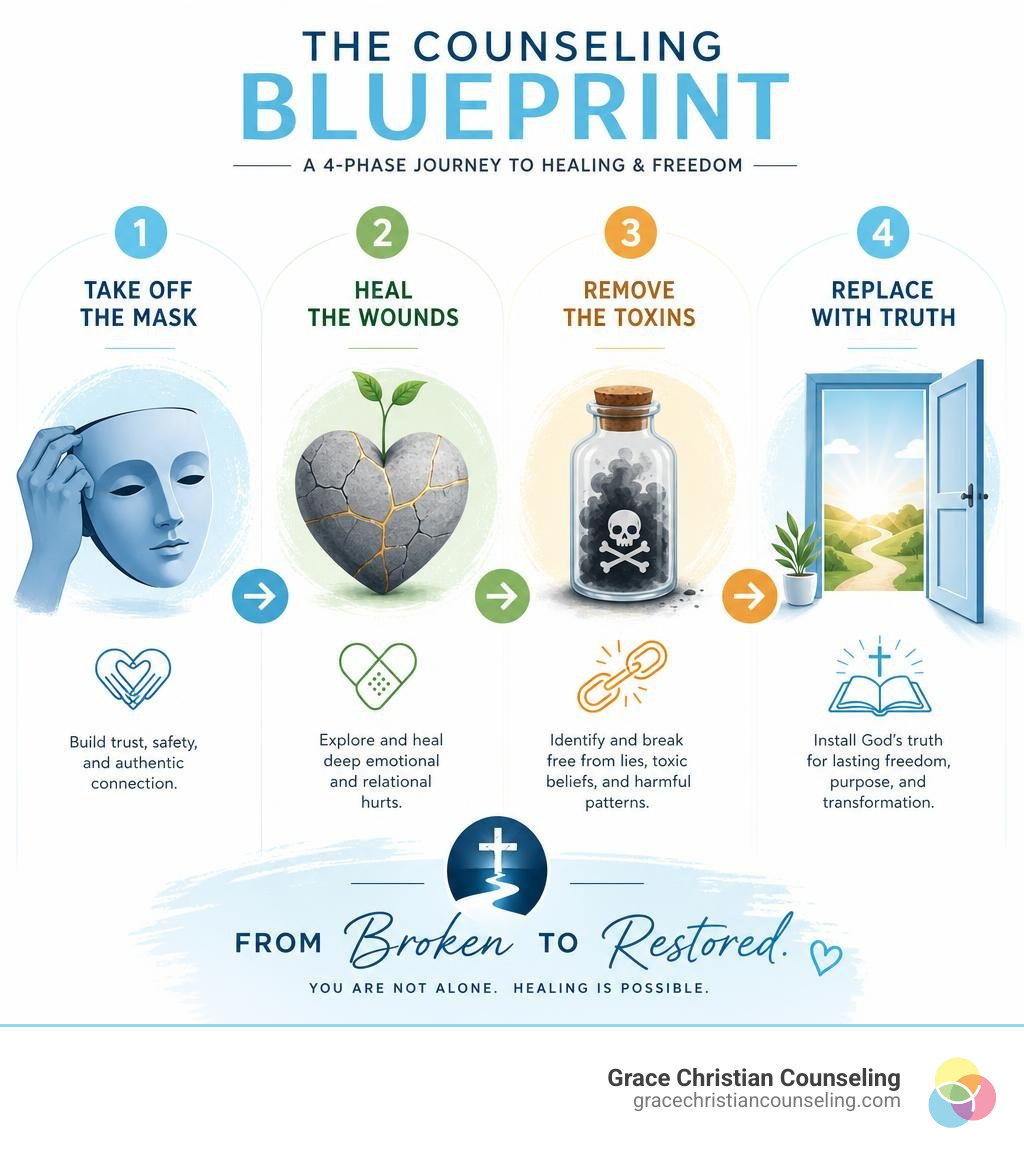
- Take Off the Mask: In this first phase, we focus on building genuine rapport, safety, and trust. You are invited to show up exactly as you are, without having to perform or hide your struggles.
- Heal the Wounds: Together, we gently explore the deep emotional, relational, and historical hurts that have left lasting scars on your heart.
- Remove the Toxins: We work to identify and tear down unhelpful beliefs, lingering lies, and toxic thought patterns that keep you feeling stuck or defeated.
- Replace with Truth: Finally, we install empowering, accurate perspectives about yourself, others, and the world, deeply rooted in God’s unchanging truth and love.
Matching with a Counselor Who Shares Your Values
We do not believe in assigning counselors at random. Instead, we use a dedicated clinical matching process to pair you with the therapist best suited to your unique personality, psychological struggles, and spiritual needs.
For personal comfort and biblical alignment, many clients prefer gender-matched counseling (women working with female therapists, and men working with male therapists). This can foster a deeper sense of safety and mutual understanding from your very first session. If you are ready to find your ideal match, browse our state-specific directories for Pennsylvania or Georgia.
What Are the Limitations of Online Christian Counseling and When Is In-Person Care Required?
Online counseling can be an effective option for many people, but there are times when telehealth alone may not provide the level of support you need. If you are experiencing an immediate safety concern, severe psychiatric symptoms, or a substance-use crisis that may require medical care, your counselor may recommend additional local support or a higher level of care.
Situations that may require additional or more intensive support include:
- Immediate risk of suicide or harm to another person.
- Symptoms of psychosis, mania, or another psychiatric crisis that significantly affect safety or functioning.
- Severe substance withdrawal or dependence that may require medically supervised treatment.
- A need for services that cannot appropriately or legally be provided through telehealth.
Before we begin virtual therapy, we work with you to establish clear safety protocols and a crisis intervention plan. If your clinical needs change during the course of your care, we will help you transition smoothly and safely to a higher level of local, face-to-face care.
If you live in Western Pennsylvania, we are blessed to offer local, in-person counseling options in addition to our virtual services. We have physical clinic locations serving communities across the region, including Pittsburgh, North Huntingdon, Penn Hills, Uniontown, Bethel Park, Sewickley, Mt. Lebanon, Pleasant Hills, Ligonier, Belle Vernon, and Punxsutawney. If you are located in neighboring regions, you can also explore our virtual services through West Virginia Online Christian Counseling.
Navigating Severe Mental Illness with Local Support
For clients managing complex, long-term mental health diagnoses, a hybrid or coordinated care model is often the safest and most effective approach. We are fully equipped to coordinate care with your local primary care physicians, psychiatrists, and in-person specialists. This collaborative effort ensures that you have a comprehensive, safe, and supportive network of care covering both your physical and psychological needs.
How Do You Get Started with Online Christian Counseling Today?
Taking the first step toward counseling can feel intimidating, but we have designed our intake process to be as straightforward and stress-free as possible:
- Step 1: Schedule Your Consultation. Reach out to us to schedule an initial free consultation or meet with one of our matching specialists to discuss your personal goals and find your ideal counselor.
- Step 2: Complete Your Intake Forms. Access our secure client portal to easily complete and submit your intake, policy, and consent forms online from the comfort of your home.
- Step 3: Prepare Your Technology. Find a quiet, private space in your home, ensure your device’s camera and microphone are working, and open your secure, encrypted video link.
- Step 4: Attend Your First Session. Show up with an open heart, ready to experience a compassionate, non-judgmental space filled with grace, truth, and clinical excellence.
You do not have to carry your heavy burdens, anxiety, or broken relationships alone. Taking the step to seek professional help is a sign of courage and a vital part of growing into the person God created you to be.
If you are ready to begin your journey toward emotional and spiritual restoration, we invite you to take that first step today. Visit us at Grace Christian Counseling to schedule your consultation and let us walk with you toward hope and healing.
Frequently Asked Questions About Online Christian Counseling?
Can couples or families receive online Christian counseling together?
Yes. Our secure virtual counseling rooms allow multiple participants to join the same session. Whether you and your spouse are sitting together on your living room couch, or family members are logging in from different physical locations, online therapy is a highly convenient and effective way to participate in premarital, marriage, or family counseling.
Do I have to be a Christian to receive Christian counseling?
No, you do not have to be a Christian to receive care from us. We warmly welcome clients of all faiths, beliefs, and backgrounds. Our primary goal is to provide compassionate, clinically excellent care. While we operate from a biblical worldview, faith-based elements like scripture reading and prayer are entirely optional and are only integrated into your sessions at your explicit request.
What should I do if my internet connection fails during a session?
If your video connection drops or your internet becomes unstable, do not worry. Your counselor will immediately call your phone to continue the session. Switching to a standard phone call is a reliable, secure, and clinically sound backup plan that keeps your therapy on track and ensures you do not lose your valuable session time.
Final Thoughts on Online Christian Counseling
Online Christian counseling can offer a meaningful path toward emotional, relational, and spiritual healing without requiring you to step away from the comfort and privacy of your home. With secure technology, clinically trained counselors, and a Christ-centered approach, you can receive care that honors both your mental health needs and your faith.
If you are carrying anxiety, grief, trauma, relationship stress, or spiritual pain, you do not have to sort through it alone. Grace Christian Counseling is here to help you take the next step with compassion, clinical excellence, and biblical hope. When you are ready, we invite you to connect with our team and begin moving toward healing with support you can trust.
This guide is for educational and spiritual encouragement and is not a substitute for personalized professional counseling. If you are in crisis, please reach out for immediate help.


