

When Life Feels Heavy, Christian Counseling Can Help
Christian counseling brings together licensed clinical care and biblical truth to help you heal as a whole person, mind, body, and spirit.
Quick answer: What is Christian counseling?
- It is professional mental health therapy provided by licensed counselors
- It integrates evidence-based methods (like CBT) with Scripture, prayer, and a biblical worldview
- It addresses anxiety, depression, trauma, marriage conflict, addiction, grief, and more
- It is available in-person and online, including across Western Pennsylvania
- It is not just for Christians; anyone who values a faith-informed approach can benefit
Life is hard. Anxiety, relationship strain, grief, and depression do not wait for a convenient time. And for many people, finding help that honors both their emotional struggles and their faith feels nearly impossible.
That is exactly where Christian counseling comes in.
A 2021 survey published by the American Psychological Association found that many Americans prefer therapists who understand and respect their spiritual beliefs. Yet many people do not know where to start, what to expect, or whether faith-based care is as clinically sound as traditional therapy. The relationship between you and your counselor (what clinicians call the “therapeutic alliance”) is one of the strongest predictors of whether therapy actually helps. In fact, studies suggest it can account for about 5–10% of improvement across different types of therapy, regardless of the specific approach used (Horvath et al., American Psychological Association).
In real clinical settings, clients often report that the most important factor in healing is not a specific technique, but the sense of being understood by their counselor. For many Christian clients, this includes the ability to talk openly about faith, prayer, guilt, forgiveness, and meaning without feeling dismissed or misunderstood. When counselors are trained in both evidence-based treatment and spiritual integration, they are better equipped to support the emotional and relational complexity that often comes with anxiety, trauma, grief, and relationship conflict.
Research consistently supports the effectiveness of integrating mental health treatment with a client’s cultural and spiritual values, including faith. For many Christian clients, it matters whether faith can be part of that conversation in a natural, respectful way. According to Pew Research, about 70% of U.S. adults identify as spiritual in some form, which means most people already carry some level of spiritual belief into their healing process. Studies have found that when therapy aligns with a person’s belief system, clients are more likely to engage in treatment, build a stronger therapeutic alliance, and report higher levels of satisfaction with care. In practice, this means that Christian counseling is not a separate or alternative form of therapy, but rather a culturally responsive approach that uses established clinical methods within a faith-informed framework.
At Grace Christian Counseling, we serve individuals, couples, families, and teens across Western Pennsylvania, including Pittsburgh, North Huntingdon, Bethel Park, and surrounding communities, as well as online throughout the state. Our licensed counselors combine clinical training with biblical wisdom so you can find real, lasting healing.
As Philippians 4:6-7 reminds us, you do not have to carry your burdens alone. There is peace available, and support is closer than you think.
What Is Christian Counseling and How Is It Different From Secular Counseling?
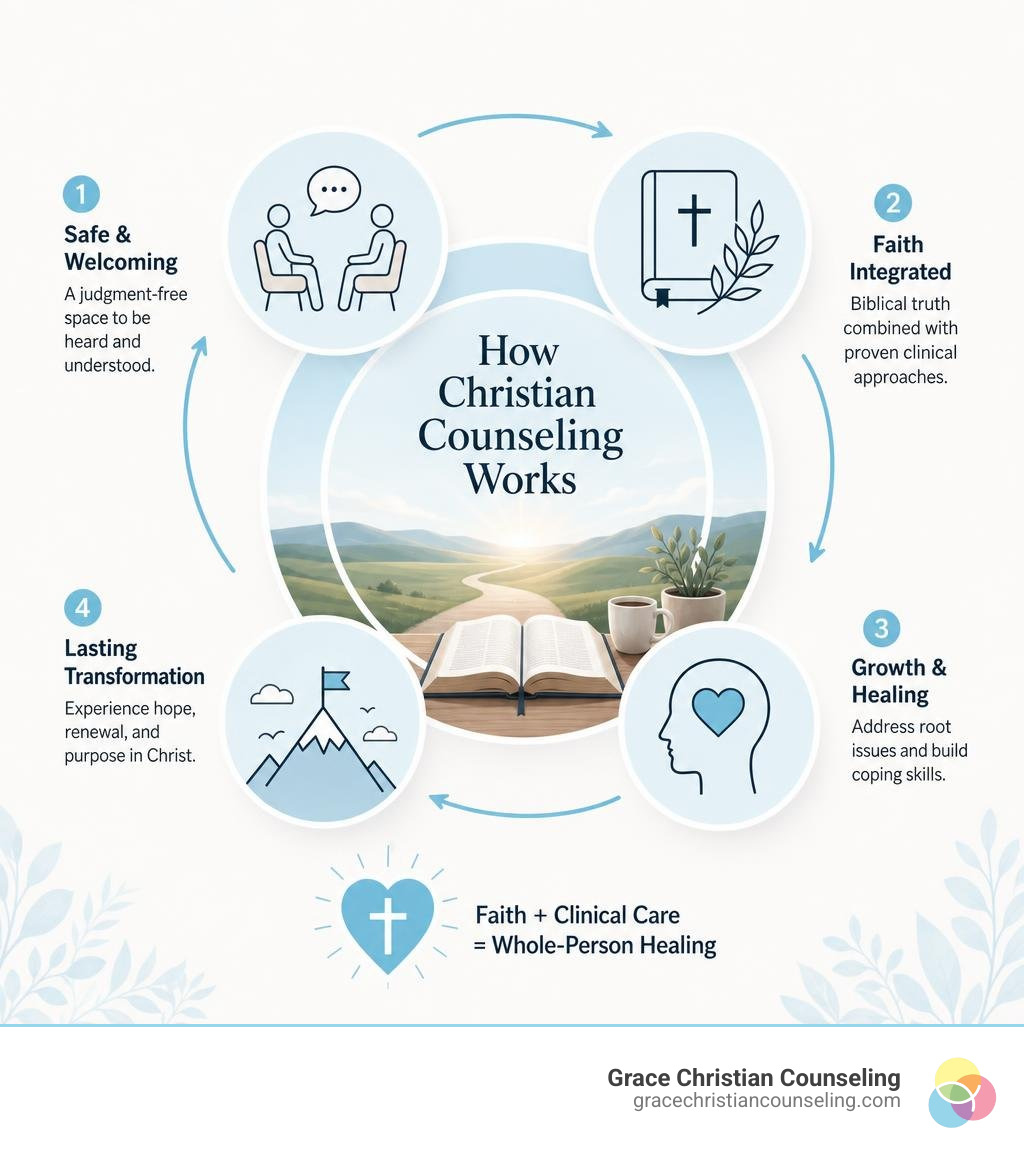
At its core, Christian counseling is counseling that combines sound clinical care with a Christian understanding of life, suffering, identity, relationships, and hope. It does not ignore anxiety, trauma, depression, or relationship pain. It addresses them seriously, using proven therapeutic tools, while also making room for Scripture, prayer, spiritual questions, and God’s presence in the healing process.
Secular counseling can be helpful and compassionate, and many clinical methods used in Christian counseling are the same ones used in broader mental health practice. The biggest difference is worldview. Christian counseling asks not only, “How do we reduce symptoms?” but also, “What is true about who you are, what you are carrying, and how God meets you in it?”
What christian counseling means in practice
In real sessions, Christian counseling may include:
- Clinical assessment and treatment planning
- Evidence-based tools such as CBT, ACT, EFT, and trauma-informed care
- Exploration of thought patterns, emotions, relationships, and behavior
- Optional prayer during or outside sessions
- Scripture reflection when it is helpful and welcomed
- Support for spiritual growth, forgiveness, identity, and reconciliation
This means Christian counseling is not “just prayer with advice.” It is also not secular therapy with a Bible verse taped on top, like a spiritual bumper sticker. It is an intentional, thoughtful integration of faith and clinical skill.
Christian counseling vs. secular counseling
Here is a simple comparison:
| Area | Christian Counseling | Secular Counseling |
|---|---|---|
| Worldview | Rooted in a biblical view of people, suffering, and healing | Usually grounded in psychological theory without spiritual authority |
| Goals | Symptom relief plus spiritual, relational, and emotional growth | Symptom relief, functioning, insight, and behavior change |
| Meaning and morality | Openly considers biblical truth, values, and purpose | Often shaped by client preference or nonreligious frameworks |
| Tools used | Clinical methods plus prayer, Scripture, and spiritual reflection when desired | Clinical methods without built-in faith integration |
| View of the person | Whole person, mind, body, relationships, and spirit | Often focuses on emotional, cognitive, behavioral, and relational factors |
The key point is that both may use effective therapy techniques. Christian counseling simply places those techniques inside a Christian framework of truth, grace, dignity, and hope.
Is christian counseling only for Christians?
No. While Christian counseling is especially meaningful for people whose faith is central to their lives, it is not limited to Christians only.
Some clients are:
- Committed Christians seeking faith-integrated therapy
- People returning to faith after a hard season
- Couples with different spiritual backgrounds
- Individuals who are curious about Christianity
- Clients who simply want counseling that respects spiritual values
At Grace Christian Counseling, we aim to offer respectful, non-judgmental care. We never force spiritual practices. We listen first, and we integrate faith in a way that fits the client’s comfort level and goals.
Biblical Foundations and Core Principles of Christian Counseling
Christian counseling rests on more than inspiration. It has theological foundations that shape how we understand people and how we care for them.
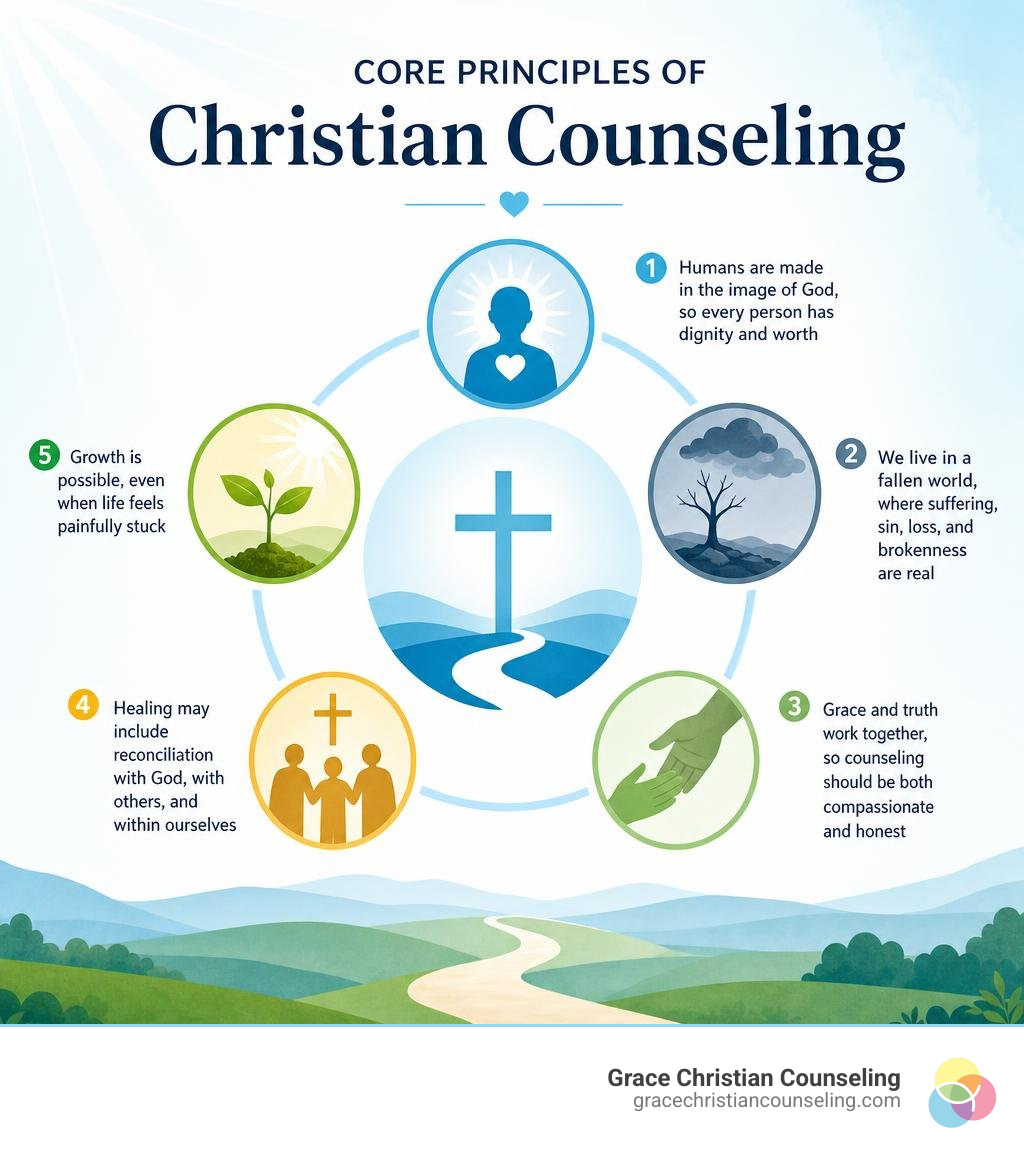
A few core ideas matter deeply:
- Humans are made in the image of God, the imago Dei, so every person has dignity and worth
- We live in a fallen world, where suffering, sin, loss, and brokenness are real
- Grace and truth work together, so counseling should be both compassionate and honest
- Healing may include reconciliation with God, with others, and within ourselves
- Growth is possible, even when life feels painfully stuck
Scripture, prayer, and the work of the Holy Spirit
Scripture gives language for both suffering and hope. Philippians 4:6-7 reminds us to bring our anxieties to God in prayer. The Psalms show us how to lament. The Gospels show us Christ’s compassion. Romans 8 speaks to suffering, weakness, and the Spirit’s help.
In counseling, prayer and Scripture are not used as shortcuts. We do not toss a verse at deep pain and call it progress. Instead, we use biblical truth carefully, wisely, and pastorally.
That may look like:
- Praying at the start or end of a session if the client wants that
- Reflecting on passages related to fear, grief, forgiveness, identity, or endurance
- Asking for the Holy Spirit’s wisdom in discernment and decision-making
- Helping clients apply faith to practical next steps in everyday life
Core principles that guide effective care
Good Christian counseling should be both spiritually grounded and professionally responsible. Core principles include:
- Compassion, because people heal best where they feel safe
- Confidentiality, because trust matters
- Healthy boundaries, because care is not control
- Ethical practice, because good intentions are not enough
- Identity in Christ, because shame is a terrible therapist
- Practical growth, because insight should lead to change
Christian counseling should never be manipulative, simplistic, or dismissive of mental health needs. It should be careful, skilled, and full of grace.
Why biblical truth and clinical skill belong together
Emotional health and spiritual health are connected. That does not mean every panic attack is a spiritual problem, or that every trauma symptom can be solved by “trying harder to trust God.” It means people are whole beings, and care should reflect that. Readers in West Virginia can explore Christian panic attack counseling for West Virginia adults, including online access and Morgantown options.
That is why we believe biblical truth and clinical skill belong together. Trauma-informed care, cognitive tools, nervous system regulation, attachment work, and communication skills can all be used in ways that honor God and help people heal. In our counseling work, many clients are not looking for faith language alone, they also want practical steps they can use between sessions. The strongest care often happens when biblical hope, emotional safety, and evidence-based tools are woven together with patience and humility.
If you want to explore this approach further, you can schedule a free discovery call with us.
What Issues Christian Counseling Can Help Address
Christian counseling can help with many of the same issues addressed in traditional therapy, with the added benefit of faith integration for those who want it.
Common concerns include:
- Anxiety and panic
- Depression and hopelessness
- Trauma and PTSD
- Marriage conflict
- Family stress and parenting challenges
- Addiction and compulsive behaviors
- Grief and loss
- Anger and resentment
- Identity struggles
- Spiritual confusion or crisis of faith
Anxiety, depression, and emotional distress
Anxiety can show up as racing thoughts, dread, irritability, panic, insomnia, perfectionism, or constant worst-case-scenario thinking. Depression may include sadness, numbness, fatigue, guilt, low motivation, or loss of hope.
Christian counseling helps by addressing both emotional symptoms and the deeper questions they often stir up, such as:
- Am I safe?
- Am I failing?
- Has God forgotten me?
- Will this ever change?
Treatment may include coping skills, thought reframing, behavioral activation, emotional regulation, spiritual support, and, when appropriate, referrals for medication evaluation or medical follow-up.
For more focused support, visit our Christian Depression Counseling.
Marriage, family, and relationship struggles
Relationships can be one of God’s greatest gifts and one of life’s fastest ways to reveal that we still need help. Marriage stress, broken trust, communication problems, parenting tension, blended family challenges, and unresolved grief can all strain a home.
Christian counseling for couples and families may help with:
- Communication and conflict resolution
- Premarital preparation
- Emotional disconnection
- Trust rebuilding
- Parenting skills and family roles
- Boundary setting with extended family
- Grief after loss or major life change
We often help clients build practical communication habits while also addressing deeper patterns, such as fear, pride, withdrawal, resentment, or shame.
You can learn more through our Christian Marriage Counseling and Grief Counseling pages.
Addiction, trauma, grief, and anger
Some struggles run especially deep and often need layered care.
Addiction may involve substances, pornography, compulsive sexual behavior, or other patterns that feel impossible to break alone. Trauma may stem from abuse, neglect, assault, accidents, betrayal, or chronic stress. Grief can follow death, divorce, infertility, miscarriage, job loss, or other painful endings. Readers carrying infertility-related grief can explore faith-integrated support for fertility stress that also makes room for relationships, decisions, and unanswered spiritual questions. Anger may be loud and explosive, or quiet and simmering.
Christian counseling can help by offering:
- Trauma-informed treatment that respects the nervous system and personal history
- Honest support without shaming language
- Practical tools for relapse prevention and accountability
- Space to process loss, lament, and unanswered questions
- Help untangling forgiveness from denial or unsafe reconciliation
- Strategies for anger regulation and repair
If these areas are part of your story, explore our Christian Trauma Counseling and Anger Management Counseling.
How Christian Counselors Integrate Faith With Clinical Techniques
One of the most common questions people ask is, “What actually happens in Christian counseling?” Fair question. Nobody wants to show up wondering whether they are getting therapy, a Bible study, or an awkward combination of both.
The answer is that good Christian counseling is structured, relational, and clinically grounded.
What a session may include
Over the years, our counselors have found that many clients come into their first session worried that they will be judged for struggling with anxiety, depression, trauma, or doubt. In reality, those concerns are far more common than most people realize. One of the first goals of counseling is helping clients feel safe enough to be honest about what they are experiencing so that meaningful healing can begin.
A typical session may include:
- Reviewing current symptoms, stressors, and progress
- Identifying goals for treatment
- Learning coping tools for anxiety, depression, trauma, or conflict
- Exploring patterns in thoughts, emotions, and relationships
- Reflecting on Scripture if relevant to the client’s goals
- Prayer, only if appropriate and desired
- Between-session homework, such as journaling, thought tracking, communication practice, or grounding exercises
Sessions are collaborative. We do not lecture at you. We work with you.
Evidence-based approaches used in Christian counseling
At Grace Christian Counseling, our work may include evidence-based models such as:
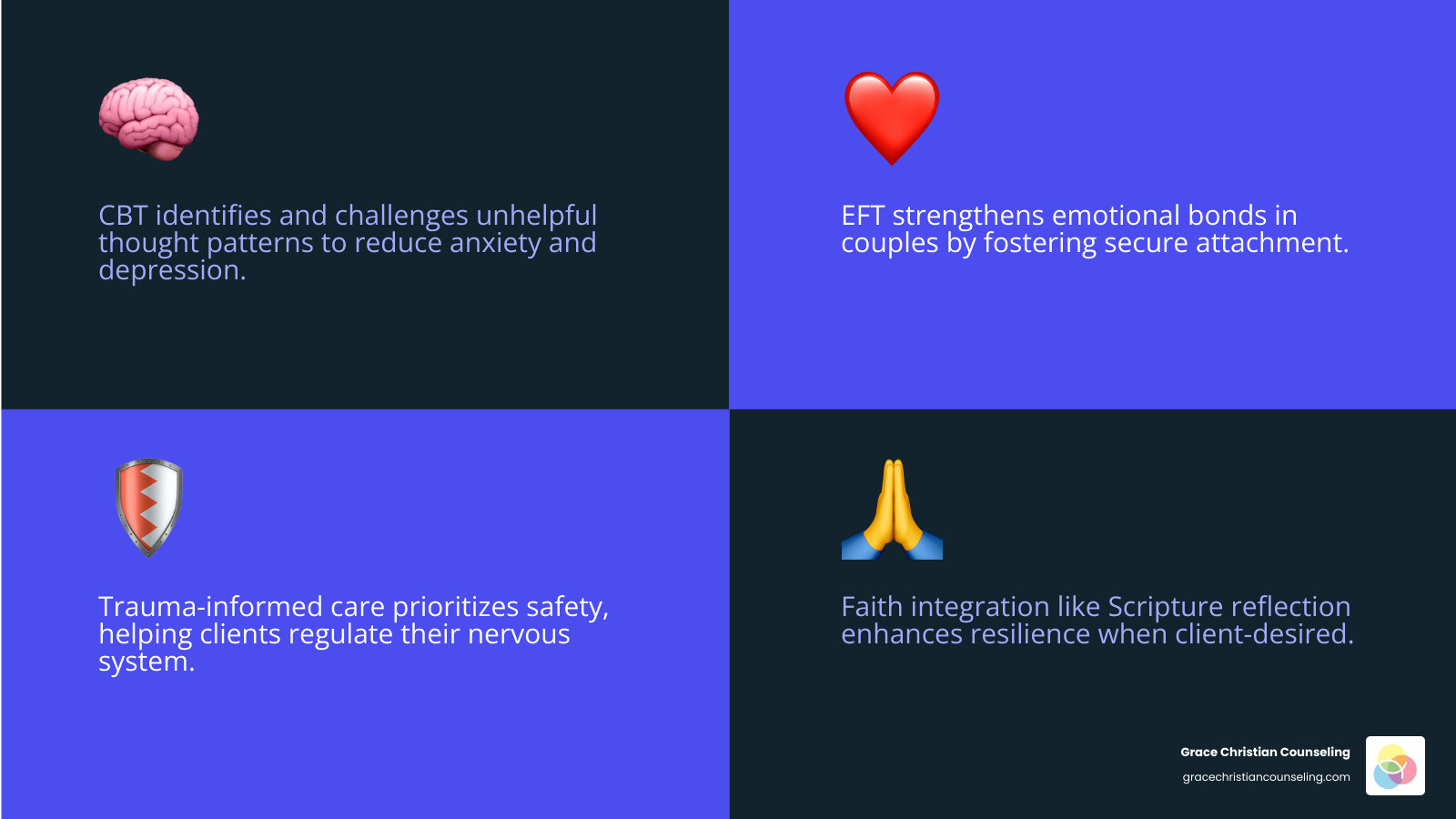
- CBT, to identify and challenge unhelpful thought patterns
- ACT, to build flexibility, values-based living, and acceptance
- EFT, especially for couples and attachment-related concerns
- Family systems work, to understand interaction patterns
- Trauma-informed care, to help clients feel safer in their bodies and relationships
- Nervous system regulation skills, such as grounding and calming techniques
These approaches are not opposed to faith. They can support wise, compassionate care when used within a biblical framework.
When referrals, psychiatry, or higher levels of care are needed
Christian counseling is valuable, but it is not the answer to every need by itself.
Sometimes good care includes:
- Risk assessment for self-harm, suicide, or abuse
- Referral to psychiatry for medication support
- Coordination with primary care providers
- Referral to intensive outpatient, inpatient, or addiction treatment when needed
- Crisis planning and emergency support
Ethical Christian counseling knows its limits. Wisdom includes collaboration.
If flexible access matters to you, our Online Christian Counseling option allows clients across Pennsylvania to receive support securely from home. For additional online faith-based wellness resources, some also explore NuWellonline.com.
Qualifications, Career Paths, and Accessibility in Christian Counseling
Not everyone who gives spiritual advice is a qualified counselor. That may sound obvious, but it is worth saying kindly and clearly.
A Christian counselor should have both faith-informed perspective and professional training.
What qualifications a Christian counselor should have
In most cases, qualified Christian counselors have:
- A master’s degree in counseling, social work, or a related field
- State licensure or licensure track status, such as LAPC, LSW, LPC, or LMFT
- Supervised clinical training, often totaling 2,000 to 4,000 hours depending on the path and state requirements
- Ongoing continuing education
- Training in ethics, confidentiality, assessment, and intervention
- Ability to integrate faith responsibly rather than casually
Licensing requirements vary by state, but in Pennsylvania, clients should look for professionals who are properly credentialed and practicing within state guidelines.
Where Christian counselors work and serve
Christian counselors may serve in:
- Private practice
- Churches or ministry partnerships
- Nonprofit counseling centers
- Schools or universities
- Community agencies
- Telehealth platforms
At Grace Christian Counseling, we serve Western Pennsylvania communities in person and offer virtual counseling statewide. That means support can be more accessible whether you live near Pittsburgh, Penn Hills, Sewickley, Uniontown, Pleasant Hills, Bethel Park, Ligonier, Belle Vernon, Punxsutawney, North Huntingdon, or Mt. Lebanon.
Cost, insurance, telehealth, and finding care near you
Accessibility matters. People often assume counseling is out of reach, but there are more options than many realize.
Depending on the provider, counseling access may include:
- In-person sessions
- Telehealth appointments
- HSA or FSA payment options
- Private pay
- Possible scholarship or reduced-fee options in some settings
- Flexible scheduling
Telehealth has made Christian counseling much more available, especially for busy families, rural communities, parents, and clients who prefer privacy at home. If you are looking for care in Pennsylvania and surrounding Grace service areas, local in-person offices and statewide virtual support are often the most practical place to begin.
Readers in western Pennsylvania can compare Christian counseling options in Butler County, including two in-person locations and statewide online care.
How to Choose the Right Christian Counseling Provider for Your Needs
Finding a counselor is a little like finding good shoes. The right fit matters more than the label, and if it hurts immediately, that is useful information.
Questions to ask before you book
Before starting, it can help to ask:
- Are you licensed, or under supervised licensure track status?
- How do you integrate faith into counseling?
- Do you use evidence-based methods such as CBT or trauma-informed care?
- Do you have experience with my concern, such as anxiety, trauma, or couples work?
- Do you offer telehealth?
- What are your fees and scheduling options?
- How much choice do I have about prayer or Scripture in sessions?
These questions are not rude. They are wise.
Signs of a healthy counseling relationship
A good counseling relationship often feels like:
- Safe, not shaming
- Respectful, not pushy
- Collaborative, not controlling
- Honest, but compassionate
- Structured enough to create progress
- Grounded in biblical encouragement, not spiritual clichés
You should feel heard. You should understand the goals. You should see practical movement over time, even if growth is gradual.
Frequently Asked Questions About Christian Counseling
What happens in the first Christian counseling session?
The first session usually includes intake, history, current concerns, and goal-setting. We want to understand your story, what is hurting, what has helped, and what you hope will change.
We also talk about faith preferences. Some clients want prayer and Scripture woven in naturally. Others want a gentler pace. Both are okay.
Can Christian counseling help if I am dealing with trauma, anxiety, or depression?
Yes. Christian counseling can be very helpful for trauma, anxiety, and depression, especially when it combines evidence-based care with biblical hope.
Healing is usually not instant. It is often steady, layered, and deeply meaningful. We focus on both symptom relief and whole-person restoration.
How do I get started with Christian counseling in Pennsylvania?
If this feels like the right next step, Grace Christian Counseling makes it simple to request a session, share what you need, and connect with a counselor who fits your goals and season of life.
You can begin by identifying the main issue you want help with, such as anxiety, marriage stress, trauma, or grief. Then review providers, ask questions, and schedule an initial appointment.
A Hopeful Next Step
While every client’s story is unique, our counseling team has observed that many people seeking Christian counseling are looking for more than symptom relief. They often want practical tools for managing emotional distress while also understanding how their faith connects to what they are experiencing. Questions about purpose, forgiveness, identity, and trust frequently emerge alongside concerns such as anxiety, grief, relationship conflict, and trauma. Christian counseling offers something many people are searching for, even if they do not know how to name it yet: real mental health support that does not ask them to leave their faith at the door.
At Grace Christian Counseling, we believe healing happens through truth, grace, wise clinical care, and the hope of Christ. Whether you are dealing with anxiety, depression, trauma, grief, family conflict, or a season that simply feels too heavy, you do not have to carry it alone.
If you are ready to begin, we invite you to book a free discovery call with our care team.
This guide is for educational and spiritual encouragement and is not a substitute for personalized professional counseling. If you are in crisis, please reach out for immediate help.
How Online Christian Therapy Can Help You Heal


