

Why Bible Scripture on Mental Health Matters More Than Ever
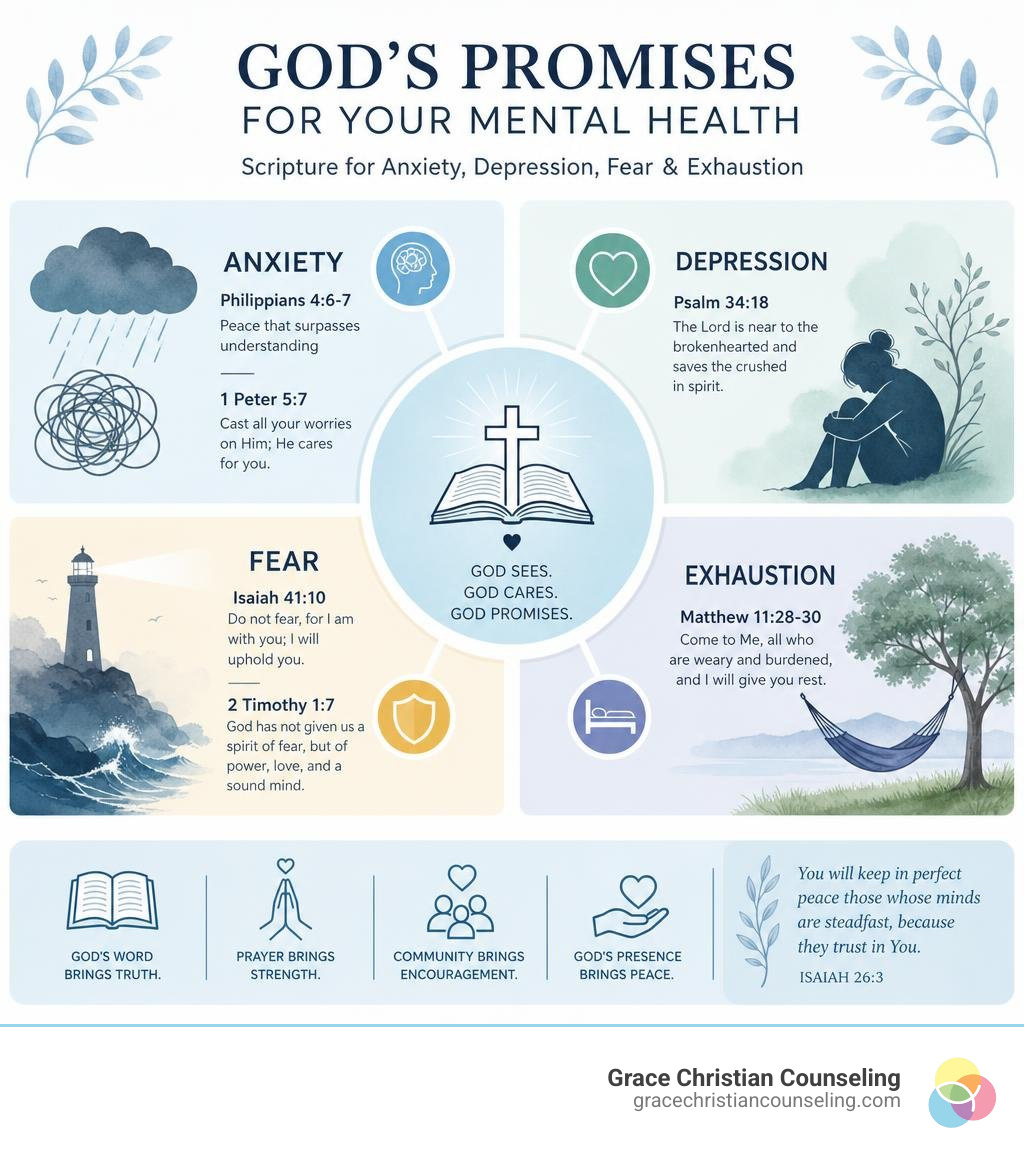
The most searched bible scripture on mental health verses are listed below, so you can find comfort right away:
| Scripture | Theme | Key Promise |
|---|---|---|
| Philippians 4:6-7 | Anxiety relief | Peace that surpasses understanding |
| 1 Peter 5:7 | Casting worry | God cares for you |
| Isaiah 41:10 | Fear and strength | God upholds you |
| Psalm 34:18 | Depression and grief | God is near the brokenhearted |
| Matthew 11:28-30 | Exhaustion and burnout | Rest for the weary |
| 20 Timothy 1:7 | Fear and anxiety | Spirit of power and sound mind |
| Isaiah 26:3 | Mental peace | Perfect peace through trust |
Mental health struggles are more common than many people realize. According to the National Institute of Mental Health, more than 1 in 5 U.S. adults (about 59.3 million people) were living with a mental illness in 2022. These are not just statistics. They are people sitting in church pews, attending small groups, raising families, going to work, and sometimes quietly wondering whether God sees what they are carrying. These are not just statistics; they are real people sitting in church pews, attending small groups, and quietly wondering if God sees their pain.
The good news is that Scripture has never been silent on emotional suffering. The Bible is filled with people who cried out in despair, begged God for relief, and wrestled with fear and hopelessness. And God met every single one of them.
At Grace Christian Counseling, we believe that the Bible and professional mental health care work together, not against each other. Faith is not a substitute for treatment, and treatment is not a threat to faith. Both point toward the same goal: healing and wholeness for the whole person.
This guide walks through the most powerful biblical scriptures on mental health, the real stories of biblical figures who struggled just like you do, and practical ways to find peace through both Scripture and support.
What Does the Bible Say About Mental Health and Emotional Suffering?
To truly understand what the Bible says about our emotional struggles, we must first look back to the beginning of the human story. In the Garden of Eden, everything was in perfect harmony; our minds, bodies, relationships, and spirits were completely aligned. When the Fall occurred, as described in Genesis, brokenness entered every part of creation. This brokenness did not just affect the physical ground we walk on; it also touched our biology, our neural pathways, and our emotional lives.
Because we live in a fallen world, our minds can experience seasons of deep darkness. The Bible does not use modern clinical terminology like “major depressive disorder” or “generalized anxiety disorder,” but it describes the symptoms of these conditions with breathtaking accuracy. Scripture speaks of a “crushed spirit,” a “divided mind,” and “bones that waste away” from grief. God does not ignore these experiences; instead, He addresses them with immense compassion.
According to research gathered by the Denison Forum, we are currently living in an unprecedented mental health crisis, which makes understanding the biblical perspective on mental well-being more critical than ever. In our own work with clients across Pennsylvania, we have seen how integrating scriptural truth with clinical therapy helps individuals move from a state of fear to a state of deep, lasting peace. If you want to explore how faith can anchor your mental wellness, you can read more about balancing these principles in our guide on Mind Over Matter and Faith Over Fear with These Bible Quotes About Mental Health.
Deconstructing Myths and Stigma Around Mental Illness in the Church
Unfortunately, many Christians have encountered harmful myths about mental health within their church communities. Perhaps you have heard someone suggest that depression is simply a result of personal sin, or that anxiety is merely a sign of weak faith. These ideas are not only clinically inaccurate; they are also biblically incorrect.
When we look closely at the Scriptures, we see that God never shames those who are hurting. In Proverbs 17:22, the Bible tells us that “a cheerful heart is good medicine, but a crushed spirit dries up the bones.” This verse acknowledges the profound physical impact of emotional suffering, validating that mental pain is a real, tangible burden.
Spiritual shame has no place in the healing process. When we treat mental illness as a spiritual failure, we drive hurting people away from the very support systems they need. Real healing begins when we align our hearts with God’s compassionate character, recognizing that our struggles are a reflection of human fragility, not a lack of devotion. For a deeper look at how the Word of God brings restoration to our emotional lives, explore our article on Healing the Heart with the Word.
Understanding the Mind-Body Connection Through a Biblical Lens
The Bible teaches that we are integrated beings; we are made of body, soul, and spirit. What happens in our minds directly impacts our physical health, and what happens in our bodies affects our emotions. For example, severe anxiety can manifest as chest tightness, headaches, or stomach pain, while physical exhaustion can make us far more vulnerable to intrusive thoughts.
Sometimes, we confuse spiritual health with emotional health. It is entirely possible to have a deep, genuine love for God while simultaneously struggling with emotional wounds or chemical imbalances in the brain. The table below illustrates the differences and connections between these two vital aspects of our lives:
| Spiritually Healthy | Emotionally Healthy |
|---|---|
| Deeply committed to prayer, worship, and scripture study | Able to identify, express, and manage a wide range of emotions |
| Actively serving in a local church community | Setting healthy boundaries and maintaining balanced relationships |
| Recognizing God’s sovereignty and trusting His promises | Processing past trauma and resolving conflicts constructively |
| Potential Pitfall: Using spiritual activities to avoid processing deep emotional pain | Potential Pitfall: Relying solely on human effort without seeking the Holy Spirit’s guidance |
Recognizing that we are integrated beings allows us to seek holistic care. We do not have to choose between praying and going to therapy; we can do both, honoring how God designed our minds and bodies to function together.
Comfort in the Storm: The Best Bible Scripture on Mental Health
During a mental health crisis, finding the right words to pray can feel impossible. In those moments, turning to a specific bible scripture on mental health can give voice to your pain and bring a sense of divine peace into your situation. God’s Word acts as an anchor, holding us steady when the waves of anxiety and depression threaten to overwhelm us. If you are looking for a curated list of verses to carry with you through difficult seasons, we encourage you to bookmark our resource on 10 Healing Scriptures for Mental Health Recovery.
Powerful Bible Scripture on Mental Health and Anxiety Relief
Anxiety can feel like a constant, heavy weight in your chest. In the original Greek language of the New Testament, the word for anxiety is closely related to the concept of a “divided mind.” It pulls your thoughts in a dozen different directions, making it impossible to rest.
The Apostle Paul addressed this struggle directly in his letter to the Philippians. In Philippians 4:6-7, he writes:
“Do not be anxious about anything, but in everything by prayer and supplication with thanksgiving let your requests be made known to God. And the peace of God, which surpasses all understanding, will guard your hearts and your minds in Christ Jesus.”
Paul was writing these words from a dark, cold prison cell, yet he spoke of a peace that “guards” our minds. The Greek word for “guard” refers to a military garrison stationed to protect a city. When we bring our worries to God, His peace stands watch over our thoughts like a protective soldier.
Similarly, the Apostle Peter encourages us in 1 Peter 5:7 to “cast all your anxiety on him because he cares for you.” The word “cast” (epirrhiptō in Greek) implies a forceful, intentional throwing action. It means taking the heavy, exhausting pack of worries off your own shoulders and throwing it onto Christ, trusting that He is strong enough to carry it. For more practical ways to apply these truths, check out Scripture-Based Anxiety Relief: A Christian Guide.
Uplifting Bible Scripture on Mental Health and Overcoming Depression
Depression often feels like living in a thick, gray fog. It drains your energy, steals your joy, and whispers the lie that you are completely alone. If you are in this dark place, the Psalms offer a beautiful, honest language for your pain.
In Psalm 34:18, we receive this beautiful assurance:
“The Lord is near to the brokenhearted and saves the crushed in spirit.”
God does not distance Himself from you when you are sad; He draws closer. He is not put off by your tears or your silence.
In the New Testament, Jesus extends a gentle, personal invitation to anyone carrying the heavy burden of emotional exhaustion. In Matthew 11:28-30, He says:
“Come to me, all who labor and are heavy laden, and I will give you rest. Take my yoke upon you, and learn from me, for I am gentle and lowly in heart, and you will find rest for your souls.”
Jesus does not demand that you fix yourself before you come to Him. He asks you to bring your weariness to Him just as it is. If you are struggling to find hope in the midst of burnout, you may find comfort in reading our article on From Burnout to Blessing: Bible Verses for Depression and Hopelessness.
Biblical Figures Who Modeled Honest Struggles with Despair and Anxiety

One of the greatest gifts of the Bible is its absolute honesty. It does not present us with plastic, perfect heroes who never struggle. Instead, it introduces us to real people who experienced profound emotional pain, showing us that mental health struggles are a normal part of the human experience.
When we read their stories, we see that God did not condemn them for their weakness. If you are feeling overwhelmed, reading about their lives can remind you that your pain does not disqualify you from God’s love. For a deep devotional experience on praying through unresolved sadness, we highly recommend reading Yes, God Does Care: Praying Through Despair With Psalm 88.
Elijah’s Burnout and God’s Gentle Response
In 1 Kings 19, we find the prophet Elijah in the midst of a severe mental health crisis. Immediately after a massive spiritual victory on Mount Carmel, Elijah received a death threat from Queen Jezebel. Terrified, exhausted, and completely burned out, he fled into the wilderness, sat down under a broom tree, and prayed that he might die. He told God, “It is enough; now, O Lord, take away my life.”
Elijah’s story includes experiences that may feel familiar to someone struggling with depression, anxiety, burnout, or overwhelming distress. He was afraid, exhausted, isolated, hopeless, and even asked God to take his life. Scripture does not give Elijah a modern mental health diagnosis, but it does show us something important: profound emotional distress is not evidence that God has abandoned you. He isolated himself, felt hopeless, and wanted his life to end.
Look closely at how God responded to Elijah. He did not lecture him, scold him for a lack of faith, or tell him to “snap out of it.” First, God addressed his physical needs. He sent an angel to provide Elijah with food and water, and He allowed him to sleep. After Elijah was rested, God met him in a “gentle whisper” rather than a dramatic windstorm or earthquake. God met Elijah with gentle, quiet care, showing us that physical rest, nutrition, and quiet spaces are sacred components of mental health recovery.
David’s Lament and Cry for Help in the Psalms
King David, described as a man after God’s own heart, was incredibly familiar with emotional instability. Throughout the Psalms, David rode an emotional roller coaster, moving from high praise to deep, dark despair.
In Psalm 42:11, David asks himself a question that many of us have asked in our darkest moments:
“Why are you cast down, O my soul, and why are you in turmoil within me? Hope in God; for I shall again praise him, my salvation and my God.”
David did not hide his feelings from God. He flooded his bed with tears, wrestled with feelings of abandonment, and openly asked God why He felt so distant. This honest lament is a beautiful model for us. God is big enough to handle our anger, our confusion, and our deepest sadness. We do not have to put on a happy face when we pray.
Jesus in Gethsemane: Normalizing Severe Emotional Distress
Perhaps the most comforting example of emotional distress in all of Scripture is found in the life of Jesus Himself. On the night before His crucifixion, Jesus entered the Garden of Gethsemane.
In Luke 22:44, we read:
“And being in agony he prayed more earnestly; and his sweat became like great drops of blood falling down to the ground.”
Luke describes Jesus’ sweat as becoming ‘like great drops of blood.’ A rare medical condition called hematidrosis, or sweating blood, has been documented in medical literature and has sometimes been associated with extreme stress. However, researchers note that the condition is extremely rare and its underlying cause is still not well understood, so we should be careful about using a modern medical diagnosis to explain exactly what occurred in Gethsemane.
Jesus was sinless, yet He experienced emotional agony so severe that it physically impacted His body. Jesus’ anguish in Gethsemane reminds us that experiencing intense emotional distress is not a spiritual failure. Christians can bring fear, grief, anguish, and exhaustion honestly before God rather than believing they must hide those emotions. Because of this, He empathizes with our weaknesses with perfect, gentle compassion.
Faith and Therapy: Balancing Scripture with Professional Mental Health Support
A common misconception among some believers is that seeking professional therapy means you lack faith in God. However, we believe that seeking professional mental health support is a beautiful act of stewardship. Just as we use God-given medical expertise to treat a broken bone or a thyroid condition, we should also use clinical therapy to care for our minds.
Scripture and evidence-based psychology are not enemies; they are partners in the healing process. God often uses the clinical tools of therapy to help us live out the biblical command to renew our minds. If you are looking for additional pastoral counseling resources we recommend, we invite you to visit NuWellonline.com and explore other resources on Bible Verses for Mental Health.
The Counseling Blueprint: Integrating Clinical Psychology and Biblical Truth
At Grace Christian Counseling, we utilize a unique, four-stage healing journey called the Counseling Blueprint. This approach allows our licensed professional counselors (such as our LAPCs and LSWs) to blend evidence-based clinical practices with timeless Biblical truth:
- Take Off the Mask: We begin by building a safe, genuine relationship with you. You do not have to pretend to have it all together in our sessions; this is a space where you can be completely honest about your pain.
- Heal the Wounds: We work together to explore your emotional and relational hurts, examining past experiences and family dynamics that may be fueling your current struggles.
- Remove the Toxins: Together, we identify unhelpful beliefs, cognitive distortions, and lingering lies that have taken root in your mind.
- Replace with Truth: Finally, we install empowering, accurate perspectives based on God’s truth about who you are, helping you walk in lasting freedom and confidence.
We are proud to offer this integrated care to individuals, couples, and families throughout Western Pennsylvania, with physical office locations in Penn Hills, Sewickley, Uniontown, Pleasant Hills, Bethel Park, Ligonier, Belle Vernon, Punxsutawney, North Huntingdon, and Mt. Lebanon. We also offer highly effective online counseling sessions for clients across PA, West Virginia, Georgia, and Florida.
Practical Biblical Practices to Support Your Mental Well-Being
Alongside professional care when you need it, simple spiritual practices can give you meaningful ways to slow down, connect with God, and feel less alone in what you are carrying. They are not replacements for mental health treatment, but they can become supportive rhythms in your everyday life. These practices help quiet your nervous system and refocus your mind on God’s presence:
- Renewing the Mind: Romans 12:2 calls us to “be transformed by the renewal of your mind.” In therapy, this aligns closely with Cognitive Behavioral Therapy (CBT), where we learn to identify negative, distorted thoughts and actively replace them with what is true and commendable.
- The Power of Worship: Worship shifts our perspective. When we focus on God’s goodness and character, our problems, while still real and significant, begin to feel smaller in comparison to His infinite love and power.
- Engaging in Community: Ecclesiastes 4:9-10 reminds us that “two are better than one… for if they fall, one will lift up his fellow.” When you are depressed, withdrawing from other people can feel easier than explaining what you are going through. But you do not have to carry everything privately. Sharing what you are experiencing with a trusted friend, pastor, family member, or counselor can give you connection and support during a difficult season.
- Simple Prayer Habits: You do not need to pray long, eloquent prayers. Simply turning to God throughout the day and saying, “Lord, I am overwhelmed, please be near to me,” is a powerful way to practice His presence.
Frequently Asked Questions About Scripture and Mental Well-Being
Is mental illness a sign of weak faith or personal sin?
No, mental illness is not a sign of weak faith, nor is it a personal punishment from God. While we live in a broken world where sickness exists, Jesus made it clear that individual suffering is not always tied to personal sin. In John 9, when asked who sinned to cause a man’s blindness, Jesus replied that neither the man nor his parents sinned, but that the works of God might be displayed in him. Mental health challenges are a reflection of our fragile human biology, not a measure of your spiritual devotion.
What should I do when God feels silent during my depression?
When you are in the depths of depression, God can often feel incredibly distant or silent. During these seasons, your feelings, though very real, are not always accurate indicators of reality.
Look to Psalm 88, a unique lament that ends in darkness without a neat, happy resolution. The inclusion of this Psalm in the Bible proves that God hears and values your prayers even when there seems to be no immediate relief. Continue to cry out to Him, and lean heavily on the faith of others when your own faith feels too weak to carry you.
How can I support a loved one who is struggling with their mental health?
The best way to support a loved one is to practice the presence of Christ by listening without judgment. Galatians 6:2 urges us to “bear one another’s burdens.”
Avoid offering quick fixes, spiritual platitudes, or unhelpful advice. Instead, validate their pain, pray with and for them, and gently encourage them to seek professional support from a licensed counselor if their struggles are interfering with their daily life.
Walking Toward Healing and Wholeness
If you are walking through a dark season of anxiety, depression, or emotional exhaustion, please know that you do not have to carry this heavy load by yourself. God sees you, He cares deeply for your pain, and He has provided practical pathways to help you find relief.
At Grace Christian Counseling, we are dedicated to walking alongside you on your journey toward wholeness. Whether you prefer to meet with a licensed counselor in person at one of our Western Pennsylvania locations, or you would like to utilize our convenient virtual options, we are here to provide the compassionate, Christ-centered care you deserve.
Take the first step toward lasting peace today. Reach out to us to learn more about our services or to schedule an online Christian counseling in PA session. You are not alone, and there is hope for a brighter tomorrow.
This guide is for educational and spiritual encouragement and is not a substitute for personalized professional counseling. If you are in crisis, please reach out for immediate help.


