

Why Biblical Anger Management Online Is Worth Taking Seriously
Biblical anger management online is one of the most practical ways Christians can find real, lasting help for anger — rooted in Scripture and accessible from anywhere.
Here is a quick overview of what the Bible teaches about managing anger:
In our counseling at Grace Christian Counseling, we frequently see individuals and couples who feel trapped by anger. They describe it as a sudden “seeing red” moment — where one comment or situation triggers an explosive reaction they later regret. Many come to us feeling ashamed, believing they are “just an angry person,” but when we help them understand anger as a secondary emotion and pair biblical truth with practical tools, we regularly witness significant breakthroughs in emotional regulation and healthier relationships.
| Biblical Principle | Key Scripture |
|---|---|
| Anger itself is not always sin | Ephesians 4:26 — “Be angry and do not sin” |
| Don’t let anger linger overnight | Ephesians 4:26-27 — “Do not let the sun go down on your wrath” |
| Be slow to anger | James 1:19 — “Slow to speak, slow to wrath” |
| Self-control is a fruit of the Spirit | Galatians 5:22-23 |
| Ruling your spirit matters deeply | Proverbs 16:32 — “He who rules his spirit [is better] than he who captures a city” |
| Forgiveness breaks the cycle | Ephesians 4:31-32 |
Anger is something every person deals with. But when it becomes a pattern — hurting relationships, damaging health, or creating a foothold for the enemy — it’s time to take a closer look. The good news? The Bible doesn’t just warn us about anger. It gives us a clear path through it.
I’m Stephen A. Luther, MSEd, MEd, LPC, Executive Director of Grace Christian Counseling and a licensed professional counselor, with decades of experience helping individuals and families find healing through the integration of evidence-based therapy and Biblical truth — including guiding people through biblical anger management online and in person. In this guide, we’ll walk you through exactly what Scripture says, practical steps you can take today, and the best online resources available to help you move from frustration to lasting peace.
Understanding the Spectrum: Righteous vs. Sinful Anger
One of the most common misconceptions we hear in counseling is that “Christians shouldn’t get angry.” However, if we look at the life of Jesus, we see a much more nuanced picture. Anger is a powerful emotional arousal, but it is not a “one-size-fits-all” experience.

Distinguishing Holy Indignation from Selfish Pride
Biblical history is full of “holy indignation.” We see God’s anger directed at injustice and idolatry throughout the Old Testament. We see Moses, fueled by a passion for God’s law, breaking the stone tablets in response to the golden calf. Most famously, we see Jesus in the temple (Mark 11:15), overturning tables because the house of prayer had been turned into a den of thieves.
The difference between Jesus’ anger and ours usually comes down to the “why.” Righteous anger is:
- Grief-driven: Jesus looked at the Pharisees with anger, but He was “deeply distressed at their stubborn hearts” (Mark 3:5).
- God-centered: It seeks the glory of God and the protection of the vulnerable.
- Controlled: It does not lead to a loss of self-governance.
In contrast, sinful anger is often rooted in selfish pride. It happens when our “rights” are violated or our “kingdom” is threatened. This is why James 1:19 is so vital for Biblical anger management online: we are called to be “slow to speak and slow to wrath.” When anger is fast, it is usually about us. When it is slow, it has room to be filtered through the Holy Spirit. If you find yourself struggling with explosive reactions, you may find our resources on Healing From Anger And Aggression helpful.
For those looking for a structured way to evaluate their heart, The Eruption Within: A Biblical Plan for Managing Anger offers a deep dive into these motives.
The High Cost of Uncontrolled Wrath in 2026
As we move through April 2026, the pace of life hasn’t slowed down, and neither have the physiological effects of stress. Uncontrolled anger isn’t just a “spiritual” problem; it is a total-body crisis.
When you “see red,” your body releases a flood of stress chemicals. Research shows that chronic, uncontrolled anger leads to:
- Cardiovascular Strain: Increased high blood pressure and a higher risk of heart attacks.
- Digestive Issues: Metabolic changes that can lead to ulcers or digestion problems.
- Physical Pain: Frequent headaches and skin flare-ups like eczema.
- Mental Exhaustion: Constant “fight or flight” mode drains your cognitive resources.

Beyond the body, uncontrolled wrath creates a “foothold for the devil” (Ephesians 4:27). This isn’t just poetic language; it means that unresolved anger gives the enemy an entry point to sow discord in your marriage, your parenting, and your local church community. Learning Anger Management Strategies For Adults is an essential part of maintaining your physical and spiritual health.
The Danger of Second-Day Anger
There is a specific warning in Ephesians 4:26: “Do not let the sun go down while you are still angry.” In Biblical anger management online, we often refer to this as the danger of “second-day anger.”
By definition, anger is meant to be a temporary emotional arousal—something that peaks and recedes within minutes or hours. When we carry it into the next day, it begins to accrue “interest” like an unpaid loan. It rots into cynicism and bitterness. As noted in the works of David E. Pratte on Anger and Temper Control, this lingering resentment often manifests as “clamming up”—an internalizing of rage that is just as destructive as “blowing up.”
Practical Steps for Biblical Anger Management Online
If you are ready to move from being “ruled” by your temper to “ruling your spirit,” the Bible provides a very clear roadmap. It starts with the understanding that self-control is a fruit of the Spirit (Galatians 5:22-23), meaning it is something God empowers us to grow as we stay connected to Him.
Resources for Biblical anger management online
In April 2026, the availability of high-quality, faith-based resources has never been greater. If you are looking for structured learning, consider these options:
- Christian Leaders Institute: They offer a free anger management class built to make biblical learning accessible, using a donation-supported model for those who want affordable training.
- SAMHSA-informed Courses: Many Christian programs draw from the SAMHSA Anger Management Workbook to help people spot triggers, recurring conflict patterns, and unhealthy responses while applying these tools through a biblical lens.
- Grace Christian Counseling: For a more personalized and Christ-centered approach, explore resources from Grace Christian Counseling, which address anger, emotional regulation, and spiritual growth.
- NuWell Online: NuWellonline.com is a national pastoral counseling option for people seeking online support that integrates faith and personal care.
Implementing Biblical anger management online daily
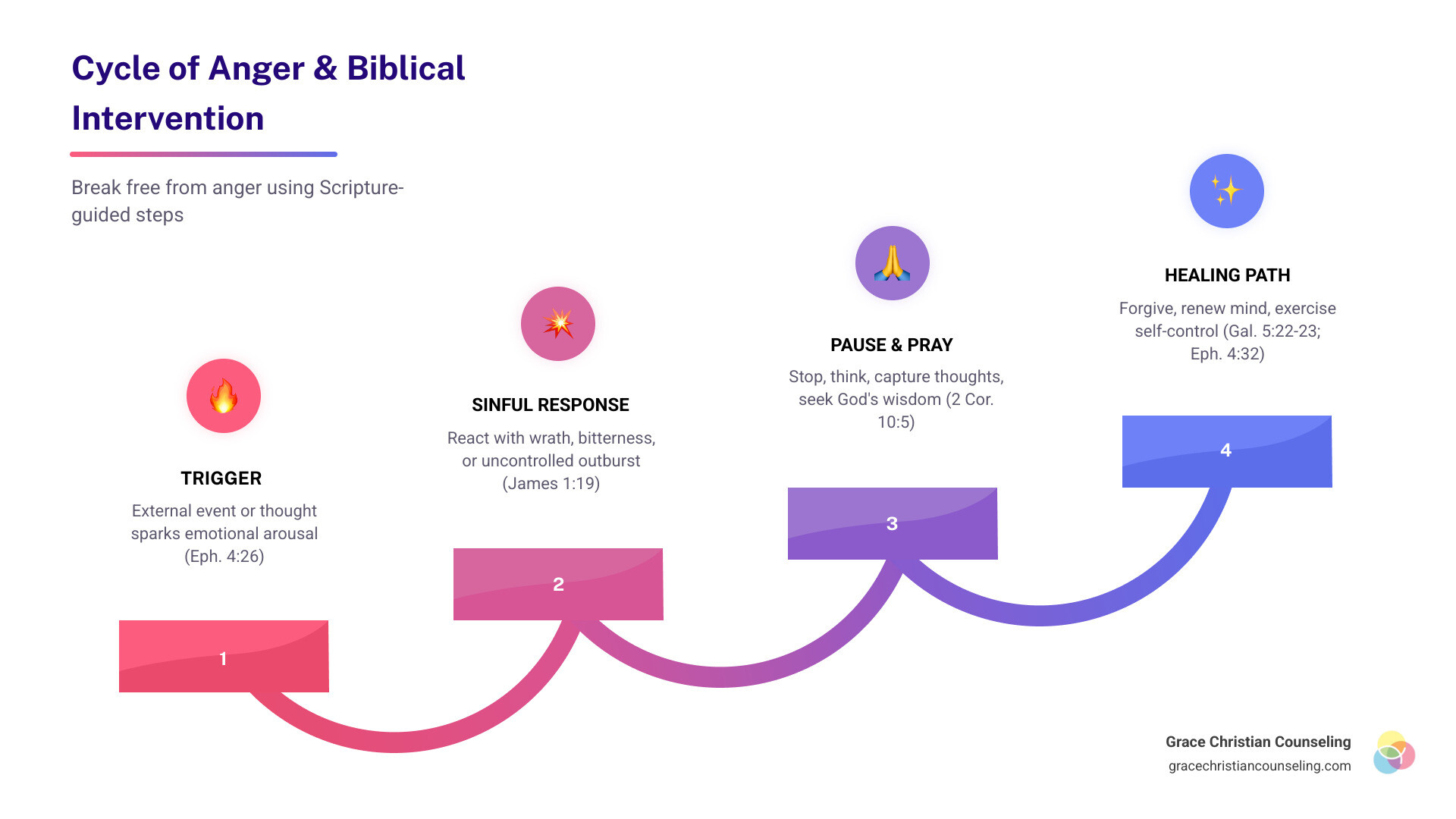
Knowledge is only half the battle. To see real change, you need a daily “tactical plan.” We recommend the Stop-Think-Pray method:
- Stop: Recognize the physical warning signs (clenched jaw, racing heart).
- Think: Take the thought captive (2 Corinthians 10:5). Ask, “Is this about God’s glory or my pride?”
- Pray: Ask the Holy Spirit for the “fruit” of self-control in that exact moment.
Consistency is key. Engaging with our Anger Management Tag can provide ongoing articles and tips to keep these principles fresh in your mind. Additionally, the Take Back Your Temple Bible Lesson offers a fantastic 4-step framework for those struggling with the intersection of emotions and physical habits.
Over the past 25+ years working with families in Western Pennsylvania, we’ve observed at Grace Christian Counseling that the most lasting change happens when clients combine the pause-breath-Scripture technique with honest heart examination. Husbands and wives who once spiraled into destructive arguments now report being able to pause, breathe, and turn to God’s Word in the heat of the moment. What used to escalate quickly often de-escalates, leading to greater peace in the home and deeper intimacy in marriage.
Overcoming the Roots: Pride, Fear, and Bitterness
To truly stop seeing red, we have to look beneath the surface. Anger is often a “secondary emotion”—a shield used to protect us from feeling hurt, afraid, or disrespected.
The first example of human anger in the Bible is Cain. God asked him a piercing question: “Why are you angry?” (Genesis 4:6). Cain’s anger wasn’t based on a legitimate injustice; it was based on his own failure to “do well” and his subsequent jealousy of Abel. Like Cain, much of our modern anger stems from:
- Unmet Expectations: We feel we are “owed” a certain level of service or respect.
- Violated Rights: We forget that, as followers of Christ, we are called to be servants.
- Selfish Pride: We take things personally that weren’t meant that way.
By identifying these roots, we can begin the process of heart transformation. You can explore more on these deep-seated issues through our Anger Management Strategies For Adults Tag.
Replacing Irritation with Grace
The ultimate “antidote” to anger in the Bible is grace. This involves “forbearance”—the act of putting up with people’s quirks and failures because we recognize how much God puts up with ours.
Jesus took this to the extreme in Matthew 5:44, telling us to “love your enemies and pray for those who persecute you.” This isn’t just a nice suggestion; it is a psychological “circuit breaker.” It is nearly impossible to remain in a state of blind rage while sincerely praying for God to bless the person you are angry with. This is the essence of “renewing the mind” (Romans 12:2).
Frequently Asked Questions about Biblical Anger
Is it always a sin to feel angry?
No. As we see in Ephesians 4:26, the command is to “be angry and do not sin.” Anger is an emotional arousal that alerts you to a problem. The sin occurs in the reaction—when we lose control, use words to tear others down, or let the feeling turn into a permanent grudge.
What does the Bible say about letting anger linger overnight?
The Bible is very firm on this: don’t do it. Letting anger linger (second-day anger) creates a spiritual foothold for bitterness. It turns a temporary emotion into a character trait. Prompt resolution—whether through a difficult conversation or a personal decision to forgive—is the biblical standard.
Can online Christian courses fulfill court-ordered requirements?
Yes, in many cases. Many Christian counseling organizations provide a 6–12 session Anger Management Course specifically designed for court-ordered requirements. These are typically completed individually with a licensed counselor who can then issue a formal certificate of completion. At Grace Christian Counseling, we provide these individualized services to meet legal standards while focusing on heart change.
Conclusion
Managing your temper isn’t about “trying harder”; it’s about surrendering deeper. Whether you are in Pittsburgh, Sewickley, Uniontown, or accessing our services virtually from across Pennsylvania, West Virginia, Georgia, or Florida, the path to peace is the same.
At Grace Christian Counseling, we believe in a “both/and” approach. We use evidence-based psychology—like Cognitive Behavioral Therapy (CBT) to help you identify triggers—and we blend it with the life-changing power of the Gospel. We serve communities across Western Pennsylvania, including North Huntingdon, Bethel Park, Ligonier, and Mt. Lebanon, ensuring that you don’t have to walk this journey alone.
It is now April 2026, and there has never been a better time to reclaim your peace of mind and your relationships. Anger doesn’t have to be the headline of your story. Through prayer, community, and professional guidance, you can learn to rule your spirit and reflect the heart of Christ.
This guide is for educational and spiritual encouragement and is not a substitute for personalized professional counseling. If you are in crisis, please reach out for immediate help.


