

When Your Family Needs More Than Good Intentions
Christian Family Counseling brings together professional, evidence-based therapy and the healing truth of Scripture to help families find real restoration — not just temporary relief.
Here’s a quick overview of what it covers:
| Question | Quick Answer |
|---|---|
| What is it? | Licensed therapy that integrates Biblical principles with proven clinical methods |
| Who is it for? | Individuals, couples, children, teens, blended families, and parents |
| What issues does it address? | Conflict, anxiety, depression, trauma, communication, parenting, and more |
| Does it work? | Yes — 75% of couples report meaningful improvement after counseling |
| Is it available online? | Yes — in-person and telehealth options are available |
Family life is beautiful. It’s also hard.
Conflict builds. Communication breaks down. Kids struggle. Marriages feel strained. And many Christian families find themselves caught between two unsatisfying choices: “just pray more” or purely secular therapy that ignores their faith entirely.
Neither feels quite right.
That’s exactly where Christian Family Counseling fits. It doesn’t ask you to choose between your faith and good clinical care. It holds both together — because we believe God’s design for families is reflected in both Scripture and in what science reveals about how people heal and grow.
At Grace Christian Counseling, we work with families across Western Pennsylvania — in Pittsburgh, North Huntingdon, Penn Hills, Uniontown, and beyond — as well as online. Our licensed counselors use proven therapies like CBT and trauma-informed care, woven together with Biblical truth, prayer, and the guidance of the Holy Spirit.
Below, we answer the 10 most common questions people ask about Christian Family Counseling — so you can move forward with clarity and confidence.
1. What Exactly is Christian Family Counseling?
At its core, Christian Family Counseling is the practice of professional mental health care viewed through the lens of a Biblical worldview. It differs from secular counseling not in its commitment to clinical excellence, but in its foundational understanding of who we are and how we are meant to relate to one another.
Secular counseling often focuses on the “self” as the ultimate authority. In contrast, our approach recognizes that God is the author of the family unit. From the creation of Adam and Eve, He established a design for how families should operate—with love, sacrifice, and mutual respect. We see therapy as a form of discipleship where spiritual maturity and emotional health go hand-in-hand.
Christian family counseling aims for more than short-term symptom relief. It addresses patterns, beliefs, and relationships at a deeper level. Using sound clinical methods alongside a biblical worldview, this approach helps families grow in personal wholeness, stronger relationships, and greater emotional stability. The goal is not just to reduce conflict, but to support lasting change that reflects God’s design for family life. For more on restoring family relationships, visit How To Resolve Family Conflict/.
2. How Do Faith and Biblical Principles Integrate with Therapy?
You might wonder, “Do we just read the Bible for an hour?” Not exactly. Integration is more like a conversation between two reliable sources of truth: God’s Word (Special Revelation) and the observable facts of psychology and neurobiology (General Revelation).
In our sessions, this looks like:
- Scripture Truth: Applying the wisdom of Proverbs to family conflict or the comfort of the Psalms to grief. We believe that Scripture provides the ultimate framework for truth.
- Prayer in Session: With your consent, we often begin or end sessions by inviting the Holy Spirit to lead the conversation. We believe God is the ultimate healer, and we are simply his instruments.
- Empirically Based Methods: We use “evidence-based” practices—meaning they have been scientifically tested and proven to work—but we filter them through a Biblical lens. For example, when we teach communication skills, we ground them in the command to “speak the truth in love” (Ephesians 4:15).
This kind of integration matters deeply for parents who want to guide their children with both wisdom and faith. You can learn more in our article on teenage identity development.
3. Who Should Seek Help? Addressing Common Family Issues
Many people wait until a “house fire” before calling for help. However, Christian Family Counseling is beneficial for families at any stage—whether you are dealing with a crisis or simply want a “check-up” to keep things healthy.
Common issues we address include:
- Blended Families: Navigating the unique challenges of step-parenting and half-siblings requires extra grace and strategic planning.
- Sibling Rivalry: Moving from “tug-of-war” dynamics to a plan for peace.
- Behavioral Problems: When a child or teen is acting out, it often signals a deeper emotional need or a breakdown in the family system.
- Life Transitions: Moving, job loss, or the “empty nest” phase can strain even the strongest bonds. Parents and couples facing this change can also explore faith-integrated support for parents and couples entering an empty nest, with attention to identity, boundaries, and relationship renewal.
If you are feeling overwhelmed by the atmosphere in your home, it’s a sign that your family could benefit from a safe, neutral space to talk. Discover more about our services on our Family Counseling/ page.

4. How Does Counseling Support Parents and Children Specifically?
Children make up a significant portion of the population, but they represent 100% of our future. Parenting has become more complex than ever. Our counselors provide specific coaching to help parents navigate these waters with wisdom and confidence.
We help families set media boundaries, ensuring that technology serves the family rather than the other way around. We also specialize in addressing developmental trauma. Using models that understand the neurosequential development of the brain, we help parents understand why their child is struggling and how to provide the specific type of nurture they need.
For those raising adolescents, the challenges can feel especially intense. We offer specialized support to help parents navigate the teen years, strengthen communication, and stay connected during the transition from childhood to adulthood.
5. Can Counseling Help Resolve Deep-Seated Conflict?
Yes. In fact, resolving conflict is one of the primary reasons families seek us out. Whether it’s chronic bickering or the devastating blow of infidelity, there is a path back to peace.
We focus on:
- Communication Skills: Learning to express needs without attacking the other person’s character.
- The Theology of Forgiveness: Secular therapy often views forgiveness as a “letting go” for one’s own sake. In Christian Family Counseling, we view forgiveness as a reflection of the Gospel—an essential, active process that allows for true reconciliation.
- Infidelity Recovery: We help couples navigate the “fog” of betrayal, using narrative therapy to rewrite a future that is defined by healing rather than the mistake.
If your family is stuck in a cycle of hurt, please read our guide on How To Resolve Conflict In Family/ for practical first steps.
6. What Evidence-Based Techniques Are Used?
We believe that because God designed our brains and our relationships, the best scientific findings will naturally align with His truth. At Grace Christian Counseling, we utilize several world-class modalities:
- Gottman Method: This is the “gold standard” for marriage and family work. It uses decades of research, such as that conducted by The Gottman Institute, to help families build “Love Maps” and manage conflict effectively.
- CBT (Cognitive Behavioral Therapy): This helps family members identify toxic thought patterns that lead to destructive behaviors.
- Narrative Therapy: This allows families to separate the “problem” from the “person,” helping them rewrite their family story through the lens of God’s grace.
- Neurobiology: We understand how the brain responds to stress and trauma, allowing us to provide tools that actually calm the nervous system.
You can read more about our commitment to these methods on Our Approach to Clinical Excellence page.
7. What Are the Primary Goals of the Counseling Process?
The goal isn’t just to stop the fighting; it’s to build something beautiful. We aim for:
- Personal Wholeness: Each family member growing in their individual identity in Christ.
- Interpersonal Competence: Developing the skills to love others well, even when it’s difficult.
- Mental Stability: Reducing the symptoms of anxiety, depression, and stress that cloud family life.
- Restoring the Family Unit: Rebuilding trust and creating a “Plan for Peace.”
As Proverbs 11:29 warns, “He who troubles his own house will inherit the wind.” Our goal is to help you build a house that inherits a blessing instead. For more on restoring harmony, see How To Resolve Family Conflict/.
8. What Are the Expected Outcomes and Success Rates?
Statistics show that counseling is highly effective. Research, such as data provided by the American Association for Marriage and Family Therapy, indicates that 65% of couples who participate in counseling report “significant” improvement in their relationships. Furthermore, about 75% of couples are better off than similar couples who did not receive counseling.
In the context of a Christian worldview, we see “success” as more than just staying together. We see it as:
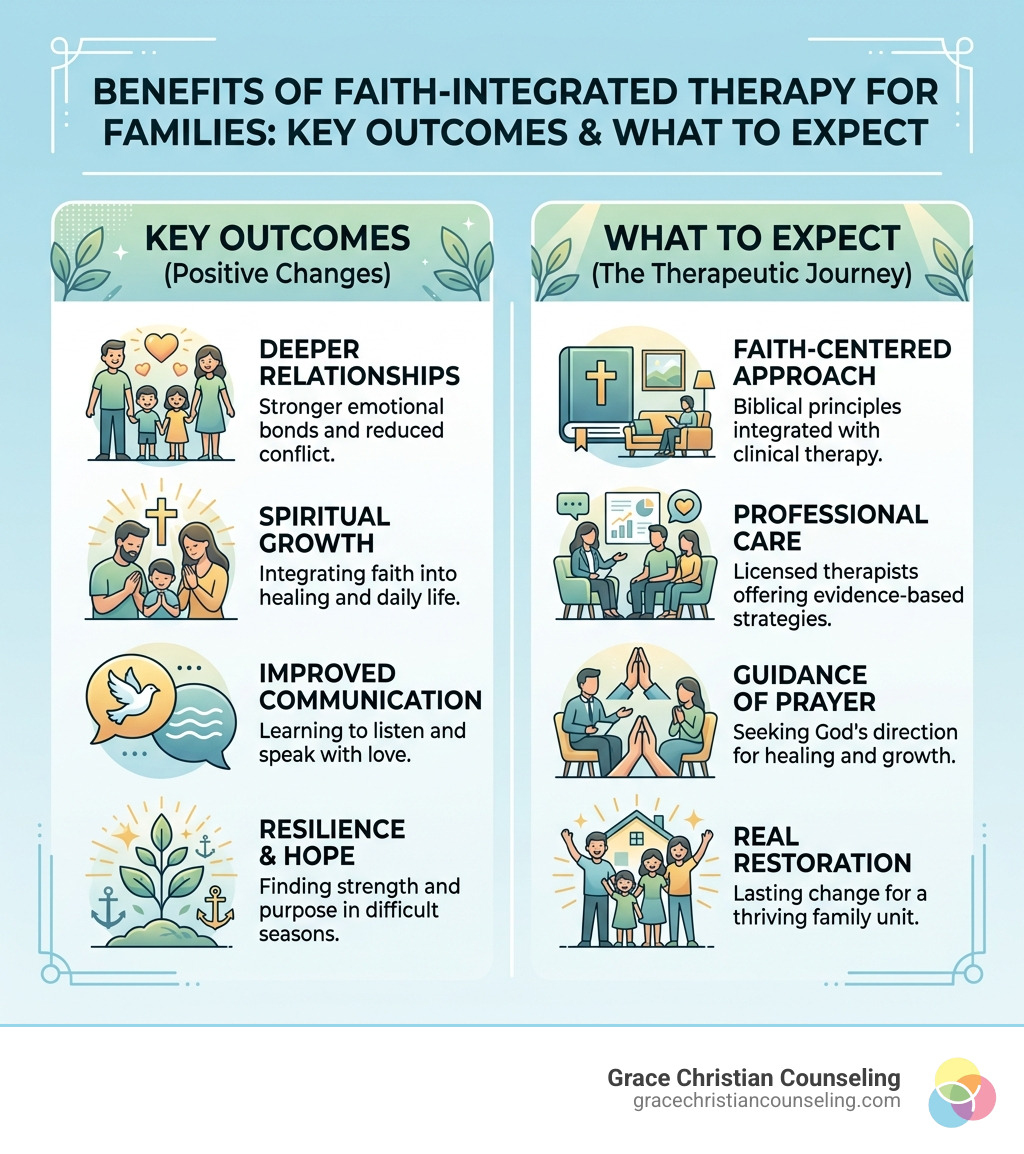
- Improved communication and emotional intimacy.
- Children who feel safe and supported.
- A home environment characterized by the “Fruit of the Spirit.”
- Long-term spiritual growth for all members.
By engaging in Tag/Family Therapy/, you are making a strategic investment in your family’s legacy for generations to come.
9. What Should We Expect During the Journey Toward Restoration?
Walking into a counselor’s office for the first time can feel intimidating. We want you to know that our environment is one of non-judgmental care. We are humans who have made our own mistakes, and we reflect God’s love by accepting you exactly where you are.
Preparing for Your First Session
When you start with us, here is what the process usually looks like:
- Intake: You’ll fill out some paperwork so we can understand your family history.
- Joint Sessions: Initially, we often meet with the whole family to see how everyone interacts.
- Individual Breakouts: Sometimes the counselor will meet with parents alone or children alone to provide a safe space for individual expression.
- Homework: Healing happens between sessions. We often provide “tasks” or communication exercises to try at home.
Confidentiality is a core part of family counseling, and we explain its limits clearly with children and teens so everyone understands what helps create a safe space. You can learn more about the counseling process on our Family Counseling page.

10. How Do Logistics Like Costs, Insurance, and Online Options Work?
We believe that high-quality Christian Family Counseling should be accessible.
- Online Options: We offer secure telehealth sessions for residents across Pennsylvania, West Virginia, Georgia, and Florida. This is a great option for busy families or those who don’t live near one of our physical offices.
- In-Person Locations: We have offices throughout Western Pennsylvania, including Penn Hills, Sewickley, Uniontown, Pleasant Hills, Bethel Park, Ligonier, Belle Vernon, Punxsutawney, North Huntingdon, and Mt. Lebanon.
- Specialized Intensives: Sometimes, one hour a week isn’t enough. We offer more intensive formats for families in crisis who need faster results.
If you’re ready to take the next step, you can Contact Grace Christian Counseling directly.
Navigating Costs and Insurance Coverage
We understand that finances can be a stressor.
- Insurance: Many of our providers are in-network with major insurance plans. We recommend calling your provider to verify coverage for “Family Counseling.”
- Superbills: For out-of-network benefits, we can provide a “superbill” that you can submit for potential reimbursement.
- Accessibility: Historically, many clients in the Christian counseling field are helped through sliding scales or reduced fees based on need.
Finding the Right Christian Family Counselor for Your Needs
The “therapeutic alliance”—the bond between you and your counselor—is one of the biggest predictors of success. When looking for a counselor, ensure they are:
- Licensed: They should have a Master’s or Ph.D. and be licensed by the state (LPC, LCSW, LMFT, etc.).
- Faith-Aligned: They should share your commitment to Biblical truth.
- Experienced: They should have specific training in family dynamics, not just individual therapy.
You can Meet Our Counselors to see who might be the best fit for your family’s unique personality and needs.
Frequently Asked Questions about Family Therapy
Does Christian counseling work for non-believers or those questioning their faith?
Absolutely. While our foundation is Christian, we respect everyone’s personal journey. We provide a compassionate, non-judgmental environment for anyone seeking healing. You don’t have to be a “perfect Christian” (or a Christian at all) to benefit from the wisdom and clinical tools we offer.
How long does the counseling process typically take to see results?
Every family is different. Some see significant shifts in 8–12 sessions, while families dealing with deep trauma or chronic conflict may stay in counseling longer. Our goal is to equip you with the tools so that you eventually don’t need us anymore.
Can we do family counseling if one member refuses to attend?
Yes. While it is ideal for everyone to be present, the family is a system. When one person changes their behavior and learns new ways of relating, it forces the rest of the system to shift. “Partial” attendance is still much better than no attendance.
Conclusion: Your Path to Healing in Western Pennsylvania
At Grace Christian Counseling, we believe that no family is beyond the reach of God’s restoring power. Whether you are in Pittsburgh, North Huntingdon, Penn Hills, Uniontown, or connecting with us virtually from across the state, we are here to walk with you.
You don’t have to navigate the “fog” of family conflict alone. By combining the best of modern psychology with the timeless truths of the Gospel, we help you move from survival mode to a life of love, peace, and harmony.
Start your healing journey with Grace Christian Counseling today and see what God can do in your home.
This guide is for educational and spiritual encouragement and is not a substitute for personalized professional counseling. If you are in crisis, please reach out for immediate help.
The Ultimate Guide to Finding a Great Teen Therapist Nearby
How to Help a Teenager with Anxiety: A Parent’s Guide
Christian counseling for life transitions in Pennsylvania


