

When Your Teen Is Struggling: Finding the Right Help for Teenage Depression
If you’re looking for a therapist for teenage depression near me, here’s a quick-start guide:
- Start with the therapist’s website and look for experience with adolescents, depression, and family involvement
- Check credentials – look for LCSW, LPC, LMHC, or PsyD with teen specialization
- Verify insurance and costs – ask about in-network benefits, out-of-network reimbursement, superbills, or sliding scale options
- Consider online therapy – telehealth can make consistent attendance easier for busy teens and families
- Ask about approach – effective teen therapists often use evidence-based methods like CBT or DBT, tailored to your teen’s needs
- Faith matters to you? Look for a Christ-centered counselor who combines biblical principles with sound clinical care
- Ready to explore options? Visit the Grace Christian Counseling counselor page to learn more about available support
Being a teenager has never been easy. But something has shifted in recent years.
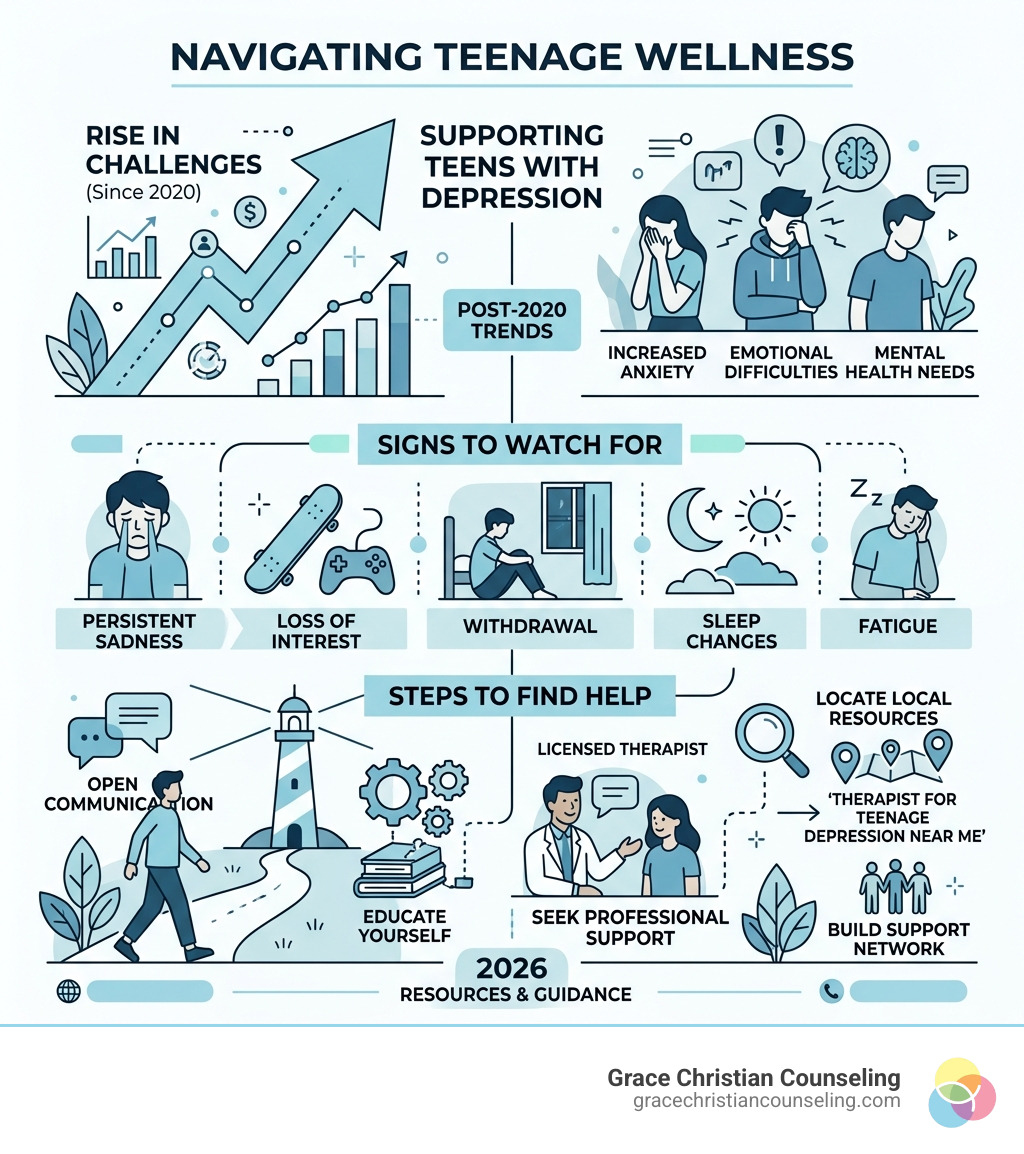
Since the COVID-19 pandemic, rates of depression and anxiety among teens have climbed sharply. Many parents are watching their child withdraw, lose hope, or struggle in ways that feel unfamiliar — and frightening.
You’re not alone in noticing something is wrong. And you’re not alone in wondering what to do next.
The good news is that teenage depression responds well to professional care. With the right therapist, most teens don’t just cope — they heal, grow, and rediscover purpose.
I’m Stephen A. Luther, MSEd, MEd, LPC, Executive Director and founder of Grace Christian Counseling, and I’ve spent nearly three decades helping families in Pennsylvania find hope through a blend of evidence-based therapy and Biblical truth — including helping parents find the right therapist for teenage depression near me for their struggling child. In this guide, I’ll walk you through everything you need to know to find the right support for your teen.
Recognizing the Signs: When to Search for a Therapist for Teenage Depression Near Me
As parents, we often ask ourselves: “Is this just a phase, or is it something more?” Adolescence is naturally a time of transition, filled with mood swings and a drive for independence. However, depression is more than just “teenage angst.” It is a persistent weight that interferes with a young person’s ability to function and enjoy life.

When you begin searching for a therapist for teenage depression near me, it is usually because you’ve noticed specific “red flag” behaviors. Statistics show that anxiety and depression have become increasingly common among teens, reflecting the heavy psychological changes they navigate. Since the beginning of the COVID-19 pandemic, there has been a sharp rise in these struggles, often exacerbated by social media pressure and academic stress.
Common signs and symptoms of depression in teenagers include:
- Persistent Sadness or Irritability: Unlike a bad day, this lasts for weeks. In teens, depression often manifests as anger or extreme “touchiness” rather than just tearfulness.
- Social Withdrawal: They may stop hanging out with friends they used to love or lose interest in activities like sports or hobbies.
- Academic Decline: A sudden drop in grades or a lack of motivation to attend school (school avoidance) can be a major indicator.
- Sleep and Appetite Changes: This might look like staying up all night and sleeping all day, or a significant change in weight.
- Hopelessness and Low Self-Esteem: Using negative self-talk, expressing that they are “worthless,” or feeling like things will never get better.
- Self-Harm or Risky Behavior: Cutting, substance use, or an increase in impulsive, dangerous actions.
When to seek immediate help: If your teen expresses thoughts of suicide, mentions wanting to “give up,” or engages in severe self-harm, do not wait for a therapy appointment. Seek immediate crisis intervention through your local emergency room or a mental health crisis hotline like the 988 Suicide & Crisis Lifeline.
Understanding Effective Modalities: CBT, DBT, and Family Therapy
When you find a therapist for teenage depression near me, you’ll likely hear them talk about different “modalities” or types of therapy. It can feel like alphabet soup (CBT, DBT, ACT!), but these are simply evidence-based tools designed to help your teen navigate their emotions.
At Grace Christian Counseling, we believe that psychology reflects God’s amazing design for the human mind. By using these clinical tools alongside Biblical truth, we can address both the emotional and spiritual needs of the teen.
Evidence-Based Approaches
- Cognitive Behavioral Therapy (CBT): This is the “gold standard” for treating depression. It focuses on identifying negative thought patterns (like “I’m a failure”) and replacing them with balanced, truthful perspectives. More info about teen therapy services can help you see how we apply these principles.
- Dialectical Behavioral Therapy (DBT): Originally developed for intense emotional struggles, DBT is excellent for teens who experience “emotional whirlwinds.” it teaches mindfulness, distress tolerance, and emotional regulation.
- Narrative Therapy: This approach helps teens see themselves as the “protagonist” of their own story, allowing them to “edit” their narrative and find hope for future chapters.
- Attachment-Based Family Therapy: Depression doesn’t happen in a vacuum. This therapy focuses on repairing the bond between parents and teens, creating a “secure base” at home that fosters healing.
Comparing Therapy Types
| Therapy Type | Primary Focus | Best For |
|---|---|---|
| CBT | Changing negative thoughts and behaviors | Depression, anxiety, perfectionism |
| DBT | Emotional regulation and distress tolerance | Self-harm, intense mood swings, impulsivity |
| Family Therapy | Improving communication and home dynamics | Conflict at home, trauma, systemic support |
Navigating the Search: Credentials, Costs, and Locations
Finding a therapist is a bit like finding a good pair of shoes—the fit matters just as much as the quality. You want someone with the right training, but also someone your teen feels they can trust.
How to Choose the Right Therapist for Teenage Depression Near Me
When reading therapist profiles, you will usually see letters after a name. Here is a simple guide to some common credentials:
- LPC / LMHC: Licensed Professional Counselor or Licensed Mental Health Counselor. These therapists usually have a master’s degree and supervised clinical training.
- LCSW: Licensed Clinical Social Worker. They are trained to provide therapy and may also help families connect with school, community, or support resources.
- LAPC / LSW: Licensed Associate Professional Counselor or Licensed Social Worker. These are associate-level licenses. They provide therapy under clinical supervision and can be a strong option for teen depression care.
Beyond the letters, look for someone who specifically lists “adolescents” or “teens” as a specialty. Teens are not just “small adults”; they require a therapist who understands their unique developmental stage, peer pressures, and need for autonomy.
Understanding Costs, Insurance, and Accessibility
One of the biggest hurdles for families is the cost. In Pennsylvania and Georgia, there are hundreds of verified therapists, but their fee structures vary.
- Insurance: Many therapists are in-network with major providers. If they are “out-of-network,” you can often request a “superbill” to submit to your insurance for partial reimbursement.
- Sliding Scale: Some practices offer fees based on your income level to make care more accessible.
- Session Frequency: Typically, teens start with once-a-week sessions. As they improve, this might move to bi-weekly.
Grace Christian Counseling provides both in-person and online options across Pennsylvania, including locations like Penn Hills, Sewickley, Uniontown, Pleasant Hills, Bethel Park, Ligonier, Belle Vernon, Punxsutawney, North Huntingdon, and Cranberry Twp. Whether you are in Western PA or looking for statewide virtual care, we strive to make the process as seamless as possible.
Supporting the Journey: Parental Involvement and Encouraging Your Teen
It is a delicate balance: you want to be involved in your child’s healing, but your teen needs a private space to open up. Most teen therapists prioritize confidentiality to build trust. This means they won’t tell you every detail of the session unless there is a safety concern (like self-harm or threats of violence).

How You Can Help at Home
- Validate, Don’t Fix: When your teen shares a struggle, try saying, “That sounds really hard,” instead of immediately offering a solution.
- Be Patient: Healing is rarely a straight line. There will be good weeks and bad weeks.
- Model Mental Health Care: If you are stressed or struggling, show them that it’s okay to seek support or practice self-care.
- Encourage the Reluctant Teen: If your teen refuses therapy, try suggesting a “consultation” or just three sessions to see if they like the therapist. Giving them a choice in who they see can also help them feel more in control.
Frequently Asked Questions about Finding a Therapist for Teenage Depression Near Me
How long does it typically take for therapy to show results?
While every teen is unique, many families begin to see progress within 12 to 20 sessions, sometimes sooner. Initial goals usually focus on safety and reducing the most severe symptoms. Long-term resilience and the building of coping skills take time, but consistent participation is the key to lasting change.
Is online therapy as effective as in-person sessions for teens?
Yes! In fact, many teens prefer online therapy because they feel more comfortable in their own rooms. It reduces the “stigma” of walking into an office and eliminates the stress of a commute. For busy families in places like Uniontown or Pittsburgh, telehealth offers a HIPAA-compliant, convenient way to stay consistent with care.
What should I do if my teen refuses to attend therapy?
This is a common challenge. Start by having a non-judgmental conversation about why they are hesitant. Is it fear of being “crazy”? Is it a bad experience with a previous counselor? Sometimes, framing it as “coaching” for stress or academic pressure can lower their defenses. At Grace Christian Counseling, we focus on building a warm, authentic relationship from day one to help even the most reluctant teen feel at ease.
Conclusion: There Is Hope for Your Teen
If you have been searching for a therapist for teenage depression near me, please know that reaching out is an act of courage and love. You don’t have to carry this burden alone, and neither does your child.
At Grace Christian Counseling, we are dedicated to providing Christ-centered, evidence-based care for families across Western Pennsylvania and beyond. We believe that through the integration of professional clinical practices and the hope found in Jesus Christ, true restoration is possible. Whether you are in Pittsburgh, North Huntingdon, Uniontown, or seeking virtual support from anywhere in the state, our team is ready to walk alongside you.
As Scripture reminds us in Lamentations 3:22-23, “The steadfast love of the Lord never ceases; his mercies never come to an end; they are new every morning.” There is a new morning waiting for your teen.
Schedule a consultation for teen therapy today and take the first step toward healing.
This guide is for educational and spiritual encouragement and is not a substitute for personalized professional counseling. If you are in crisis, please reach out for immediate help.
How to Help a Teenager with Anxiety: A Parent’s Guide
Finding a Christian Therapist for Depression Who Understands


