

Have you ever wondered why some relationships feel easy while others leave you anxious, distant, or stuck? The way we connect with our children, our partners, and even ourselves often grows out of early experiences that shaped how we love, trust, and communicate. Attachment therapy helps you understand those patterns, heal old wounds, lower relationship stress, and build stronger, more secure bonds.
Key takeaways
- Early relationships with caregivers shape “attachment styles” that affect how we handle closeness, conflict, and trust.
- Attachment-focused counseling helps you recognize your patterns and practice new, healthier ones.
- It can help parents and children, couples, adoptive and foster families, and individuals.
- Sessions are available individually, as a couple, or as a family, in person or online.
- Faith offers a secure foundation: God’s steady love models the security we long for.
In this article
- Why relationships can feel like a rollercoaster
- Common attachment styles
- How attachment therapy eases stress
- Relationship challenges it can help
- Can You Change Your Attachment Style and Develop Earned Security?
- Signs You Need a Therapist for Attachment Style Healing
- Who can benefit
- What to expect
- Frequently asked questions
Why relationships can feel like a rollercoaster
Our earliest bonds with parents and caregivers lay the foundation for how we connect as adults. These bonds shape attachment styles that influence how we respond to closeness, conflict, and vulnerability. You might fear being abandoned, avoid emotional intimacy, or struggle to trust. These patterns can leave you stressed, frustrated, or disconnected. Attachment therapy is not about dwelling on the past. It helps you understand your patterns so you can build healthier relationships today.
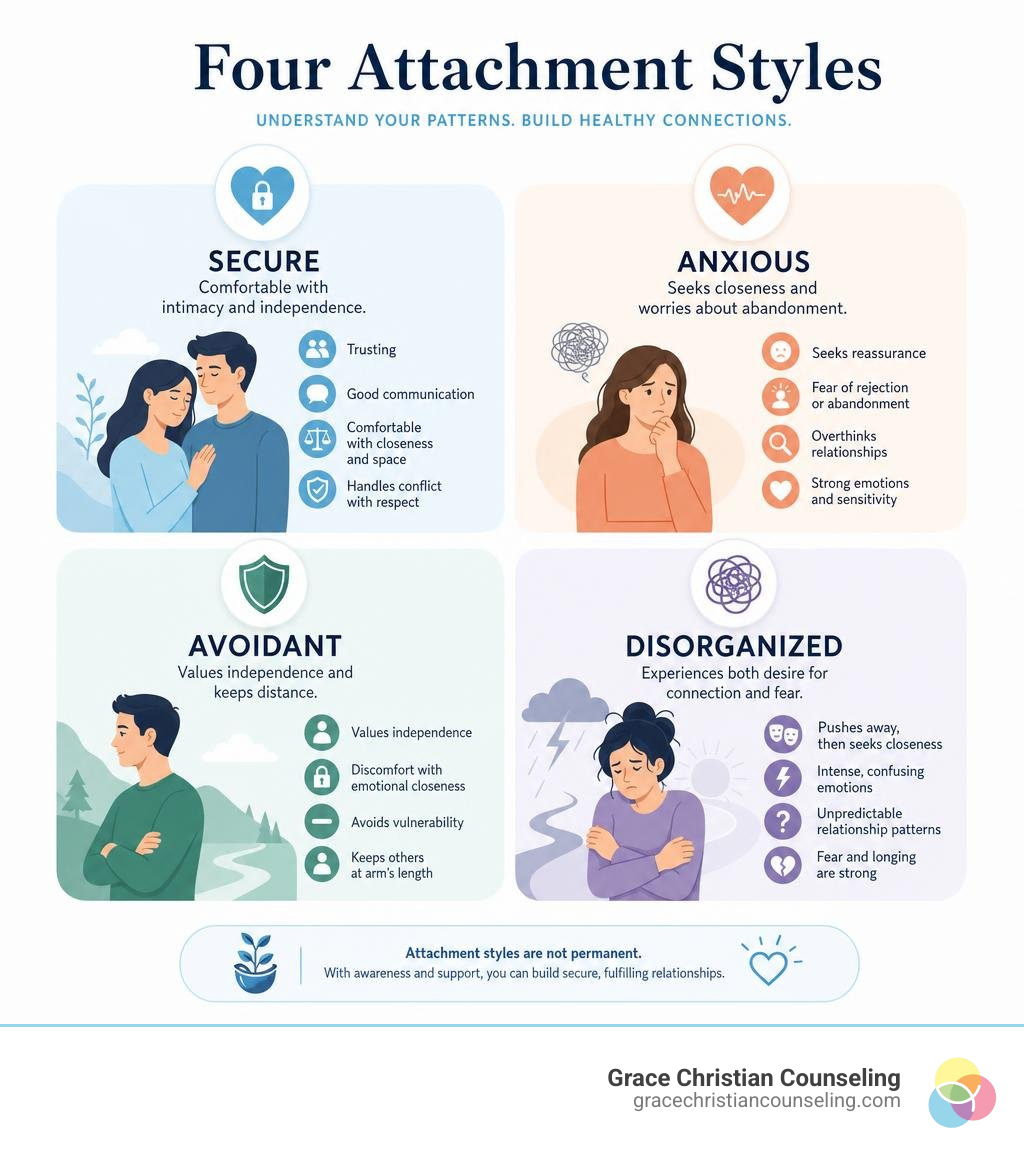
Common attachment styles
SecureComfortable with closeness and independence; trusts others and communicates needs.
AnxiousWorries about rejection or abandonment; may feel clingy or need frequent reassurance.
AvoidantValues independence and may pull away when relationships get emotionally close.
DisorganizedWants closeness but also fears it, often after inconsistent or frightening early care.
Styles are not labels for life. With awareness and support, people can grow toward more secure ways of relating. Our guide to healing an anxious attachment style goes deeper.
How Childhood Trauma Shapes Adult Bonds
Our attachment styles do not develop in a vacuum. They are formed during our most vulnerable years through our interactions with early caregivers. When a baby cries, they are looking for a response that says, “I see you, I hear you, and you are safe.” If caregivers are consistently responsive, warm, and emotionally attuned, the child learns that the world is a safe place and that people are reliable. This forms the foundation of secure attachment.
However, if caregiving is inconsistent, emotionally distant, or abusive, the child may experience emotional misattunement or relational trauma. An inconsistently affectionate mother or an emotionally absent father can leave a child wondering if their needs will ever be met, which may contribute to anxious patterns. If a caregiver is rejecting, the child may learn to suppress vulnerability, while a caregiver who feels unsafe can contribute to disorganized attachment.
This relational trauma can make us feel incredibly broken, but God’s word offers profound comfort. In Psalm 34:18, we are reminded that “The Lord is close to the brokenhearted and saves those who are crushed in spirit.” Healing early wounds is not just a psychological task; it can also become a sacred process of restoration.
How attachment therapy eases stress
Relationship strain spills into your mood, energy, and sleep. Attachment therapy offers practical tools:
- Clarity on your patterns: understand your attachment style and how it drives your reactions.
- Calming skills: use breathing, grounding, and mindfulness during tense moments, like an argument or a parenting meltdown.
- Processing old pain: work through hurts from childhood or past relationships in a safe space.
- Greater confidence: build self-worth so rejection and conflict feel less overwhelming.
Build more secure connections
Licensed Christian counselors, in person across Western PA and online in PA, WV, GA, and OH.
Core Techniques Used by an Attachment Therapist
An experienced therapist for attachment style healing will use several evidence-based techniques to help you process old wounds and build secure patterns. These are not one-size-fits-all tools. They are carefully tailored to your unique history.
- The Ideal Parent Figure (IPF) Method: In this visualization technique, you imagine ideal parent figures who meet the five conditions of secure attachment: felt safety, being seen and known, felt comfort, being valued, and support for independence. This helps your nervous system experience the safety you missed in childhood.
- EMDR Integration: Eye Movement Desensitization and Reprocessing (EMDR) can be powerful for transforming present-day abandonment fears. By processing painful childhood memories with bilateral stimulation, your brain can file those memories away as “past history” rather than active, daily triggers. If you are ready to explore this deeper, you can learn more about Relationship Trauma Therapy Near Me to find a counselor trained in these integrative approaches.
- Parts Work (Ego State or Internal Family Systems): This technique recognizes that we all have different parts of ourselves. You might have an anxious “inner child” part that panics when a partner is quiet, and a protective, avoidant part that wants to shut down. Your therapist helps you understand, welcome, and soothe these parts with compassion.
How It Differs from Traditional Talk Therapy
Traditional talk therapy often operates from a top-down approach, focusing primarily on your thoughts and cognitive patterns. While Cognitive Behavioral Therapy (CBT) is highly effective for many issues, talk therapy alone may not be enough to heal deep relational trauma.
Attachment-based therapy frequently incorporates bottom-up processing and somatic experiencing. This means we pay close attention to how your body holds trauma and anxiety. When you feel sudden panic in a relationship, your heart rate may spike and your chest may tighten before your conscious mind even registers a thought.
Relationship challenges it can help
Parent-child connection
Learn to respond to your child’s needs with empathy and consistency, building trust and security. This is especially valuable for families navigating adoption, behavior challenges, or developmental needs. Our adoption-informed Christian counseling in Pennsylvania supports foster, adoptive, and kinship families.
Romantic relationships
Break cycles of miscommunication, distance, or fear of intimacy so you and your partner can build a more open, secure bond. See Christian marriage counseling.
Family tension
Understand how attachment patterns fuel conflict with relatives and learn new ways to communicate.
Life transitions
Blending a family, grieving a loss, or becoming a parent can shake relationships. Therapy helps you stay connected through change.
Your relationship with yourself
Address shame or feelings of not being enough that grew out of past experiences.

Navigating Relationship Dynamics with Your Partner
One of the most common dynamics we see in couples counseling is the anxious-avoidant trap. This occurs when one partner is anxiously attached and the other is avoidantly attached.
When a conflict arises, the anxious partner moves closer, demanding communication and reassurance. Sensing the intensity, the avoidant partner withdraws to self-soothe. This withdrawal triggers more panic in the anxious partner, who pursues harder, causing the avoidant partner to withdraw even further.
It is an exhausting cycle, but it can be broken. Through open communication and emotional safety, partners can learn to support each other’s healing. We are reminded of the beautiful description of love in 1 Corinthians 13:4-7: “Love is patient, love is kind… It always protects, always trusts, always hopes, always perseveres.”
Rebuilding Trust Through Family-Focused Therapy for Attachment Style
Attachment challenges do not just affect individuals; they impact entire family systems. Attachment-Based Family Therapy (ABFT) is an empirically supported model designed to rebuild trust between children, adolescents, and their caregivers. ABFT has research support for treating adolescent mood disorders, suicidal ideation, and trauma by focusing directly on repairing fractured family bonds.
In an ABFT framework, a therapist works with parents to help them become a secure base for their children. The therapist guides the family through structured conversations to address past hurts, improve emotional communication, and establish a renewed sense of safety within the home. If you are interested in applying these principles within a faith-based household, you can read our guide on Grace-Filled Healing for Attachment Wounds in Christian Parenting.
Can You Change Your Attachment Style and Develop Earned Security?
One of the most encouraging discoveries in modern psychology is that attachment styles are not set in stone. While our early childhood experiences lay the foundation, our brains possess incredible neuroplasticity; this means we can form new neural pathways and relational habits at any age.
Through dedicated therapy, individuals can develop what psychologists call earned secure attachment. This term describes someone who grew up with an insecure attachment style but, through self-awareness, personal growth, and healing relationships, has developed a secure state of mind as an adult.
Developing earned security relies heavily on the quality of the therapeutic alliance; the trusting relationship you build with your counselor acts as a laboratory for practicing healthy vulnerability and communication. As you learn to regulate your emotions and challenge old fears, your relationship satisfaction will naturally begin to rise. Healing your attachment style is a journey of self-discovery that allows you to experience relationships the way God intended; filled with mutual trust, peace, and joy.
Signs You Need a Therapist for Attachment Style Healing
It can be easy to minimize relationship struggles as “normal drama,” but certain persistent patterns may point to something deeper. Working with a specialized therapist could be life-changing if you experience any of the following:
- Deep Trust Issues: Finding it incredibly difficult to believe that others genuinely care about you or will stay with you, even when they show consistent support.
- Chronic People-Pleasing: Constantly abandoning your own needs, values, and boundaries to keep others happy and avoid conflict.
- Emotional Unavailability: Desiring closeness but pulling away, finding flaws in your partner, or shutting down as soon as a relationship starts to feel serious.
- Boundary Difficulties: Either having no boundaries (allowing others to mistreat you) or building walls so high that no one can truly get close to you.
Key Questions to Ask a Potential Therapist for Attachment Style
When you are looking for a therapist for attachment style healing, finding the right fit is crucial. The therapeutic relationship itself is one of the primary tools for recovery. Here are a few practical questions you can ask during an initial consultation:
- What is your training background regarding attachment theory and relational trauma? (Look for licensed professionals like an LPC, LMFT, LAPC, or LSW who have pursued post-graduate training in attachment modalities).
- How do you measure treatment progress in our sessions?
- What does a typical session structure look like in your practice?
- Do you offer online counseling options, and how do you build a secure therapeutic bond virtually?
Integrating Faith and Psychology with a Therapist for Attachment Style
At Grace Christian Counseling, we believe that true healing involves the whole person: mind, body, and spirit. While psychology gives us helpful tools to understand our human design, Scripture provides the ultimate foundation for our identity and worth.
When you work with a Christian therapist, you do not have to leave your faith at the door. We integrate evidence-based clinical practices with biblical truth. This approach recognizes that our ultimate secure attachment is found in our relationship with God.
This faith-integrated approach can also be powerful for families. If you are a parent wanting to break generational cycles and raise secure children, you can explore our resources on Grace-Filled Healing for Attachment Wounds in Christian Parenting to discover how to bring Christ-centered healing into your home.
Who can benefit
- Parents who want a closer bond with a child, through tantrums, teen years, or adoption.
- Individuals with relationship anxiety who fear being left, feel clingy, or push people away.
- Couples struggling with trust, frequent arguments, or emotional distance.
- Adults with a painful past, such as inconsistent caregiving, neglect, or early loss.
- Adoptive and foster parents building bonds with children who experienced early disruption.
- Anyone seeking growth in self-understanding and confidence in relationships.
“Yea, I have loved thee with an everlasting love: therefore with lovingkindness have I drawn thee.”
Jeremiah 31:3 (KJV)
What to expect
- A judgment-free space where you can share your story confidentially.
- Tailored strategies, such as communication exercises and emotional regulation skills.
- Flexible options: individual, couples, or family sessions, in person or online.
- Your pace: ongoing support as you build lasting change.
- Faith when you want it: our counselors can include prayer and Scripture in your sessions.
You deserve relationships that feel safe and supportive. Meet our counselors or explore individual Christian counseling.
Frequently asked questions
What is attachment therapy?
It is counseling that focuses on how early relationships shaped the way you connect with others, and helps you build more secure, healthy relationships now.
What are the four attachment styles?
Secure, anxious, avoidant, and disorganized. Most people lean toward one style, and styles can become more secure over time.
Can your attachment style change?
Yes. Through awareness, safe relationships, and counseling, many people grow toward a more secure attachment style.
Is attachment therapy for children or adults?
Both. It can help parents and children bond, and it can help adults and couples change relationship patterns.
Can I do attachment-focused counseling online?
Yes. Grace Christian Counseling offers online sessions in Pennsylvania, West Virginia, Georgia, and Ohio, plus in-person care across Western Pennsylvania.
Can I attend attachment therapy individually or do I need a partner?
You do not need a partner to attend attachment therapy. In fact, most people begin this work individually. Because attachment styles are built on your internal models of safety and self-worth, the most important relationship you will work on in therapy is the relationship you have with yourself. As you learn to connect with your own emotions, set healthy boundaries, and soothe your inner child, your external relationships with friends, family, and romantic partners will naturally begin to transform.
How does understanding my attachment style improve my daily relationships?
Understanding your attachment style increases your self-awareness; it helps you recognize your emotional triggers before you react automatically. When you know why you feel anxious or why you want to pull away, you can communicate your needs clearly to your partner, resolve conflicts constructively, and ultimately experience deeper relationship satisfaction.
Can cognitive behavioral therapy help with attachment issues?
Yes, cognitive behavioral therapy (CBT) can help with attachment challenges. When personalized to your specific situation, CBT helps you identify and restructure the negative core beliefs (such as “I cannot trust anyone”) that drive insecure behaviors, allowing you to make positive behavioral changes in your relationships.
Related services
Sources
- National Institute of Mental Health. Psychotherapies.
- The alliance in adult psychotherapy: A meta-analytic synthesis


