

When Love Isn’t Enough: Understanding Attachment Trauma in Christian Parenting
Attachment trauma in Christian parenting is more common than most families realize, and it can leave even the most devoted parents feeling confused, exhausted, and spiritually discouraged.
Here is a quick overview of what you need to know:
- What it is: Attachment trauma happens when a child’s early experiences of care are inconsistent, frightening, or absent, disrupting the foundational sense of safety they need to trust others and regulate emotions.
- How it shows up: Explosive behavior, emotional shutdown, rejection of affection, hypervigilance, and difficulty with transitions are all common signs.
- Why faith matters: Biblical principles of covenant love, grace, and long-term commitment give Christian parents a uniquely powerful framework for healing.
- What helps: Consistent emotional attunement, rupture-and-repair cycles, understanding your own attachment history, and professional trauma-informed support all make a real difference.
- Where to start: Shifting focus from behavior change to heart-level connection is the first and most important step.
Research on attachment patterns shows that insecure attachment is not rare. In one large meta-analysis of more than 10,500 Adult Attachment Interview classifications, about 58% of the North American non-clinical mothers studied were classified as secure, while the rest showed dismissing or preoccupied attachment patterns. In everyday terms, that means a significant number of caring adults carry some attachment insecurity into family life. For children who have experienced early neglect, abuse, loss, foster care, adoption, or major family disruption, attachment-related struggles can be even more pronounced. Grace also offers dedicated support for foster and adoptive families who are working through these attachment-related challenges. Many Christian parents deeply want to help their children heal, but they often feel unsure where to begin.
The hard truth is that standard parenting advice rarely works for children with attachment trauma. Reward charts, consequences, and even heartfelt prayer can feel like they fall flat. That is not a failure of your faith or your love. It is a sign that your child needs something deeper than behavior management; they need relational healing.
This guide walks you through the science, the Scripture, and the practical steps to help your child, and yourself, move toward secure, grace-filled attachment.
What is Attachment Trauma and How Does It Manifest?
Attachment trauma occurs when a child’s early relational environment fails to provide consistent safety, attunement, and security. In a healthy developmental setting, a baby cries, a parent responds, and the baby learns that the world is a safe place. This “serve-and-return” interaction builds the foundational neural pathways for relational security.
When those early needs are neglected, ignored, or met with fear, the child’s brain adapts for survival. This disruption leads to insecure attachment styles, which manifest as anxious-avoidant, anxious-ambivalent, or disorganized patterns. Research shows that about 60% of children in non-clinical populations exhibit secure attachment, while roughly 40% exhibit insecure patterns. These attachment styles can be remarkably stable over time. A meta-analysis on early childhood attachment stability found that attachment security is moderately stable across childhood, while also showing that risk factors and major family stressors can make attachment patterns more likely to change over time.
In everyday terms, a child’s attachment patterns are not fixed forever, but they are shaped powerfully by repeated experiences of safety, stress, repair, and relational consistency. For parents, understanding this underscores the critical importance of early, targeted intervention. If you want to dive deeper into these dynamics, you can find More info about healing childhood trauma to help guide your family’s journey.
Differentiating Normal Misbehavior from Attachment Trauma Christian Parenting Challenges
It is easy to mistake trauma-driven behavior for simple disobedience or a strong-willed personality. However, traditional discipline methods often backfire with traumatized children because their behaviors are survival strategies rather than deliberate rebellion. When a child is hypervigilant, their brain is constantly scanning the environment for threats, interpreting even minor corrections as catastrophic rejection.
To help you distinguish between the two, we have compiled a comparison table:
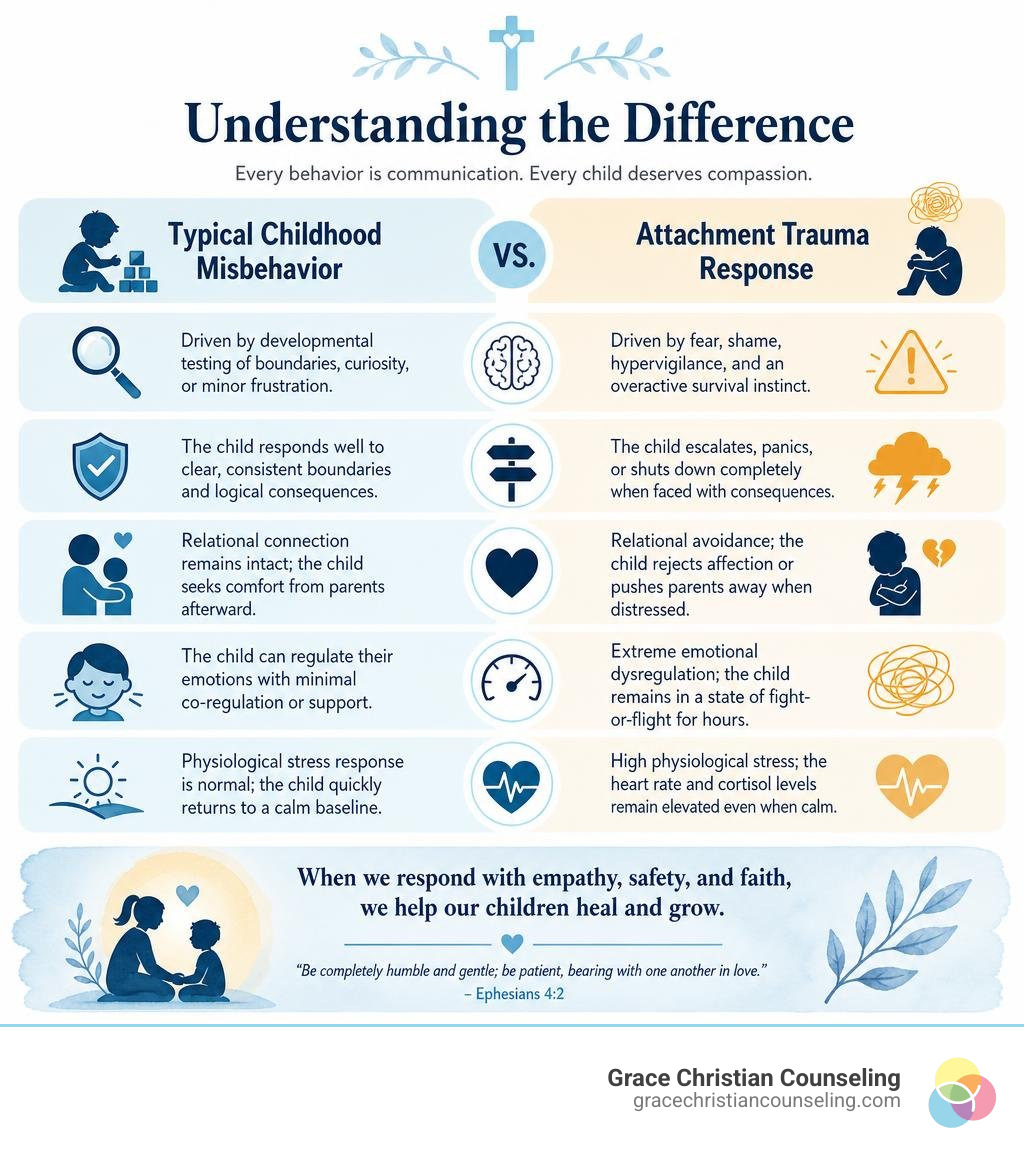
When parenting a child with attachment trauma, realizing that their behavior is an involuntary survival mechanism is a game-changer. They are not trying to control you; they are trying to feel safe.
The Neurobiology of Trauma and the Nervous System
Childhood trauma literally rewires the developing brain. Chronic stress and relational instability sensitize the amygdala, the brain’s alarm system, keeping the child in a constant state of red alert. At the same time, trauma alters the default mode network, which is responsible for self-referential thinking and identity, and the central executive network, which handles problem-solving and emotional control.
This neurological disruption means that a child with attachment trauma cannot simply “think” their way out of a meltdown. Their nervous system has registered a threat, and their logical brain has gone offline. Infants with insecure-avoidant attachment actually show greater physiological stress responses, such as elevated heart rates and cortisol levels, than securely attached infants, even when they appear completely calm and aloof on the outside. Their bodies are working in overdrive to protect them.
Healing this neurobiological wound requires safe, consistent, and repetitive relational experiences. For families navigating these complex neurobiological waters, professional support is often essential. You can explore More info about how Christian therapy can help trauma to understand how evidence-based clinical practices can be integrated with faith to soothe a wounded nervous system.
Biblical Principles for Attachment Trauma Christian Parenting
As Christian parents, we are called to model the character of God to our children. When we parent a child with attachment trauma, this calling takes on a profound, sacrificial dimension. The gospel is a story of adoption, reconciliation, and covenant love, which is the exact spiritual framework needed to parent a traumatized child.
Covenant love, or hesed in Hebrew, is unconditional, long-term commitment. It is a love that does not depend on the recipient’s response. When our children push us away, reject our affection, or lash out in anger, we are invited to reflect God’s steadfast, unyielding love. This is not easy; in fact, it is impossible to do in our own strength. It requires us to rely daily on the grace of God, trusting that He is working even when we cannot see the results. We can find comfort in Scripture on God’s steadfast love, which reminds us that His mercy endures forever, even in our hardest parenting moments. For more foundational guidance, you can read More info about biblical parenting principles to align your home with God’s design.
Moving from Behavior Modification to Heart-Level Connection
In many Christian circles, parenting is mistakenly reduced to behavior modification, using shame, isolation, or strict punishment to enforce obedience. However, this approach is deeply damaging to a child with attachment trauma. When we focus solely on external behavior, we miss the heart-level cries for safety and love.
God does not parent us through mere behavior modification; He parents us through heart-level conviction and relationship. He draws us with kindness and assures us of our security in Christ. When we shift our focus from “how do I stop this behavior?” to “what does my child’s heart need right now?”, we begin to see their outbursts as opportunities for connection.
How Secure Attachment to God Anchors Attachment Trauma Christian Parenting
To offer secure attachment to a child, we must first experience it ourselves. God is our ultimate secure base. He is the perfect parent who is always accessible, responsive, and engaged. When we understand our identity as beloved children of Abba Father, we are no longer dependent on our children’s behavior for our sense of worth or success.
Abiding in Christ is not just a spiritual discipline; it is a clinical necessity for trauma parents. When our children dysregulate, our own nervous systems can easily become triggered. By anchoring ourselves in the love of God, we can co-regulate with our children, offering them our calm instead of joining their chaos. We are reminded of this in Scripture on abiding in Christ, which highlights that apart from Him, we can do nothing.
Practical Strategies to Foster Relational Security and Healing
Fostering secure attachment in a traumatized child is a slow, intentional process. It does not happen through grand gestures, but through thousands of small, daily moments of emotional attunement and connection. Here are several practical strategies to help your child feel safe, seen, and secure:
- Practice Serve-and-Return: Pay close attention to your child’s subtle cues. When they look at you, make eye contact and smile. When they express a feeling, validate it before trying to fix the problem.
- Use Touch Wisely: Physical touch is a powerful regulator for the nervous system, but only if it is welcomed. Offer gentle, non-threatening touch, such as a hand on the shoulder, a back rub, or a warm hug, always respecting your child’s boundaries.
- Keep Your Voice Calm: A raised voice or a harsh tone can instantly trigger a trauma response. Practice speaking in a low, slow, and soothing voice, even when you are setting firm boundaries.
- Create Predictable Routines: Children with trauma histories thrive on predictability. Use visual schedules, transition warnings, and consistent daily rhythms to reduce anxiety and build a sense of safety.
If you are looking for more ways to build deep, lasting connections with your child, you can find More info about building bridges to trauma recovery on our blog.
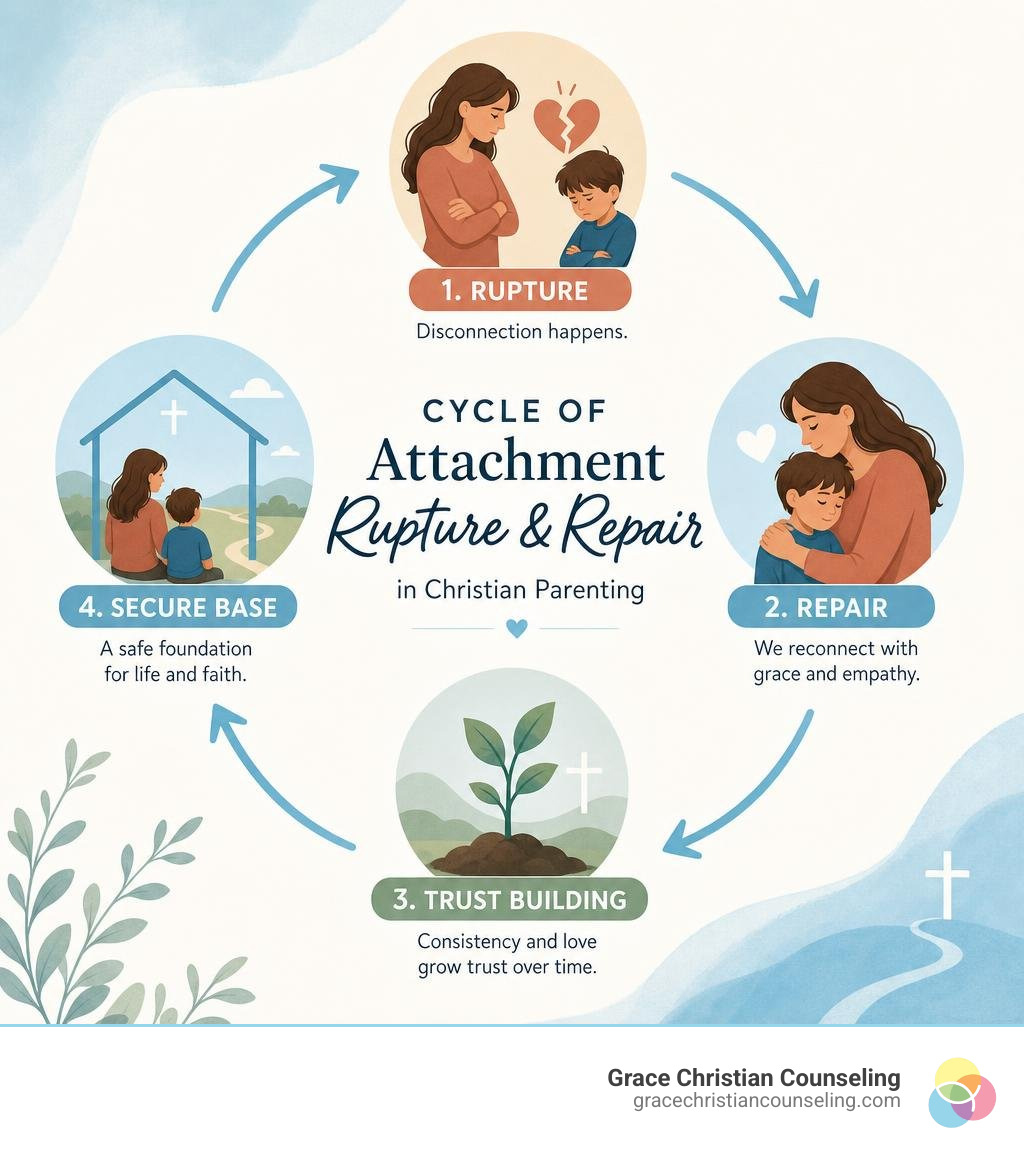
The Power of Rupture and Repair
You do not have to be a perfect parent to foster secure attachment. In fact, research indicates that caregivers only need to respond accurately about 30% of the time to build a secure bond. Developmental psychologist Ed Tronick’s work on parent-infant interaction shows that even loving, attentive caregivers miss cues and fall out of sync with their children at times. In one frequently cited study, Tronick and Jeff Cohn found that mother-infant pairs moved in and out of coordinated interaction; later summaries of this work note that mismatches were often repaired quickly, with about 70% repaired in the next interactive step and new repairs occurring every three to five seconds. What matters most is not avoiding every mistake, but what you do after a mistake is made. Learning to notice the rupture and move back toward connection. This is the cycle of rupture and repair.
A rupture occurs when we lose our temper, misunderstand our child, or react out of frustration. Repair is the intentional act of stepping in, owning our mistake, and seeking reconciliation. This process mirrors the biblical concepts of repentance, forgiveness, and restoration. When we apologize to our children, we teach them that relationships can survive conflict, which is a vital concept for a child with attachment trauma.
Simple scripts can help initiate repair:
- “I am so sorry I raised my voice earlier. I was feeling frustrated, but it was not okay for me to yell. Will you forgive me?”
- “I missed that you were feeling scared when we left the store. I want to make sure you always feel safe with me. Let’s try that transition again together.”
Balancing Nurture and Structure
Healing requires a delicate balance of nurture and structure. High nurture without structure can lead to permissiveness, leaving the child feeling anxious and uncontained. High structure without nurture can feel cold and punitive, triggering the child’s survival instincts.
To create a safe environment, we must provide clear, consistent boundaries while maintaining deep emotional warmth. When consequences are necessary, they should be natural, logical, and delivered with empathy rather than anger. For practical tips on navigating these family dynamics, read More info about resolving family conflict.
Healing the Parent’s Heart: The Key to Secure Attachment
We cannot lead our children to a place of emotional safety that we have not yet reached ourselves. Often, the behaviors that trigger us most in our children are direct reflections of our own unhealed childhood wounds or generational trauma. To parent a traumatized child with grace, we must be willing to look inward and seek healing for our own hearts.
Generational trauma can quietly shape how we respond to stress, conflict, and vulnerability. When we take the time to address these legacy issues, we interrupt the cycle of pain and pave the way for our children’s healing. You can find More info about healing generational trauma to help you begin this vital work.
Exploring Your Own Attachment History
Every parent brings their own attachment history into their parenting journey. If you grew up in a home where emotions were dismissed, conflict was explosive, or love felt conditional, you may carry insecure attachment patterns into your relationship with your children.
Understanding your own attachment style, whether it is anxious, avoidant, or disorganized, allows you to recognize your triggers before they lead to parenting ruptures. For example, if you have an anxious attachment style, your child’s emotional distance might trigger a deep fear of rejection, causing you to overreact or cling too tightly. If you want to explore your own relational patterns, we offer More info about healing anxious attachment to support your personal growth.
Abiding in Christ for Parental Resilience
Parenting a child with attachment trauma is a marathon, not a sprint. It is easy to experience compassion fatigue, secondary traumatic stress, and spiritual burnout. To sustain this work, we must prioritize our own spiritual and emotional renewal.
This means regularly taking our pain, frustration, and exhaustion to the Lord in prayer. It means surrounding ourselves with a supportive community that understands our challenges and does not judge our family. Most importantly, it means resting in the truth that our worth is secure in Christ, regardless of our parenting outcomes. We can find deep comfort in Scripture on finding peace, which promises that God’s peace will guard our hearts and minds.
Frequently Asked Questions about Attachment Trauma
How do I know if my child has attachment trauma or just a strong-willed personality?
While strong-willed children can be defiant and independent, children with attachment trauma exhibit deeper relational avoidance and physiological distress. A strong-willed child will still seek comfort from their parents when hurt or scared, whereas a child with attachment trauma may reject comfort, become hostile under stress, or show extreme hypervigilance.
Can a child fully heal from severe attachment wounds?
Yes, healing is entirely possible. Thanks to neuroplasticity, the brain’s ability to reorganize and form new neural connections, consistent relational safety can literally rewire a child’s nervous system. Over time, through steady care and professional support, a child can develop what psychologists call “earned secure attachment.” You can find More info about addressing childhood traumas to learn more about the hope and science behind trauma recovery.
How can our local church support families dealing with attachment trauma?
Churches can support families by fostering a trauma-informed environment, avoiding judgmental attitudes toward challenging behaviors, and offering practical help like respite care or meals. Church leaders can also partner with professional counselors to better understand the unique needs of foster, adoptive, and traumatized families.
Moving Toward Secure, Grace-Filled Connection
Parenting a child with attachment trauma is one of the most challenging callings a family can face, but you do not have to walk this road alone. At Grace Christian Counseling, we provide compassionate, professional, and Christ-centered care to help your family find hope and restoration.
Our licensed counselors serve families across Western Pennsylvania, with convenient locations in Pittsburgh, Penn Hills, Sewickley, Uniontown, Pleasant Hills, Bethel Park, Ligonier, Belle Vernon, Punxsutawney, North Huntingdon, and Mt. Lebanon, as well as statewide via online counseling in Pennsylvania, West Virginia, Georgia, and Florida.
We utilize a structured, four-stage healing journey called the Counseling Blueprint:
- Take Off the Mask: We build genuine rapport and trust in a safe, non-judgmental environment.
- Heal the Wounds: We explore the deep emotional and relational hurts that drive survival behaviors.
- Remove the Toxins: We identify and dismantle unhelpful beliefs, fears, and lingering lies.
- Replace with Truth: We install empowering, accurate perspectives based on God’s truth about your identity and security.
If you are ready to take the next step toward healing for your child and your home, we invite you to learn More info about attachment therapy and schedule a consultation with us today.
This guide is for educational and spiritual encouragement and is not a substitute for personalized professional counseling. If you are in crisis, please reach out for immediate help.


