

When we talk about recovery, it is easy to focus only on the behavior like drinking, gambling, pornography use, or another pattern that feels increasingly difficult to control. But recovery often involves looking at the whole person. Emotional pain, trauma, relationships, habits, mental health, biological factors, and spiritual struggles can all play a role. From a Christian perspective, recovery also creates space to examine sin, shame, identity, and our need for God’s grace and renewal. The goal is not to reduce a man to the label of “addict,” but to understand what is happening and help him pursue meaningful, lasting change.
One of the most powerful metaphors for this process is found in the book of Nehemiah. Nehemiah looked at the broken walls of Jerusalem and wept, but then he went to work. He surveyed the damage, gathered a team, and rebuilt the protection around his city. In the same way, men in recovery must survey the “broken walls” of their lives. Without a brutal honesty about where we are, we cannot move toward where God wants us to be.
We often see that men suffer silently because they believe they have to “tough it out.” But biblical recovery teaches that true strength is found in acknowledging our need for a Savior. It is about more than stopping a bad habit; it is about a total spiritual overhaul where we admit that our life has become unmanageable and that only God can restore us to sanity.
Aligning the 12 Steps with Bible Principles Men’s Recovery
Many men are familiar with the 12 Steps, but they may not realize how deeply these steps are rooted in the teachings of Jesus, specifically the Beatitudes found in Matthew 5. At Grace Christian Counseling, we believe that integrating these spiritual truths with clinical excellence provides a roadmap for the soul.
- Step 1: Powerlessness. “For I know that good itself does not dwell in me, that is, in my sinful nature” (Romans 7:18). This aligns with being “poor in spirit,” recognizing our total spiritual bankruptcy without God.
- Step 2: Hope. “For it is God who works in you to will and to act in order to fulfill his good purpose” (Philippians 2:13). This is the belief that a Higher Power—the living God—can and will restore us.
- Step 3: Surrender. “Therefore, I urge you, brothers and sisters, in view of God’s mercy, to offer your bodies as a living sacrifice” (Romans 12:1). We move from knowing God can help to actually turning our will over to Him.
- Step 4: Moral Inventory. “Let us examine our ways and test them, and let us return to the Lord” (Lamentations 3:40). This is the “searching and fearless” look at our past mistakes and the character defects that led us there.
By aligning these steps with Bible principles men’s recovery, we move from a secular self-help model to real spiritual change.
Breaking the Silence: Accountability and Godly Fellowship
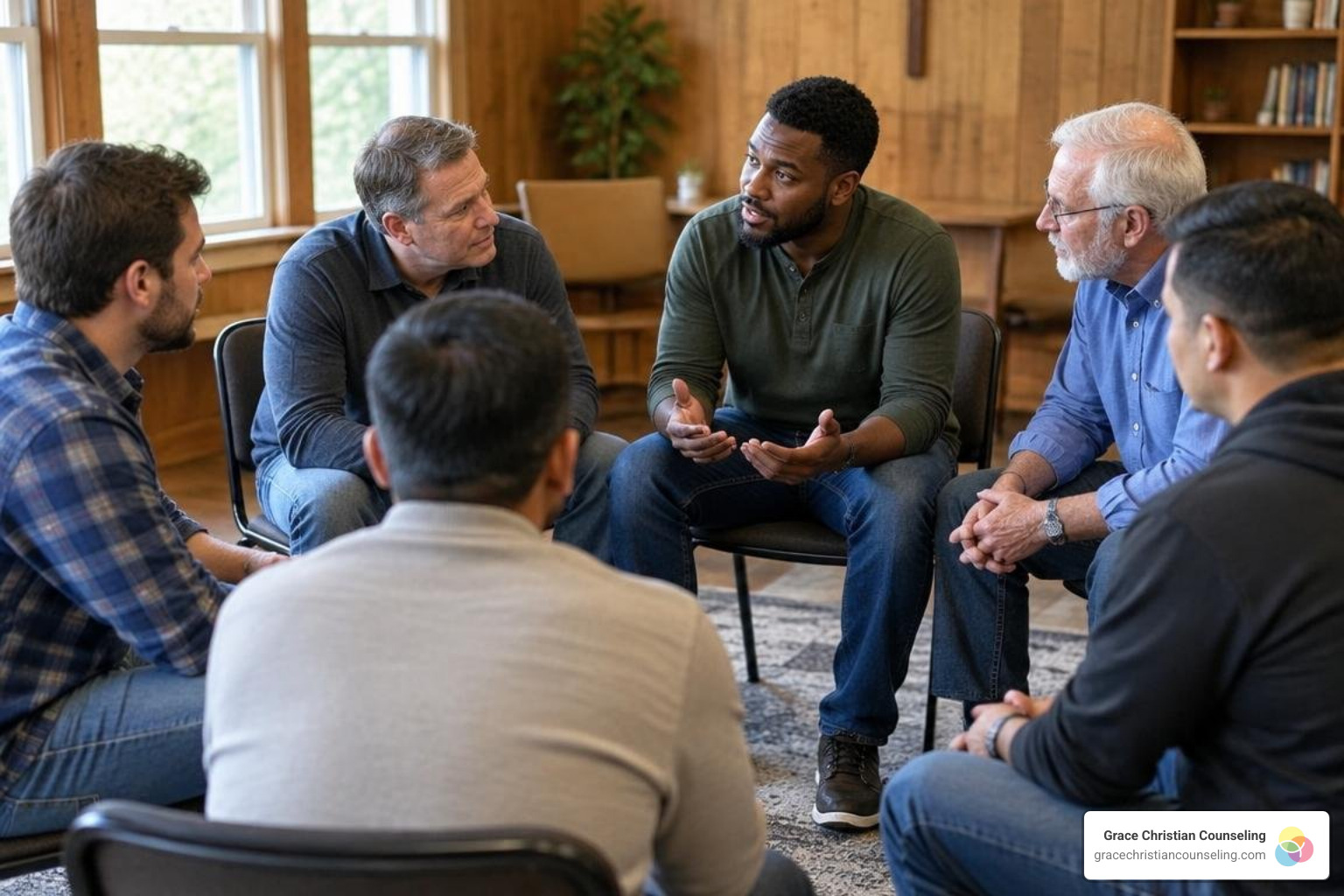
Isolation is the fuel of addiction. Most men struggle in the shadows, convinced that they are the only ones facing these giants. But the Bible is clear: “As iron sharpens iron, so one man sharpens another” (Proverbs 27:17). We were never meant to carry these burdens alone.
Accountability is more than having someone check your browser history; it is about “godly association.” Scripture warns that “bad company corrupts good character” (1 Corinthians 15:33), but the inverse is also true. Surrounding yourself with faithful brothers who will ask the hard questions—and who you can trust with the raw truth—is essential for staying sober.
In Western Pennsylvania, from the hills of Punxsutawney to the streets of Pittsburgh, we see men finding freedom when they finally step into the light. Whether through a local church small group or specialized support, unmasking trauma: the power of Christian trauma counseling helps men realize that their past does not have to dictate their future. If you are in Uniontown, North Huntingdon, or Bethel Park, finding a brotherhood of men who value integrity over image is your greatest defense against relapse.
Reclaiming Your Identity in Christ to Overcome Addiction
Perhaps the greatest lie addiction tells a man is that he is defined by his worst mistakes. You might feel like “the guy who relapsed,” “the guy who lied to his wife,” or “the guy who can’t stop.” But Bible principles men’s recovery shifts the focus from what you have done to who you belong to.
Scripture tells us, “Therefore, if anyone is in Christ, the new creation has come: The old has gone, the new is here!” (2 Corinthians 5:17). This isn’t just a nice sentiment; it is a legal and spiritual reality. When we address the “wounded identity” that often drives addiction—whether that wound came from childhood trauma, a distant father, or past failures—we begin to heal.
You are not a mistake; you are a “masterpiece” (Ephesians 2:10) and part of a “royal priesthood.” Understanding what God says about loving yourself is not about vanity; it is about accepting God’s verdict over your life. When you know you are a son of the King, you realize you don’t have to settle for the “table scraps” of addiction. We help men build a roadmap to wholeness: integrating faith and evidence by teaching them to walk in their spiritual authority over the enemy’s lies.
Practical Disciplines for Lasting Freedom
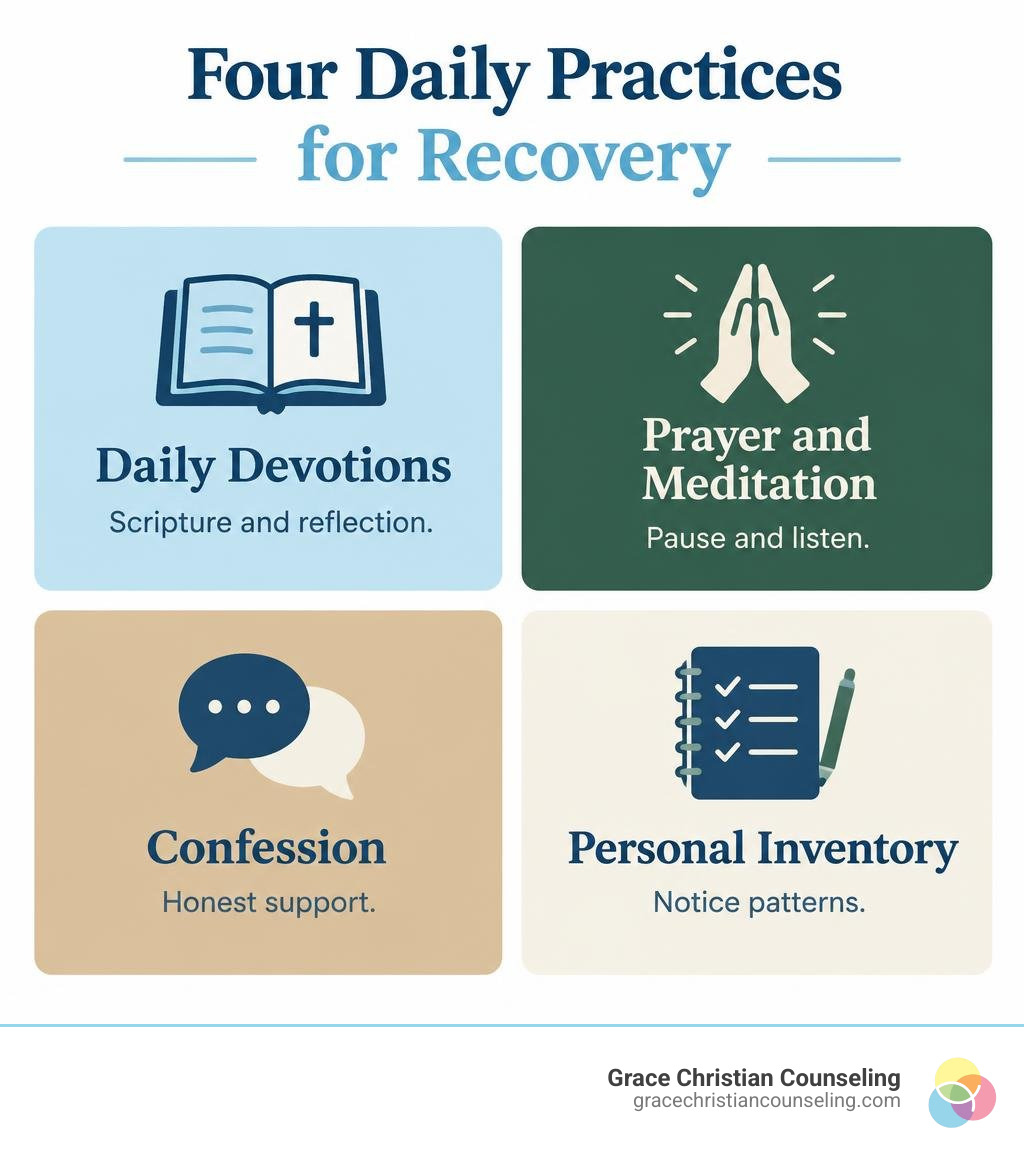
Recovery is not a one-time event; it is a daily walk. Just as a physical injury requires physical therapy, a spiritual struggle requires spiritual disciplines. These aren’t “rules” to follow to make God happy; they are lifelines that keep us connected to the Source of our strength.
- Daily Devotions: Begin with a brief, unhurried time to read Scripture, pray, and bring the day honestly before God. A notebook can help men notice recurring thoughts, emotions, and situations that make recovery feel harder. When difficult memories, shame, or strong urges arise, a licensed counselor or trusted recovery support can help connect spiritual reflection with practical coping skills.
- Prayer and Meditation: Prayer gives you a place to be honest with God about cravings, fear, anger, shame, or discouragement instead of carrying them alone. Biblical meditation can help you slow down, reflect on Scripture, and return to God’s truth when temptation or difficult emotions surface.
- Confession: James 5:16 points toward honest prayer and trusted community rather than secrecy. Sharing struggles with a trusted pastor, accountability partner, recovery support, or licensed Christian counselor can break isolation and create space for honesty, encouragement, and accountability.
- Personal Inventory: At the end of the day, take a few moments to consider what brought peace, what stirred distress, and where temptation felt strongest. This simple practice can reveal patterns involving sleep, isolation, conflict, or emotional overload before they become more difficult to manage. Bringing those observations to God and a trusted support person can encourage both humility and meaningful change.
By healing the heart with the Word, we find that the cravings and triggers can lose their power. We recommend keeping a list of Bible verses for mental health on your phone or mirror to use as “sword and shield” when temptation strikes. For Christian men, Scripture and spiritual disciplines can become meaningful parts of recovery, helping them respond to temptation with greater awareness, hope, and connection to God. At the same time, persistent cravings or substance use may require professional addiction treatment, medical care, recovery support, or medication depending on the substance and the individual’s needs. SAMHSA emphasizes that recovery can involve multiple forms of support, including counseling, behavioral treatment, medication, peer support, family support, and faith-based approaches.

Countering Lies with Bible Principles Men’s Recovery
The enemy of our souls is a master of the “shame cycle.” He tempts us by saying, “It’s not that big of a deal,” but the moment we fall, he switches to, “You’re a disgusting hypocrite; God is finished with you.”
We must counter these lies with the truth of John 8:32: “Then you will know the truth, and the truth will set you free.”
- The Lie: “I’ve failed too many times to be forgiven.” The Truth: God’s mercies are new every morning (Lamentations 3:22-23).
- The Lie: “If people knew the real me, they’d leave.” The Truth: God knows the “real you” better than anyone and still chose to die for you (Romans 5:8).
- The Lie: “I’ll never be free.” The Truth: “So if the Son sets you free, you will be free indeed” (John 8:36).
Using the “Armor of God” isn’t just for Sunday school; it is a practical strategy for spiritual warfare in the middle of a Tuesday afternoon craving.
The Path to Forgiveness and Purpose Beyond the Struggle
In the process of Bible principles men’s recovery, forgiveness is often the hardest bridge to cross. This includes receiving God’s forgiveness, forgiving those who hurt us (often the people who contributed to our trauma), and—perhaps most difficult—forgiving ourselves.
The story of the Apostle Peter is a perfect example. After denying Jesus three times, he was devastated. But Jesus didn’t just forgive him; He restored him and gave him a mission. You can learn from Peter to you: finding emotional recovery in Christ that your failure is not the end of your story.
One important step is making amends. Matthew 5:23-24 tells us that if we are offering a gift at the altar and remember our brother has something against us, we should go and be reconciled first. This is about taking ownership of the damage our addiction caused.
| Worldly Sorrow | Godly Sorrow |
|---|---|
| Focuses on the consequences (getting caught) | Focuses on the heart and the offense against God |
| Leads to shame and “hiding” | Leads to repentance and “turning” |
| Temporary behavior change | Lasting change in character |
| Produces death and despair | Produces life and freedom |
Finally, true recovery leads to purpose. We are not just “sober”; we are “sent.” Jesus said He came not to be served, but to serve (Mark 10:45). When a man uses his story to help another man, the “sting” of the past is removed. Your testimony gives hope to others still trapped in the dark.
Frequently Asked Questions about Biblical Recovery
Can a Christian man truly overcome deep-seated addiction?
Absolutely. While the struggle is real and often requires a combination of spiritual discipline and professional support, “nothing is impossible with God” (Luke 1:37). Recovery is a process of sanctification—becoming more like Christ over time. We have seen men in Western PA walk away from decades of substance abuse and pornography through the power of the Gospel and consistent counseling.
How is Christian counseling different from other approaches to addiction recovery?
Secular therapy offers many helpful tools, but it often ignores the spiritual dimension of a man’s life. Christian counseling at Grace Christian Counseling blends evidence-based clinical practices (like CBT and trauma-informed care) with the truth of Scripture. We don’t just talk about “coping skills”; we talk about “transformation.” We believe that for a man to be truly whole, his spirit, soul, and body must all be addressed.
Evidence-based addiction treatment can provide important tools for understanding substance use, triggers, relationships, trauma, and relapse prevention. Christian counseling can incorporate those clinical insights while also addressing spiritual concerns that matter deeply to Christian men, including identity, repentance, forgiveness, shame, relationships, purpose, and dependence on God.
Recovery does not have to be either clinical or spiritual. In fact, SAMHSA recognizes that recovery is highly personal and may include clinical treatment, medication, faith-based approaches, peer support, family support, and other resources. At Grace Christian Counseling, our goal is to help men receive appropriate clinical support without asking them to separate recovery from their Christian faith.
How do I handle a relapse while following Biblical principles?
A relapse does not mean that everything you have worked toward has been erased or that recovery has failed. It is important to respond quickly: reach out to your counselor, treatment provider, recovery supports, or trusted accountability person and look honestly at what contributed to the return to the behavior. For a Christian, confession, prayer, and supportive Christian community can also be important parts of that response. The enemy wants you to believe that one mistake means you have to start at zero. That is a lie. If you fall, you practice immediate confession (1 John 1:9), reach out to your accountability partners, and analyze what led to the fall. Was it hunger, anger, loneliness, or tiredness (HALT)? Use the relapse as a data point to strengthen your “walls” for the future.
If the relapse involves alcohol or drugs, it may also signal that the treatment plan needs to be resumed or adjusted. This is especially important after a period of abstinence because reduced tolerance can increase overdose risk with some substances. The National Institute on Drug Abuse explains that recurrence of substance use can occur during recovery and should prompt reevaluation of treatment rather than being viewed simply as personal failure.
A New Beginning: Finding Freedom Through Biblical Recovery
At Grace Christian Counseling, we understand the unique pressures facing men today. Whether you are in Pittsburgh, Sewickley, Ligonier, or connecting with us online from anywhere in Pennsylvania or Georgia, we are here to walk with you. Our licensed counselors provide a safe, non-judgmental space to apply Bible principles men’s recovery to your specific situation.
You don’t have to “man up” by suppressing your pain; you “man up” by having the courage to face it with Christ by your side. From Uniontown to Penn Hills, and throughout Western Pennsylvania, we offer Christian counseling services: find hope & healing that integrate clinical expertise with the power of the Holy Spirit.
If you’re ready to move forward, reach out to us today. There is a seat at the table for you, and there is a path to freedom that starts with a single step of faith.
This guide is for educational and spiritual encouragement and is not a substitute for personalized professional counseling. If you are in crisis, please reach out for immediate help.


