

Finding Faith-Based Therapy in Pittsburgh: What You Need to Know First
Pittsburgh christian counseling brings together licensed mental health care and biblical truth, so you can heal emotionally, relationally, and spiritually at the same time. If you are looking for a therapist in Western PA who respects your faith, here is a quick overview of what is available:
Top options for Christian counseling in Pittsburgh:
Finding Christian counseling in Pittsburgh:
- Look for a mental health professional with the appropriate Pennsylvania credentials and experience treating the concerns you want to address.
- Ask how the counselor integrates Christian faith with clinical care, including whether Scripture, prayer, or other spiritual practices are incorporated according to your preferences.
- Consider practical factors such as location, virtual availability, scheduling, cost, and insurance.
- Grace Christian Counseling provides Christ-centered counseling for individuals, couples, and families throughout Western Pennsylvania, with both in-person and online options.
What to expect from Christian counseling:
- Sessions with a licensed counselor (such as LPC, LCSW, LAPC, LSW, LMFT, etc.)
- Evidence-based methods like Cognitive Behavioral Therapy (CBT) alongside biblical principles
- A safe, non-judgmental space where faith integration is guided by your comfort level
- In-person or virtual options across Pennsylvania
Many people in Pittsburgh are searching for a therapist who understands both the clinical side of mental health and the spiritual side of being human. Anxiety, depression, grief, relationship struggles, and trauma are real, and they do not mean your faith is failing. As Philippians 4:6-7 reminds us, bringing our burdens to God and seeking support are not opposites; they work together.
This guide walks you through everything you need to know about finding the right faith-based therapist in Pittsburgh, from understanding how Christian counseling works to sorting out costs, insurance, and virtual care.
Understanding Pittsburgh Christian Counseling and How It Differs from Secular Therapy
When you begin looking for professional support, you might wonder what makes Christian therapy unique. Christian counseling does not require choosing between sound mental health care and your faith. Many forms of therapy can help people understand emotions, relationships, behaviors, and patterns of thinking. What distinguishes faith-integrated Christian counseling is that, when the client desires it, these conversations can also include Scripture, prayer, spiritual concerns, and questions about identity, meaning, forgiveness, suffering, and hope.
For example, a counselor using Cognitive Behavioral Therapy (CBT) may help you recognize patterns of thinking that contribute to emotional distress and develop healthier ways of responding. In Christian counseling, that clinical work can also include exploring how your beliefs and responses relate to biblical truth and your relationship with God.
By choosing Pittsburgh Christian counseling, you do not have to leave your faith at the door. We believe that true healing occurs when we address the spirit, the mind, and the body together. To explore this approach in more detail, you can read an essential guide to christian counseling. Our approach focuses on spiritual growth alongside emotional recovery. We recognize that human beings are created for connection with God and with one another; therefore, mental health struggles are not viewed as personal failures, but as opportunities to experience God’s grace in a deeper way.
Blending Clinical Excellence with Biblical Truth in Pittsburgh Christian Counseling
A common misconception is that Christian counseling only consists of reading the Bible and praying. While prayer and Scripture are central to our faith, professional faith-based therapy also utilizes proven, evidence-based clinical practices. We blend clinical excellence with biblical truth to give you the most comprehensive care possible.
For example, our counselors utilize Cognitive Behavioral Therapy, which helps you identify unhelpful thought patterns and behaviors. We look at these patterns through a biblical lens, comparing clinical cognitive distortions with what God says about your value and purpose. If you are dealing with deep trauma, we can incorporate trauma-informed techniques to help your brain and body process painful memories, all while relying on the comforting presence of the Holy Spirit.
By integrating clinical psychology with biblical values, we ensure that you receive top-tier professional care that honors your relationship with Christ. This integrated approach allows us to address mental health concerns while also honoring the faith, values, and spiritual questions that are important to you.
The Role of Licensed Counselors in Faith-Based Care
It is essential to work with a professional who is fully qualified to handle complex mental health issues. Our team includes mental health professionals with different levels of licensure and experience, including masters-level student interns, associate professional counselors and social work professionals. Associate-level counselors practice under qualified supervision as they complete the clinical experience required for independent licensure.
While pastors and ministry leaders provide wonderful spiritual guidance, they often lack the specialized clinical training required to treat severe anxiety, clinical depression, or deep-seated trauma. Licensed Christian counselors bridge this gap; we combine the professional standards of clinical therapy with the heart of pastoral care. When you sit down with a licensed counselor, you can trust that you are receiving safe, ethical, and highly competent care.
Our Counseling Blueprint: A Four-Stage Path to Healing
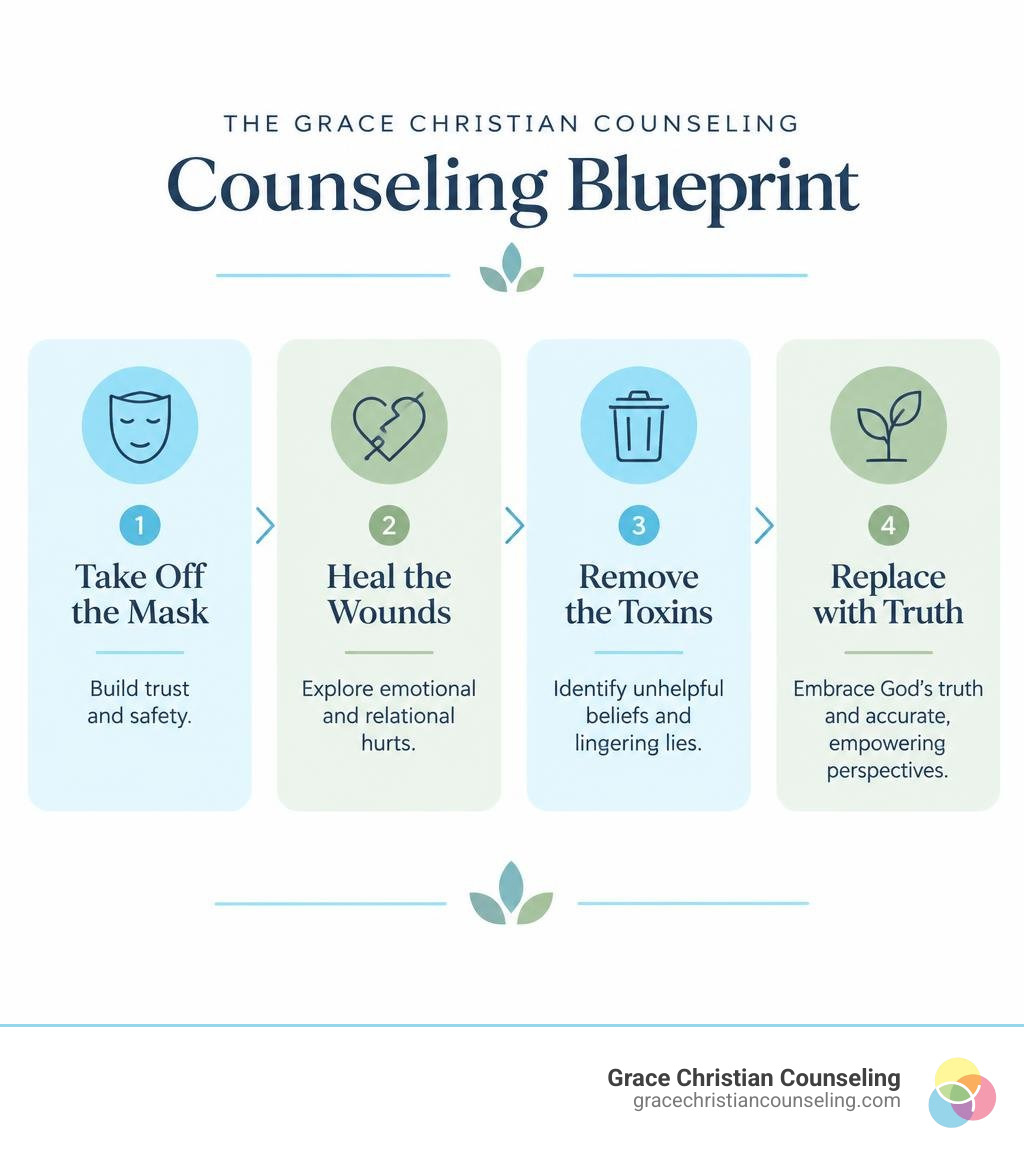
To guide our clients toward recovery, we use a structured framework known as the Counseling Blueprint. This blueprint ensures that your therapy is purposeful, organized, and focused on healing the whole person. To understand how we apply this framework to various mental health struggles, you can read about christian mental health counseling pittsburgh.
Stage 1 and Stage 2: Take Off the Mask and Heal the Wounds
The first stage of our blueprint is to Take Off the Mask. Many of us walk through life pretending that everything is fine, especially in our church communities. We carry a heavy burden of trying to look perfect, which only increases our feelings of isolation. In this first stage, we focus on building a genuine relationship of trust and safety; you are invited to drop the act and share your raw, honest struggles without fear of judgment.
Once we have established a safe foundation, we move to Stage 2, which is to Heal the Wounds. This involves exploring your emotional and relational hurts, which often stem from past trauma, family-of-origin issues, or difficult life transitions. We do not rush this process; rather, we gently sit with you in your pain, helping you talk through these experiences so that true emotional recovery can begin.
Stage 3 and Stage 4: Remove the Toxins and Replace with Truth
In Stage 3, we work together to Remove the Toxins. Toxins are the unhelpful, false beliefs that fester inside our emotional wounds. These are lies like “I am not good enough,” “God has abandoned me,” or “I will always be broken.” Using both clinical tools and spiritual discernment, we help you identify these cognitive distortions and see how they are holding you back.
Finally, in Stage 4, we Replace with Truth. We replace lies with accurate perspectives about yourself, others, and the world based on God’s Word. We help you embrace your true identity in Christ, allowing His truth to renew your mind and reshape your daily habits. This final stage solidifies your healing, leaving you equipped with practical tools to maintain your mental and spiritual wellness.
Common Mental Health Challenges Addressed by Faith-Based Therapy
Life in Western Pennsylvania can be stressful, leading to a variety of emotional and relational challenges. Our faith-based therapy is designed to address these struggles directly, providing a compassionate space for individuals, couples, and families.

Overcoming Anxiety and Depression with Spiritual Support
Anxiety and depression are among the most common reasons people seek professional help. Clinical depression can make you feel as though you are trapped in a dark pit, while chronic worry can leave you feeling constantly on edge. In these difficult moments, spiritual support can be a powerful source of comfort.
We offer specialized support to help you find relief, which you can explore further by visiting our page on christian depression counseling pittsburgh. We help you manage physical symptoms of anxiety and depression using clinical coping strategies, while simultaneously inviting the peace of God into your recovery. We look at biblical figures who struggled with deep despair and anxiety, reminding you that your feelings do not separate you from God’s love.
Healing from Trauma, Grief, and Spiritual Abuse
Trauma, grief, and spiritual abuse can shatter your sense of safety and make it difficult to trust others, including spiritual leaders. If you have experienced church hurt or spiritual manipulation, you may struggle to connect with God or find peace in a church community. Our counselors are trained in trauma-informed care and understand the unique pain of spiritual wounds.
We help you work through these complex feelings, allowing you to grieve your losses and rebuild your faith at your own pace. For additional resources on whole-person mental wellness and recovery, you can visit NuWellonline.com. We are committed to helping you find freedom from bitterness and resentment, guiding you toward a place of genuine peace.
Practical Considerations: Costs, Insurance, and Virtual Options
We believe that professional, faith-integrated mental health care should be accessible and practical for everyone in our community. Here is what you need to know about the practical details of scheduling a session.

Insurance and Affordable Care Options
When seeking professional therapy, understanding the financial aspect is highly important. Many clients choose to utilize their commercial health insurance plans to help cover the cost of care. It is always a good idea to contact your insurance provider directly to verify your mental health benefits, copays, or out-of-network coverage options.
If you do not have health insurance, or if your plan does not cover counseling, there are still affordable pathways to care. Many local organizations and networks offer sliding scale fees based on your household income, ensuring that financial limitations do not prevent you from receiving the support you need.
Accessing Virtual Care with Online Pittsburgh Christian Counseling
In our busy world, finding the time to drive to a physical office can be a significant barrier to starting therapy. To make care as convenient as possible, we offer secure, HIPAA-compliant telehealth options. This allows you to meet with a licensed counselor from the comfort and privacy of your own home.
For many concerns, research suggests that psychotherapy delivered by secure video can produce outcomes comparable to in-person care. For example, a meta-analysis of randomized controlled trials found video-based psychotherapy and in-person psychotherapy produced roughly comparable outcomes for depressive symptoms. Whether virtual counseling is the right fit depends on your needs, preferences, clinical concerns, and the professional’s ability to provide care where you are physically located. Whether you live in downtown Pittsburgh, Penn Hills, Sewickley, Uniontown, Pleasant Hills, Bethel Park, Ligonier, Belle Vernon, Punxsutawney, North Huntingdon, or Mt. Lebanon, you can easily connect with our team. To learn more about this convenient option, check out our page on online christian counseling pa.
Frequently Asked Questions about Faith-Based Therapy
Is seeking counseling a sign of weak faith?
Absolutely not. Seeking professional help is not a sign of weak faith; rather, it is a courageous step of stewardship over the mind and body God has given you. Throughout Scripture, we see God using practical means, community support, and wise counselors to bring about healing. Acknowledging our limitations and asking for help is an act of humility and trust in God’s provision.
How is faith integrated if I prefer a more clinical focus?
Your comfort level always guides our sessions. We respect your boundaries and will never force spiritual practices, Scripture, or prayer into your therapy. If you prefer a highly clinical focus, our licensed therapists will utilize evidence-based tools like CBT while maintaining a warm, Christian worldview in the background. You decide how much or how little explicit faith integration occurs in the room.
What credentials should I look for in a Christian therapist?
When searching for a therapist, you should always look for state-licensed professionals, such as a Licensed Associate Professional Counselor or a Licensed Social Worker. These credentials ensure that the therapist has met strict educational and ethical standards. To meet our team of qualified, compassionate professionals, you can browse our list of counselors.
Conclusion
You do not have to face life’s challenges alone. Whether you are dealing with anxiety, family conflict, deep grief, or the heavy burden of trauma, professional support that respects your faith is available right here in Western Pennsylvania. At Grace Christian Counseling, we are dedicated to helping you find the hope, healing, and spiritual freedom that God desires for you.
When you are ready to take the next step, we invite you to reach out and book a session with us today.
This guide is for educational and spiritual encouragement and is not a substitute for personalized professional counseling. If you are in crisis, please reach out for immediate help.


