
Anger Is One of the Most Common Struggles Christians Face
Scripture based anger help matters because anger affects more than your mood. Cleveland Clinic notes that unmanaged anger can harm your health, relationships, work, and daily life, while anger management helps you notice triggers and choose healthier responses. Biblical wisdom gives that process a stronger foundation.
Here are the core biblical principles for managing anger, drawn from Scripture:
- Feel it, don’t fuel it. Anger itself is not a sin. Ephesians 4:26 says, “Be angry and do not sin.” The problem is what you do with it.
- Be slow to anger. James 1:19 calls believers to be quick to listen, slow to speak, and slow to become angry.
- Don’t let it linger. Ephesians 4:26-27 warns not to let the sun go down on your anger, or you give the devil a foothold.
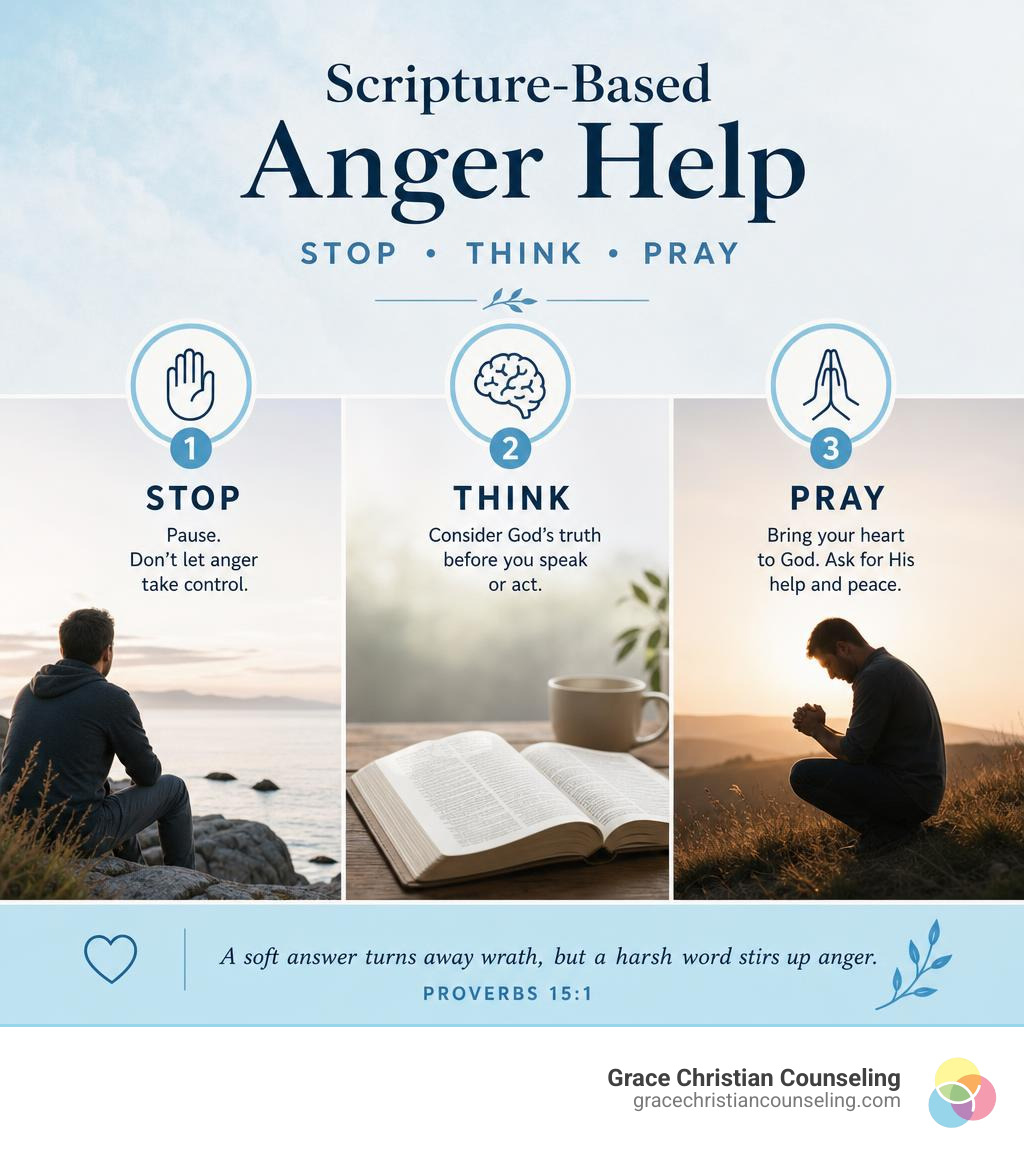
- Speak softly. Proverbs 15:1 reminds us that a gentle answer turns away wrath.
- Deal with the root. Anger is often a secondary emotion, covering fear, hurt, or pride. Scripture calls us to examine the heart, as seen in Luke 6:45.
- Pray first. Bringing anger to God before acting on it is the biblical standard.
- Forgive. Ephesians 4:31-32 calls believers to be kind, forgiving one another, and putting away bitterness.
Anger shows up in every life. It can be a flash of heat in traffic, a slow burn after a hard conversation, or a deep wound that never quite healed. For many Christians, it is a daily battle that quietly damages marriages, families, and faith.
The good news is that the Bible does not just tell you to stop being angry. It gives you a real path forward, one that starts in the heart and works outward into your relationships and your daily habits.
Why Anger Often Feels So Hard to Control
In counseling, many people are surprised to discover that anger is rarely the primary problem. What we often see beneath chronic anger is hurt, fear, disappointment, grief, shame, or a deep sense of being misunderstood.
A husband may appear angry every time he comes home from work, but underneath the frustration is exhaustion and the fear that he is failing his family. A wife may seem quick-tempered during conflict, while carrying years of feeling unheard. Parents may find themselves yelling at their children when what they are actually experiencing is stress and overwhelm.
This is one reason anger can feel so confusing. The emotion itself arrives quickly, but the deeper wounds underneath often remain hidden. Proverbs 4:23 reminds us to “guard your heart, for everything you do flows from it.” Lasting change usually begins when we stop asking only, “How do I control my anger?” and start asking, “What is my anger trying to tell me about my heart?”
Many Christians spend years trying to manage angry reactions without addressing the pain beneath them. Scripture-based anger help becomes much more effective when we invite God to heal both the behavior and the deeper wounds driving it.
The Heart of the Matter: Distinguishing Righteous from Sinful Anger
As we navigate the complexities of life in 2026, the pace of the world often leaves us feeling on edge. To find true Scripture based anger help, we must first understand what is happening in our hearts. In biblical terms, anger is a God-given capacity to respond to wrongs. However, because we are fallen human beings, this “God-given energy” is frequently hijacked by our own desires.
The Bible makes a clear distinction between “righteous indignation” and “sinful anger.” We see the perfect example of righteous anger in Jesus. When He overturned the tables in the temple (John 2:13-18), He wasn’t losing His temper because someone cut Him off in traffic. He was motivated by a zeal for God’s holiness and a desire to protect the vulnerable from exploitation.
Most of our daily anger, unfortunately, falls into the “sinful” category. This type of anger is usually rooted in pride, selfishness, or unmet expectations. When we don’t get our way, our “flesh” indulges in a hot-blooded passion that makes us the judge and jury of everyone around us.
| Righteous Anger | Sinful Anger | |
|---|---|---|
| Focus | God’s kingdom and justice | Self-interest and pride |
| Fruit | Leads to prayer and restoration | Leads to bitterness and destruction |
| Control | Disciplined and purposeful | Explosive or passive-aggressive |
| Duration | Resolved through redemptive action | Lingers and turns into a grudge |
As we explore What does the Bible say about anger?, we see that anger is often a secondary emotion. Like a shield, it hides deeper feelings of fear, hurt, or disrespect. Think of Cain and Abel; Cain’s anger was a reaction to his own heart issue, which eventually led to a tragic outburst. Luke 6:45 reminds us that “out of the abundance of the heart his mouth speaks.” If we want to manage our anger, we must allow the Holy Spirit to perform heart-level surgery.
Essential Scripture Based Anger Help: Key Verses for Transformation
The Word of God is our primary tool for “cooling the fire.” When we memorize and meditate on specific passages, we are essentially training our brains to respond with the Spirit rather than the flesh.
Key verses that offer immediate Scripture based anger help include:
- James 1:19: “Let every person be quick to hear, slow to speak, slow to anger.”
- Proverbs 15:1: “A soft answer turns away wrath, but a harsh word stirs up anger.”
- Ephesians 4:26: “Be angry and do not sin; do not let the sun go down on your anger.”
Why Believers Need Scripture Based Anger Help
Why does the Bible place such a high premium on being “slow to anger”? Proverbs 14:29 explains that “whoever is slow to anger has great understanding, but he who has a hasty temper exalts folly.”
Spiritual maturity is often measured by our ability to “overlook an offense” (Proverbs 19:11). This isn’t about being a doormat; it’s about having the strength to rule one’s spirit. A person who can control their temper is more powerful than a warrior who takes a city (Proverbs 16:32). By seeking Scripture based anger help, we are asking God to help us represent His character—the God who is “slow to anger and abounding in love”—to a world that is very quick to rage.
What Anger Looks Like Before It Explodes
One of the most common mistakes people make is waiting until they are already angry before paying attention to their emotions. The American Psychological Association notes that anger raises heart rate, blood pressure, and stress hormones, which is why early awareness matters.
In counseling sessions, many clients can clearly identify when they exploded, but struggle to recognize the warning signs that appeared hours earlier. Their shoulders became tense. Their thoughts grew increasingly critical. They began rehearsing arguments in their minds. Small frustrations started feeling larger than they really were.
Gottman research links conflict flooding with pulse rates around 100 beats per minute. Recognizing early signals matters because anger is physical before it is verbal: heart rate and blood pressure rise, stress hormones surge, and one meta-analysis found the two hours after an anger outburst were linked with a 4.74 times higher heart attack risk and a 3.62 times higher ischemic stroke risk.
Learning to recognize these early signals can be one of the most effective forms of anger prevention. Ask yourself:
- Do I become more impatient when I am tired?
- Do I withdraw before I become angry?
- Do I find myself replaying offenses repeatedly?
- Do I become increasingly critical toward others?
These moments are often invitations from the Holy Spirit to slow down, pray, and re-center before anger gains momentum. Many outbursts can be prevented when believers learn to notice the spark before it becomes a fire.
Daily Habits for Consistent Scripture Based Anger Help
Overcoming a “short fuse” requires more than a one-time prayer; it requires daily habits that build the “Fruit of the Spirit.” Self-control is listed in Galatians 5:22-23 as a direct result of walking with God and being made new by His Spirit.
Our guide on Healing From Anger And Aggression emphasizes that mind renewal is a process. Romans 12:2 tells us not to be conformed to this world but to be transformed by the renewal of our minds. This happens through prayerful meditation on the Word and a daily commitment to bring our triggers to the foot of the Cross.

Practical Biblical Strategies for Controlling Anger in the Moment
When you feel that “flash of heat,” your body is experiencing physiological flooding. Adrenaline spikes, your pulse rate climbs, and your “fight-or-flight” response takes over. In this state, your ability to communicate rationally is severely limited.
Here are some Anger Management Strategies For Adults that combine clinical wisdom with biblical truth:
- The Pause: Take a “timeout.” Walk away until your pulse returns to a resting level.
- Deep Breathing: Count backward from 50 while taking slow, deep breaths. This calms the nervous system.
- Take Thoughts Captive: Use 2 Corinthians 10:5 to evaluate your thoughts. Ask, “Is this thought true? Is it helpful? Does it honor King Jesus?”
- The Soft Answer: Intentionally lower your voice volume. As Proverbs 15:1 teaches, a soft answer can de-escalate a mounting argument.
Another practical method we suggest is “anger journaling.” By looking at the “5 W’s” (Who, What, When, Where, and Why) of your recent outbursts, you can begin to see patterns. Are you most angry when you are tired? Is it always with a specific person?
Frequently Asked Questions about Biblical Anger Management
We know that applying these principles can be difficult, especially when you are in the middle of a trial. Our licensed counselors (LAPC, LSW) in Western PA often receive these questions during Anger Management Counseling.
Is it always a sin to feel angry?
No. Anger itself is not automatically sinful. Clinically, anger is a normal emotion, often a signal that something feels threatening, unfair, painful, or out of control. Biblically, Scripture shows that God’s anger is holy and just, and Ephesians 4:26 says, “Be angry and do not sin.” The key question is what we do with anger. Does it move us toward truth, protection, repentance, and repair, or toward control, contempt, revenge, and harm? Righteous anger grieves what is wrong; sinful anger attacks the person instead of addressing the problem.
How can I apply “do not let the sun go down on your anger” in marriage?
Ephesians 4:26-27 is not a rigid rule that every issue must be fully solved before the literal sunset every day. The warning is about letting anger settle in, harden, and give the devil a foothold. Practice honest communication, prayer, and humility. If resolution takes time, agree to keep moving toward peace, without withdrawing, punishing, or nursing a grudge that leads to bitterness, resentment, etc.
Why do I keep getting angry about the same things?
Many people assume they have an anger problem when they actually have an unresolved hurt problem.
In Christian counseling, recurring anger is often connected to patterns that have existed for years. A person may react strongly to criticism because they grew up feeling constantly judged. Someone may become angry when plans change because uncertainty feels unsafe. Others carry unresolved grief, betrayal, or disappointment that continues to influence present-day reactions. This does not excuse sin, but it helps explain why some triggers feel much bigger than the situation itself.
When anger keeps showing up around the same themes, it is often worth asking a deeper question: “What wound, fear, expectation, or belief is being touched right now?” Bringing those deeper issues into prayer, trusted relationships, or counseling can help break cycles that behavior changes alone rarely solve.
When should I seek professional help for my anger?
If you notice chronic patterns of rage, physical aggression, or if your anger is sabotaging your relationships and career, it is time to seek help. There is great strength in admitting you can’t do it alone. Many times, anger is a symptom of deep trauma roots that require the care of a professional. At Grace Christian Counseling, we provide evidence-based clinical care that never compromises on Biblical truth.
Finding Lasting Peace in Christ
Managing anger is not about having a “perfect” personality; it is about being a person who is increasingly surrendered to the Holy Spirit. Whether you are in Pittsburgh, North Huntingdon, Penn Hills, or Uniontown, you don’t have to fight this battle in isolation.
Grace Christian Counseling serves communities across Western Pennsylvania, including Bethel Park, Sewickley, Mt. Lebanon, and Ligonier. Our team of licensed counselors is dedicated to helping you find the root of your anger and applying the healing truth of the Gospel. We offer both in-person sessions and online Christian counseling for those throughout Pennsylvania, West Virginia, Georgia, and Florida.
If you are tired of “seeing red” and are ready to experience the peace that surpasses all understanding, we are here for you. Let us help you move from a place of rage to a place of redemptive rest in Christ.
Contact Grace Christian Counseling today to schedule an appointment with a licensed professional who understands your faith and your struggle.
This article was researched with AI and heavily edited by Bekah McCrorey for accuracy and relevance.
Bekah McCrorey is a counselor at Grace Christian Counseling. She holds a Master’s degree in Counseling from Dallas Theological Seminary and a Bachelor’s degree in Christian Ministry from Chesapeake Bible College and Seminary. She is a provisionally licensed counselor working under supervision toward full licensure as a Licensed Professional Counselor (LPC) in Pennsylvania.
With over 12 years of full-time ministry experience supporting individuals, families, ministry leaders, and churches nationally and internationally, Bekah brings a deep understanding of emotional and spiritual struggles. As a counselor, she uses a client-centered, trauma-informed, and evidence-based approach. She is Level 1 trained in Restoration Therapy and is passionate about helping clients navigate anxiety, depression, grief, trauma, life transitions, and relational difficulties while integrating emotional and spiritual well-being.
This guide is for educational and spiritual encouragement and is not a substitute for personalized professional counseling. If you are in crisis, please reach out for immediate help.
Anger Management Counseling


