

When Your Marriage Feels Stuck, Can Online Counseling Actually Help?
Marriage counseling online is a real, effective option for couples who want professional support without the barriers of travel, rigid scheduling, or limited local availability. Here is what you need to know right away:
Quick answers:
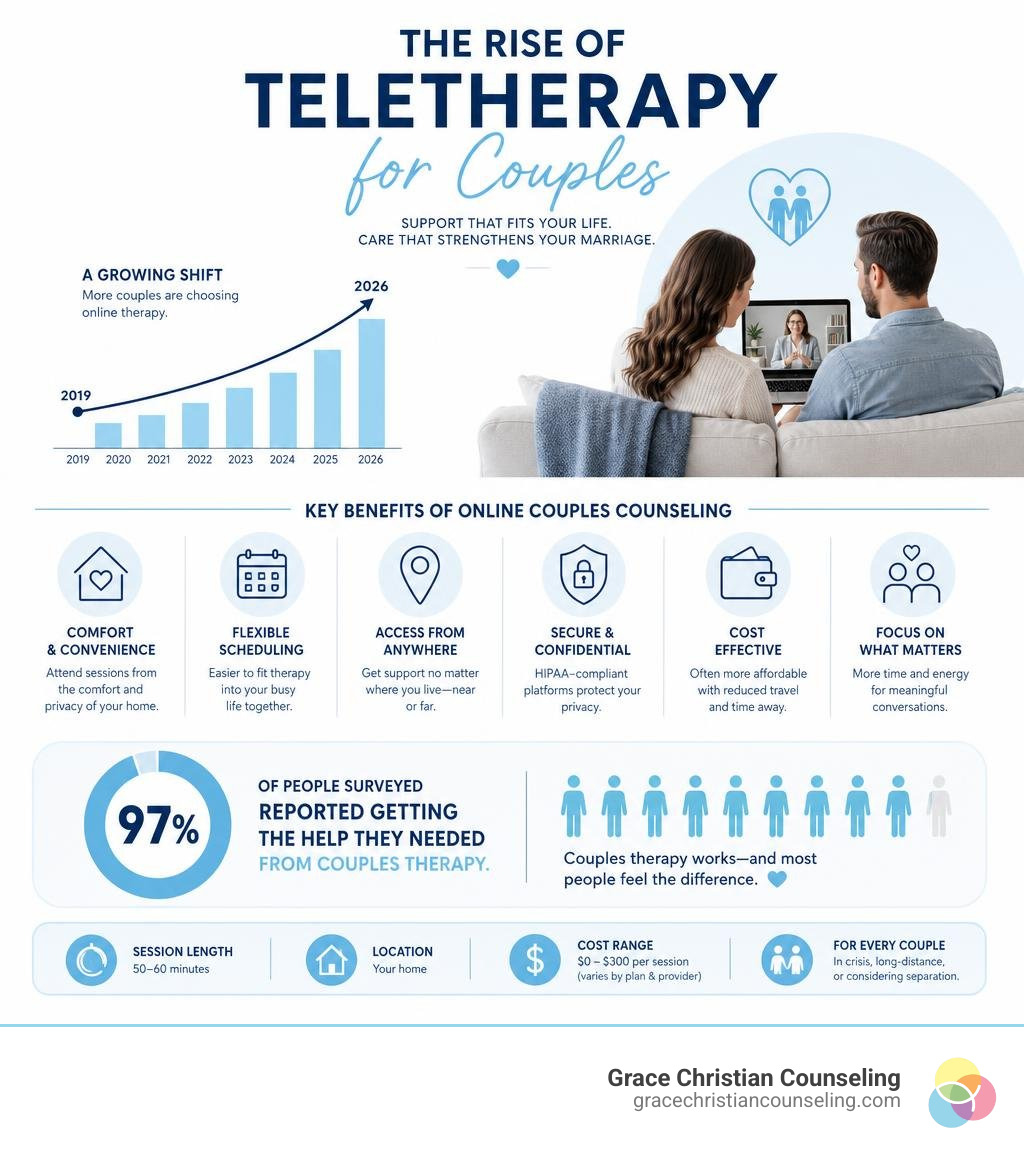
- Online marriage counseling uses secure video, messaging, or phone sessions with a licensed therapist
- Research shows it is as effective as in-person therapy for most couples
- Over 97% of people surveyed reported getting the help they needed from couples therapy
- Sessions typically last 50 to 60 minutes and can be done from your home
- Cost ranges from $0 (with insurance) to around $300 per session depending on your plan and provider
- It works for most couples, including those in crisis, long-distance relationships, or considering separation
Many couples wait too long before asking for help. By the time they do, small frustrations have grown into deep disconnection. If your marriage feels heavy, confusing, or lonely, that is exactly the moment when support matters most.
At Grace Christian Counseling, we combine evidence-based clinical methods with biblical truth and the guidance of the Holy Spirit to help couples in Western Pennsylvania and beyond find real healing, whether in person or online.
Understanding Marriage Counseling Online and How It Differs from In-Person Therapy
Many couples have found support by meeting with a counselor in an office, where a dedicated setting can help conversations feel focused. Today, telehealth offers another effective and helpful path for relationship care.
Online marriage counseling delivers the exact same professional therapeutic support through virtual sessions. Using secure, encrypted video platforms, couples can meet with a licensed counselor from the privacy of their own living room. The core clinical work remains identical to traditional therapy; your counselor will still guide you through exercises, facilitate active listening, and help you identify destructive communication patterns.
The primary difference lies in the setting and accessibility. In virtual therapy, you do not have to worry about rushing through traffic after work or finding a babysitter for your children. You simply log on from your computer or tablet. This modern format makes it much easier to integrate therapy into a busy lifestyle, ensuring that both partners can show up focused and ready to do the hard work of healing. To learn more about how we facilitate these virtual visits, you can find more info about online services on our dedicated portal.
Who Can Benefit Most from Marriage Counseling Online?
While any couple can benefit from virtual counseling, certain situations make the online format particularly advantageous.
- Premarital Couples: Couples preparing for marriage often juggle wedding planning, career building, and relocation. Virtual sessions allow them to build a strong foundation without adding scheduling stress. If you are preparing to tie the knot, you can read more about why premarital couples need counseling to start your journey on the right foot.
- Empty Nesters: When children leave the home, couples often realize they have forgotten how to connect as individuals. Virtual therapy offers a quiet, private space to redefine their partnership. For couples who want help rebuilding shared rhythms, support for reconnecting after children leave home can provide a focused place to begin.
- Long-Distance Partners: For couples living apart due to military deployment, work contracts, or family caregiving, online counseling allows both partners to join the same digital room from different locations.
- Busy Parents: Juggling school schedules, sports, and household chores leaves very little time for self-care. Virtual sessions can easily be scheduled during nap times or after the kids go to bed.
The Core Differences Between Virtual and Traditional Sessions
In a traditional office setting, the therapist controls the environment. The lighting, seating, and lack of distractions are carefully managed to create a neutral space.
When you choose virtual sessions, you bring that environment into your own home. This shifts the dynamic in a powerful way. Many partners find that they feel less defensive and more relaxed when sitting on their own couch. There is no awkward waiting room experience; you can grab your favorite mug of coffee and log in when you are ready.
While virtual therapy requires you to manage your own distractions, such as turning off your phone notifications and ensuring the kids are in another room, the trade-off is unparalleled convenience and comfort.
Does Marriage Counseling Online Actually Work? (The Evidence)
It is natural to wonder if virtual counseling can truly match the depth and impact of sitting in the same room as a therapist. Fortunately, clinical research has answered this question with a resounding yes.
Multiple studies demonstrate that virtual couples therapy is highly effective at helping partners grow closer, resolve conflicts, and improve their overall relationship satisfaction. The success of online counseling does not depend on the physical room; it depends on the clinical framework used and the commitment of the couple.
At Grace Christian Counseling, we use evidence-based approaches, including principles from the Gottman Method, to help couples see their patterns more clearly, reduce communication breakdowns, manage conflict, and rebuild emotional closeness. Research supports this kind of structured online help. In one randomized clinical study of 300 distressed couples, an online relationship program led to significant improvements in relationship satisfaction, relationship confidence, and negative relationship patterns, with some couples also reporting better individual emotional health. You can review that study published by the NIH here: online relationship intervention research.
What the Statistics Say About Virtual Couples Therapy
The numbers paint a very encouraging picture for couples considering virtual support:
- 97% of people surveyed by the American Association of Marriage and Family Therapy believe they received the exact help they needed from couples therapy.
- 70% of couples report that professional counseling successfully helped them salvage their marriage.
- 90% of individuals reported a significant improvement in their emotional health after completing couples therapy.
- In clinical studies examining online relationship programs, 94% of couples reported high satisfaction, and 91% of partners experienced measurable relationship improvements.
- Furthermore, research on virtual telehealth platforms indicates that 80% of users found online therapy to be just as effective, if not more effective, than traditional face-to-face sessions.
These statistics prove that you do not need to sit in a physical office to experience emotional healing, restored trust, and healthier communication patterns.
Key Benefits of Choosing Marriage Counseling Online
Choosing virtual therapy offers several distinct advantages that can make your healing journey smoother:
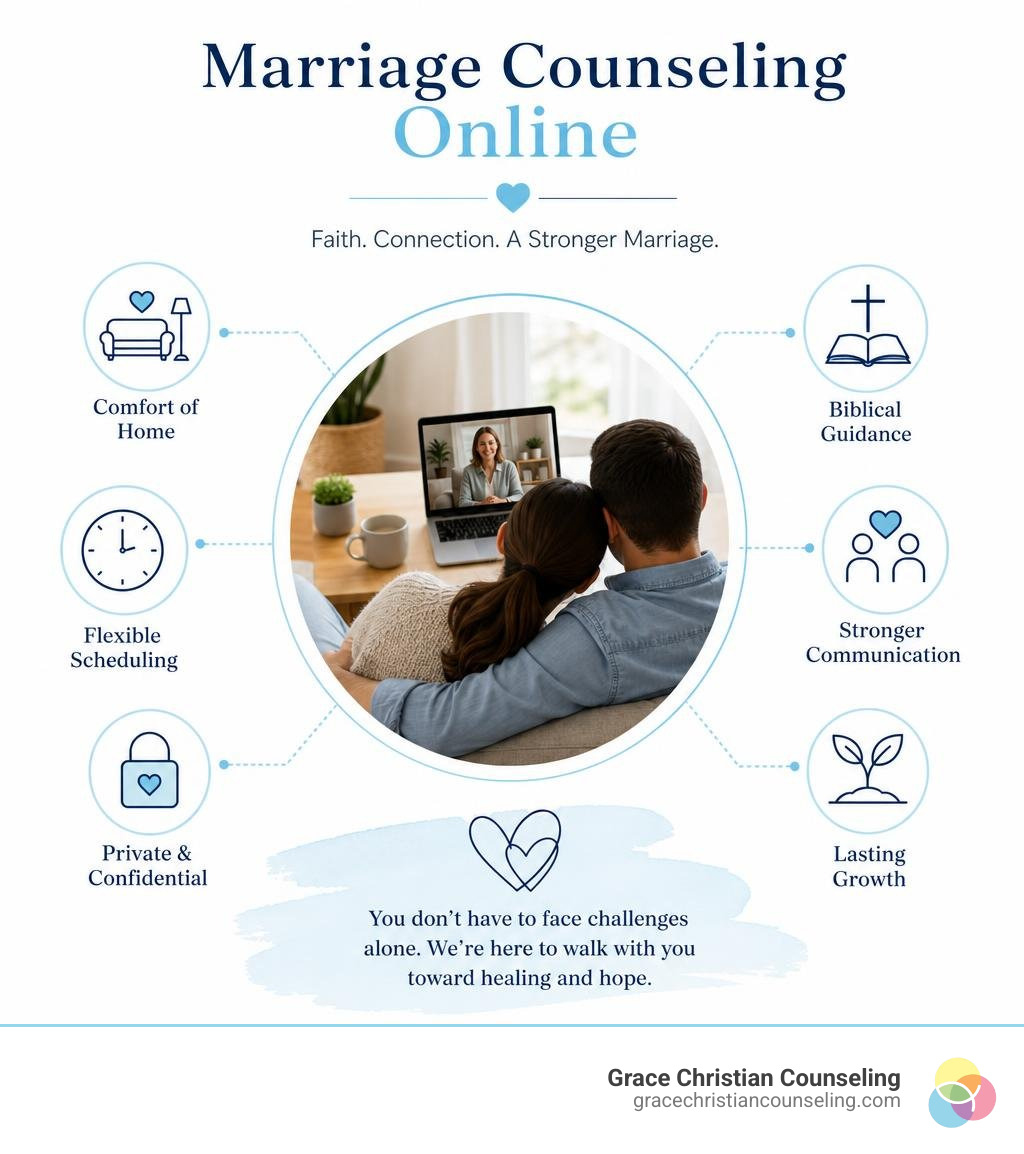
- Greater Affordability: Online therapy often reduces overhead costs, making it a highly cost-effective option. Additionally, you save money on gas, parking, and childcare.
- Unmatched Comfort: You can discuss difficult, vulnerable topics from the safety and familiarity of your own home, which often helps partners open up more quickly.
- Access to Top-Tier Specialists: You are no longer limited to counselors who live within driving distance. You can work with highly qualified, state-licensed therapists who align with your values, regardless of where they are located in Pennsylvania.
- Flexible Scheduling: Virtual counselors often offer wider scheduling windows, including early morning, evening, or weekend slots, making it easy to find a time that works for both of you.

Common Relationship Issues Addressed in Virtual Therapy
Virtual therapy is not a “light” version of counseling; it is a robust clinical space capable of handling the most complex marital struggles. Whether your relationship is facing a sudden storm or a slow, quiet drift, online counseling can help you navigate the path forward.
Many couples seek help when they realize they are caught in repetitive, exhausting arguments that never seem to reach a resolution. Others reach out because they feel like roommates rather than romantic partners. If you are wondering if your relationship has reached this point, you can explore the common signs your relationship needs support to gain more clarity. For a comprehensive overview of how professional care can guide you, we encourage you to read The Ultimate Guide to Christian Counseling for Relationships.
Rebuilding Trust and Emotional Intimacy
When trust is broken through infidelity, financial deception, or emotional withdrawal, the damage can feel permanent. Rebuilding that bond requires a safe, structured environment where both partners can express their pain without escalating into further conflict.
In virtual sessions, your counselor will help you identify the root causes of the betrayal and establish clear, healthy boundaries. We work on fostering emotional vulnerability, helping you move away from defensiveness and toward genuine empathy. If you are ready to start working on these skills at home, you can read our practical guide on how to improve communication in marriage. Understanding these dynamics is a vital step, and you can explore how clinical, faith-integrated care makes a difference by reading about how professional Christian marriage counseling saves relationships.
Navigating Life Transitions and External Stressors
Even the strongest marriages can be strained by external pressures. Life transitions often disrupt established routines and force couples to renegotiate their roles. Common stressors addressed in virtual therapy include:
- Career Changes and Job Loss: Financial strain and professional uncertainty can trigger anxiety, leading to miscommunication and tension.
- Empty Nest Syndrome: When children grow up and move away, partners must learn to reconnect with one another outside of their parental identities.
- Caregiving Responsibilities: Caring for aging parents or a child with special needs can leave partners feeling physically and emotionally depleted, leaving little energy for the marriage.
Navigating these seasons requires patience, grace, and practical coping strategies. You can find encouragement and guidance on this topic by reading our resource on navigating marriage challenges.
How to Choose the Right Platform and Prepare for Your First Session
Finding the right counselor is a deeply personal decision. Because virtual therapy relies on video connection, you want to ensure you choose a platform and a professional that make you feel safe, respected, and understood.
Preparation is key to getting the most out of your therapeutic journey. Before your first appointment, it is incredibly helpful to discuss your goals as a couple and agree to approach the process with an open mind. To help you feel confident and prepared, we have put together a detailed guide on how to prepare for couples counseling.
What to Look for in a Licensed Counselor
When selecting a counselor for marriage counseling online, you should look for specific credentials and clinical experience:
- Credentials: Ensure your counselor is state-licensed, holding credentials such as a Licensed Associate Professional Counselor (LAPC), Licensed Social Worker (LSW), or Licensed Marriage and Family Therapist (LMFT).
- Couples Specialization: Marriage counseling requires a different skill set than individual therapy. Choose a professional who has specific training in evidence-based couples modalities.
- Shared Values: For many couples, integrating their Christian faith into the healing process is essential. Look for counselors who can seamlessly blend psychological expertise with biblical truth.
We are proud to offer this specialized, Christ-centered care, and you can learn more about our team by visiting our page on professional Christian counseling in Western Pennsylvania.
What to Expect During Your First Virtual Session
Your initial session is primarily about assessment and connection. Your counselor will ask questions to understand your relationship history, your current challenges, and your hopes for the future.
We will work together to establish clear goals and design a customized treatment plan. You will also learn practical communication exercises to practice at home between sessions. Think of this first meeting as a collaborative conversation; it is an opportunity for you to get to know your therapist and experience how virtual counseling works.
Frequently Asked Questions About Online Couples Therapy
To help you make an informed decision, we have compiled answers to the most common questions couples ask when considering virtual therapy.
Can online marriage counseling work if only one spouse is ready?
Yes, online marriage counseling can still help, but it works best when both spouses are willing to participate. If one person is hesitant, starting with an individual session can be a wise first step. A counselor can help you understand relationship patterns, reduce reactivity, set healthier boundaries, and choose responses that are more calm and constructive.
Clinically, one partner’s changes can shift the tone of the relationship, especially when conflict cycles have become repetitive. That said, individual counseling is not a full substitute for couples therapy, because the counselor cannot assess both perspectives or guide shared communication in the same way. Often, the goal is to create enough safety, clarity, and momentum that the hesitant spouse may become more open to joining later.
How long does online marriage counseling usually take?
It depends on the couple, the issues involved, and how consistently you practice between sessions. Some couples feel progress after a few focused sessions, especially when the main goal is improving communication or making a specific decision. Others benefit from longer support, particularly when rebuilding trust, healing after betrayal, or working through years of conflict.
A good counselor will usually start with an assessment, help you name clear goals, and then use practical exercises to change the patterns that keep causing pain. The real work also happens between sessions, in the small conversations, repairs, and choices you make at home. If there is abuse, addiction, or serious mental health risk involved, online marriage counseling may still help, but it should include careful safety planning and the right level of clinical support.
Do we need to be in the same room for virtual couples counseling?
Not always. Many counselors can meet with couples who are in different locations, as long as privacy, safety, and licensing rules are protected. This can be helpful for travel, work schedules, military families, long-distance relationships, or temporary separation.
Each person should have a private space where they can speak honestly without being overheard or interrupted. Your counselor may also need to confirm where each partner is physically located during the session, since telehealth laws can vary by state. If there is active abuse, intimidation, or a safety concern, the counselor may recommend a different plan before starting joint sessions.
Is virtual counseling suitable for couples in severe crisis or considering separation?
Yes, virtual counseling can be incredibly effective for couples in crisis. If you are dealing with deep-seated resentment, discussing divorce, or struggling to communicate without explosive arguments, online sessions offer a structured, neutral ground to slow down and listen.
However, if your relationship requires a highly concentrated effort to break through years of pain, a traditional weekly schedule might not feel like enough. In these situations, we often recommend a structured, intensive format to jumpstart your healing. You can learn more about this deep, focused approach by exploring our Christian Marriage Intensive program.
Safety Note: If your relationship involves active domestic violence, physical abuse, or safety concerns, virtual couples therapy is not appropriate. Please reach out to local emergency services or a domestic violence hotline for individual safety planning.
What privacy and security measures should we look for in a provider?
When participating in virtual therapy, your privacy matters, and it is worth asking a few direct questions before your first session. Your provider should use a secure, HIPAA-compliant platform with appropriate safeguards for video, audio, messaging, and records. That simply means the technology is designed to protect your health information and reduce the risk of unauthorized access.
You can also help protect the session by joining from a private room, using headphones, and avoiding shared or public Wi-Fi when possible. A good counselor will explain confidentiality, how your information is stored, and the rare situations where privacy has legal or safety limits, such as risk of harm or abuse. If anything feels unclear, ask; a trustworthy provider will welcome the question.
Finding Hope and Healing Through Online Marriage Counseling
Your marriage is one of the most significant investments you will ever make. While relationship challenges can feel overwhelming, you do not have to navigate them alone. Online marriage counseling offers a convenient, scientifically proven, and deeply supportive way to rebuild your bond from the comfort of your own home.
At Grace Christian Counseling, we are dedicated to walking alongside couples in Western Pennsylvania and across the state. As of June 2026, we are also able to meet with couples living in WV, GA, and FL. Our licensed counselors provide compassionate, Christ-centered care that honors your faith while utilizing evidence-based clinical practices.
If you are feeling anxious or uncertain about the future, we encourage you to hold fast to the promise found in Philippians 4:6-7: “Do not be anxious about anything, but in everything by prayer and supplication with thanksgiving let your requests be made known to God. And the peace of God, which surpasses all understanding, will guard your hearts and your minds in Christ Jesus.”
Take the first step toward a stronger, healthier relationship today. We invite you to Schedule a Christian Marriage Counseling session with our team and begin your journey toward lasting healing.
This guide is for educational and spiritual encouragement and is not a substitute for personalized professional counseling. If you are in crisis, please reach out for immediate help.
Christian Relationship Counselor: Tips for Finding One You Trust


