
When Faith and Healing Need to Work Together
Licensed Christian counselors in WV are licensed mental health professionals who bring both clinical training and a biblical worldview into the therapy room. If you’re looking for one, here’s what you need to know right away:
- While West Virginia faces ongoing mental health provider shortages in some rural communities, residents can access a growing number of licensed Christian counselors through both in-person and telehealth services throughout the state.
- Licensed Christian counselors hold state credentials such as LPC, LAPC, LICSW, or LSW, the same licenses as secular therapists
- They accept major insurance plans including BlueCross BlueShield, Aetna, Highmark, UnitedHealthcare, Cigna, Medicaid, and TRICARE
- Online Christian counseling is available statewide, including rural and Appalachian communities
- Grace Christian Counseling serves West Virginia residents through online counseling
Finding the right counselor is hard enough. Finding one who understands your faith, too, can feel even harder. Many Christians across West Virginia carry real struggles, including anxiety, depression, grief, and relationship pain, while also feeling like secular therapy won’t honor what they believe.
Why Many Christians Wait Longer Than They Need To
One of the most common things Christian counselors hear from new clients is, “I wish I had come sooner.”
Many people spend months—or even years—trying to carry emotional burdens on their own. They pray, read Scripture, talk with trusted friends, and hope the struggle will eventually pass. While those can be valuable sources of support, some challenges continue to affect daily life despite a person’s best efforts.
In counseling, it is common to meet individuals who have been living with anxiety, depression, grief, relationship strain, or unresolved trauma for far longer than their families realize. By the time they reach out, many are emotionally exhausted from trying to manage everything alone.
Seeking counseling is not a sign that faith has failed. For many believers, it is simply the next faithful step toward healing, growth, and support.
Research from the American Psychological Association consistently shows that people who receive appropriate mental health treatment often experience meaningful improvements in emotional well-being, relationships, and overall functioning. The earlier support begins, the easier it can be to address unhealthy patterns before they become deeply entrenched.
You shouldn’t have to choose between professional care and your faith. The good news is that you don’t have to. Licensed Christian counselors combine evidence-based therapy with biblical truth, so your healing addresses the whole person: mind, heart, and spirit. This guide walks you through everything you need to find the right licensed Christian counselor in West Virginia, from understanding credentials to knowing what your first session will look like.
According to the Substance Abuse and Mental Health Services Administration (SAMHSA), approximately 1 in 5 U.S. adults experiences mental illness each year, underscoring the need for accessible, qualified mental health care across both urban and rural communities.
Rural states like West Virginia face additional barriers to care, including provider shortages and transportation limitations, making telehealth counseling an increasingly important access point.
What is a Licensed Christian Counselor in West Virginia?
A Licensed Christian Counselor in WV is a mental health professional who is fully licensed by the state of West Virginia to provide therapy, while also incorporating Christian values, biblical principles, and spiritual practices into their clinical work.
In West Virginia, these professionals are trained to understand both the complexities of human psychology and the depth of biblical truth. They do not view faith and science as enemies; rather, they understand that God has provided clinical tools to help heal the human mind, just as He has provided medicine to heal the physical body. When you work with a licensed Christian therapist, you do not have to leave your faith at the door. Your beliefs are treated as a vital asset in your healing journey.
Licensed Professional Counselors in West Virginia are regulated by the West Virginia Board of Examiners in Counseling and must complete graduate-level training, supervised clinical experience often totaling 2,000–4,000 hours, and national board certification exams such as the NCE (National Counselor Examination). This regulatory structure ensures that Christian counseling is not informal spiritual advice, but clinically accountable mental health treatment.
This holistic approach is designed to foster spiritual growth alongside psychological healing. While a secular counselor might help you manage stress using only cognitive tools, a Christian therapist will help you apply those same tools while also anchoring your identity in Christ, exploring what Scripture says about peace, and inviting the Holy Spirit into the healing process.
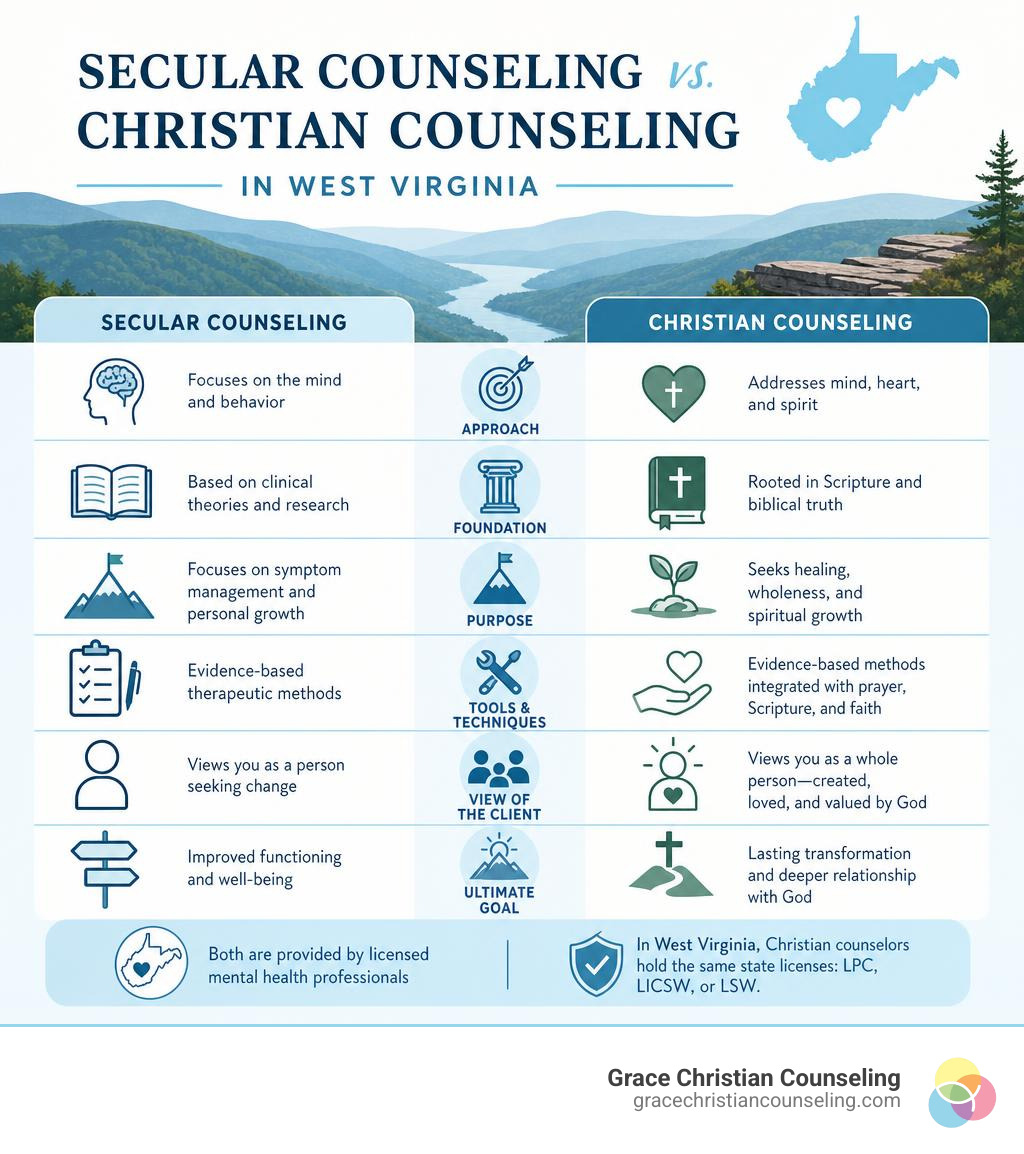
To help you visualize how these two approaches compare, here is a breakdown of their primary differences:
| Aspect | Secular Counseling | Christian Counseling |
|---|---|---|
| Foundational Authority | Humanist psychology, scientific research, and clinical theories. | Biblical truth, spiritual authority, and evidence-based clinical psychology. |
| View of the Human Person | A biological and psychological being shaped by environment and genetics. | A physical, emotional, and spiritual being created in the image of God. |
| Role of Faith and Prayer | Generally not included, or only addressed if the client brings it up. | Actively integrated through prayer, Scripture, and faith-based goal setting. |
| Ultimate Goal of Therapy | Symptom reduction, personal happiness, and self-actualization. | Holistic healing, restoration of relationships, and spiritual maturity in Christ. |
If you are looking for a deeper understanding of how these faith-integrated clinical services work, you can find More info about our services to learn how we blend professional psychology with biblical principles.
Licensing and Verification for Licensed Christian Counselors WV
When you are looking for a counselor, it is incredibly important to ensure they possess the necessary clinical credentials. Anyone can call themselves a “Christian counselor,” but a Licensed Christian Counselor in WV has met rigorous state standards for education, clinical experience, and ethical practice.
Working with a licensed professional ensures that you receive high-quality care that adheres to strict safety, privacy, and clinical standards.
State Licensing Requirements for WV Counselors
In West Virginia, licensed therapists must complete extensive academic and clinical training before they can practice independently. The most common credentials you will see in the Mountain State include:
- Provisionally Licensed Counselor (PLC): These professionals hold a master’s degree in counseling and practice under supervision while working toward full licensure as an LPC.
- Licensed Professional Counselor (LPC): These counselors hold a master’s degree in counseling or a closely related field from an accredited institution. They must complete supervised clinical experience and pass a national licensing exam.
- Licensed Graduate Social Worker (LGSW): These professionals hold a Master of Social Work (MSW) degree and have passed the required licensing exam. In West Virginia, they may provide social work services, including counseling-related support, within their scope of practice and supervision requirements.
- Licensed Independent Clinical Social Worker (LICSW): These professionals hold a Master of Social Work (MSW) degree, complete supervised clinical social work hours, and pass a board exam to practice therapy independently.
- Licensed Marriage and Family Therapist (LMFT): These therapists hold graduate training in marriage and family therapy or a related field, complete supervised clinical hours, and are licensed to help couples, families, and individuals with relational and mental health concerns.
The American Counseling Association emphasizes that clients should always verify licensure status, disciplinary history, and scope of practice before beginning treatment. This step is especially important in online searches, where the title “Christian counselor” is not legally regulated and may be used by both licensed and unlicensed providers.
These credentials guarantee that your therapist has studied human development, counseling theories, ethics, and crisis intervention. For you as a client, this means you are getting a professional who is equipped to handle complex mental health challenges, not just offer casual advice.
In addition, you may also encounter the following types of practitioners that can also support you in your mental health journey in their area of expertise:
- Licensed Psychologists: Provide testing, diagnosis, and therapy for mental health concerns; many hold a doctoral degree and may use evidence-based approaches with a Christian worldview when requested.
- Psychiatrists: Medical doctors who diagnose mental health conditions and prescribe medication; some also provide therapy or coordinate care with a Christian counselor.
- Psychiatric Mental Health Nurse Practitioners (PMHNP): Advanced practice nurses who assess, diagnose, and often prescribe medication; they may support treatment plans that respect your faith and counseling goals.
How to Verify Your Licensed Christian Counselors WV
Before you schedule your first appointment, it is wise to verify your counselor’s credentials. This step gives you peace of mind, knowing your therapist is in good standing with the state licensing board. Here is how you can do it:
- Check the State Licensing Board: You can visit the West Virginia Board of Examiners in Counseling website to look up an LPC or LAPC, or the West Virginia Board of Social Work Examiners website to verify an LICSW or LSW.
- Review Professional Associations: Many qualified Christian therapists belong to professional networks, such as the American Association of Christian Counselors (AACC). Membership in these organizations shows a commitment to ongoing training in faith integration.
- Use Trusted Directories: You can search online directories that verify licensing credentials automatically. For example, you can search Psychology Today to find verified professionals in your local area or statewide via telehealth.
How Faith and Clinical Practice Integrate in Christian Therapy
Some people worry that Christian counseling is just a Bible study with a different name. Others worry that it is secular therapy with a few scriptures tacked onto the end. True Christian counseling is neither of those things. It is an intentional, thoughtful integration of clinical excellence and biblical truth.
Evidence-Based Modalities with a Biblical Worldview
Licensed Christian counselors use the same proven therapeutic methods as secular therapists, but they view and apply them through a biblical lens. Here are a few examples of how clinical tools are integrated with faith:
- Cognitive Behavioral Therapy (CBT): CBT focuses on identifying and changing negative thought patterns. A Christian counselor will help you do this by comparing your thoughts to the truth of Scripture, helping you “take every thought captive” as described in 2 Corinthians 10:5.
- Eye Movement Desensitization and Reprocessing (EMDR): This powerful trauma therapy helps the brain reprocess painful memories. Your counselor can guide you through EMDR while providing a safe, Christ-centered space to process spiritual questions about pain and suffering.
- Acceptance and Commitment Therapy (ACT): ACT teaches mindfulness and psychological flexibility. In a Christian context, this translates to surrendering control to God, practicing biblical mindfulness, and committing to actions that align with your God-given values.
- Adlerian Therapy: This approach looks at how your family history and social connections shape your lifestyle. Your therapist will help you explore these dynamics while anchoring your ultimate sense of belonging and purpose in the family of God.
Research consistently supports the effectiveness of Cognitive Behavioral Therapy (CBT) for anxiety and depression. A meta-analysis published in Psychological Bulletin found CBT to be highly effective across anxiety disorders, with many studies reporting 60–80% symptom improvement rates depending on condition and population. When integrated with a client’s faith worldview, engagement and treatment adherence may improve for religious clients who prefer spiritually congruent care.
If you want to experience this clinical and biblical integration from the comfort of your own home, we offer Online Christian Counseling designed to meet you exactly where you are.
Common Issues Addressed by Licensed Christian Counselors WV
Life in West Virginia brings unique challenges, from the economic pressures facing our rural and mining towns to the quiet struggles families face behind closed doors. Licensed Christian therapists are equipped to address a wide variety of mental and emotional health concerns, including:
- Anxiety: Finding peace when life feels chaotic. Through Christian Anxiety Counseling, you can learn practical coping skills while learning to rest in God’s promises, reflecting on passages like Philippians 4:6-7.
- Depression: Finding hope in the darkness. Our Christian Depression Counseling program combines clinical strategies for mood regulation with spiritual support to renew your sense of purpose.
- Trauma and PTSD: Healing deep wounds from the past. Through Christian Trauma Counseling, we help you process traumatic experiences while walking a path of spiritual restoration and safety.
- Marriage and Relationship Pain: Rebuilding trust and communication. Our Christian Marriage Counseling helps couples apply biblical principles of forgiveness, grace, and love to restore their covenant relationship.
- Teen Challenges: Helping the next generation navigate modern pressures. We offer Christian Counseling for Teens to help adolescents build a strong identity in Christ while dealing with school stress, anxiety, and peer pressure.
Finding and Choosing the Right Counselor in West Virginia
Finding a therapist is a deeply personal process. Research shows that the “therapeutic alliance,” which is the relationship and trust between you and your counselor, is one of the most important factors in successful therapy. You want to find someone who is not only highly trained but also someone you feel safe talking to.
Questions Worth Asking Before Choosing a Counselor
Not every counselor will be the right fit, and that is okay. One of the healthiest things a prospective client can do is ask thoughtful questions before committing to ongoing therapy.
Consider asking:
- How do you integrate faith into counseling sessions?
- Have you worked with concerns similar to mine?
- What counseling approaches do you typically use?
- How do you approach trauma, anxiety, depression, or relationship issues?
- What can I expect during the first few sessions?
In clinical practice across rural and Appalachian regions, common presenting concerns often include anxiety related to financial strain, depression linked to geographic isolation, and relational stress influenced by intergenerational patterns and limited access to care. These trends align with national data showing higher mental health treatment barriers in rural populations compared to urban areas.
Experienced counselors welcome these conversations. In fact, many Christian therapists encourage prospective clients to ask questions because trust and transparency are foundational to effective care.
The goal is not simply to find a licensed professional. It is to find a counselor whose clinical expertise, communication style, and approach to faith feel like a good fit for your unique situation.
When searching for a counselor, look for someone who shows cultural sensitivity and respects your unique background. If you live in a small West Virginia town, you want a therapist who understands the values, work ethic, and community dynamics of Appalachian life. To learn more about our team and find a therapist who fits your needs, you can browse our list of professional Counselors.
What to Expect in Your First Session
It is completely normal to feel nervous before your first therapy session. Knowing what to expect can help ease your mind. Your first appointment is primarily an intake session, which is focused on getting to know you. Here is what typically happens:
- The Intake Process: Your counselor will ask about your history, your current struggles, and what prompted you to seek therapy.
- Setting Goals: Together, you will discuss what you hope to achieve through counseling, whether that is managing anxiety, saving your marriage, or healing from past trauma.
- Discussing Faith Preferences: Your counselor will ask how you would like to integrate faith into your sessions. You can decide if you want to start and end with prayer, look at specific scriptures, or simply keep a biblical perspective in the background of your conversations.
- Creating a Safe Space: This session is your opportunity to see if the counselor is a good fit for you. A good therapist will make you feel heard, respected, and completely safe.
What Clients Often Say After Their First Appointment
Many people feel nervous before their first counseling session. Some worry they will not know what to say. Others wonder whether they will feel judged or pressured to share more than they are comfortable discussing. In practice, we encounter many clients who leave their first appointment saying something surprisingly simple: “That wasn’t nearly as scary as I expected.”
The first session is rarely about having all the answers. It is about beginning a conversation. Most clients find relief simply from being able to speak honestly about what they have been carrying without feeling rushed, criticized, or misunderstood.
Christian counseling can be especially meaningful for people who have felt forced to separate their faith from their emotional struggles. Many clients express gratitude that prayer, Scripture, questions about God’s presence, and mental health concerns can all be discussed in the same room without conflict.
A strong therapeutic relationship is built over time, but many people begin experiencing hope the moment they realize they do not have to carry their struggles alone.
Insurance, Costs, and Online Counseling Options in WV
A major concern for many people seeking therapy is cost. Fortunately, mental health care is more accessible than ever, and many licensed Christian therapists accept insurance.
In West Virginia, Christian counselors regularly accept multiple major insurance plans, including:
- Highmark BlueCross BlueShield
- Aetna
- Cigna
- UnitedHealthcare
- Medicaid
- TRICARE (for military families and veterans)
If you choose to pay out-of-pocket, self-pay rates in the industry typically range from $25 per session for master’s-level clinical interns to $150 or more for fully licensed, experienced counselors. Many practices also offer sliding-scale fees based on your income.
For many West Virginians living in rural or mountain communities, driving to a physical counseling office every week is simply not practical. Winter weather, long distances, and busy schedules can make in-person appointments a barrier to healing.
This is where telehealth makes a massive difference. Through West Virginia Online Christian Counseling, you can receive the exact same high-quality, clinical, and faith-integrated care from the comfort and privacy of your own home. Online therapy is highly flexible, allowing you to schedule sessions during your lunch break, while your children are napping, or after work hours.
Frequently Asked Questions about Christian Counseling in WV
Does insurance cover Christian counseling in West Virginia?
Yes; as long as your therapist is a licensed mental health professional (such as an LPC or LICSW) and is in-network with your insurance provider, your insurance will cover Christian counseling just like secular therapy. Your standard copays, deductibles, and out-of-pocket rules will apply. It is always a good idea to contact your insurance company before your first session to verify your mental health benefits.
What is the difference between pastoral counseling and a licensed Christian counselor?
The primary difference lies in licensing, education, and state oversight:
- Licensed Christian Counselors hold master’s degrees in counseling or social work, have completed thousands of hours of supervised clinical training, and are licensed by a state board. They are bound by professional ethics and are trained to treat clinical mental health disorders like major depression, PTSD, and generalized anxiety.
- Pastoral Counselors are usually ministers, pastors, or church staff members who offer spiritual guidance, prayer, and biblical advice. While they are wonderful resources for spiritual direction and basic relationship advice, they are generally not licensed by the state to treat clinical mental health conditions unless they hold a separate professional license.
Is online Christian counseling as effective as in-person therapy?
Yes, absolutely. Extensive research published in respected medical journals, such as the Journal of Affective Disorders, has shown that online therapy is just as effective as in-person counseling for treating depression, panic disorder, social anxiety, and generalized anxiety.
Online therapy offers incredible convenience and privacy; you don’t have to worry about bumping into someone you know in a local waiting room. If you are looking for virtual options outside of West Virginia, Pennsylvania, Georgia, or Florida, you can also explore national faith-based networks like NuWell Online to find pastoral care or coaching.
Your Next Step Toward Faith-Based Healing in WV
Your emotional, mental, and spiritual health are deeply connected. When you are going through a difficult season, you deserve care that honors every part of who you are. Seeking help is not a sign of weak faith; it is a courageous step toward the abundant life God desires for you. As Psalm 34:18 reminds us, “The Lord is close to the brokenhearted and saves those who are crushed in spirit.”
At Grace Christian Counseling, we are dedicated to walking alongside you on your journey toward hope, freedom, and healing. Whether you are dealing with anxiety, working through trauma, or trying to rebuild your marriage, our licensed Christian counselors are ready to help.
Across psychotherapy research, one of the strongest predictors of successful outcomes is the quality of the therapeutic relationship, often called the “therapeutic alliance.” Studies published in the Journal of Counseling Psychology and Psychotherapy consistently show that the client–therapist relationship is a major factor in treatment success across modalities, often more predictive than the specific intervention used.
If you are ready to take that first step, you can Book a Session with us today. We are here to support you, pray with you, and help you heal.
This guide is for educational and spiritual encouragement and is not a substitute for personalized professional counseling. If you are in crisis, please reach out for immediate help.
Finding a Christian Therapist for Depression Who Understands


