

Blended Family Faith Counseling: What You Need to Know
Blended family faith counseling helps stepfamilies navigate the unique emotional, relational, and spiritual challenges that come with merging two families, using both evidence-based therapy and Biblical principles to build lasting unity.
Here’s what the research tells us at a glance:
- 40% of married couples with children in the US are blended families
- 1,300 new stepfamilies form every single day
- It takes an average of 5 to 7 years for a blended family to develop a shared identity
- Children often carry hidden grief, loyalty conflicts, and hopes that their biological parents will reunite
- Faith-based counseling provides a safe space to work through these layers — with clinical tools and the grace of God
One of the most helpful ways to think about blending a family comes from family therapist Ron Deal: you’re not using a blender, you’re using a Crockpot. Slow, steady, and intentional. Forcing things too fast leads to more harm than good. That’s exactly what makes this journey both hard and hopeful.
In a practical sense, that slower pace gives each person room to adjust without feeling pressured to perform closeness before trust has had time to grow. Children may need repeated reassurance that loving a stepparent does not mean betraying a biological parent, and adults may need patience when affection develops unevenly across the household.
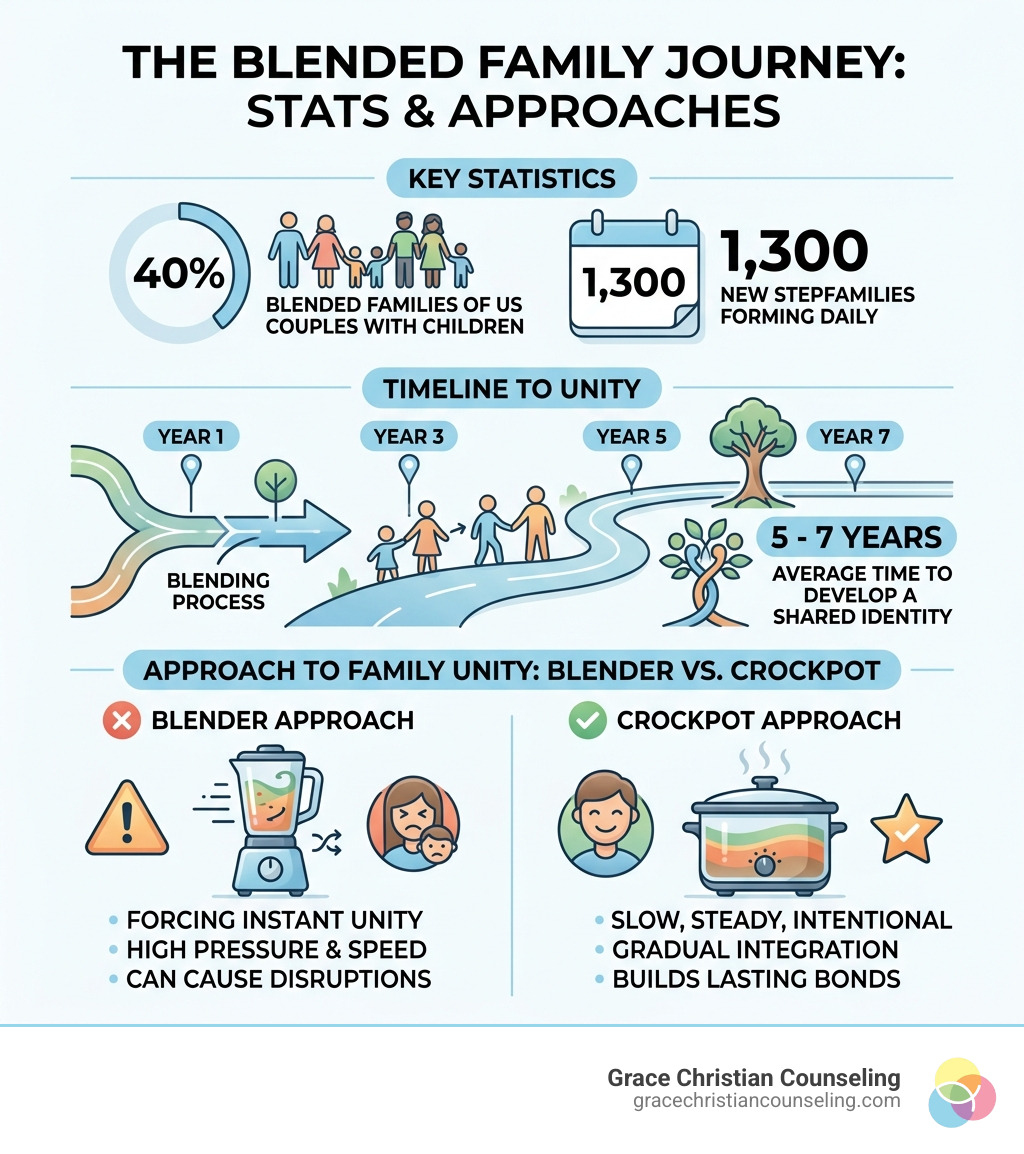
For Christian families, this patient approach also creates space for grace. Rather than forcing instant unity, parents can model humility, consistency, prayer, and repair after conflict. Over time, those small faithful choices can help a blended family move from simply sharing a home toward building a shared sense of belonging. That kind of growth often happens in ordinary moments, such as apologizing after a hard conversation, protecting a child’s relationship with both households, or choosing gentleness when old wounds are stirred up. In counseling, families can learn how to notice those moments and respond with both emotional wisdom and Christ-like compassion.
Understanding the Unique Dynamics of Stepfamilies

When we talk about blended families, we are talking about a significant portion of our community. The “traditional” family structure has evolved, and many married couples with children are navigating stepfamily dynamics. However, just because it is common doesn’t mean it is easy. The dynamics of a stepfamily are fundamentally different from those of a biological family, and recognizing these differences is the first step toward healing.
One of the primary challenges we see in Family Counseling is the “loyalty conflict.” Children often feel that if they love or enjoy their stepparent, they are somehow betraying their biological parent. This internal tug-of-war can lead to sudden outbursts, withdrawal, or “testing” behaviors. As parents, it is easy to take this personally, but through the lens of blended family faith counseling, we see this as a manifestation of a child’s unprocessed grief.
Every blended family is born out of loss, whether through divorce, abandonment, or the death of a parent. Even if the new marriage is a joyous occasion for the adults, for the children, it often represents the final death of the dream that their biological parents might one day reunite. This loss creates divided attachments. A child might feel like they are living in two different worlds with two different sets of rules, leading to significant stress.
Learning How To Resolve Family Conflict in this context requires a high degree of empathy. We must acknowledge that children are often “creatures of habit” who didn’t choose this new arrangement. They are reacting to a disruption in their sense of security. By understanding these dynamics, we can stop reacting to the behavior and start ministering to the heart.
A Biblical Perspective on Remarriage and Step-Parenting
It is a common misconception that the Bible is silent on the complexities of blended families. In reality, Scripture is filled with stories of non-traditional family structures, and it provides a robust framework for how we are to love and lead within them.
At the core of a healthy home is the sacred bond between husband and wife. As Mark 10:7-9 reminds us, “For this reason a man will leave his father and mother and be united to his wife, and the two will become one flesh… Therefore what God has joined together, let no one separate.” In a blended family, the temptation is often to put the children’s immediate happiness above the marriage relationship. However, a stable marriage is actually the greatest gift you can give your children. It provides the “secure base” they need to feel safe.
Biblical wisdom also emphasizes the importance of seeking guidance. Proverbs 15:22 states, “Plans fail for lack of counsel, but with many advisers they succeed.” This is why Navigating Marriage Challenges often requires external support. Whether you are dealing with the “ghosts” of past relationships or the practicalities of co-parenting with an ex-spouse, applying Biblical grace is essential.
Sacrificial love (Agape) is the standard for step-parenting. It is a love that chooses to serve and protect even when the feeling of “natural” affection hasn’t developed yet. This isn’t about pretending to be a biological parent; it’s about being a godly mentor and protector who models Christ’s love to children who may be resistant to it.
Strengthening the Home with Blended Family Faith Counseling
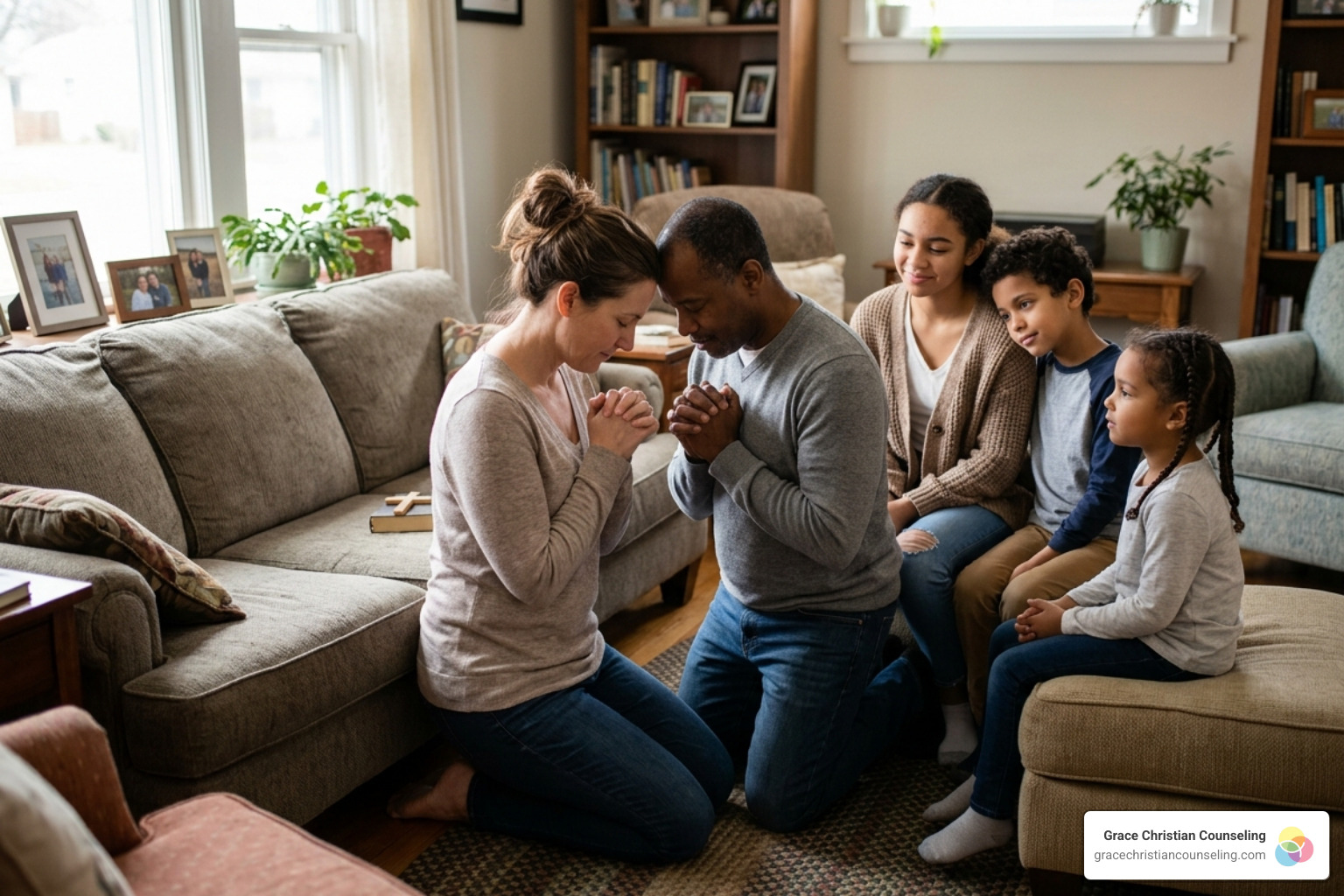
In our practice at Grace Christian Counseling, we view the marriage as the “engine” of the family. If the engine isn’t working, the whole car stalls. Blended family faith counseling focuses heavily on strengthening this marital foundation. We often refer to this as the “secure cord of three”—the husband, the wife, and God. When this cord is tight, the family can withstand the external pressures of ex-spouses, financial strain, and child resistance.
We provide couples with specific communication tools to handle “hot topics” like child support, holiday schedules, and discipline. Often, couples find themselves in a cycle of defensiveness. One spouse feels the other is too harsh with their biological child, while the other feels the first is too “soft.” Marriage Counseling helps bridge this gap by creating a unified front. For couples in deep crisis or those wanting a head start, a Christian Marriage Intensive can provide the concentrated time needed to break old patterns and establish new, healthy ones.
The Role of Prayer in Blended Family Faith Counseling
Prayer is not just a “nice addition” to therapy; it is a vital clinical tool. In blended families, the “spiritual warfare” can feel very real. Resentment, bitterness, and unforgiveness from past relationships can act like poison in the new home.
We encourage families to develop rituals that incorporate faith naturally. This might include:
- Scripture Meditation: Finding verses that speak to peace and patience.
- Family Prayer: Praying with and for the children, acknowledging their needs before God.
- Blessing Rituals: Speaking words of affirmation over stepchildren to build their sense of belonging.
These practices are essential for How To Improve Communication In Marriage because they shift the focus from “my rights” to “our mission” under God.
Overcoming Resistance through Blended Family Faith Counseling
Resistance from children is a normal part of the blending process. Often, this resistance is rooted in their “childhood worldviews”—the beliefs they formed during the trauma of their parents’ split. They might believe, “If I get too close to my stepmom, I’m hurting my real mom,” or “All adults eventually leave.”
Counseling helps parents manage these behavioral patterns without becoming authoritarian. We work on emotional management for the adults so they can remain the “calm in the storm.” When a child acts out, we teach parents to look for the underlying emotion. Is it fear? Is it grief? Is it a need for control in a world that feels out of control? By addressing the root, the behavior eventually follows.
Navigating Discipline, Favoritism, and Children’s Grief
One of the most common questions we receive is: “Who gets to discipline the kids?” The research and our clinical experience suggest a clear path: The biological parent should remain the primary disciplinarian in the early years.
Think of it this way: the biological parent has “relationship capital” built up over years. The stepparent is still in the “investment” phase. If a stepparent jumps straight into heavy discipline, it often creates a wall of resentment. Instead, the stepparent should focus on building a relationship—being the “fun” adult or the mentor—while the biological parent handles the corrections.
This requires a unified set of rules. You must sit down and agree on the “house laws” so that children cannot play one parent against the other. This prevents the “favoritism pitfall,” where children feel that one set of kids is getting a better deal than the other. How To Resolve Conflict In Family settings often boils down to perceived unfairness. Consistency is the antidote to this.
We also must make space for children’s grief. Grief isn’t a linear process; it comes in waves. A child might be fine for months and then suddenly melt down because a certain holiday tradition has changed. In blended family faith counseling, we teach parents how to “sit in the sadness” with their children rather than trying to “fix” it or tell them to “be happy for us.”
Practical Steps and Resources for Long-Term Unity
Success in a blended family is a marathon, not a sprint. As mentioned in the intro, expert Ron Deal’s “Crockpot” method is the gold standard. You cannot force a family to “blend” any more than you can force a slow-cooker to finish in ten minutes.
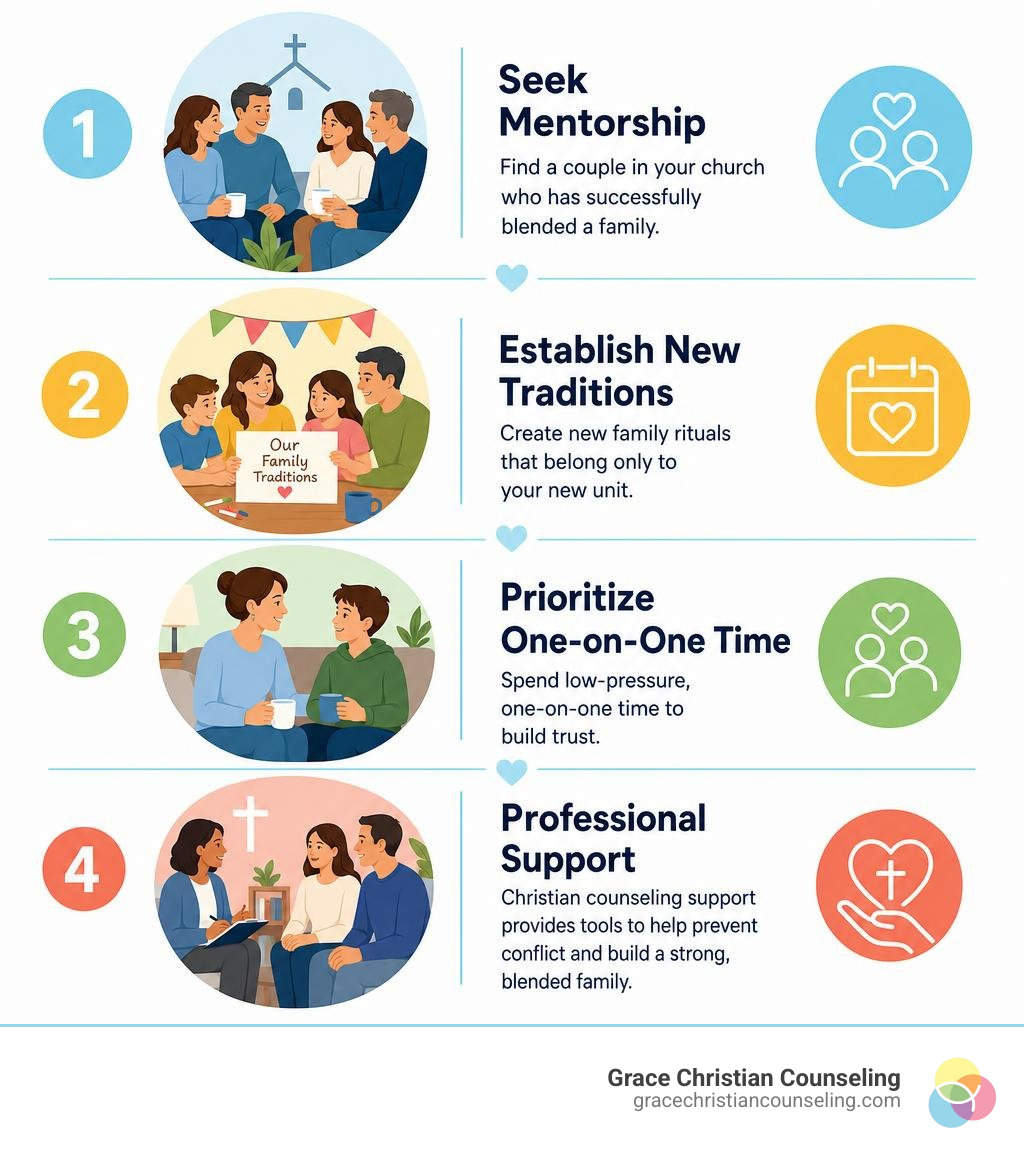
Here are some practical steps to take:
- Seek Mentorship: Find a couple in your church who has successfully blended a family. Their perspective is invaluable.
- Establish New Traditions: While honoring the past, create “new” family rituals that belong only to this new unit—like a specific game night or a unique Saturday morning breakfast.
- Prioritize One-on-One Time: Stepparents should spend low-pressure, one-on-one time with stepchildren to build trust without the biological parent present.
- Professional Support: Don’t wait until the house is “on fire” to seek help. Understanding How Professional Christian Marriage Counseling Saves Relationships can give you the preventative tools to avoid a blowout.
Frequently Asked Questions about Blended Families
How long does it typically take for a blended family to feel unified?
Research consistently shows that the average stepfamily needs between five to seven years to form a cohesive family identity. Some families with very young children may blend faster, while those with teenagers may take longer. The key is patience. If you are in year three and still feel like “two separate camps,” you aren’t failing—you are right on schedule.
Who should handle discipline in a new stepfamily?
Initially, the biological parent should handle the “heavy lifting” of discipline. The stepparent should support the biological parent’s authority and focus on building a bond. Over time, as the relationship grows, the stepparent can take on more of a traditional parental role. For more on this, Ron Deal is one of the voices so many blended families have trusted for specific “step-parenting” strategies.
How can we prioritize our marriage without neglecting the children?
It’s a delicate balance of sacrificial love. You must set firm boundaries. This might mean having a set “date night” that is non-negotiable or ensuring that your bedroom is a private sanctuary for the couple. Explain to the children that “Mom and Dad need time to keep our love strong so we can take good care of you.” If you find yourselves constantly arguing about the kids, it may be one of the Signs You Need Couples Counseling.
Building a Blended Family Rooted in Grace
At Grace Christian Counseling, we understand that your blended family is not a “mistake” or a “plan B” in God’s eyes. It is a unique opportunity to witness the power of redemption and grace. Whether you are in Pittsburgh, North Huntingdon, Penn Hills, or anywhere across Pennsylvania and beyond, our team is dedicated to providing Christ-centered care.
We blend evidence-based psychology like CBT and attachment theory with the timeless truth of the Bible. Our licensed counselors are here to help you move from chaos toward lasting unity at a pace your family can sustain. You don’t have to navigate these complex waters alone. There is hope, there is healing, and there is a path forward for your family.
If you are ready to take the next step in your journey, explore our Christian Counseling Services to Find Hope and Healing. We offer both in-person sessions at our Western Pennsylvania locations and convenient online counseling for residents across the state. Let us walk with you as you build a home that honors Christ and nurtures every member of your family.
This guide is for educational and spiritual encouragement and is not a substitute for personalized professional counseling. If you are in crisis, please reach out for immediate help.


