

Safety and privacy note: If you are in immediate danger in the United States, call 911 as safely as possible. If a partner may monitor your device, consider using a safer device before researching or contacting support. The National Domestic Violence Hotline is available 24/7 at 800-799-SAFE (7233), by text (START to 88788), or by live chat at thehotline.org. For a mental-health, emotional-distress, or suicide-related crisis, call or text 988.
When is couples counseling not recommended?
When couples counseling is not recommended, the reason is not that a relationship is beyond hope. The concern is that a joint room may be unsafe or may frame one person’s abuse as a shared communication problem. Couples counseling is usually not the right first step when one partner fears retaliation, cannot speak freely, or is living under coercive control or active abuse. A private conversation with a domestic-violence advocate or appropriately qualified professional is safer than using a joint session to test what will happen.
Other concerns, such as active substance use, an undisclosed affair, severe or rapidly worsening mental-health symptoms, or deep uncertainty about staying, may change the order or type of care. They are not universal, reader-diagnosed bans on all forms of joint treatment. A qualified provider should assess safety, consent, stability, and treatment fit privately.
Conflict and abuse are not the same problem
Ordinary conflict can be painful. Partners may interrupt, become defensive, withdraw, speak sharply, or repeat the same argument. Those patterns deserve attention, responsibility, and repair. In a basically safe relationship, both people can name their part, disagree without fearing punishment, and make choices without one person controlling the other.
Abuse is different. The Centers for Disease Control and Prevention describes intimate partner violence as abuse or aggression in a romantic relationship. It can include physical or sexual violence, stalking, and psychological aggression intended to harm or exert control (CDC: About Intimate Partner Violence).
Ordinary conflict
- Both people can name their part
- Disagreement does not bring punishment
- Each person makes their own choices
- Patterns can be addressed and repaired
Coercive control or abuse
- Power, intimidation, threats, or retaliation
- Surveillance, isolation, or financial control
- Sexual coercion or physical violence
- One partner’s freedom and safety are limited
The key distinction is not whether both people have ever behaved badly. It is whether there is a pattern of power, control, intimidation, surveillance, isolation, sexual coercion, financial control, threats, or retaliation that limits one partner’s freedom and safety. A checklist cannot diagnose your relationship, and you do not need a perfect label before asking for private help.
When couples counseling is not recommended as the first step
You cannot speak honestly without fearing what happens later
A counseling office may feel private for an hour, but the conversation continues to have consequences after the appointment. If you are deciding what to say based on whether your partner may punish, threaten, humiliate, monitor, or isolate you later, joint disclosure may increase risk. The National Domestic Violence Hotline specifically does not encourage couples counseling with an abusive partner because the power imbalance remains and material disclosed in therapy may be used later. Read The Hotline’s guidance on couples therapy and abuse.
One partner controls the story, the choices, or access to help
Couples counseling assumes that each person can participate with meaningful consent. That assumption breaks down when one partner controls money, transportation, medical care, communication, friendships, church access, sexual choices, or whether the other person may seek private help. A joint communication exercise cannot correct a power structure that denies one person freedom. Grace’s guide to the signs of emotional and psychological abuse explains these patterns in more depth.
Spiritual language can also be used coercively. Quoting submission, forgiveness, unity, or covenant to silence disclosure is not faithful care. Christian marriage calls both spouses toward truth, love, and mutual submission (Ephesians 5:21). Scripture also condemns leaders who rule harshly and fail to protect the vulnerable (Ezekiel 34:4). These passages should never be used to make a personalized safety decision for someone else, but they do show that domination is not the biblical picture of loving authority.
Joint treatment could turn abuse into mutual blame
Most couples work asks each partner to examine personal patterns. That is often constructive in ordinary conflict. It becomes dangerous when it implies that the harmed partner shares responsibility for another person’s choice to abuse. A provider who misses coercive control may focus on tone, communication, or forgiveness while the central problem, one person using power and fear, goes unnamed.
This does not mean a harmed person has no healing work of their own. Individual counseling, including trauma-informed Christian counseling, may help someone process trauma, rebuild confidence, clarify boundaries, and make decisions. But healing work is not an admission of shared responsibility for being harmed.
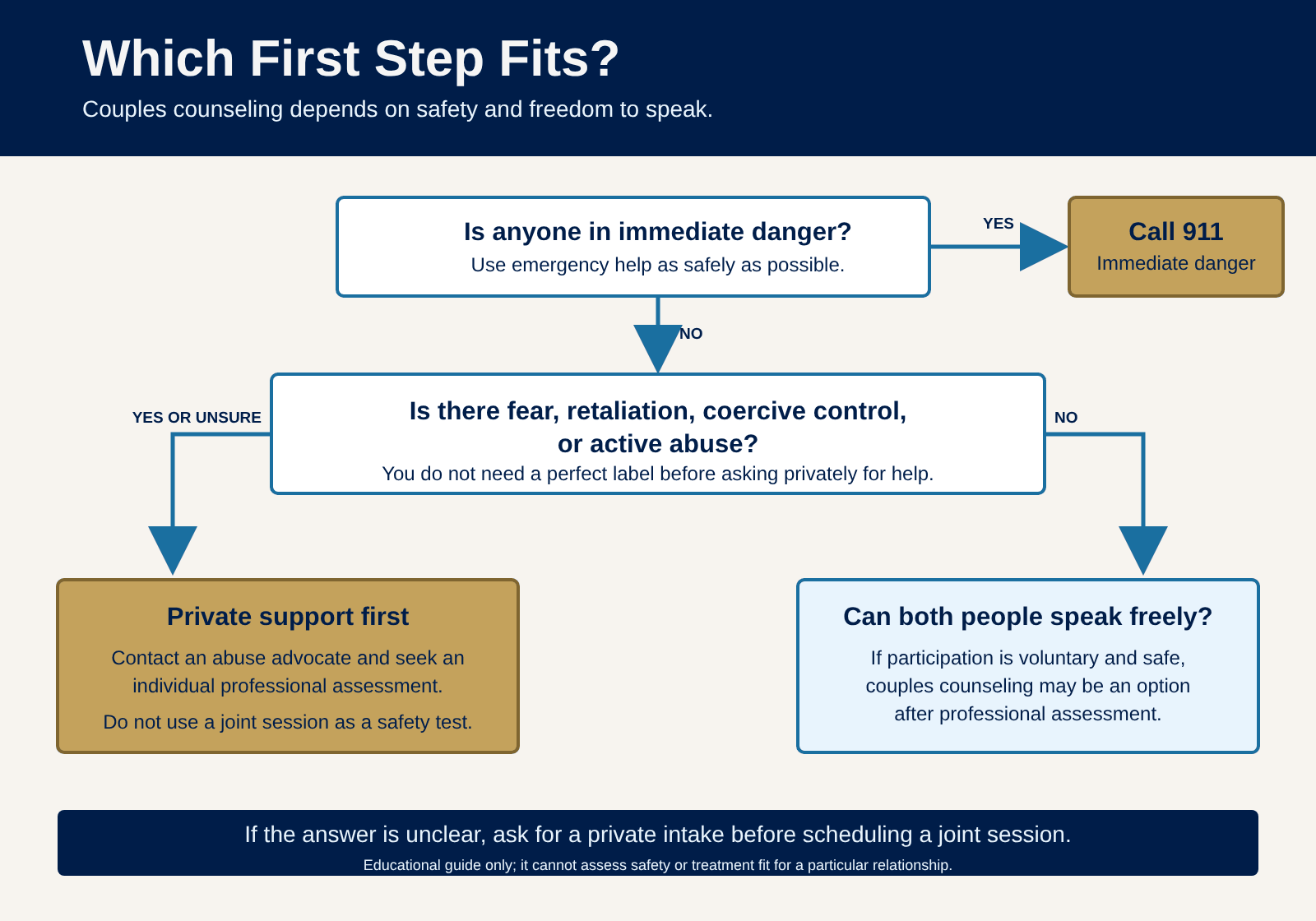
The decision guide in plain text
- If anyone is in immediate danger, contact 911 as safely as possible.
- If there is fear, possible retaliation, coercive control, or active abuse, seek private support first from a domestic-violence advocate and an appropriately qualified professional. Do not use a joint appointment as a safety test.
- If there is no identified safety concern and both people can participate voluntarily and speak freely, couples counseling may be an option after professional assessment.
- If you are unsure, ask for a private intake before scheduling a joint session. Uncertainty is enough reason to slow down and ask questions.
Concerns that may change the sequence of care
Some relationship problems may require stabilization, individual treatment, medical care, specialized services, or a different counseling goal before or alongside couples work. Examples can include active substance use, severe or rapidly worsening symptoms, an undisclosed ongoing affair, or one person being firmly decided to leave while the other expects reconciliation.
These situations are not all equivalent to abuse, and they do not create one universal rule. Substance-use severity, immediate health risk, willingness, informed consent, honesty, and the provider’s training all matter. A careful clinician may recommend individual assessment, coordinated care, discernment-focused work, or a pause before conventional couples sessions. The responsible question is not, “Which label disqualifies us?” It is, “What setting can address this safely and honestly?”
What a safer first step can look like
Talk privately with an advocate when abuse may be present
The National Domestic Violence Hotline offers confidential support, safety planning, and local referrals. Call 800-799-SAFE (7233), text START to 88788, or use live chat. If researching on a monitored device could create danger, use a safer device if possible and review The Hotline’s digital-safety guidance.
Request an individual assessment
A private assessment can help a provider understand the relationship context without requiring you to disclose concerns in front of a partner. Ask how the practice screens for intimate partner violence, handles separate communication, protects confidentiality within legal limits, and decides whether joint work is appropriate. Do not assume that a therapist who offers couples counseling has specialized training in coercive control.
Address urgent health or stabilization needs
Rapidly worsening mental or physical symptoms, intoxication, withdrawal risk, threats of self-harm, or other urgent concerns may require crisis, medical, psychiatric, or substance-use services. Couples counseling should not delay emergency care. In the United States, call or text 988 for mental-health, emotional-distress, or suicide-related crisis support; call 911 for immediate danger.
From our counseling work: In work with couples and families, an early question is not only whether both people want the relationship to improve, but whether each person can speak honestly without fear. When that freedom is missing, slowing down for a private assessment can be a responsible first step rather than a failure of faith or commitment.
How Christian faith and professional counseling can work together
Christ-centered counseling can take Scripture, prayer, covenant, sin, grace, lament, and hope seriously while also using clinically excellent assessment and treatment. Faith integration should make room for truth, consent, wise boundaries, and appropriate outside help. It should not reduce danger to a spiritual attitude problem or ask someone to prove faithfulness by remaining silent.
Forgiveness is not the same as denying harm, dropping boundaries, restoring trust, resuming access, declining legal protection, or reconciling before safety and accountability exist. A counselor or pastor can support spiritual reflection, but neither should pressure a predetermined relationship outcome. Read more about how faith can be integrated into professional counseling. Pastors and church leaders can also read when a pastor should refer someone to counseling, including how to respond to an abuse disclosure.
When couples counseling may be a reasonable option
Couples counseling may fit when both partners can speak freely, participation is voluntary, neither fears retaliation, and both are willing to take responsibility for their choices. It can help with recurring conflict, emotional disconnection, grief, parenting strain, betrayal repair, communication, and other relationship concerns when the setting is clinically appropriate.
The first appointment is not a promise that joint treatment will continue. One of Grace’s professionally trained Christian counselors may recommend a different format or referral after learning more. If you are seeking ordinary relationship support and can contact Grace safely, explore Christian marriage counseling or individual Christian counseling.
Frequently Asked Questions
Is yelling during conflict always abuse?
No. Yelling can be harmful and should be addressed, but one behavior alone does not establish a pattern of coercive control. Consider the larger context: fear, threats, retaliation, isolation, surveillance, sexual coercion, financial control, physical violence, and whether one person can make choices or speak freely. A private professional assessment can help.
Can a Christian seek individual counseling without a spouse?
Yes. Individual counseling can provide a private place to understand what is happening, process emotions, clarify boundaries, and consider options. Seeking individual support is not a declaration that the marriage must end, and it does not require a spouse’s participation.
Does forgiveness mean returning to joint counseling?
No. Forgiveness is not the same as restored trust, reconciliation, renewed access, or a decision that joint counseling is safe. Those questions require wisdom, accountability, consent, and an honest assessment of risk. Scripture should not be used to rush that process.
What if I am not sure whether my relationship is abusive?
You do not need certainty before asking privately for help. Contact a domestic-violence advocate or an appropriately qualified professional, describe the behaviors and your concerns, and ask about safer options. If a partner may monitor your device, use a safer device if possible.
A careful next step
You do not have to decide the future of your relationship before asking for help. You also do not have to persuade a partner to attend, disclose a private support call, or label the relationship before speaking with an advocate or professional. If safety is uncertain, begin privately.
If there is no abuse or retaliation concern and you want help finding a counselor whose experience, approach, availability, and faith background fit your needs, Grace’s care team can help. A discovery call is not emergency or domestic-violence crisis support.
Sources and support resources
- Centers for Disease Control and Prevention: About Intimate Partner Violence
- National Domestic Violence Hotline: Should I Go to Couples Therapy With My Abusive Partner?
- National Domestic Violence Hotline: 24/7 support and local resources
- 988 Suicide & Crisis Lifeline

This article was researched with the help of AI and reviewed and edited by Stephen Luther, MEd, MSEd, LPC, for accuracy, Scripture references, and consistency with Grace’s clinical standards.
Stephen A. Luther, MEd, MSEd, LPC, is the founder and Executive Director of Grace Christian Counseling and a Licensed Professional Counselor. He holds a master’s degree in Education and a master’s degree in Marriage and Family Therapy from Duquesne University and has helped children, adolescents, adults, couples, and families since 1997.
Scope note: This article is educational. It is not diagnosis, treatment, emergency care, a safety assessment, legal advice, or individualized professional advice. Services and clinician availability can change. Confirm fit, location, licensure, and appointment format directly with the care team.


