

When Faith and Trauma Collide: What You Need to Know About PTSD, Narcissistic Abuse, and Christian Healing
If you are searching for help with recovery for PTSD and narcissistic abuse or trauma as a Christian, here is what you need to know right away:
Key facts at a glance:
- Narcissistic abuse causes real, clinical trauma, even when there is no physical violence.
- Chronic relational abuse produces Complex PTSD (C-PTSD), which is more intense and longer-lasting than single-event PTSD.
- Your brain processes emotional threats like gaslighting and manipulation the same way it processes physical danger.
- Healing is possible, and your faith does not have to be a casualty of what happened to you.
- Faith-integrated, trauma-informed counseling addresses both the nervous system and the soul.
Imagine flinching at a gentle question from someone who loves you. Your mind knows you are safe, but your body has not gotten the message yet. This is what narcissistic abuse does, it rewires your nervous system at a level that goes far deeper than conscious thought.
For many Christians in Pennsylvania and beyond, this kind of pain is compounded by confusion about faith. You may wonder why God allowed this. You may feel that seeking help is a sign of weak faith. Or you may have experienced abuse from someone who used scripture itself as a weapon against you.
You are not weak. You are not broken beyond repair. What happened to you was real, and it left real marks on your mind, body, and spirit. At Grace Christian Counseling, we believe that healing the whole person, mind, body, and soul, is not only possible but is exactly what God intends for you, as Psalm 34:18 reminds us: “The Lord is close to the brokenhearted and saves those who are crushed in spirit.”
This guide will walk you through what narcissistic abuse trauma actually is, how to recognize it in your own life, and what a Christ-centered path to recovery looks like in practical terms.
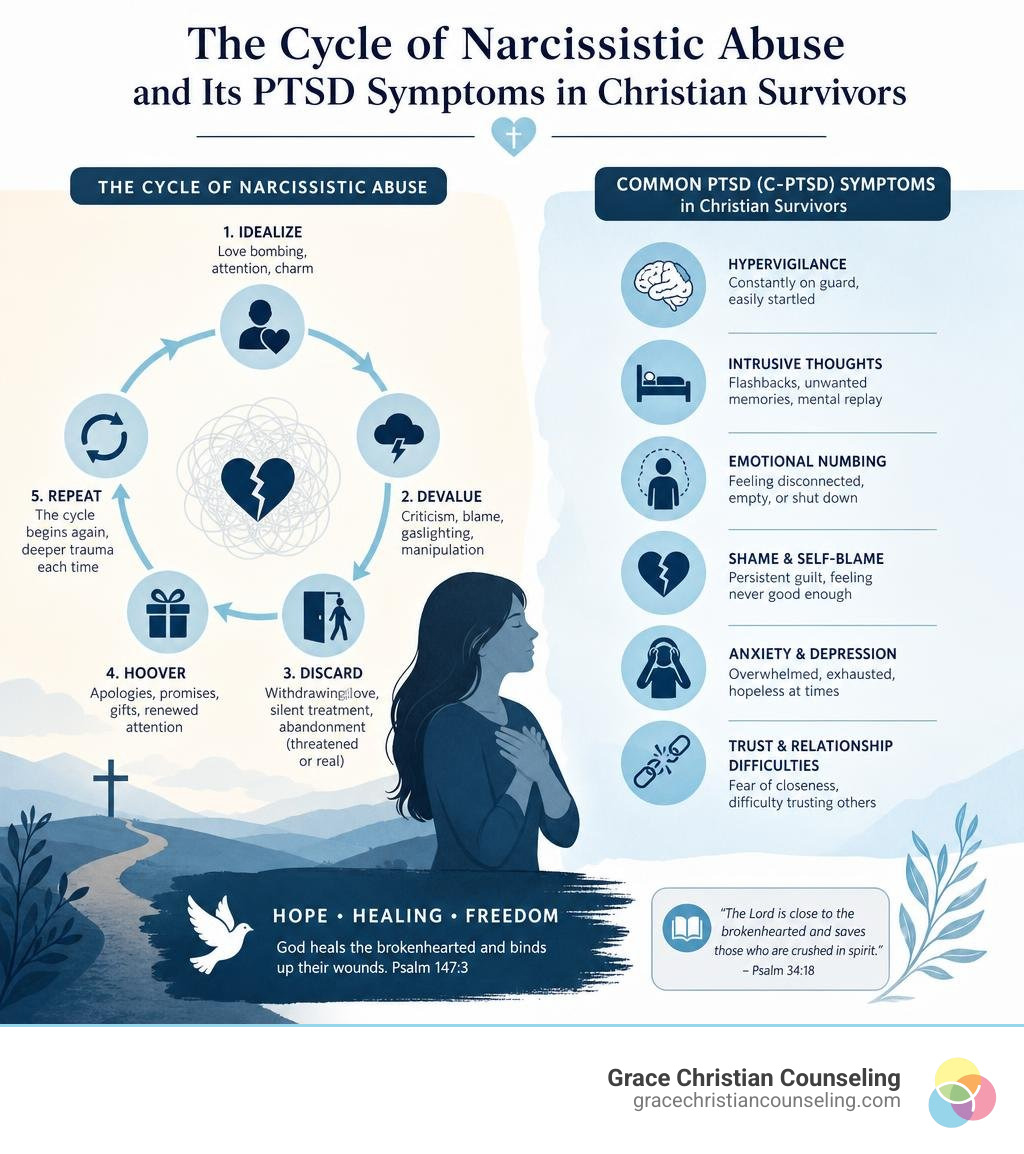
What is Narcissistic Abuse and Complex Trauma?

To begin healing, we must first understand the unique nature of the wound. Many people associate Post-Traumatic Stress Disorder (PTSD) with single, life-threatening events; such as a car accident or a natural disaster. While this is a very real form of trauma, narcissistic abuse typically results in something known as Complex PTSD, or C-PTSD. This condition stems from chronic, ongoing relational trauma where escape feels difficult or impossible.
PTSD is not rare, and it is not a sign of spiritual failure. The National Institute of Mental Health reports that an estimated 3.6% of U.S. adults had PTSD in the past year, and 6.8% experience PTSD at some point in life. The VA National Center for PTSD gives a similar public-facing estimate, about 6 out of every 100 people in the United States will have PTSD during their lifetime.
Unlike a single-incident event, the relational distress in a narcissistic dynamic is sustained over months or even decades. When you are constantly subjected to gaslighting, emotional manipulation, and devaluation, your sense of reality is systematically eroded. You may find yourself reading resources like the Recovering from the Narcissistic Parent and C-PTSD guide, only to realize that your childhood or marriage was defined by a constant state of survival. To explore how these dynamics unfold over time, you can read our Detailed Guide to the Narcissistic Abuse Cycle.
It is highly common for survivors to ask why they feel so physically damaged when there was never any physical violence. The answer lies in how God designed our neurobiology. The human brain does not distinguish between psychological threats, such as severe emotional invalidation, and physical threats when activating the threat response. Both are processed through the exact same neural architecture; meaning your body reacts to emotional cruelty with the same fight, flight, freeze, or fawn responses as it would to physical danger.
Furthermore, narcissistic relationships are characterized by unpredictable threat, which is also known as intermittent reinforcement. One day you are showered with love; the next, you are ignored or criticized. This unpredictability is far more dysregulating to the nervous system than continuous, predictable threat. Because you can never safely drop your guard, your body stays locked in a state of high alert, eventually leading to profound, chronic nervous system dysregulation.
Overcoming PTSD and Narcissistic Abuse or Trauma as a Christian: Pathways to Healing

When recovering from PTSD and Narcissistic Abuse or Trauma as a Christian, perspectives must address both the clinical and the spiritual layers of the pain. One of the heaviest burdens survivors carry is the feeling of spiritual confusion. You might ask, “If God is loving, why did He let this person destroy my peace?” It is important to know that asking these hard questions is not a sign of weak faith; rather, it is a sign of honest suffering.
In many cases, the trauma is compounded by spiritual abuse within high-control religious environments. This occurs when an abuser weaponizes Scripture to demand submission, enforce silence, or shame you for setting boundaries. This creates a painful experience of double betrayal; the sacred trust of faith is used to exploit you, and the church community may close ranks to protect the abuser’s reputation. If you are navigating this specific pain, our article on When a Narcissist Tries to Destroy a Christian offers deep validation and biblical clarity.
Reconciling your trauma with a loving God requires untangling the abuser’s behavior from God’s true character. Often, survivors project the traits of their earthly abusers onto their Heavenly Father, viewing Him as demanding, distant, or impossible to please. Rebuilding your faith involves realizing that God does not demand that you tolerate abuse in the name of legalistic forgiveness.
As we seek spiritual pathways to recovery, we find comfort in God’s Word. Scripture is filled with promises of comfort and peace for those who have been crushed by relational cruelty. In Philippians 4:6-7, we are encouraged to bring our anxieties to God, receiving a peace that surpasses all human understanding. True healing is not about pretending the abuse did not happen; it is about bringing our shattered pieces to the One who promises to restore our souls.
Recognizing the Signs of PTSD and Narcissistic Abuse or Trauma: Mind and Body
The trauma of narcissistic abuse is not just “in your head”; it lives in your physical body. When the nervous system is chronically dysregulated, it manifests in a specific cluster of cognitive and physical symptoms. Recognizing these signs is a vital step in validating your experience and realizing you are not simply “overly sensitive.”
Common symptoms include:
- Chronic Hypervigilance: Always waiting for the next shoe to drop; scanning environments for threat, and feeling unable to relax.
- Intrusive Thoughts: Replaying conversations, gaslighting incidents, or arguments in your mind, even years after the relationship has ended.
- Freeze and Fawn Responses: Feeling physically paralyzed when confronted, or immediately agreeing and placating others to avoid conflict.
- Pervasive Shame: Carrying a deep, internalized belief that you are fundamentally unworthy, unlovable, or to blame for the abuse.
- Somatic Symptoms: Experiencing chronic muscle tension, headaches, digestive issues, and sleep disruption due to constant stress hormones.
To understand how these physical and mental symptoms intersect, you can read our resource on Trauma Therapy for Healing from Narcissistic Abuse. The shame and sense of worthlessness planted by an abuser can feel like a spiritual stronghold that keeps you bound. Breaking these mental chains requires combining clinical trauma-informed care with the liberating truth of Christ.
Complex trauma also has recognized diagnostic language in international clinical resources. The VA National Center for PTSD explains that ICD-11 Complex PTSD includes the core symptoms of PTSD plus three disturbances in self-organization, affect dysregulation, negative self-concept, and relational difficulties. This helps explain why survivors of chronic relational abuse may struggle not only with fear and intrusive memories, but also with shame, identity, trust, and connection.
In our clinical experience, survivors of narcissistic abuse often arrive with a complicated mix of trauma symptoms, anxiety, shame, grief, and difficulty trusting their own perceptions. A licensed therapist does not diagnose PTSD simply because someone has experienced emotional abuse. Assessment looks at the duration and severity of symptoms, how they affect sleep, relationships, work, and daily functioning, and whether symptoms meet established diagnostic criteria. We may also use validated screening tools to help assess trauma, anxiety, depression, or related concerns while listening carefully to the client’s own story.
Treatment is then paced according to the person’s level of safety and stability rather than pushing immediately into painful memories. In trauma-informed care, we often begin by strengthening emotional regulation, identifying triggers, building healthy boundaries, and developing a sense of safety before deeper trauma processing. As trust develops, the therapist can monitor symptoms and adjust treatment accordingly. For Christian clients, spiritual beliefs and practices can be incorporated into that process when they are supportive and meaningful to the client, without using faith to minimize trauma or pressure someone to forgive before they are ready.
Rebuilding Your Life After PTSD and Narcissistic Abuse or Trauma as a Christian: Counseling and Support
Reclaiming your life after chronic relational trauma is a gradual process that requires both practical strategies and supportive communities. You cannot heal in isolation; you need safe spaces where your story is heard and validated without judgment. A healthy recovery plan involves setting boundaries, practicing self-care, and seeking professional guidance.
First, establishing healthy boundaries is a non-negotiable step in protecting your peace. This may mean going completely “No Contact” with the abuser, or utilizing the “Gray Rock Method” (remaining entirely uninteresting and emotionally flat) if contact is unavoidable. Second, self-care is not selfish; it is a biblical stewardship of the body and mind God gave you. This includes prioritizing sleep, engaging in gentle movement, and spending time in nature.
Third, professional, faith-integrated support is incredibly valuable. At Grace Christian Counseling, we provide Christian Trauma Counseling designed to help you process traumatic memories while keeping your eyes fixed on Jesus. Additionally, online resources like NuWellonline.com can provide supplementary support as you walk out your recovery journey.
The Counseling Blueprint: Our Four-Stage Journey to Restoration
At Grace Christian Counseling, we do not believe in quick fixes or one-size-fits-all approaches. Healing from deep relational wounds takes time, care, and a structured path. Our counselors utilize a framework called the Counseling Blueprint, which is a four-stage journey designed to guide you from safety to complete spiritual and psychological restoration. This structured process is facilitated by our compassionate, licensed counselors who specialize in trauma-informed care. You can read a detailed breakdown of this methodology in our Step-by-Step Guide to Narcissistic Abuse Therapy.
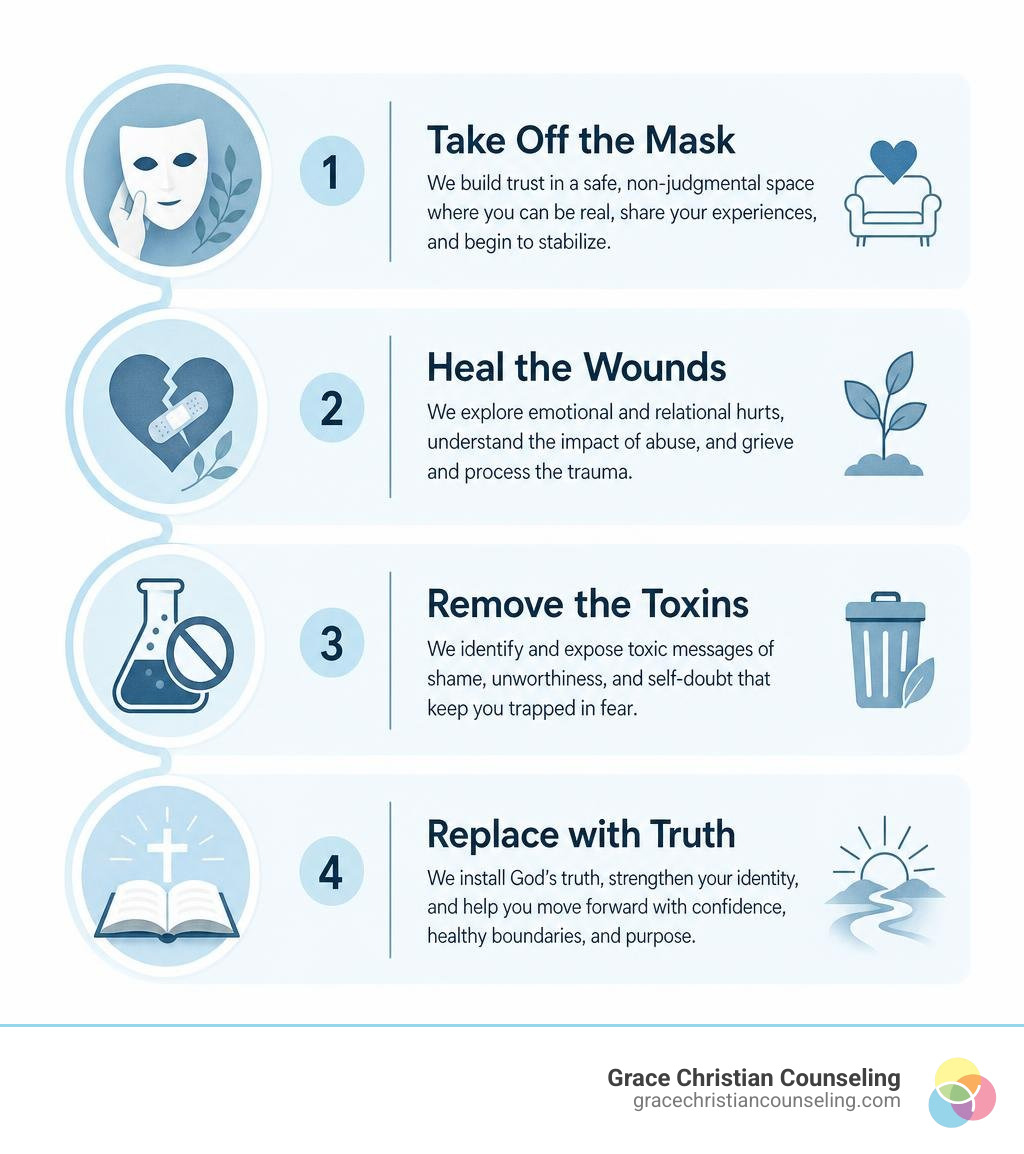
Here is how the Counseling Blueprint works:
- Take Off the Mask: In this first stage, we focus on building genuine rapport and trust. You do not have to pretend to have it all together. We create a safe, non-judgmental space where you can share your raw experiences and begin to stabilize your nervous system.
- Heal the Wounds: Once safety is established, we begin exploring your emotional and relational hurts. We look at the specific ways narcissistic abuse has impacted your body, mind, and relationships, allowing you to grieve the losses and process the trauma.
- Remove the Toxins: In this phase, we identify the unhelpful beliefs and lingering lies planted by the abuser. We expose the “toxic” messages of shame, unworthiness, and self-doubt that have kept you trapped in a cycle of fear.
- Replace with Truth: Finally, we install empowering, accurate perspectives about yourself, others, and the world. We ground your identity firmly in God’s truth, helping you move forward with confidence, healthy boundaries, and a renewed sense of purpose.
To help you understand the therapeutic modalities we use during this journey, it is helpful to look at how we combine traditional and modern clinical approaches:
| Therapeutic Approach | Primary Focus | Best Suited For | Spiritual Integration |
|---|---|---|---|
| Cognitive Talk Therapy | Analyzing thoughts, identifying behavioral patterns, and cognitive restructuring. | Identifying toxic beliefs and understanding the dynamics of abuse. | Aligning thoughts with Biblical truths and examining personal beliefs. |
| Trauma-Informed Care | Establishing safety, pacing the healing process, and avoiding retraumatization. | Survivors who need stability, trust, and choice before deeper trauma work. | Reflecting God’s gentleness through patient, compassionate care that honors your story. |
| Somatic Trauma Therapy | Regulating the nervous system, releasing physical tension, and processing somatic memories. | Calming chronic hypervigilance, freeze/fawn responses, and physical panic. | Experiencing God’s peace physically; practicing gentle, prayerful body awareness. |
Frequently Asked Questions about PTSD and Narcissistic Abuse
Can narcissistic abuse cause PTSD if there was no physical violence?
Yes, absolutely. The human brain processes psychological threats, such as emotional invalidation, gaslighting, and coercive control, using the exact same neural architecture as physical threats. When you are subjected to ongoing psychological abuse, your threat response system remains constantly active, leading to the physical and mental symptoms of PTSD.
How do I set biblical boundaries with a narcissistic family member?
Setting boundaries is a deeply biblical concept. Proverbs 4:23 instructs us to “keep your heart with all vigilance, for from it flow the springs of life.” Setting boundaries, whether through the Gray Rock Method or going No Contact, is not unforgiving; it is a necessary act of stewardship over the life and peace God has entrusted to you.
What is the difference between single-event PTSD and C-PTSD?
Single-event PTSD typically develops after a discrete, isolated traumatic event, such as a natural disaster or an accident. Complex PTSD (C-PTSD) develops from chronic, repeated interpersonal trauma where escape is difficult. C-PTSD includes the standard symptoms of PTSD but also involves deep disruptions in affect regulation, self-perception, and relational functioning.
Your Next Step Toward Peace and Restoration
Healing from the devastating impacts of PTSD and Narcissistic Abuse or Trauma as a Christian is a journey, but you do not have to walk it alone. The confusion, anxiety, and spiritual exhaustion you are feeling right now do not have to define the rest of your story. God is ready to meet you in your brokenness and lead you into a future of safety, peace, and restored identity.
At Grace Christian Counseling, we are honored to walk alongside survivors throughout Western Pennsylvania and across the state. Whether you prefer to meet in person at one of our local offices or utilize our secure online counseling services, our team of licensed counselors is ready to support you. We invite you to take the first step toward reclaiming your life today. Schedule a Consultation with us and begin your journey to hope and restoration.
This guide is for educational and spiritual encouragement and is not a substitute for personalized professional counseling. If you are in crisis, please reach out for immediate help.
Biblical Healing from Abuse: Trusting God with Trauma


