

When Anxiety Won’t Quit: What the Bible Offers and Where to Start
Scripture based anxiety relief is one of the most searched topics among Christians who are struggling emotionally, and for good reason. Anxiety disorders now affect millions of people worldwide, making them the most common mental health condition on the planet. Many believers feel caught between the weight of worry and the biblical instruction to “be anxious for nothing,” wondering if their struggle means something is spiritually wrong with them. It doesn’t. And the Bible has more to say about anxiety than most people realize.
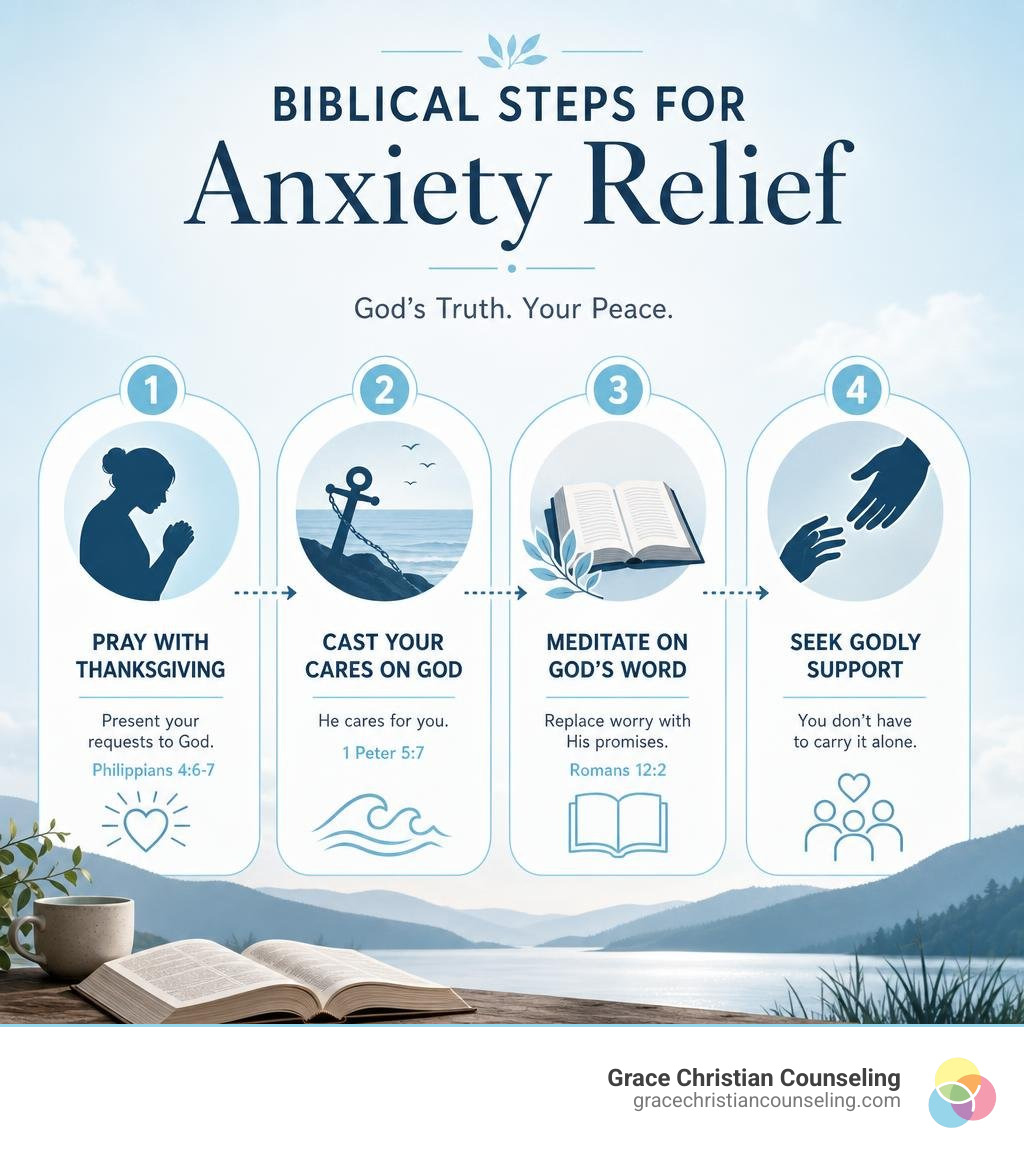
Here is a quick overview of what Scripture based anxiety relief looks like in practice:
- Pray with thanksgiving. Philippians 4:6-7 says to present your requests to God with thanksgiving, and the peace of God will guard your heart and mind.
- Cast your anxiety on God. 1 Peter 5:7 calls believers to throw their worries onto God because He genuinely cares for them.
- Meditate on God’s promises daily. Romans 12:2 reveals a core biblical strategy for renewing the mind, which we can apply by learning to replace anxious thoughts with the truth of Scripture.
- Seek first the kingdom. Matthew 6:33 teaches that redirecting focus toward God and His purposes addresses the root of daily worry.
- Combine faith with professional support. When anxiety is persistent or severe, Christ-centered counseling that integrates biblical truth with evidence-based therapy is both wise and faithful.
One pastor described anxiety as a “dreadful ogre with uninvited tentacles” that can emotionally and spiritually paralyze people. That image resonates with anyone who has lain awake at 2 a.m., mind racing, wondering when the weight will lift. The good news is that Scripture does not ignore that feeling; God speaks directly to it, with honesty and with hope.
In this guide, we walk through what the Bible actually says about worry and fear, the key verses that offer real relief, practical daily habits for meditating on God’s Word, and how professional faith-based counseling can support your healing journey, whether you are in Pittsburgh, Western Pennsylvania, or meeting with a counselor online.
What the Bible Says About Worry and Fear
To build a solid foundation for Scripture based anxiety relief, we must first understand how God views our fears. The Bible does not treat worry as a minor character flaw or something to be swept under the rug; it addresses it directly, frequently, and with immense compassion.
When we look at the teachings of Christ, particularly in the Sermon on the Mount, we find a beautiful and comprehensive framework for understanding worry. In Matthew 6:25-34, Jesus speaks to the very heart of human survival; He asks His followers not to worry about what they will eat, drink, or wear. He points to the birds of the air and the lilies of the field, showing how God meticulously cares for even the smallest aspects of His creation. If God feeds the birds who do not store up food in barns, and clothes the wildflowers in glory greater than Solomon’s, how much more will He take care of you, His beloved child?
Understanding How to Deal with Anxiety as a Christian begins with resting in God’s absolute sovereignty and goodness. When we realize that our heavenly Father knows exactly what we need before we even ask, the pressure to control our lives begins to lift. Worry is, at its core, an attempt to carry a burden we were never designed to bear. By trusting in God’s promises, we trade our fragile self-reliance for His unshakable strength.
The Root of Anxiety and the Battle for Faith
Anxiety often shows up in the body first, racing thoughts, tight chest, shallow breathing, stomach distress, poor sleep, or a constant sense of threat. Clinically, this can reflect an overactive stress response, shaped by temperament, trauma, chronic stress, medical factors, or learned patterns of fear. Spiritually, anxiety can also expose the places where trust feels hard. In Matthew 6:30-33, Jesus gently corrects His disciples, saying, “O you of little faith.” He is not shaming them, He is inviting them back to the Father’s care. In that sense, the root of anxiety is often not unbelief in God’s existence, but fear that His grace will not be enough for tomorrow, or for the crisis right in front of us.
This makes the battle against anxiety both a spiritual struggle and, for many people, a nervous system response to perceived danger. Symptoms of anxiety do not mean a person has failed God; they mean the mind and body are reacting to fear, stress, or past pain. Spiritually, anxiety often tempts us to treat unknowns and frightening possibilities as more certain realities than God’s promises. Those thoughts and threat signals need to be noticed, tested, and redirected. Scripture meditation helps renew the mind by bringing attention back to what is true, while prayer and dependence on the Holy Spirit help calm the heart and restore trust in God’s character.
Balancing Human Emotion with the Command to “Fear Not”
It is vital to recognize that experiencing anxiety is a normal part of the human condition in a fallen world. When we read the command to “not worry” or “fear not,” we must not interpret it as a harsh condemnation. Jesus is not angry with us for feeling afraid; He is inviting us into a safer way of living.
We can find comfort in knowing that even the most faithful heroes of Scripture experienced deep distress, fear, and sorrow. Overcoming Anxiety and Fear is not about achieving a state of emotional numbness; it is about learning where to take those emotions when they arise. God provides abundant grace for persistent worry, meeting us in our weakness rather than demanding that we perfect our emotional state before we approach Him.
Key Verses for Scripture Based Anxiety Relief

When anxiety strikes, having specific scriptures memorized or easily accessible can act as an immediate anchor for a racing mind. Research suggests that for many people, spiritual practices may support emotional resilience during stressful seasons. One study of 1,115 churchgoing adults found that reading Scripture for guidance and meaning appeared to lessen the relationship between stressful life events and psychological distress for some participants. While Scripture is not a replacement for professional care, many people find that combining faith, supportive relationships, and evidence-based treatment provides meaningful support for mental and emotional health. Here are some of the most powerful passages for finding peace.
Finding Peace Through Philippians 4:6-8
One of the most famous passages on this topic is Philippians 4:6-8 NIV: “Do not be anxious about anything, but in every situation, by prayer and petition, with thanksgiving, present your requests to God. And the peace of God, which transcends all understanding, will guard your hearts and your minds in Christ Jesus.”
This passage outlines what many call the biblical cure for anxiety. It provides a clear, actionable alternative to worry:
- Prayer and Petition: Honestly bringing your specific fears to God.
- With Thanksgiving: Actively recalling God’s past faithfulness and thanking Him for His blessings, even in the middle of a storm.
- The Promise: The peace of God, which does not make sense to a secular world, will stand like a military guard over your heart and mind, keeping the uninvited thoughts of dread from taking over.
Casting Cares Upon Jesus in 1 Peter 5:7
Another foundational verse is 1 Peter 5:7, which instructs us to “Cast all your anxiety on him because he cares for you.”
A brief study of the original Greek word for “cast” (epiripto) reveals that this is not a gentle, passive handoff. It is a forceful, active throwing off of a heavy burden, much like a traveler throwing a heavy pack off their shoulders onto a pack animal. God is strong enough to carry the weight of your worries, and He invites you to throw them onto Him because His care for you is personal, deep, and constant. Utilizing these Bible Verses for Mental Health helps remind us that we were never meant to carry our burdens alone.
For a deeper dive into comforting passages, you can read our list of 10 Healing Scriptures for Mental Health Recovery, which includes verses like Isaiah 41:10: “So do not fear, for I am with you; do not be dismayed, for I am your God. I will strengthen you and help you; I will uphold you with my righteous right hand.”
Practical Steps to Meditate on God’s Word Daily

Knowing the verses is a wonderful first step, but experiencing true Scripture based anxiety relief means letting God’s truth move from our heads to our hearts through daily practice. Research continues to show a meaningful connection between faith and emotional well-being. In a review of 444 studies on religion and mental health, roughly two-thirds found that religious involvement was associated with better mental health outcomes, including greater resilience and lower psychological distress. For many people, spiritual practices become one supportive part of a broader healing process. As Scripture shapes our thoughts, prayers, and responses, anxious patterns can begin to lose their grip.
Developing a Scripture Based Anxiety Relief Routine
To make Scripture meditation a natural part of your day, consider building a simple, sustainable routine:
- Start with Morning Prayer: Before looking at your phone or checking the news, spend five minutes reading a single verse of comfort and asking the Holy Spirit to write it on your heart.
- Write and Reflect: Keep a dedicated journal where you write down verses that speak to your current worries. The physical act of writing helps slow down racing thoughts.
- Use Study Resources: Utilize study Bibles, devotionals, and other digital Bible study resources such as Blue Letter Bible can deepen your understanding of the historical and theological context of these verses.
- Practice Spiritual Watchfulness: Rather than letting your mind drift into negative “what-if” scenarios, actively guard your thoughts. When an anxious thought arises, immediately counter it with a memorized promise of God.
If you struggle to sleep due to racing thoughts, practicing these habits before bed can be incredibly restorative. Read more about managing nighttime worry in our article on Anxiety Keeping You Up at Night. For more practical ideas, you can also explore our resources on defeating daily anxiety.
Combining Biblical Truth with Evidence-Based Psychology
As Christian counselors, we believe God’s truth is the ultimate source of healing, and we also recognize that God has given us clinical tools that can work well with Scripture. For example, Cognitive Behavioral Therapy, or CBT, helps a person notice distorted thoughts and replace them with thoughts that are more truthful, grounded, and healthy. This fits closely with Romans 12:2, which tells us to “be transformed by the renewing of your mind.”
In practice, we often hear our clients describe moments such as waking up with the thought, “I cannot handle today.” That thought may trigger a racing heart, tight chest, and the urge to avoid work, school, or family responsibilities. In counseling, we might help that person slow down, name the fear, test the thought, and replace it with something more truthful, such as, “Today may be hard, but God will give me grace and strength for the next step. I do not have to face this alone.” That is not pretending anxiety is gone, it is learning to respond to anxiety with both biblical truth and practical skill.
Similarly, Acceptance and Commitment Therapy (ACT) teaches individuals to accept their difficult emotions without judgment while committing to actions that align with their core values. Biblically, this looks like surrendering our circumstances to God, practicing spiritual watchfulness, and continuing to serve Him faithfully even when we feel afraid.
By integrating these clinical practices with biblical truth, we can offer a holistic approach to managing anxiety from a biblical perspective. This combination of faith and clinical excellence is at the heart of Overcoming Anxiety Through Christian Counseling.
Integrating Faith and Professional Mental Health Support
For many people, anxiety is a complex issue that involves spiritual, psychological, and physical factors. Individuals who engage in prayer or Scripture reading at least once a week are 40% less likely to experience symptoms of anxiety and depression; however, persistent or severe anxiety often requires professional support. Seeking help is not a sign of weak faith; it is a wise and courageous step toward stewardship of your mental health.
At Grace Christian Counseling, our licensed counselors, including Licensed Associate Professional Counselors (LAPC) and Licensed Social Workers (LSW), provide professional care that honors your faith. We walk alongside you, blending evidence-based clinical therapy with biblical wisdom to help you find lasting relief.
For example, a person struggling with racing thoughts before work might learn to identify anxious thought patterns, practice grounding skills, and bring those fears to God through prayer and Scripture meditation. In counseling, they may pair a Bible verse with practical tools such as paced breathing, thought reframing, and small exposure steps. Over time, the goal is not to pretend anxiety is gone, but to build steadier trust, healthier coping, and more freedom in daily life.
The Counseling Blueprint for Healing
To guide our clients through their journey of healing, we use a structured, compassionate process called the Counseling Blueprint. This four-stage journey is designed to address the root causes of anxiety and build a firm foundation for lasting peace:
- Take Off the Mask: We start with a safe, honest, and non-judgmental counseling relationship. You do not have to perform or pretend; you can name your anxiety, fears, and doubts without shame.
- Heal the Wounds: Together, we look at the emotional, relational, or situational pain that may be feeding your anxiety, inviting God’s grace into those tender places.
- Remove the Toxins: We help you notice unhealthy thought patterns, distorted beliefs, and lies that keep worry and fear running in circles.
- Replace with Truth: We then work to build healthier, more accurate beliefs about God, yourself, others, and the future, grounded in Scripture.
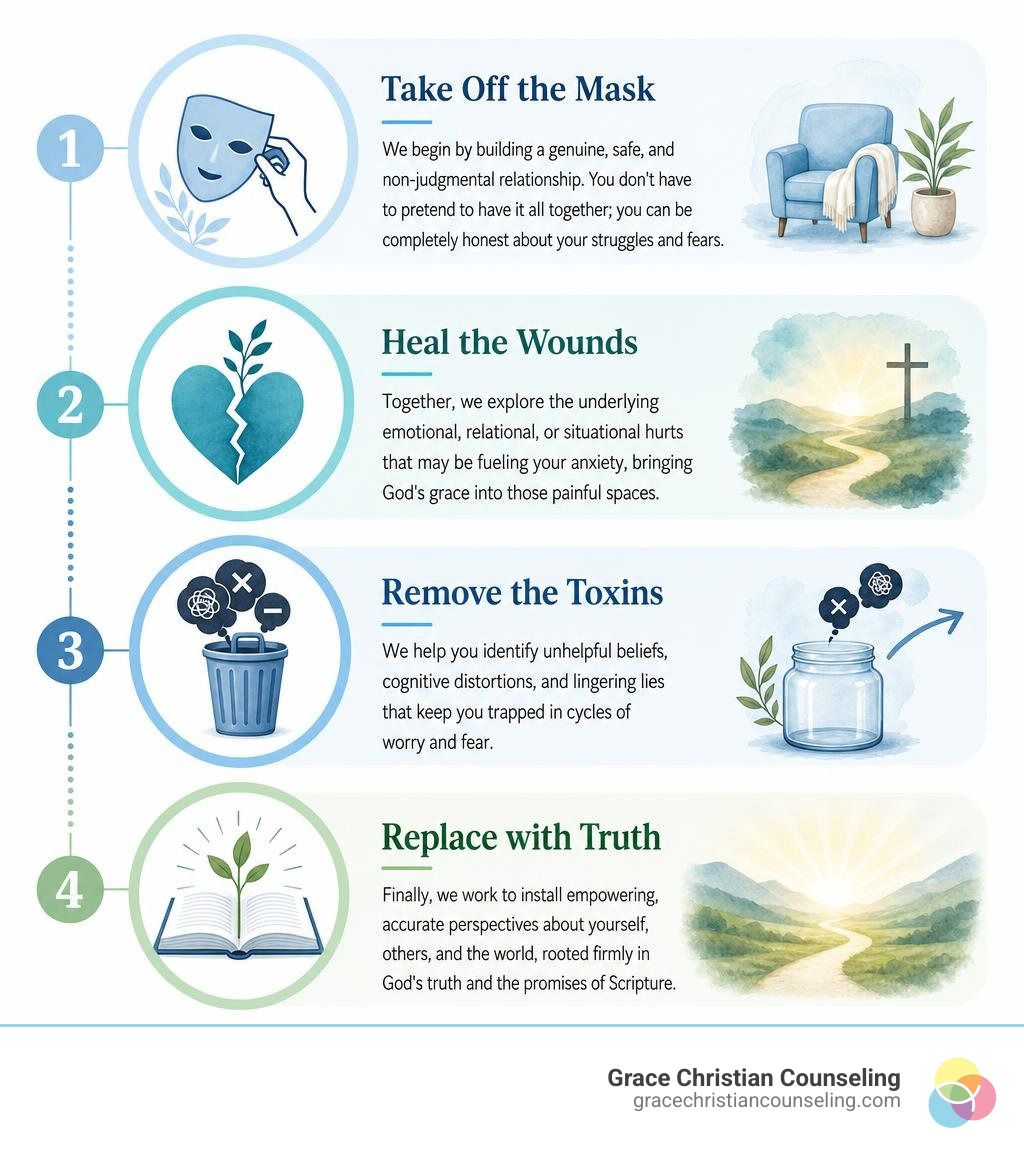
This blueprint ensures that you receive comprehensive care that addresses both your emotional pain and your spiritual growth, helping you find Christian Support for Depression and Anxiety that actually lasts.
Accessing Local and Online Scripture-Based Anxiety Relief
We believe that high-quality, Christ-centered care should be easily accessible to everyone. Grace Christian Counseling offers both in-person counseling at our local offices and convenient online therapy options for clients throughout Pennsylvania, West Virginia, Florida, and Georgia.
If you live in Western Pennsylvania, we serve several local communities with dedicated care, including Pittsburgh and surrounding suburbs like Bethel Park, North Huntingdon, Sewickley, Pleasant Hills, Uniontown, Ligonier, and Punxsutawney. If you live beyond our office locations in PA or in WV, FL, or GA, we also offer virtual telehealth options. You can find all of our locations here on our website: Locations – Grace Christian Counseling.
Frequently Asked Questions about Biblical Anxiety Relief
Is having anxiety a sign of weak faith or spiritual failure?
Not at all. Anxiety is a real human struggle, and it can be shaped by brain chemistry, trauma, long-term stress, medical issues, or painful life changes. Scripture invites us to bring our fears to God and grow in trust, but feeling anxious does not mean you have failed Him. Even the apostle Paul spoke of his “daily pressure” and “anxiety for all the churches”. God meets us with profound grace in our weakness, and He desires to walk with us through our struggles rather than condemning us for them.
How does praying with thanksgiving help reduce physical anxiety symptoms?
Anxiety is not just in your mind; it has a massive impact on your physical body, causing racing heart rates, shallow breathing, stomach discomfort, and muscle tension. When we pray with thanksgiving, as described in Philippians 4, we are practicing gratitude, which can help calm the body’s stress response and redirect the mind toward God’s care. Thanksgiving does not mean pretending life is easy; it means naming what is true about God even while anxiety is loud. Over time, this practice can help interrupt fearful thought loops, slow the nervous system, and make space for the “peace of God” Paul describes.
When should a Christian seek professional counseling for anxiety?
While daily spiritual disciplines are incredibly valuable, you should consider seeking professional counseling if your anxiety:
- Interferes with your ability to perform daily tasks at work, school, or home.
- Causes persistent sleep disruption, panic attacks, or physical health issues.
- Leads to avoidance behaviors, isolating you from family, friends, or your church community.
- Feels overwhelming, constant, or impossible to manage on your own.
Seeking professional help from a licensed counselor is a practical way to steward the mind and body God has given you.
Finding Peace Through Scripture and Compassionate Support
Anxiety can make everyday tasks feel like climbing a mountain, but you do not have to make the climb alone. Through Scripture based anxiety relief, we are reminded that our heavenly Father is intimately acquainted with our struggles, completely sovereign over our circumstances, and deeply committed to our peace. By combining the timeless truths of God’s Word with evidence-based counseling practices, real healing and lasting freedom from worry are entirely possible.
If you or someone you love is ready to take the next step on the journey toward peace, we are here to walk with you. At Grace Christian Counseling, our licensed counselors are dedicated to providing compassionate, professional, and Christ-centered care. Whether you prefer to meet in person at one of our Western Pennsylvania locations or connect with us virtually, we invite you to reach out today. Visit our website to learn more, or contact us to schedule your initial consultation. Let us help you replace the weight of worry with the perfect peace of God.
For some readers, repeated confession, reassurance seeking, or fear of having sinned may reflect an OCD pattern called scrupulosity; faith-informed OCD counseling can help clarify the difference.
This guide is for educational and spiritual encouragement and is not a substitute for personalized professional counseling. If you are in crisis, please reach out for immediate help.
A Practical Christian Counseling Guide for Real Healing and Hope


