

When You’re Hurting: Bible Quotes About Mental Health Can Help
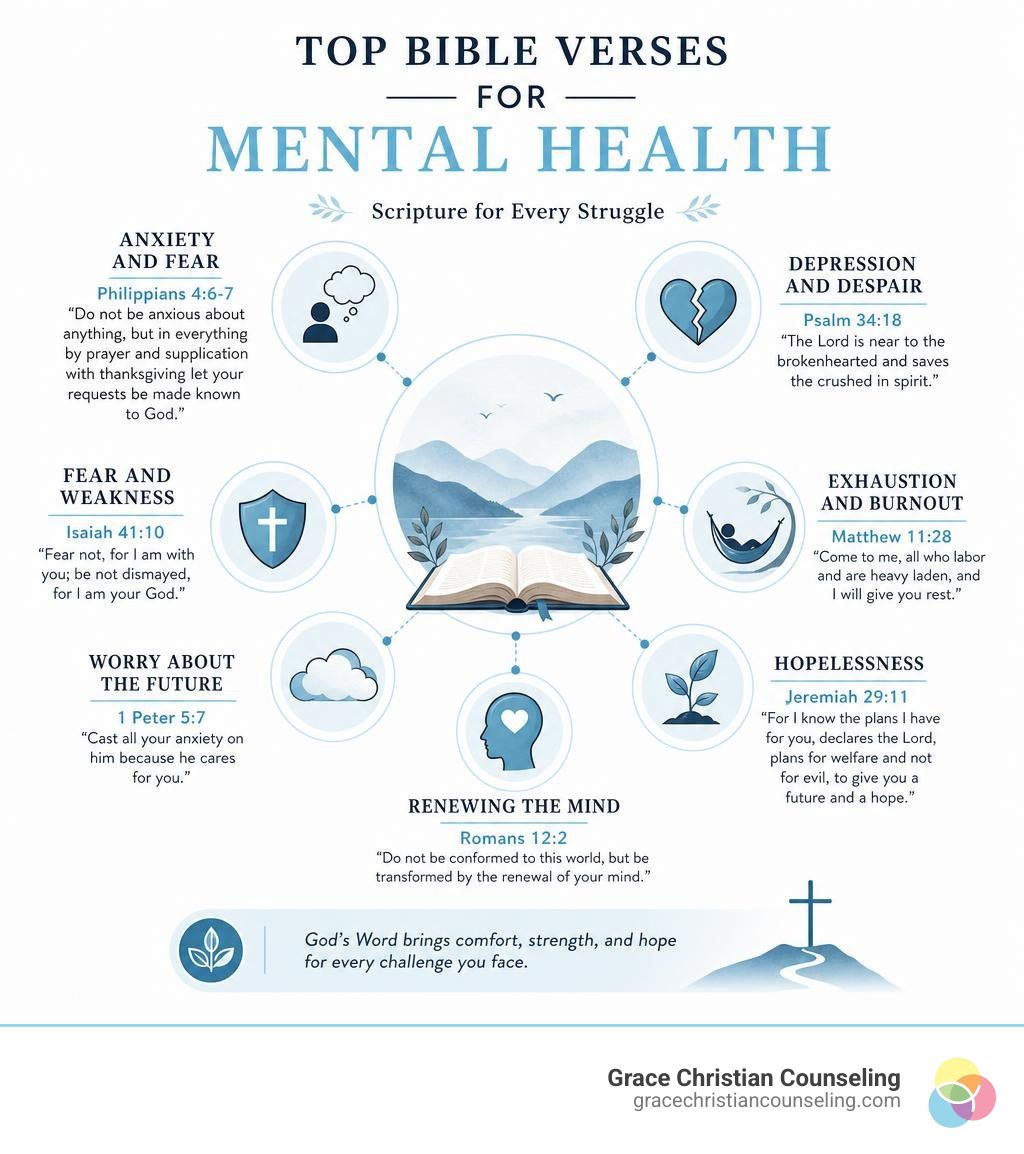
Here are some of the most comforting Bible verses for mental health struggles:
- Anxiety and fear: Philippians 4:6-7; “Do not be anxious about anything, but in everything by prayer and supplication with thanksgiving let your requests be made known to God.”
- Depression and despair: Psalm 34:18; “The Lord is near to the brokenhearted and saves the crushed in spirit.”
- Fear and weakness: Isaiah 41:10; “Fear not, for I am with you; be not dismayed, for I am your God.”
- Exhaustion and burnout: Matthew 11:28; “Come to me, all who labor and are heavy laden, and I will give you rest.”
- Worry about the future: 1 Peter 5:7; “Cast all your anxiety on him because he cares for you.”
- Hopelessness: Jeremiah 29:11; “For I know the plans I have for you, declares the Lord, plans for welfare and not for evil, to give you a future and a hope.”
- Renewing the mind: Romans 12:2; “Do not be conformed to this world, but be transformed by the renewal of your mind.”
Mental health challenges affect far more people than many realize. In the United States, nearly 1 in 5 adults (23.1%) experienced a mental illness in the past year, according to national survey data. Anxiety disorders are also the most common category of mental health condition and affect about 40 million U.S. adults each year. Yet many people who could benefit from care do not receive treatment, often because of barriers such as cost, access, uncertainty about where to start, or concerns about stigma.
For many people of faith, Scripture is one of the first places they look for comfort. And it doesn’t disappoint. The Bible speaks directly to fear, grief, exhaustion, and despair. It doesn’t offer quick fixes, but it offers something more lasting: the truth God who sees your pain and stays close.
At Grace Christian Counseling, we work with individuals, couples, teens, and families across Pennsylvania and online who are carrying real emotional weight. We believe God’s Word and evidence-based care belong together, not in competition. This article brings you some of the most powerful, hope-filled Bible quotes for mental health, along with practical ways to use them in daily life.
What Does Scripture Say About Our Emotional and Mental Struggles?
When we open the Bible, we do not find a collection of plastic characters who have their lives completely together. Instead, we see raw, unfiltered human experiences. Scripture does not shy away from emotional distress; rather, it shines a compassionate light on it. From the agonizing cries of the psalmists to the heavy burdens carried by the prophets, the Bible normalizes the reality of mental and emotional struggles.
Understanding what the Bible says about mental health helps us realize that our psychological well-being is deeply connected to our spiritual lives. However, having a mental health challenge is not a sign of weak faith. We live in a fallen, complicated world where our minds, bodies, and spirits are all subject to wear and tear. Sometimes, our struggles are a result of physical exhaustion, sometimes they stem from relational trauma, and other times they are part of a spiritual battle. By grounding ourselves in Bible Verses for Mental Health, we can begin to find a path toward holistic restoration.
The Reality of Mental Illness in a Broken World
For too long, a quiet stigma has lingered in some church communities, as if depression or anxiety would disappear if someone prayed harder. That is not biblical, and it is harmful. Mental illness is common, not rare; the National Institute of Mental Health reports that 59.3 million U.S. adults, 23.1%, lived with a mental illness in 2022. In other words, nearly every church family is touched by this pain. Faith should reduce shame, not add to it; Scripture invites the weary to seek God’s comfort, community support, and wise care.
God created us as complex, integrated beings. We have physical bodies, neurological pathways, emotional landscapes, and eternal souls. When one part of this system suffers, the rest of it feels the impact. True, holistic well-being means acknowledging that seeking clinical support is just as faithful as visiting a doctor for a broken bone.
The Power of Renewing the Mind
One of the most profound intersections between modern psychology and Scripture is found in Romans 12:2, which instructs us to be “transformed by the renewal of your mind.”
In clinical therapy, we often talk about cognitive reframing, which is the process of identifying unhelpful, distorted thoughts and replacing them with balanced, realistic ones. Long before cognitive behavioral therapy (CBT) was established, the Apostle Paul was teaching believers to take their thoughts captive.
When we engage in spiritual disciplines, such as meditating on Scripture, prayer, and worship, we are actively participating in mind renewal. We are identifying the lies of the enemy, such as “you are hopeless” or “you are entirely alone,” and replacing them with God’s absolute truth. This practice helps calm our nervous systems and reshapes our default thinking patterns over time.
How We Help Clients Use Scripture Without Ignoring Mental Health Symptoms
One pattern we regularly observe in counseling is that many Christians come into therapy assuming they must choose between faith and practical mental health care. Some feel guilty for struggling with anxiety or depression despite praying consistently. Others feel pressure to “have more faith” instead of acknowledging emotional exhaustion, grief, burnout, trauma, or chronic stress.
In practice, we often help clients distinguish between using Scripture as comfort and unintentionally using Scripture to silence difficult emotions. For example, verses about peace are not meant to shut down grief, fear, or sadness. Instead, they provide a framework for bringing those emotions honestly before God.
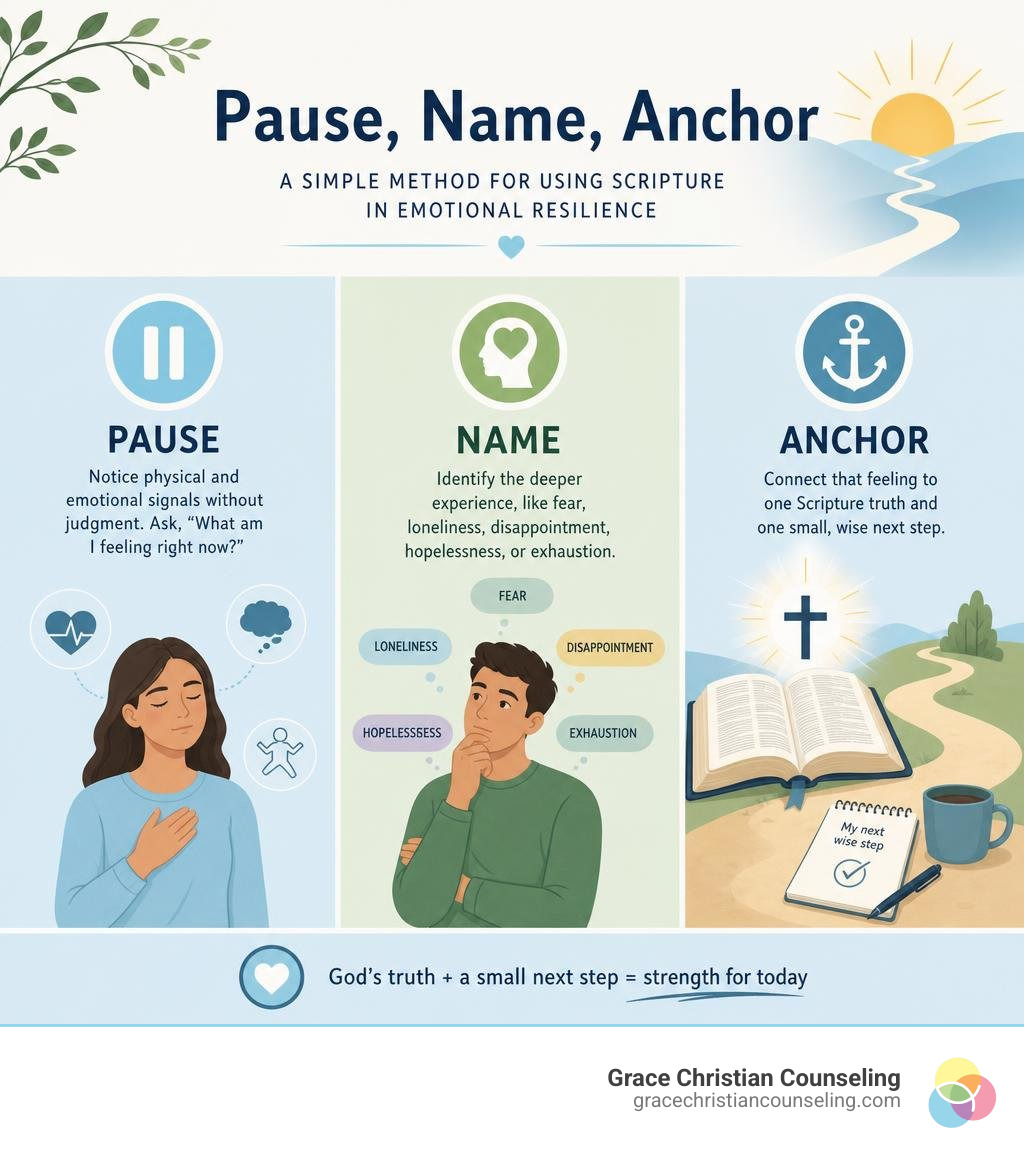
A practical exercise we encourage is what we call Pause, Name, Anchor:
- Pause: Notice physical and emotional signals without judgment. Ask, “What am I feeling right now?”
- Name: Identify the deeper experience, like fear, loneliness, disappointment, hopelessness, or exhaustion.
- Anchor: Connect that feeling to one Scripture truth and one small, wise next step.
For example, someone feeling overwhelmed may pair Matthew 11:28 with scheduling prayerful rest, reaching out to a trusted person, or following through on a counseling appointment. The goal is not to deny emotions but to respond to them intentionally. Over time, many people report that combining Scripture with practical care helps reduce shame and builds healthier patterns of emotional processing and spiritual connection.
Comforting Bible Quotes About Mental Health for Anxiety and Fear

Anxiety can feel like a physical weight, racing thoughts, a pounding heart, tight breath, and sleepless nights. Scripture does not shame these struggles; it invites us to bring them to God. Philippians 4:6-7 points us toward prayer, honest requests, and thanksgiving, while 1 Peter 5:7 reminds us to cast our cares on the Lord because He cares for us. If you are facing panic, chronic worry, or fear, you can explore practical next steps in Overcoming Anxiety Through Christian Counseling and connect more biblical truth with clinical wisdom.
Trading Worry for Perfect Peace
Let us look closely at Philippians 4:6-7. Paul writes, “Do not be anxious about anything, but in everything by prayer and supplication with thanksgiving let your requests be made known to God. And the peace of God, which surpasses all understanding, will guard your hearts and your minds in Christ Jesus.”
The Greek word translated as “anxious” in Philippians 4:6 is merimnaō (μεριμνάω), which carries the idea of being troubled by cares, distracted, or pulled in multiple directions by concern. Paul’s instruction is not simply to suppress difficult emotions or “stop worrying.” Instead, he redirects anxious thoughts toward prayer, thanksgiving, and active dependence on God.
This is echoed in 1 Peter 5:7, which tells us to cast our anxieties on Him. The Greek word for “cast” (epirrhiptō) suggests a forceful throw, like flinging a heavy, awkward pack off your shoulders. It is an active, daily surrender. When we do this, God promises a supernatural peace that acts like a military guard, protecting our vulnerable hearts and minds from the assault of fear.
Additionally, Isaiah 41:10 provides a firm foundation when we feel weak: “Fear not, for I am with you; be not dismayed, for I am your God; I will strengthen you, I will help you, I will uphold you with my righteous right hand.” We do not have to muster up our own strength; we simply have to rely on His divine protection.
Finding Rest for a Weary Soul
When life becomes overwhelming, our souls grow deeply tired. Jesus offers a beautiful, open invitation in Matthew 11:28-30: “Come to me, all who labor and are heavy laden, and I will give you rest. Take my yoke upon you, and learn from me, for I am gentle and lowly in heart, and you will find rest for your souls.” Notice that Jesus does not demand that we clean ourselves up or fix our problems before we approach Him. He simply says, “Come.” He offers a gentle, spiritual rest that restores our mental baseline.
To protect our minds from chronic burnout, Jesus also teaches us the importance of a present-moment focus. In Matthew 6:34, He advises, “Therefore do not be anxious about tomorrow, for tomorrow will be anxious for itself. Sufficient for the day is its own trouble.” By focusing on daily grace rather than borrowing trouble from the future, we can significantly reduce our daily anxiety. For more on this, check out our guide on How to Deal with Anxiety as a Christian.
Finding Hope in the Darkness: Scriptures for Depression and Hopelessness
Depression is often described as a thick, heavy fog that distorts reality, leaving us feeling entirely isolated and empty. During these dark seasons, reading the Bible can sometimes feel difficult. However, Scripture does not ignore our sorrow. It contains deep, comforting laments that validate our pain. We can find deep encouragement in Prov_17:22, which reminds us that “a joyful heart is good medicine, but a crushed spirit dries up the bones.” God understands how deeply a heavy spirit affects our physical health.
If you are walking through a season of profound darkness where hope feels entirely out of reach, we encourage you to read Yes, God Does Care: Praying Through Despair With Psalm 88 | Bible Gateway News & Knowledge . Psalm 88 is one of the unique passages in Scripture that ends without a tidy resolution, proving that God allows us to express raw despair to Him. For additional resources, you can read From Burnout to Blessing: Bible Verses for Depression and Hopelessness.
To help understand how faith addresses our darkest moments, let us compare the characteristics of biblical lament with worldly despair:
| Biblical Lament | Worldly Despair |
|---|---|
| Honest, raw expression of pain directly to God | Feeling completely isolated and cut off from help |
| Remembers God’s past faithfulness and character | Believes that circumstances will never improve |
| Asks God to intervene and bring relief | Leads to withdrawal, hopelessness, and giving up |
| Moves slowly toward trust, even amidst tears | Keeps the soul trapped in a cycle of self-condemnation |
God’s Closeness to the Brokenhearted
When you are in the depths of depression, you might feel like God has abandoned you. But Scripture tells us the exact opposite is true. Psalm 34:17-18 promises, “When the righteous cry for help, the Lord hears and delivers them out of all their troubles. The Lord is near to the brokenhearted and saves the crushed in spirit.”
God does not stand at a distance, waiting for you to feel better. He steps directly into your grief. This is emotional healing in its purest form, a divine comfort that validates your pain rather than rushing you through it. Furthermore, Psalm 147:3 declares, “He heals the brokenhearted and binds up their wounds.” Just as a tender physician carefully wraps a physical injury, God gently tends to your emotional and mental wounds.
Moving from Mourning to Joy
Though depression can make nights feel endless, God promises that darkness does not have the final say. Psalm 30:5 reminds us, “Weeping may tarry for the night, but joy comes with the morning.” This is not a promise of an instant fix, but a reassurance of spiritual endurance and eternal hope.
Our ultimate security rests in God’s unconditional love, as beautifully detailed in Romans 8:38-39: “For I am sure that neither death nor life, nor angels nor rulers, nor things present nor things to come, nor powers, nor height nor depth, nor anything else in all creation, will be able to separate us from the love of God in Christ Jesus our Lord.” No matter how dark your thoughts may feel, they cannot separate you from His grasp. If you are seeking professional support to navigate these feelings, consider exploring Christian Counseling for Depression or Biblical Counseling for Depression.
What We Commonly See When People Turn to Scripture During Mental Health Struggles
Across counseling conversations, one experience appears repeatedly: people often stop engaging with Scripture not because they no longer believe, but because emotional pain changes how they experience familiar truths. Clients frequently describe opening the Bible and feeling numb, distracted, discouraged, or frustrated that verses which once felt comforting seem difficult to connect with. Others tell us they avoid prayer because they feel disappointed with themselves or assume God must be disappointed with them too.
One of the most meaningful shifts we see happens when people stop treating spiritual practices as a performance test and begin approaching them as a relationship. Instead of reading large portions of Scripture, many benefit from slowing down and sitting with a single passage for several days, journaling one observation, or praying one honest sentence.
This approach does not replace therapy, medical care, or church support. Rather, it often helps restore a sense of connection during seasons when faith feels harder than usual. Emotional healing is rarely instant, but small, consistent practices frequently create space for hope to return.
Biblical Figures Who Struggled: Proof That Faith Doesn’t Prevent Pain

One of the greatest gifts of Scripture is its absolute honesty. The Bible is filled with heroes of faith who wrestled with severe mental and emotional distress. Seeing their stories reminds us that our struggles do not disqualify us from God’s love or purpose. You can discover more about these journeys in 10 Healing Scriptures for Mental Health Recovery.
Elijah’s Journey Through Despair
In 1 Kings 19, we find the prophet Elijah in a state of severe crisis. Immediately after a massive spiritual victory on Mount Carmel, he receives a death threat from Queen Jezebel. Overwhelmed by fear, physical exhaustion, and isolation, Elijah flees into the wilderness, sits under a broom tree, and asks God to take his life. How does God respond to Elijah’s suicidal ideation and depression? He does not lecture him, scold him, or tell him to have more faith.
Instead, God addresses his physical needs first. He sends an angel to provide Elijah with food, water, and deep rest. Only after Elijah is physically restored does God speak to him, not in a dramatic wind or fire, but in a gentle, quiet whisper. This story is a beautiful reminder that our physical health, nutrition, and rest are deeply intertwined with our mental well-being.
David’s Honest Laments in the Psalms
King David, a man after God’s own heart, was no stranger to deep emotional valleys. Throughout the Psalms, he expresses raw, unfiltered feelings of grief, betrayal, and despair. In Psalm 42:11, David talks directly to his own soul: “Why are you cast down, O my soul, and why are you in turmoil within me? Hope in God; for I shall again praise him, my help and my God.”
In Psalm 13, he cries out, “How long, O Lord? Will you forget me forever?” David teaches us the importance of emotional expression. He does not suppress his pain; he pours it out honestly before God, and only after doing so does he gently shift his focus back to praise and trust.
Integrating Scripture with Professional Care: A Balanced Perspective
While Bible quotes about mental health provide a beautiful foundation of hope, God also works through the common grace of clinical psychology and medical science. Seeking help from a licensed counselor, such as a Licensed Social Worker (LSW) or a Licensed Associate Professional Counselor (LAPC), is a courageous step that honors the way God designed our minds to heal. For a deeper look at how clinical expertise and biblical truth work hand in hand, please read Healing the Heart with the Word.
The Counseling Blueprint for Healing
At Grace Christian Counseling, we utilize a structured approach to care called the Counseling Blueprint. This four-stage journey is designed to help you move from feeling overwhelmed to experiencing lasting wholeness:
- Take Off the Mask: We begin by building a genuine, safe, and non-judgmental space where you can share your real struggles without fear of shame.
- Heal the Wounds: Together, we gently explore the deeper emotional, relational, and historical hurts that are contributing to your current distress.
- Remove the Toxins: We help you identify the unhelpful core beliefs, cognitive distortions, and lingering lies that keep you stuck in cycles of anxiety or depression.
- Replace with Truth: Finally, we work to install empowering, accurate perspectives based on God’s truth about who you are, helping you build practical coping skills for the future.
Combining Faith and Therapy
A truly holistic approach to mental health recognizes that we must care for the mind, body, and spirit simultaneously. This means combining prayer, Scripture, and spiritual discernment with evidence-based therapeutic techniques like Cognitive Behavioral Therapy (CBT) and trauma-informed care. For some individuals, it may also involve working with a medical professional to manage medication.
If you are looking for local support in Pennsylvania, we offer compassionate, professional care tailored to your unique needs. You can explore Faith-Based Depression Therapy Pennsylvania to learn more about our services. Additionally, for virtual care options beyond PA, WV, GA, and FL, you can connect with NuWellonline.com.
Frequently Asked Questions About Bible Quotes About Mental Health
What is the most comforting Bible quote about mental health for anxiety?
While many passages offer comfort, Philippians 4:6-7 is widely considered one of the most powerful scriptures for anxiety. It provides a practical, step-by-step approach: bring your worries directly to God through prayer, accompany those requests with thanksgiving for His past faithfulness, and allow His supernatural peace to guard your heart and mind. This process helps shift our focus from our overwhelming circumstances to a sovereign, loving God.
Does relying on Bible quotes about mental health mean I shouldn’t seek therapy?
Not at all. In fact, combining Scripture with professional counseling is a highly effective way to pursue healing. God often uses doctors, counselors, and therapists as instruments of His healing grace. Seeking therapy is a sign of strength and wisdom, not a lack of faith. Just as we would pray and go to a doctor for a physical illness, we can pray and seek professional care for our mental and emotional well-being.
How can I use Scripture daily to build emotional resilience?
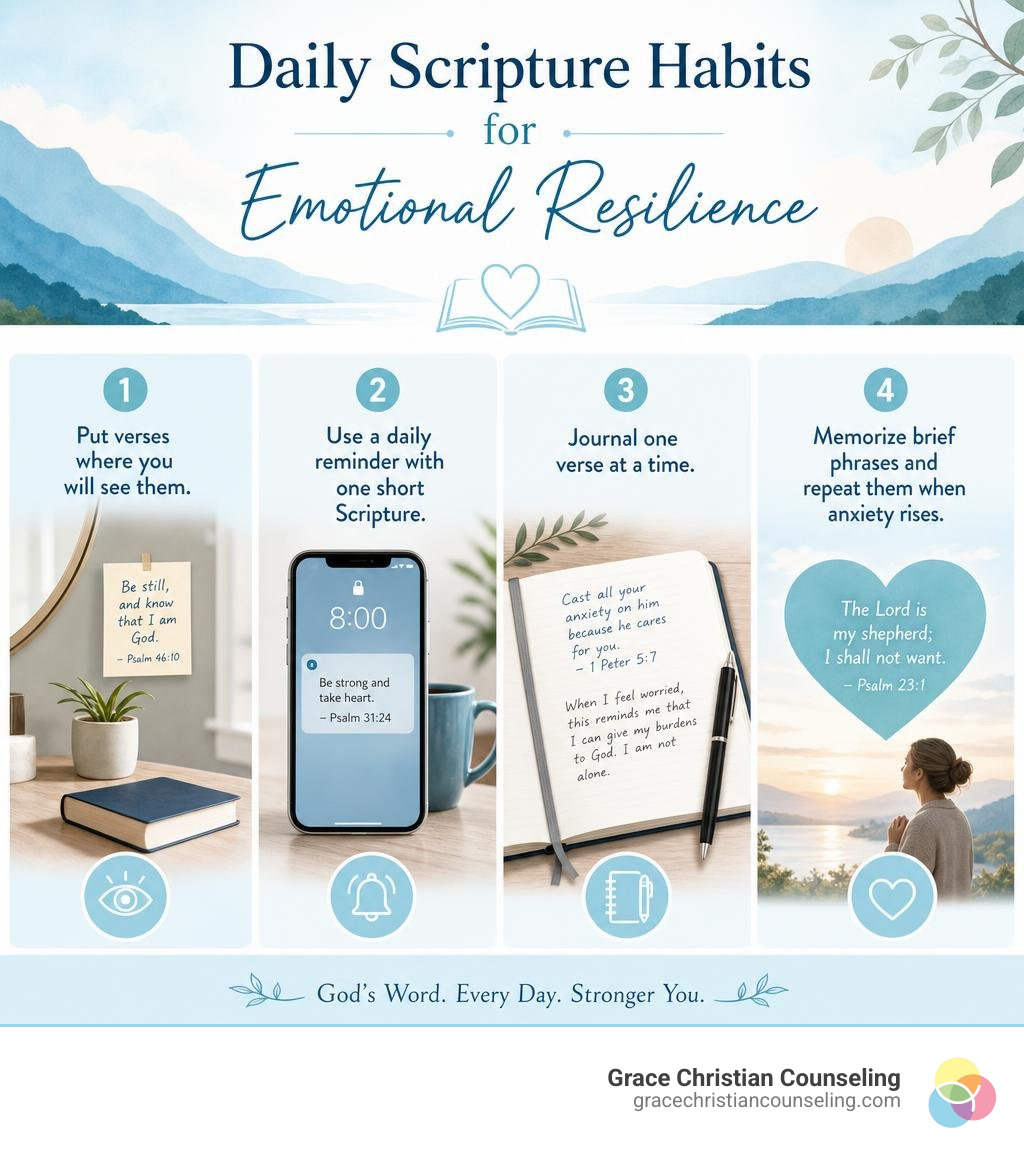
Using Scripture each day can help you slow down, name what is true, and respond to hard thoughts with faith. Try these simple practices:
- Put verses where you will see them, like your mirror, desk, fridge, or car dashboard.
- Use a daily phone reminder with one short Scripture, then pause, breathe, and pray.
- Journal one verse at a time, and write how it speaks to your fear, sadness, anger, or stress.
- Memorize brief phrases such as “The Lord is my shepherd” or “Fear not, for I am with you,” and repeat them when anxiety rises.
Your Journey to Healing and Wholeness
If you are carrying a heavy burden today, please remember that you do not have to carry it alone. God sees your pain, knows your thoughts, and remains close to you in the midst of the storm. Whether you are navigating anxiety, depression, burnout, or trauma, there is hope, and there is a path forward.
At Grace Christian Counseling, we are honored to walk alongside individuals, couples, and families throughout Western Pennsylvania, including Pittsburgh, Bethel Park, Penn Hills, Sewickley, Mt. Lebanon, North Huntingdon, and Uniontown. Our team of licensed counselors is dedicated to providing warm, compassionate, and professional care that honors both clinical excellence and your Christian faith.
We invite you to take the first step on your healing journey today. Learn more about our services or reach out to us directly through our website schedule a consultation. Let us help you replace the lies of fear and despair with the life-giving truth of God’s love.
This guide is for educational and spiritual encouragement and is not a substitute for personalized professional counseling. If you are in crisis, please reach out for immediate help.
Finding Hope With Christian Support for Depression and Anxiety


