

What Is the Narcissistic Abuse Cycle? A Quick Overview
Clinical Understanding and Diagnostic Context
While “narcissistic abuse cycle” is a widely used clinical and educational framework, it is important to note that “narcissistic abuse” itself is not a formal diagnostic category in the DSM-5-TR. Instead, the behaviors described in this cycle are often associated with traits found in Narcissistic Personality Disorder (NPD) and other maladaptive personality patterns.
According to the Diagnostic and Statistical Manual of Mental Disorders (DSM-5-TR), NPD is characterized by pervasive patterns of grandiosity, need for admiration, and lack of empathy that begin in early adulthood and are present across contexts.
Research suggests that while the prevalence of clinically diagnosed NPD is estimated at approximately 0.5%–1% of the general population, narcissistic traits exist on a spectrum and may be more commonly encountered in relational dynamics outside of formal diagnosis. Understanding this distinction helps prevent over-pathologizing individuals while still validating the lived experience of those affected by emotionally abusive relational cycles.
What Is the Narcissistic Abuse Cycle?
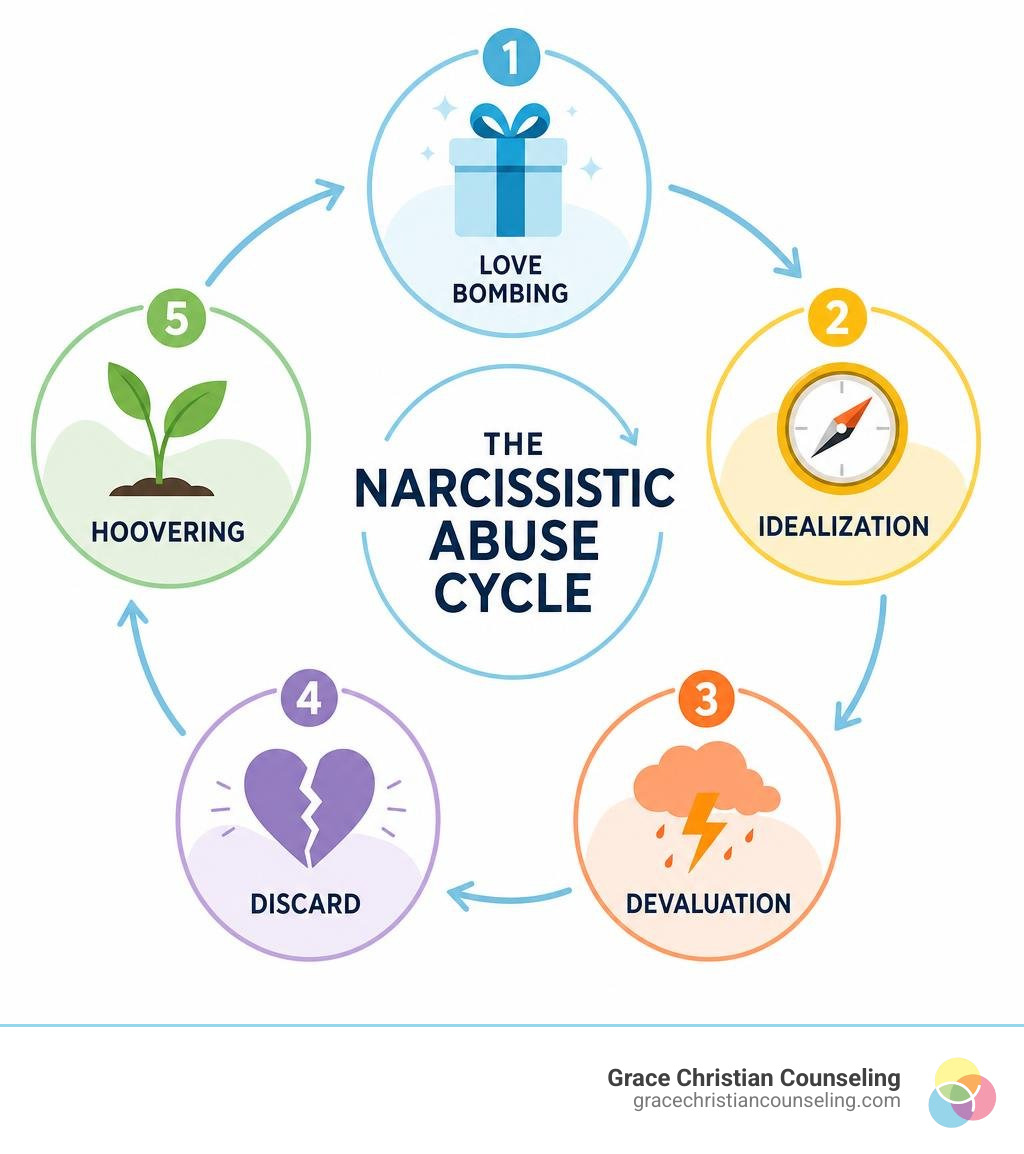
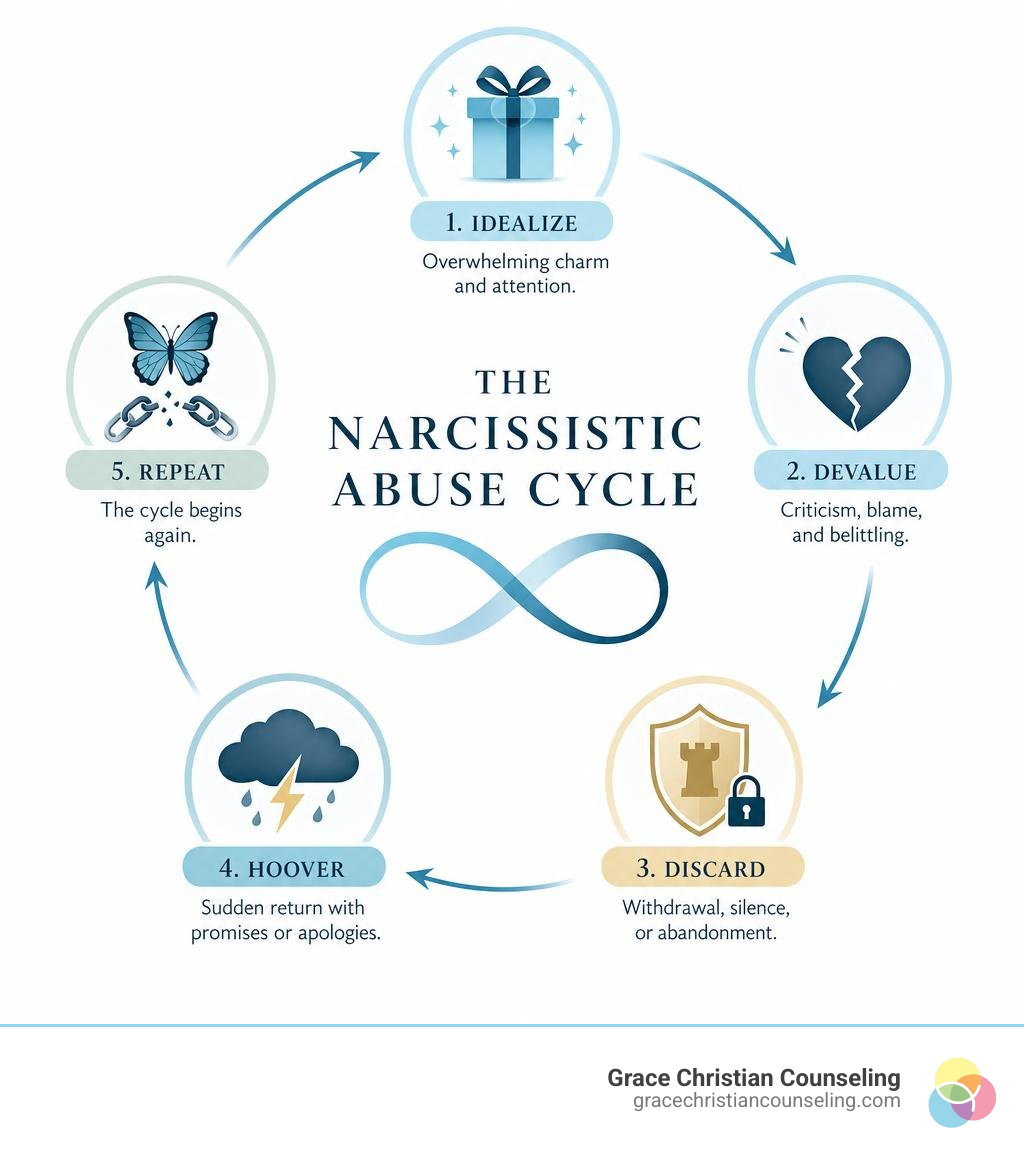
The narcissistic abuse cycle is a repeating pattern of manipulation and emotional control that can leave victims feeling confused, exhausted, and deeply wounded. It typically moves through four predictable stages:
- Idealization , the abuser showers you with affection, praise, and attention (“love bombing”) to create emotional dependency.
- Devaluation , affection is replaced with criticism, gaslighting, and control, eroding your confidence and sense of reality.
- Discard , the abuser withdraws emotionally or ends the relationship, often suddenly and cruelly.
- Hoovering , the abuser attempts to pull you back in with apologies, false promises, or guilt.
This cycle then repeats, sometimes for years. If you have ever looked back on a relationship and asked yourself, “Why did I stay so long? Why couldn’t I see it?” you are not alone. Many people, including Christians with strong faith and deep community support, find themselves trapped in relationships that felt like a dream at first but slowly became something unrecognizable.
Narcissistic abuse rarely begins with obvious cruelty. It often starts with what feels like a perfect connection, someone who seems to truly see you, value you, and share your hopes and dreams. That is precisely what makes this pattern so hard to detect and so painful to escape.
Understanding the cycle is the first and most important step toward breaking free from it. Whether you are currently in a difficult relationship, supporting someone you love, or still making sense of a past experience, knowing what this cycle looks like can bring clarity where there has only been confusion.
At Grace Christian Counseling, we walk alongside individuals and couples in Western Pennsylvania and online who are navigating this kind of pain. We believe healing is possible, through evidence-based care, compassionate support, and the hope found in Christ.
Understanding the Narcissistic Abuse Cycle
To understand the narcissistic abuse cycle, we must first understand the nature of Narcissistic Personality Disorder, or NPD, and narcissistic traits. While only about 1% to 6% of the general population is clinically diagnosed with NPD, many more individuals display traits on the narcissistic spectrum. These traits can include a lack of empathy, a constant need for admiration, and a strong sense of entitlement.
Unlike traditional cycles of abuse that may center on physical violence, Narcissistic Abuse Cycle: Definition, Stages, and Coping shows us that this specific pattern is often systematic and involves identity manipulation. It often unfolds through everyday interactions that seem confusing rather than clearly abusive at first. The abuser is not simply “having a bad day”; they are often using recurring tactics to maintain control, protect a fragile ego, and keep a power imbalance in place.
In our communities across Western PA, from the quiet streets of Ligonier to the bustling neighborhoods of Mt. Lebanon, this kind of abuse can leave deep emotional and spiritual wounds. It is especially disorienting because the abuser may appear charming, generous, and believable in public while causing psychological harm in private. This pattern can leave victims feeling as though they are “going crazy,” which is often the result of gaslighting.
At Grace Christian Counseling, our licensed counselors help individuals and families understand these patterns through evidence-based, trauma-informed care grounded in Biblical truth. We also recognize that many people begin seeking support online outside of PA, which is why resources such as NuWellonline.com may help some individuals take an initial step toward understanding their options, while ongoing counseling can provide deeper healing and support.
The Evidence Base for Emotional Abuse Patterns
Clinical research on psychological and emotional abuse supports many of the relational patterns described in the narcissistic abuse cycle, even though terminology varies across disciplines (e.g., “coercive control,” “psychological aggression,” or “emotional abuse”).
The World Health Organization recognizes intimate partner violence as including emotional and psychological abuse, which can have long-term impacts on mental health comparable to physical violence in some populations. Studies in trauma psychology also show that chronic emotional manipulation, including gaslighting and intermittent reinforcement, can contribute to symptoms consistent with trauma responses such as anxiety, hypervigilance, and impaired self-trust. This is why clinicians often focus less on labeling the other person and more on identifying the impact of relational patterns on psychological safety and functioning.
The Four Stages of the Narcissistic Abuse Cycle
The narcissistic abuse cycle is remarkably predictable once you know what to look for. It functions as a form of behavioral conditioning. Much like a gambler is hooked by the occasional “win,” a victim in this cycle is kept hooked by the memory of the “good times” and the hope that they will return.

This cycle doesn’t always have a clear beginning or end; it can loop back on itself or skip stages depending on the abuser’s needs. However, most survivors recognize these four distinct phases.
Recognizing Love Bombing in the Narcissistic Abuse Cycle
The first stage is the Idealization phase, commonly known as “love bombing.” In this stage, the relationship moves at a dizzying speed. You might feel like you have finally met your soulmate. The narcissist may tell you they have never felt this way before, shower you with excessive praise, and talk about a future together within weeks of meeting.
This mirroring is a calculated tactic. By reflecting your own values, hopes, and dreams back to you, the abuser creates an instant, intense bond. They put you on a pedestal, making you feel more seen and valued than ever before. However, this isn’t genuine connection; it is a strategy to create emotional dependency. By making themselves the sole source of your happiness, they ensure that when they eventually pull away, the loss will feel devastating.
The Devaluation Stage and Manipulation Tactics
Slowly, the pedestal begins to crack. The Devaluation stage is where the “mask” starts to slip. The excessive praise is replaced by subtle criticisms, which eventually grow into overt insults. You may find yourself walking on eggshells, constantly monitoring your words and actions to avoid a conflict that seems inevitable.
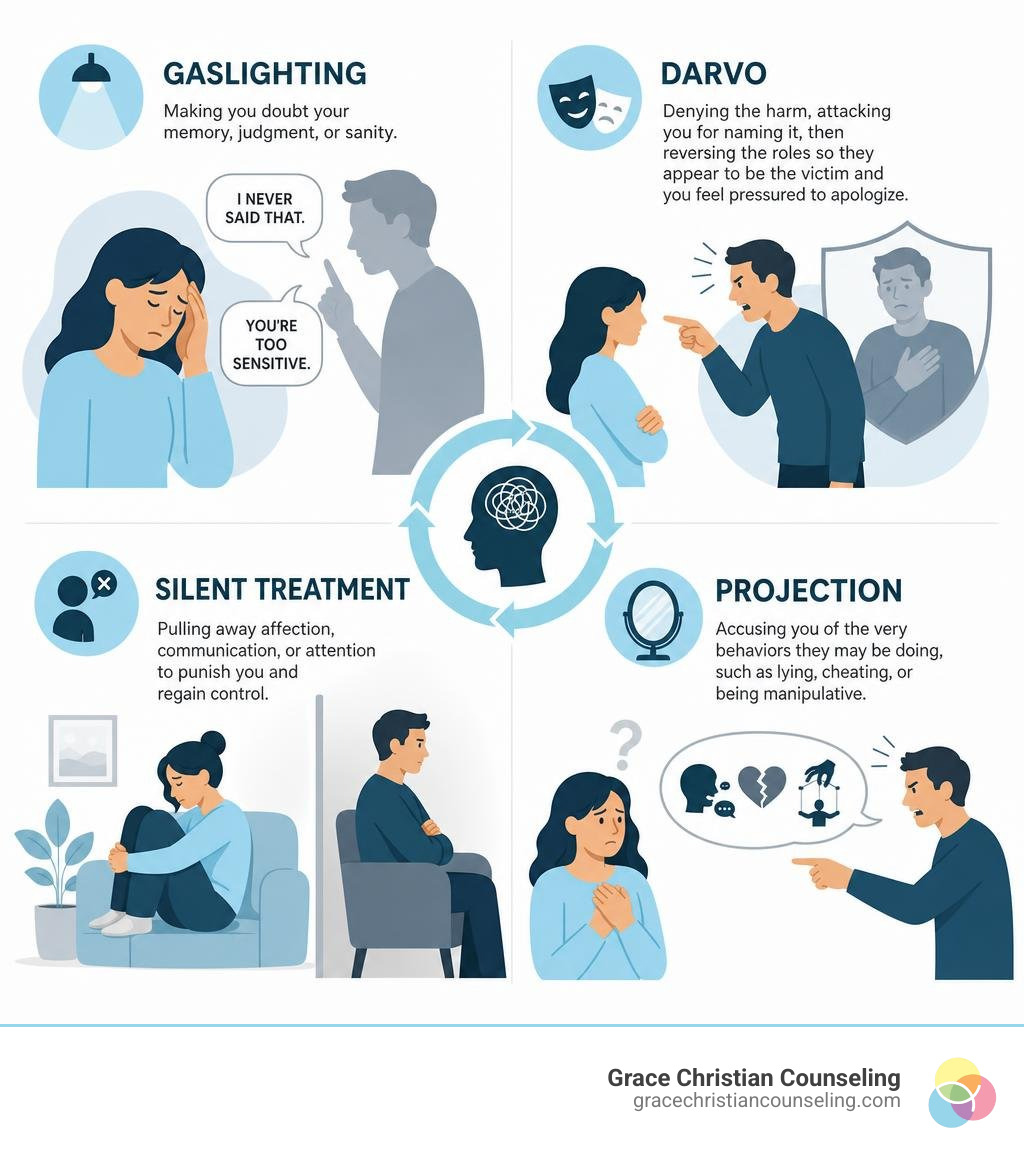
Common tactics in this stage include:
- Gaslighting: Making you doubt your memory, judgment, or sanity, often with lines like, “I never said that,” or “You’re too sensitive.”
- DARVO: Denying the harm, attacking you for naming it, then reversing the roles so they appear to be the victim and you feel pressured to apologize.
- Silent Treatment: Pulling away affection, communication, or attention to punish you and regain control.
- Projection: Accusing you of the very behaviors they may be doing, such as lying, cheating, or being manipulative.
During this time, victims often experience a significant increase in stress and anxiety. We often see individuals seeking healing from anger and aggression because they have begun to react to the constant mistreatment, a phenomenon known as reactive abuse.
The Discard and Emotional Abandonment
The Discard phase is perhaps the most painful part of the narcissistic abuse cycle. Once the abuser feels they have “won” or that you are no longer providing the “narcissistic supply” (admiration and control) they crave, they may dispose of the relationship with shocking coldness.
This discard is often sudden. One day you are their “everything,” and the next, you are treated as a stranger or an enemy. They may weaponize your deepest vulnerabilities, things you shared in confidence during the idealization phase, to hurt you. For many, this feels like an identity erosion. You may feel like you’ve lost yourself entirely. When this happens, it is vital to remember that when a narcissist tries to destroy a Christian, they are attacking your worth, but they can never take away your identity in Christ.
The Role of Hoovering in the Narcissistic Abuse Cycle
Just when you think it is over, the narcissist often returns. Named after the vacuum brand, “hoovering” is an attempt to suck the victim back into the relationship. This usually happens when the abuser feels lonely, bored, or in need of validation.
They may use:
- Faux-pologies: “I’m sorry you felt that way,” which isn’t a real apology but a way to re-engage.
- Future Faking: Making grand promises to change or finally go to counseling, with no intention of following through.
- Manufacturing Crises: Claiming a health emergency or a sudden tragedy to exploit your empathy.
- Guilt-tripping: Reminding you of the “good times” or accusing you of being heartless for moving on.
Hoovering is not a sign of love; it is a sign that the abuser wants to restart the cycle and regain dominance.
Why Leaving is Difficult: Trauma Bonding and Intermittent Reinforcement
Many people wonder why victims stay in the narcissistic abuse cycle. The answer lies in the neurological mechanism of trauma bonding. This bond is created through intermittent reinforcement, the same psychological principle that makes slot machines so addictive.
When the abuser is kind (the “hit” of dopamine), it feels incredible because it follows a period of pain. Your brain begins to associate the abuser with the relief from the very pain they caused. This creates a powerful chemical bond that is much harder to break than a normal relationship bond.
This leads to “learned helplessness.” Over time, the victim loses the belief that they can escape or that they deserve better. This is compounded by cognitive dissonance, the mental struggle of holding two opposing ideas: “This person loves me” and “This person is hurting me.”
Trauma Bonding and Intermittent Reinforcement: What Research Shows
The difficulty many individuals experience when leaving abusive relational cycles is often explained through the concept of trauma bonding, which is closely related to intermittent reinforcement patterns studied in behavioral psychology. Intermittent reinforcement occurs when rewards (affection, validation, reconciliation) are delivered unpredictably after periods of distress. This pattern has been shown to significantly increase behavioral persistence, even in harmful contexts.
Trauma researchers also note that repeated cycles of fear and relief can activate the brain’s reward and stress systems in ways that strengthen attachment despite negative outcomes. This does not indicate weakness or poor judgment. Rather, it reflects normal human neurobiological responses to unpredictable relational reward systems.
Breaking Free and Finding Biblical Healing
Breaking free from the narcissistic abuse cycle requires more than just willpower; it requires a strategy and a support system.
- No Contact: This is the gold standard for recovery. It means blocking the abuser on all platforms and ending all communication. If you must communicate (due to children or legal matters), use the Grey Rock technique: become as uninteresting and non-responsive as a grey rock. Provide short, factual, and emotionless answers.
- Set Firm Boundaries: Boundaries are not about changing the narcissist; they are about protecting your peace. Keep them simple and do not feel the need to justify them.
- Professional Support: Navigating the “fog” of narcissistic abuse is difficult alone. Trauma therapy for healing from narcissistic abuse can help you process the manipulation and rebuild your sense of self.
- Identity Rebuilding: Recovery is a journey of letting go of past traumas and remembering who God says you are.
Clinically Excellent Recovery Considerations
Clinically, recovery from emotionally abusive relational cycles often involves stabilization, psychoeducation, boundary formation, and trauma processing. Evidence-based modalities commonly used include Cognitive Behavioral Therapy (CBT), Eye Movement Desensitization and Reprocessing (EMDR), and trauma-informed counseling approaches.
Research in trauma therapy consistently shows that restoring a sense of safety, autonomy, and self-trust is a primary predictor of recovery outcomes. In faith-integrated counseling settings, many individuals also benefit from integrating spiritual meaning-making alongside clinical treatment, particularly when faith has been a central part of identity prior to or during the abusive relationship.
As you walk this path, we encourage you to hold onto Philippians 4:6-7: “Do not be anxious about anything, but in every situation, by prayer and petition, with thanksgiving, present your requests to God. And the peace of God, which transcends all understanding, will guard your hearts and your minds in Christ Jesus.”
How Clinicians Differentiate Patterns in Practice
In therapy, “narcissistic abuse” is usually not treated as a separate formal diagnosis. Instead, a counselor looks at the specific patterns in the relationship, such as emotional abuse, coercive control, gaslighting, attachment wounds, and trauma symptoms. That distinction matters. Labels can help name the experience, but they can also flatten a painful, complicated story.
Ethical care focuses on what happened, how safe you are now, and how the relationship has affected your mind, body, faith, and sense of self. This keeps treatment grounded in real behaviors and evidence-based support, not only in popular online descriptions.
Frequently Asked Questions about Narcissistic Abuse
Can a narcissist truly change their behavior?
While personality exists on a spectrum, individuals with Narcissistic Personality Disorder rarely seek treatment because the disorder itself prevents them from acknowledging they are the problem. Change is only possible with years of committed, specialized therapy and a genuine desire to develop empathy; something that is unfortunately rare in these dynamics.
What is reactive abuse and how is it used against victims?
Reactive abuse occurs when a victim finally “snaps” after months or years of subtle goading, gaslighting, and mistreatment. The victim may scream, use harsh language, or lash out. The narcissist then calmly points to this reaction as “proof” that the victim is the actually abusive one. It is a manipulation tactic used to shift blame and further confuse the victim.
How long does it typically take to recover from a narcissistic relationship?
There is no set timeline. For some, the fog begins to lift in a few months; for others, the journey of rebuilding self-esteem and processing PTSD symptoms can take years. Recovery is not a linear process, but with the right therapy for overcoming emotional abuse, healing is absolutely possible.
Conclusion
The narcissistic abuse cycle is a heavy burden to carry, but you do not have to carry it alone. Whether you are in Pittsburgh, North Huntingdon, Penn Hills, Uniontown, Bethel Park, Sewickley, Mt. Lebanon, or anywhere else in Pennsylvania or West Virginia, there is a community of care ready to support you.
At Grace Christian Counseling, we provide Christ-centered, evidence-based care tailored to your specific needs. We understand the complexities of narcissistic dynamics and offer both in-person and online counseling to help you find your way back to peace and wholeness.
If you are ready to take a next step, we invite you to reach out to us in prayerful hope and practical courage. Healing is possible, and you do not have to walk this road by yourself.
Contact Grace Christian Counseling to Begin Your Healing Journey
This article was researched with AI and heavily edited by Bekah McCrorey for accuracy and relevance.
Bekah McCrorey is a counselor at Grace Christian Counseling. She holds a Master’s degree in Counseling from Dallas Theological Seminary and a Bachelor’s degree in Christian Ministry from Chesapeake Bible College and Seminary. She is a provisionally licensed counselor working under supervision toward full licensure as a Licensed Professional Counselor (LPC) in Pennsylvania.
With over 12 years of full-time ministry experience supporting individuals, families, ministry leaders, and churches nationally and internationally, Bekah brings a deep understanding of emotional and spiritual struggles. As a counselor, she uses a client-centered, trauma-informed, and evidence-based approach. She is Level 1 trained in Restoration Therapy and is passionate about helping clients navigate anxiety, depression, grief, trauma, life transitions, and relational difficulties while integrating emotional and spiritual well-being.
This guide is for educational and spiritual encouragement and is not a substitute for personalized professional counseling. If you are in crisis, please reach out for immediate help.
Understanding Family Trauma: Transgenerational vs Intergenerational


