

Why Finding the Right Therapist for Your Attachment Style Can Change Everything
If you’ve been searching for a therapist for attachment style healing, here is a quick answer to help you get started:
What to look for in an attachment-based therapist:
- Licensed mental health professional (such as an LPC, LMFT, LAPC, LSW, or LCSW)
- Specific training in attachment-based therapy techniques
- Experience working with your particular concerns (anxiety, trauma, relationship issues)
- A therapeutic style where you feel safe, heard, and comfortable being open
- Availability for in-person or online sessions that fit your schedule
The way you connect with others often traces back further than your last difficult relationship. Whether you cling tightly, pull away, or swing between both, those patterns were usually learned early through bonds with parents and caregivers. Over time, they quietly shape how you trust, love, and handle conflict as an adult.
The good news is that these patterns are not permanent. Research shows that people can move toward what is called “earned secure attachment,” even after years of struggling in relationships. Therapy can play a powerful role in that process.
At Grace Christian Counseling, we believe healing happens at the intersection of evidence-based care and Biblical truth. Whether you are in Pittsburgh, North Huntingdon, or anywhere across Western Pennsylvania, or prefer to meet online, our licensed counselors are here to walk with you through that journey.
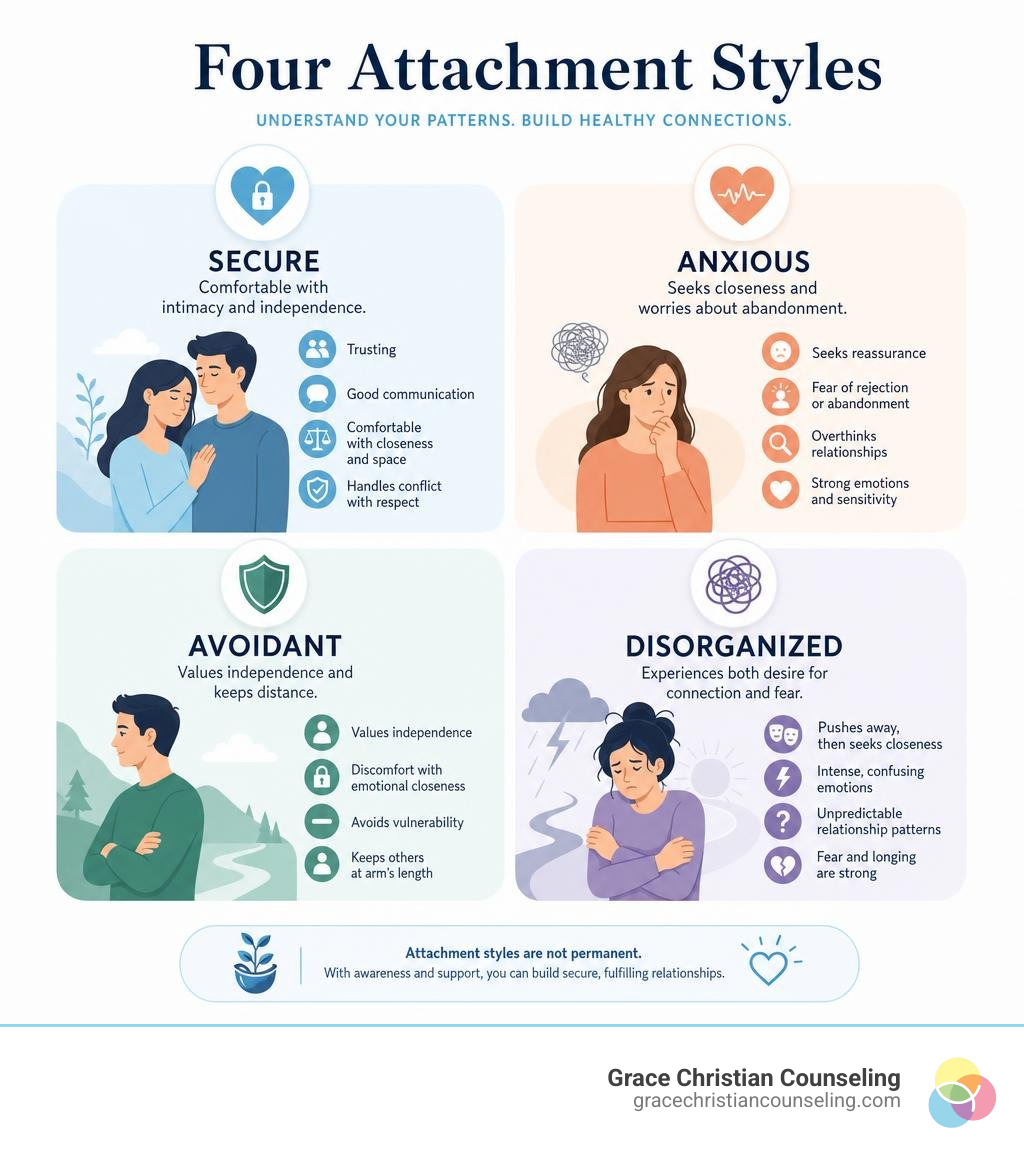
Understanding the Four Core Attachment Styles in Adults
To make sense of how a therapist for attachment style can help you, it is essential to first understand the four core ways adults experience attachment. These styles reflect how we think about ourselves and behave in relationships. They are not character flaws; they are survival strategies we learned when we were young.
- Secure Attachment: Adults with a secure attachment style generally have a healthy view of themselves and others. They trust their partners, communicate their needs openly, and feel comfortable with both intimacy and independence. They do not constantly worry about abandonment, and they are able to navigate conflicts with grace and resilience.
- Anxious Attachment: Those with an anxious attachment style, sometimes called anxious-preoccupied, often experience a deep, lingering fear of rejection and abandonment. They may seek frequent reassurance from their partner, struggle to set healthy boundaries, and feel highly sensitive to minor shifts in their partner’s mood or behavior. If you find yourself on an emotional rollercoaster of relationship anxiety, you may want to read The Ultimate Guide to Healing Your Anxious Attachment Style for deep, practical guidance.
- Avoidant Attachment: Often referred to as dismissive-avoidant, individuals with this style tend to equate intimacy with a loss of independence. When relationships become emotionally intense or vulnerable, their instinct is to pull away, minimize their feelings, or shut down. They may appear highly self-reliant, but this self-reliance is often a shield to protect themselves from being hurt or let down by others.
- Disorganized Attachment: Also known as fearful-avoidant, this style is characterized by a “come here, go away” dynamic. Individuals with disorganized attachment crave love and deep connection, but they are simultaneously terrified of it. Because their early experiences taught them that close relationships are unsafe, they may oscillate rapidly between clinging to a partner and pushing them away.
To help you visualize how these styles show up in daily relationships, we have compiled a quick reference table below:
| Attachment Style | View of Self | View of Others | Common Adult Relationship Pattern |
|---|---|---|---|
| Secure | Generally positive and stable | Generally positive and trusting | Comfortable with closeness and autonomy; able to communicate needs and repair conflict |
| Anxious / Preoccupied | Often negative or uncertain | Often positive, but approval feels essential | Heightened fear of rejection or abandonment; may seek reassurance and closeness when distressed |
| Avoidant / Dismissive | Often positive or self-reliant | Often cautious, mistrustful, or devaluing of closeness | Downplays emotional needs; may withdraw, minimize vulnerability, or prioritize independence under stress |
| Disorganized / Fearful-Avoidant | Often negative or conflicted | Often negative, unsafe, or unpredictable | Wants connection but fears it; may alternate between pursuit, withdrawal, and protective reactions |
How Childhood Trauma Shapes Adult Bonds
Our attachment styles do not develop in a vacuum. They are formed during our most vulnerable years through our interactions with early caregivers. When a baby cries, they are looking for a response that says, “I see you, I hear you, and you are safe.” If caregivers are consistently responsive, warm, and emotionally attuned, the child learns that the world is a safe place and that people are reliable. This forms the foundation of secure attachment.
However, if caregiving is inconsistent, emotionally distant, or abusive, the child may experience emotional misattunement or relational trauma. An inconsistently affectionate mother or an emotionally absent father can leave a child wondering if their needs will ever be met, which may contribute to anxious patterns. If a caregiver is rejecting, the child may learn to suppress vulnerability, while a caregiver who feels unsafe can contribute to disorganized attachment.
This relational trauma can make us feel incredibly broken, but God’s word offers profound comfort. In Psalm 34:18, we are reminded that “The Lord is close to the brokenhearted and saves those who are crushed in spirit.” Healing early wounds is not just a psychological task; it can also become a sacred process of restoration.
Identifying Your Own Attachment Patterns
Identifying your own attachment style is the first step toward lasting change. It requires gentle, non-judgmental curiosity about your current relationship triggers.
Ask yourself how you react when your partner does not text back right away. Do you feel sudden panic, fear abandonment, and want to double-text? Or do you shrug it off, convince yourself you do not care, and emotionally withdraw?
Recognizing these patterns in your adult romantic relationships can help you understand why certain dynamics feel so painful or repetitive. If you have recently experienced a painful relationship ending and feel stuck in self-doubt and grief, exploring your attachment style can be a vital part of Healing from Post-Breakup Syndrome. Your intense pain may reflect old, unhealed wounds rather than personal failure.
What is Attachment-Based Therapy and How Does It Work?
Attachment-based therapy is a specialized, trauma-informed form of counseling that focuses on the emotional bonds between humans. Rather than simply trying to change your outward behaviors, an attachment-based therapist looks at the deep, underlying internal models you hold about safety, trust, and connection.
At its core, this therapy uses the therapeutic relationship itself as a safe base. Because attachment wounds are created in relationships, they must be healed in relationships. A skilled therapist provides a consistent, predictable, and warm presence so you can experience what a secure, reliable bond feels like.
In practice, people rarely come to attachment therapy saying, “I think I have an anxious attachment style.” More often, they describe symptoms that feel confusing or frustrating: repeating the same relationship arguments, overthinking text messages, shutting down emotionally, feeling intense fear after conflict, or struggling to trust even safe people.
One reason attachment-focused therapy can feel different from traditional counseling is that the relationship itself becomes part of the healing process. Across attachment-focused counseling, an early goal is helping clients notice relational patterns without shame and begin responding differently in real time. Research on psychotherapy outcomes consistently shows that the quality of the therapeutic relationship contributes meaningfully to improvement across treatment approaches; one review found that relationship factors account for roughly 5–10% of treatment outcomes. As clients experience healthier connection inside therapy, many begin carrying those same skills into everyday relationships outside the session.
People also want practical change: less anxiety when someone pulls away, healthier boundaries, stronger communication, and the ability to feel connected without losing themselves. That is why attachment-based therapy focuses on creating emotional safety first and behavioral change second. Through this process, you learn emotional regulation, build self-esteem, and discover how to express your needs without fear of rejection. This work is essential for overall mental health and wellness, helping you cultivate a resilient mind and a peaceful spirit.
At Grace Christian Counseling, many clients seeking attachment-focused therapy describe the same core struggle: they intellectually understand their patterns, but still feel emotionally hijacked in close relationships. That is why our counselors focus not only on insight, but also on emotional safety, nervous system regulation, and spiritually grounded identity work.
Core Techniques Used by an Attachment Therapist
An experienced therapist for attachment style healing will use several evidence-based techniques to help you process old wounds and build secure patterns. These are not one-size-fits-all tools. They are carefully tailored to your unique history.
- The Ideal Parent Figure (IPF) Method: In this visualization technique, you imagine ideal parent figures who meet the five conditions of secure attachment: felt safety, being seen and known, felt comfort, being valued, and support for independence. This helps your nervous system experience the safety you missed in childhood.
- EMDR Integration: Eye Movement Desensitization and Reprocessing (EMDR) can be powerful for transforming present-day abandonment fears. By processing painful childhood memories with bilateral stimulation, your brain can file those memories away as “past history” rather than active, daily triggers. If you are ready to explore this deeper, you can learn more about Relationship Trauma Therapy Near Me to find a counselor trained in these integrative approaches.
- Parts Work (Ego State or Internal Family Systems): This technique recognizes that we all have different parts of ourselves. You might have an anxious “inner child” part that panics when a partner is quiet, and a protective, avoidant part that wants to shut down. Your therapist helps you understand, welcome, and soothe these parts with compassion.
How It Differs from Traditional Talk Therapy
Traditional talk therapy often operates from a top-down approach, focusing primarily on your thoughts and cognitive patterns. While Cognitive Behavioral Therapy (CBT) is highly effective for many issues, talk therapy alone may not be enough to heal deep relational trauma.
Attachment-based therapy frequently incorporates bottom-up processing and somatic experiencing. This means we pay close attention to how your body holds trauma and anxiety. When you feel sudden panic in a relationship, your heart rate may spike and your chest may tighten before your conscious mind even registers a thought.
By working with both the mind and the body, attachment therapy helps you soothe your nervous system in real time. If you want to dive deeper into how this approach works, our comprehensive guide on Attachment Therapy explains how we help clients move from survival mode into genuine, lasting safety.
Signs You Need a Therapist for Attachment Style Healing

It can be easy to minimize relationship struggles as “normal drama,” but certain persistent patterns may point to something deeper. Working with a specialized therapist could be life-changing if you experience any of the following:
- Deep Trust Issues: Finding it incredibly difficult to believe that others genuinely care about you or will stay with you, even when they show consistent support.
- Chronic People-Pleasing: Constantly abandoning your own needs, values, and boundaries to keep others happy and avoid conflict.
- Emotional Unavailability: Desiring closeness but pulling away, finding flaws in your partner, or shutting down as soon as a relationship starts to feel serious.
- Boundary Difficulties: Either having no boundaries (allowing others to mistreat you) or building walls so high that no one can truly get close to you.
Key Questions to Ask a Potential Therapist for Attachment Style
When you are looking for a therapist for attachment style healing, finding the right fit is crucial. The therapeutic relationship itself is one of the primary tools for recovery. Here are a few practical questions you can ask during an initial consultation:
- What is your training background regarding attachment theory and relational trauma? (Look for licensed professionals like an LPC, LMFT, LAPC, or LSW who have pursued post-graduate training in attachment modalities).
- How do you measure treatment progress in our sessions?
- What does a typical session structure look like in your practice?
- Do you offer online counseling options, and how do you build a secure therapeutic bond virtually?
For example, specialized professionals like our licensed counselors in West Virginia focus on creating a deeply supportive, relational space for clients navigating these exact patterns.
Integrating Faith and Psychology with a Therapist for Attachment Style
At Grace Christian Counseling, we believe that true healing involves the whole person: mind, body, and spirit. While psychology gives us helpful tools to understand our human design, Scripture provides the ultimate foundation for our identity and worth.
When you work with a Christian therapist, you do not have to leave your faith at the door. We integrate evidence-based clinical practices with biblical truth. This approach recognizes that our ultimate secure attachment is found in our relationship with God.
This faith-integrated approach can also be powerful for families. If you are a parent wanting to break generational cycles and raise secure children, you can explore our resources on Grace-Filled Healing for Attachment Wounds in Christian Parenting to discover how to bring Christ-centered healing into your home.
Navigating Relationship Dynamics with Your Partner
One of the most common dynamics we see in couples counseling is the anxious-avoidant trap. This occurs when one partner is anxiously attached and the other is avoidantly attached.
When a conflict arises, the anxious partner moves closer, demanding communication and reassurance. Sensing the intensity, the avoidant partner withdraws to self-soothe. This withdrawal triggers more panic in the anxious partner, who pursues harder, causing the avoidant partner to withdraw even further.
It is an exhausting cycle, but it can be broken. Through open communication and emotional safety, partners can learn to support each other’s healing. We are reminded of the beautiful description of love in 1 Corinthians 13:4-7: “Love is patient, love is kind… It always protects, always trusts, always hopes, always perseveres.”
Frequently Asked Questions about Attachment Therapy

How long does it take to see progress in attachment-based therapy?
The duration of therapy varies for everyone because healing relational wounds is a deeply personal journey. However, research offers some encouraging timelines. For example, studies have shown that focused approaches like Cognitive Behavioral Therapy (CBT) can significantly reduce attachment anxiety in just 10 weeks.
Moving all the way to “earned secure attachment” is a longer process. It involves rewriting years of subconscious programming, not just changing a few habits. Still, you will often begin to feel more grounded, less reactive, and more compassionate toward yourself within the first few months of consistent work.
Can I attend attachment therapy individually or do I need a partner?
You do not need a partner to attend attachment therapy. In fact, most people begin this work individually. Because attachment styles are built on your internal models of safety and self-worth, the most important relationship you will work on in therapy is the relationship you have with yourself. As you learn to connect with your own emotions, set healthy boundaries, and soothe your inner child, your external relationships with friends, family, and romantic partners will naturally begin to transform.
Is online attachment therapy as effective as in-person sessions?
Yes, online attachment therapy can work well when it is provided by a licensed counselor and fits your needs. One updated systematic review and meta-analysis found no significant difference between therapist-supported internet-based CBT and face-to-face CBT. Another meta-analysis of live video therapy compared with in-person therapy found that video-based psychotherapy was not less effective than in-person care, especially for CBT used with affective disorders.
At Grace Christian Counseling, we provide convenient, secure virtual therapy options across Pennsylvania and West Virginia. This ensures that whether you live in a bustling area or a smaller community, you can access specialized, Christ-centered care from the comfort of your own home.
From Attachment Wounds to Secure, Christ-Centered Connection
Your attachment style may have been shaped by your past, but it does not have to define your future relationships. The same patterns that once helped you survive can begin to soften as you experience safety, honesty, and compassionate support in therapy.
At Grace Christian Counseling, our licensed counselors help you explore anxious, avoidant, disorganized, or relational trauma patterns with both clinical wisdom and biblical hope. Through our compassionate, four-stage healing journey called the Counseling Blueprint, we walk with you toward deeper peace and healthier connection:
- Take Off the Mask: We build genuine rapport, creating a safe space where you can be completely honest about your struggles.
- Heal the Wounds: We gently explore the early relational hurts and childhood experiences that shaped your attachment patterns.
- Remove the Toxins: We help you identify and dismantle the unhelpful beliefs, fears, and lingering lies you carry about your worth and safety.
- Replace with Truth: We install empowering, accurate perspectives based on God’s unchanging truth about who you are and how you are loved.
If you are ready to stop repeating painful relationship cycles and start building secure, Christ-centered connection, we are here to support you. Schedule a consultation for attachment therapy with Grace Christian Counseling today, and take the next step toward healing with a therapist who understands attachment style wounds.
This guide is for educational and spiritual encouragement and is not a substitute for personalized professional counseling. If you are in crisis, please reach out for immediate help.
Christian Depression Counseling


