

Why Therapy for Attachment Style Can Change the Way You Relate to Everyone You Love
Therapy for attachment style is a form of counseling that helps you understand and reshape the deep emotional patterns formed in childhood, so you can build healthier, more secure relationships as an adult.
Here is a quick overview of what this guide covers:
- The four attachment styles (secure, anxious, avoidant, fearful-avoidant) and how they show up in your relationships
- How childhood experiences shape your patterns of trust, closeness, and conflict
- What attachment-based therapy looks like in practice, including specific techniques
- Whether your attachment style can change, and what research says about “earned” secure attachment
- How to find a qualified therapist who is the right fit for your needs
Most of us never stop to ask why we react the way we do in close relationships. Why do you pull away when someone gets too close? Why does a delayed text message send your anxiety through the roof? Why does real intimacy feel unsafe, even when you desperately want it?
The answers often trace back further than we expect. Attachment theory, developed by psychologist John Bowlby in the 1960s, tells us that the bonds we formed with our earliest caregivers became a kind of blueprint for how we expect love to work. When those earliest bonds are disrupted through separation, foster care, or adoption, that blueprint can be harder to build, which is where adoption-aware family counseling can help. That blueprint can follow us into our adult friendships, marriages, and even our relationship with God.
The good news is that blueprints can be redrawn. Research, including a meta-analysis of 36 studies involving more than 3,000 patients, shows that improvements in attachment security during therapy are linked to better treatment outcomes overall. Healing is genuinely possible.
At Grace Christian Counseling, we walk alongside individuals, couples, and families in Western Pennsylvania and online, using evidence-based care woven together with Biblical truth. This guide will show you exactly how therapy can help you move from insecure patterns toward something more secure, stable, and rooted.
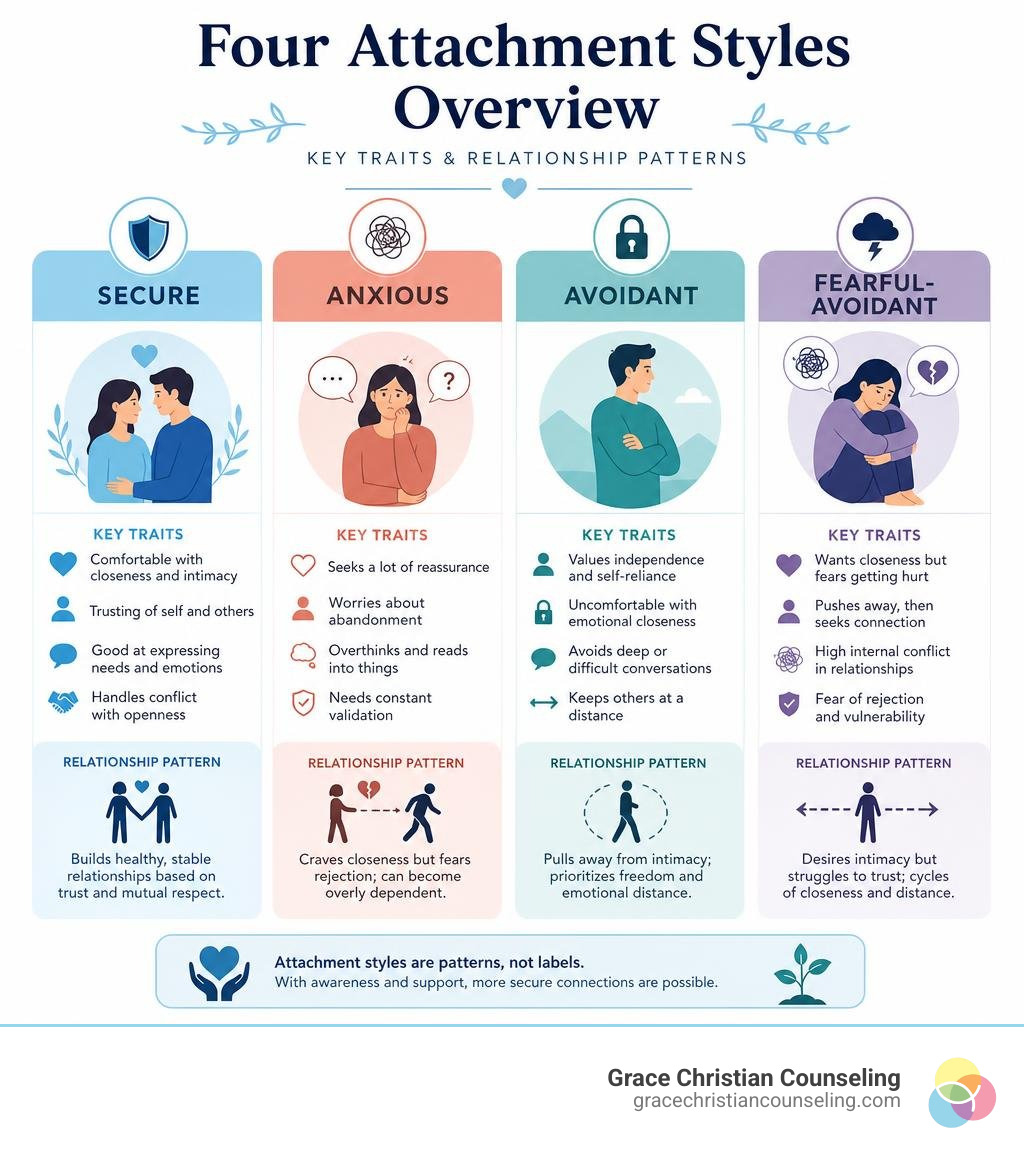
Understanding the Four Core Attachment Styles and Their Childhood Origins

To understand how therapy for attachment style can help you, it is essential to first understand how these styles develop. John Bowlby and his colleague Mary Ainsworth pioneered the study of how infants interact with their primary caregivers; they observed that children develop “internal working models.” These models are cognitive frameworks of expectations about the self and others, which dictate whether we view ourselves as worthy of love and whether we view others as reliable and safe.
When caregivers are consistently warm, responsive, and emotionally available, a child develops a secure attachment. However, when care is inconsistent, cold, or chaotic, the child adapts by developing insecure attachment patterns to survive emotionally. These adaptations follow us into adulthood, shaping our romantic partnerships and family dynamics.
Here are the four primary attachment styles and how they manifest in adult romantic relationships:
- Secure Attachment: Secure adults are comfortable with intimacy, vulnerability, and independence. They trust their partners; they communicate their needs clearly and navigate conflict with grace and emotional balance.
- Anxious Attachment (Preoccupied): Anxious adults crave high levels of intimacy but constantly fear abandonment. They may become clingy, overanalyze minor changes in their partner’s behavior, and require constant reassurance to soothe their nervous systems. If you struggle with these patterns, you can read more in The Ultimate Guide to Healing Your Anxious Attachment Style.
- Avoidant Attachment (Dismissive): Avoidant adults equate intimacy with a loss of independence. They tend to pull away when relationships become close, mask their emotional needs behind self-sufficiency, and shut down during intense emotional conversations.
- Fearful-Avoidant Attachment (Disorganized): This style is characterized by a “push-pull” dynamic, where the individual deeply desires love but is terrified of the vulnerability required to achieve it. It often stems from childhood trauma or abuse, where the caregiver was a source of both fear and safety.
The table below outlines how these adult behaviors connect directly to early caregiver responses:
| Adult Attachment Style | Relationship Manifestation | Typical Childhood Caregiver Dynamic |
|---|---|---|
| Secure | Comfort with intimacy; healthy boundaries; constructive conflict resolution. | Caregiver was consistently responsive, nurturing, and emotionally available. |
| Anxious | Constant fear of abandonment; overanalyzing partner’s behavior; high anxiety. | Caregiver was inconsistent, sometimes warm and other times cold or distracted. |
| Avoidant | Emotional distance; extreme self-reliance; discomfort with deep vulnerability. | Caregiver was emotionally unavailable, rejecting, or overly demanding of independence. |
| Fearful-Avoidant | Conflicting desire for closeness and fear of intimacy; emotional instability. | Caregiver was abusive, highly chaotic, or a source of fear instead of safety. |
What is Attachment-Based Therapy and How Does It Work?

Traditional psychotherapy often focuses on identifying cognitive distortions or managing immediate symptoms. While those approaches are incredibly valuable, Attachment Therapy takes a different path; it is a process-oriented form of counseling that focuses on exploring the emotional bonds you formed in early life to rebuild trust and improve emotional regulation today.
In attachment-based therapy, we look at the client-therapist relationship itself as a primary tool for healing. For many individuals with insecure attachment styles, the therapy room becomes the very first place they experience a “secure base” and a “safe haven.” By experiencing a consistent, non-judgmental, and emotionally attuned relationship with a licensed counselor, you can begin to rewrite your internal working models of what relationships look like.
The scientific evidence backing this approach is robust. According to a landmark Adult attachment as a predictor and moderator of psychotherapy outcome: A meta‐analysis, which reviewed 36 studies involving 3,158 patients, a client’s pretreatment attachment style significantly influences therapy outcomes. The meta-analysis revealed that patients who enter therapy with a secure attachment style generally show better outcomes.
Crucially, the research also suggests that clients with low pretreatment attachment security find significantly better treatment outcomes in therapies that incorporate a specific focus on interpersonal interactions and close relationships. By focusing directly on the relational dynamic between you and your therapist, you can build the self-awareness and emotional regulation skills needed to improve relationship satisfaction in your daily life.
Evidence-Based Techniques in Therapy for Attachment Style
Licensed counselors utilize several highly effective, evidence-based techniques to help you heal early relational wounds and transition toward secure attachment. These methods go beyond simple talk therapy to help you process trauma at both a cognitive and nervous-system level.
- The Ideal Parent Figure (IPF) Method: This technique uses guided visualization to help you imagine a set of ideal parental figures who respond to your childhood self with perfect attunement, protection, and warmth. Over time, these positive visualizations help forge new neural pathways, allowing you to experience the safety of secure attachment in your mind and body.
- Eye Movement Desensitization and Reprocessing (EMDR): When early attachment wounds are rooted in trauma or neglect, EMDR can help process those painful memories. By using bilateral stimulation, EMDR helps desensitizing the emotional charge of childhood hurts, allowing you to view past events without feeling overwhelmed by them in the present.
- Accelerated Experiential Dynamic Psychotherapy (AEDP): AEDP is a model designed to foster rapid healing through the therapeutic relationship. Therapists utilizing this approach focus on dyadic affect regulation; they actively process emotions alongside you in real-time, helping you feel deeply understood and “undone from your aloneness.” You can explore how counselors adjust these methods in this resource on Tailoring AEDP Interventions to Attachment Style.
- Cognitive Behavioral Therapy (CBT): CBT is highly effective for identifying the negative core beliefs that drive insecure attachment. A prominent study published in Changes of attachment characteristics during psychotherapy of patients with social anxiety disorder: Results from the SOPHO-Net trial | PLOS One demonstrated that personalized CBT produced significant pre-to-post decreases in both attachment anxiety and attachment avoidance. By challenging unhelpful thoughts, clients can establish healthier relationship habits.
Rebuilding Trust Through Family-Focused Therapy for Attachment Style
Attachment challenges do not just affect individuals; they impact entire family systems. Attachment-Based Family Therapy (ABFT) is an empirically supported model designed to rebuild trust between children, adolescents, and their caregivers. ABFT has proven highly effective in treating adolescent mood disorders, suicidal ideation, and trauma by focusing directly on repairing fractured family bonds.
In an ABFT framework, a therapist works with parents to help them become a secure base for their children. The therapist guides the family through structured conversations to address past hurts, improve emotional communication, and establish a renewed sense of safety within the home. If you are interested in applying these principles within a faith-based household, you can read our guide on Grace-Filled Healing for Attachment Wounds in Christian Parenting.
The Counseling Blueprint: A Faith-Integrated Approach to Therapy for Attachment Style
At Grace Christian Counseling, we utilize a unique four-stage healing journey called the Counseling Blueprint. This model beautifully integrates clinical psychology with Biblical truth:
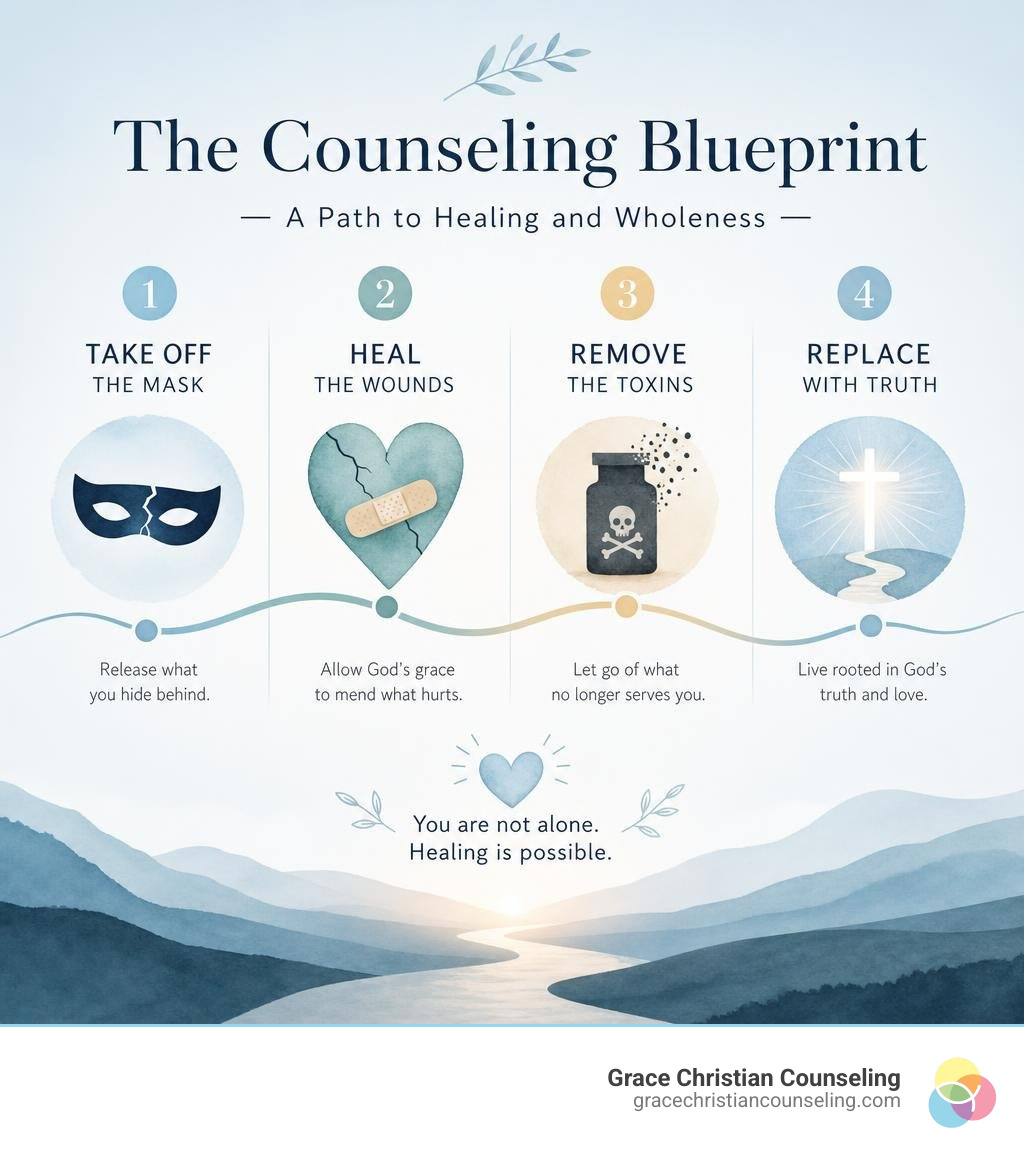
- Take Off the Mask: In this initial stage, we build genuine rapport and trust. You are invited to drop your defenses and share your struggles in a safe, non-judgmental environment.
- Heal the Wounds: Here, we explore emotional and relational hurts from your past; we look at how your early childhood experiences shaped your current attachment style.
- Remove the Toxins: We work together to identify unhelpful beliefs, coping mechanisms, and lingering lies you may believe about yourself, such as “I am unlovable” or “People will always abandon me.”
- Replace with Truth: Finally, we install empowering, accurate perspectives about yourself, others, and the world based on God’s truth.
This journey is deeply rooted in the peace and hope offered in Scripture on trust and healing. As Philippians 4:6-7 reminds us: “Do not be anxious about anything, but in everything by prayer and supplication with thanksgiving let your requests be made known to God. And the peace of God, which surpasses all understanding, will guard your hearts and your minds in Christ Jesus.” Through this integration, we foster both emotional healing and spiritual growth.
Can You Change Your Attachment Style and Develop Earned Security?
One of the most encouraging discoveries in modern psychology is that attachment styles are not set in stone. While our early childhood experiences lay the foundation, our brains possess incredible neuroplasticity; this means we can form new neural pathways and relational habits at any age.
Through dedicated therapy, individuals can develop what psychologists call earned secure attachment. This term describes someone who grew up with an insecure attachment style but, through self-awareness, personal growth, and healing relationships, has developed a secure state of mind as an adult.
Developing earned security relies heavily on the quality of the therapeutic alliance; the trusting relationship you build with your counselor acts as a laboratory for practicing healthy vulnerability and communication. As you learn to regulate your emotions and challenge old fears, your relationship satisfaction will naturally begin to rise. Healing your attachment style is a journey of self-discovery that allows you to experience relationships the way God intended; filled with mutual trust, peace, and joy.
How to Find a Qualified Attachment Therapist
When you are ready to begin therapy for attachment style, finding the right clinician is a crucial first step. Because attachment work relies heavily on the therapeutic relationship, you want to work with a licensed counselor with whom you feel genuinely safe and understood.
Look for licensed professionals who hold credentials such as Licensed Social Worker (LSW), Licensed Associate Professional Counselor (LAPC), or Licensed Marriage and Family Therapist (LMFT). When researching potential therapists, it can be helpful to ask them specific screening questions to ensure they are a good fit for your goals:
- “What is your experience in treating insecure attachment styles or childhood relationship wounds?”
- “What modalities do you use to help clients process relational trauma (e.g., EMDR, AEDP, or CBT)?”
- “How do you integrate faith and clinical practice in your counseling sessions?”
- “What should I expect our sessions to look like as we work through my relationship patterns?”
For a deeper look into this process, you can explore our comprehensive guide, All About Finding a Qualified Attachment Therapist. If you live outside Pennsylvania or are looking for pastoral counseling, coaching, or other wellness resources, you can also explore Grace Christian Counseling’s sister organization, NuWellonline.com.
Frequently Asked Questions about Attachment Therapy
How does understanding my attachment style improve my daily relationships?
Understanding your attachment style increases your self-awareness; it helps you recognize your emotional triggers before you react automatically. When you know why you feel anxious or why you want to pull away, you can communicate your needs clearly to your partner, resolve conflicts constructively, and ultimately experience deeper relationship satisfaction.
How long does it take to see progress in attachment-based therapy?
There is no fixed treatment timeline because everyone’s healing journey is unique. Some individuals notice improvements in their emotional regulation within a few months, while deeper relational patterns may take longer to reshape. Consistent attendance and a strong therapeutic bond with your counselor are the most significant factors in predicting positive progress.
Can cognitive behavioral therapy help with attachment issues?
Yes, cognitive behavioral therapy (CBT) is highly effective for addressing attachment challenges. When personalized to your specific situation, CBT helps you identify and restructure the negative core beliefs (such as “I cannot trust anyone”) that drive insecure behaviors, allowing you to make positive behavioral changes in your relationships.
Moving Toward Secure, Christ-Centered Relationships
Your past may have shaped your relationship blueprint, but it does not have to dictate your future. Through therapy for attachment style, you can heal from early childhood wounds, break unhelpful relationship cycles, and build a secure, loving foundation for your future.
At Grace Christian Counseling, we provide compassionate, Christ-centered care designed to help you thrive. We offer both in-person and online Christian counseling throughout Western Pennsylvania, serving communities in Pittsburgh, Penn Hills, Sewickley, Uniontown, Bethel Park, Mt. Lebanon, and North Huntingdon, as well as statewide virtual options in Pennsylvania, West Virginia, Georgia, and Florida. Our licensed professional counselors are dedicated to helping you find emotional healing and spiritual growth.
If you are ready to take the next step toward healthier, more secure relationships, we invite you to Schedule a consultation with a qualified attachment therapist today. Let us walk alongside you on your journey toward earned security and lasting peace.
This guide is for educational and spiritual encouragement and is not a substitute for personalized professional counseling. If you are in crisis, please reach out for immediate help.
Healing Broken Bonds: Christ-Centered Attachment Trauma Healing


