

Why Biblical Soul Care Matters for Whole-Person Healing
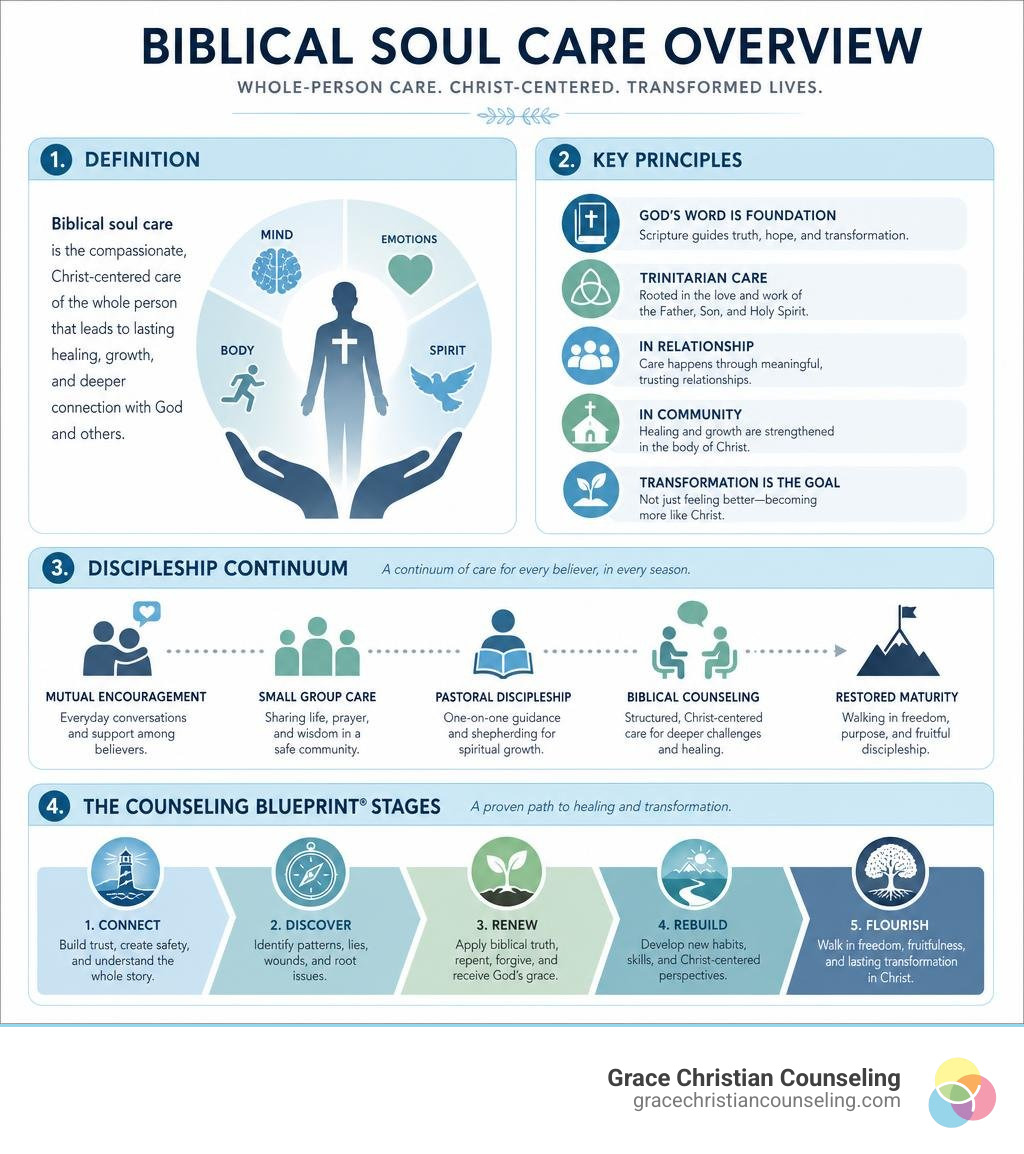
Biblical soul care is the practice of caring for the whole person, including mind, emotions, body, and spirit, using Scripture, the Holy Spirit, and the support of Christian community as the foundation for healing and growth.
Quick answer: What is biblical soul care?
- It addresses the full person, not just symptoms or behaviors
- It is rooted in Scripture and the Trinitarian model of care (Father, Son, and Holy Spirit)
- It happens in the context of relationship, whether in a local church, small group, or with a trained counselor
- It ranges from everyday mutual encouragement among believers to formal, structured Christian counseling
- Its goal is not just feeling better, but genuine transformation and restored worship of God
Many people carry anxiety, depression, grief, or trauma for years without ever finding lasting relief. They may have tried secular therapy, self-help books, or simply praying harder, and still feel stuck. Others know something is wrong but have never been asked the right question. Consider what can happen when someone finally is: a pastor once came in for a routine annual check-in, fully expecting to walk out in thirty minutes. When asked “How is your soul?”, he stopped, went quiet, and realized he had no idea. No one had ever asked him that before.
That question is at the heart of what biblical soul care is all about.
At Grace Christian Counseling, we work with individuals, couples, teens, and families across Western Pennsylvania and online, offering a Christ-centered approach that takes both your faith and your mental health seriously. This guide will walk you through what biblical soul care is, how it works, and how it can bring real healing to the whole person.
What is Biblical Soul Care? Defining a Holistic Approach to Healing
To understand biblical soul care, we must first look at how we define the soul itself. In our modern world, we often divide ourselves into neat, isolated compartments; we treat our physical health at the doctor, our mental health with a therapist, and our spiritual health at church. However, true biblical soul care rejects this artificial division, recognizing that God designed us as integrated, whole beings. When one part of our life is in pain, every other part of our being feels the impact.
As we explore this holistic approach, we discover that caring for the soul is not about finding quick self-help tips or spiritualizing away our genuine emotional pain. Instead, it is about inviting the living God into the deepest, quietest spaces of our lives. According to theological frameworks, soul care is the support and restoration of the well-being of persons in their depth and totality, with particular concern for their inner life and psychospiritual growth.
At Grace Christian Counseling, we believe that emotional health and spiritual health are completely inseparable. It is entirely possible to be highly active in church ministries while remaining deeply emotionally unhealthy, which often leads to painful relationship dynamics or sudden burnout. When we ignore our emotional cracks, we risk practicing a form of spiritual bypassing, using religious activities to run from the deep wounds God wants to heal. By pursuing a holistic path, we allow God to restore every single dimension of our lives, a journey you can explore further in The Ultimate Guide to Faith-Driven Mental Wellness and Soul Care.
The Theological Foundations of Biblical Soul Care
The foundation of biblical soul care begins in the very opening pages of Scripture. In Genesis 2:7, we read that God formed man from the dust of the ground and breathed into his nostrils the breath of life, making him a living being. The original Hebrew term used here is chay nephesh, which is best translated as an “embodied soul” or a “living being.” This reveals that we do not simply possess an abstract soul trapped inside a physical body; rather, we are souls.
Because we are embodied souls, our physical bodies and our spiritual lives are constantly interacting. If you are physically exhausted, your spiritual outlook will often feel dim; if you are carrying deep spiritual guilt, your physical body may begin to experience tension, fatigue, or illness. Our model for caring for these complex, embodied souls is rooted directly in the nature of the Triune God, who shepherds us with perfect care.
In this Trinitarian model, we experience the Father’s tender shepherding, the Son’s compassionate, incarnational presence, and the Holy Spirit’s power to bring about deep, lasting transformation. God does not watch our suffering from a safe distance; instead, He stepped into our broken world through Jesus Christ to walk alongside us, weep with us, and redeem us.
How Biblical Soul Care Differs from Secular and Formal Counseling
When seeking help, it is helpful to understand how different approaches address our struggles. Secular psychology often focuses primarily on symptom reduction, behavior modification, or self-actualization, using human wisdom as its primary guide. While these clinical tools can offer valuable relief, they often miss the spiritual core of who we are. On the other hand, formal, traditional biblical counseling sometimes focuses so heavily on theological instruction that it can overlook the complex physiological and emotional realities of trauma or mental health struggles.
At Grace Christian Counseling, we practice a thoughtful integration of evidence-based clinical psychology and timeless biblical truth. We believe that the insights of modern psychology, when viewed through the filter of Scripture, are gifts of God’s common grace that help us understand the human brain and nervous system. We do not force you to choose between professional clinical excellence and deep, vibrant faith. To help clarify these distinctions, we have outlined how these approaches compare below:
| Feature | Lay Soul Care | Formal Biblical Counseling | Professional Christian Counseling (Our Approach) |
|---|---|---|---|
| Primary Setting | Local church, small groups, or mentorship | Specialized church ministry or counseling center | Professional clinical office or secure online therapy |
| Providers | Lay leaders, elders, or trusted church friends | Certified lay biblical counselors | Licensed professionals (LAPC, LPC, LSW, LCSW, LMFT) with clinical training |
| Core Focus | Mutual encouragement, prayer, and basic discipleship | Reorienting desires and applying Scripture to specific sins or trials | Resolving clinical diagnoses, processing trauma, and integrating faith |
| Scope of Care | Everyday life struggles, grief, and spiritual dryness | Marital conflict, habits of sin, and spiritual struggles | Clinical anxiety, depression, trauma, OCD, and complex family dynamics |
By choosing a professional who understands both clinical modalities and spiritual truths, you can experience a safer, more comprehensive path to healing. You can read more about how these professional approaches work in An Essential Guide to Christian Counseling.
Effective Discipleship: Returning Care to the Body of Christ

Historically, caring for the soul was not a professionalized service outsourced to external clinics; it was the daily, beating heart of the local church. The ancient practice of cura animarum, meaning the “cure of souls,” belonged to the entire community of faith. Over the last several decades, a professionalized model of care has sometimes sidelined the local church, leaving everyday believers feeling completely unequipped to help those who are hurting.
To build a healthy culture of care, we must view ministry as a broad discipleship continuum rather than a single, formal program. This continuum spans from casual, everyday friendships to relational mentoring, all the way to intensive, professional counseling. A healthy church community serves as a supportive environment where believers walk together through life’s trials, preventing minor struggles from escalating into severe crises.
The Priesthood of All Believers and Mutual Discipleship
This vision of shared, community-based care is rooted in the biblical doctrine of the priesthood of all believers. As Peter writes in 1 Peter 2:9, the church is a royal priesthood called to offer spiritual sacrifices and declare the praises of God. This means that every single believer, not just those with professional degrees or pastoral credentials, is called and empowered by the Holy Spirit to minister to others.
Mutual discipleship happens when we take the “one another” commands of Scripture seriously. When we obey the call in Galatians 6:2 to bear one another’s burdens, we fulfill the law of Christ. This does not mean lay believers should try to act as licensed therapists; rather, it means they can offer a listening ear, a compassionate heart, and a steady presence to those who are suffering.
Five Indicators of a Healthy Church-Based Ministry
If a local church wants to cultivate a transforming soul care ministry, there are several key indicators of health to look for:
- Biblical Authority: The ministry is grounded in the wisdom of Scripture, believing that God’s Word speaks deeply to our human experience.
- Theological Clarity: Leaders share core convictions about the nature of humanity, the reality of sin, and the hope of the gospel.
- Equipping Strategy: The church actively trains lay members to speak the truth in love, rather than expecting pastors to handle every crisis.
- Discipleship Culture: Vulnerability is modeled from the leadership down, creating a safe environment where people can share their struggles without fear of judgment.
- Continuum of Care: The church has clear pathways connecting everyday small groups to specialized recovery ministries and professional Christian counseling.
Addressing Deep Struggles: Anxiety, Depression, Trauma, and Addiction
When we face deep, life-dominating struggles, we need more than simple platitudes or quick fixes. Conditions like clinical anxiety, chronic depression, deep-seated trauma, and addiction can leave us feeling isolated, exhausted, and spiritually dry. In these dark seasons, the words of Philippians 4:6-7 invite us to bring our anxieties to God in prayer, promising a peace that surpasses all human understanding.
However, applying this peace practically requires us to address the physical, emotional, and spiritual dimensions of our pain. For example, trauma is not just a mental battle; it leaves a physical footprint in our nervous system, often keeping our bodies in a state of constant fight, flight, or freeze. True healing requires us to respect how God designed our bodies while we seek his spiritual restoration.
Navigating Mental Health and Trauma with the Counseling Blueprint
At Grace Christian Counseling, we guide our clients through a structured, compassionate healing journey known as the Counseling Blueprint. This clinical and spiritual framework is designed to help you process your past hurts and step into the freedom Christ offers:
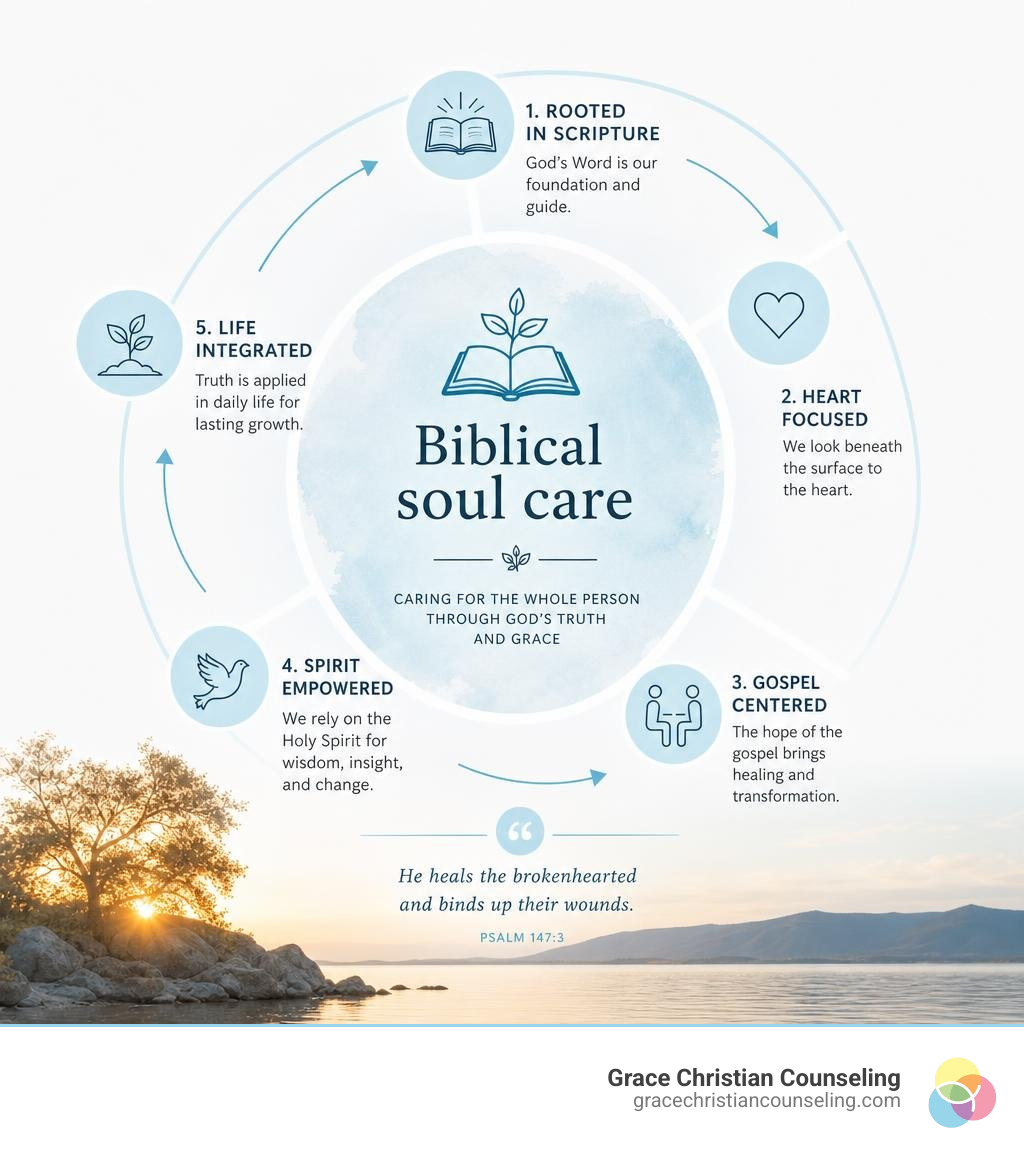
- Take Off the Mask: We begin by building a safe, trusting, and non-judgmental relationship. You can stop pretending everything is fine and safely share your honest struggles, fears, and pain.
- Heal the Wounds: We gently explore the emotional, relational, and physical hurts in your past. This includes understanding how trauma has impacted your nervous system and learning how to establish safety in your body and mind.
- Remove the Toxins: Together, we identify the unhelpful beliefs, coping mechanisms, and lingering lies you have believed about yourself, others, and God.
- Replace with Truth: We install empowering, accurate perspectives based on God’s unchanging truth. We help you anchor your identity in Christ and develop practical, healthy habits for the future.
This process respects the complex reality of trauma, recognizing that safety is a deeply spiritual act and the necessary first step in recovery. For a scholarly and theological examination of how trauma-informed care aligns with biblical truth, you can read Sufficiently Sapiential Soul-Care: A Working Paper in Therapeutic Theology. By walking through these stages, we co-labor with the Holy Spirit to bring lasting transformation to your heart, a journey we explore in depth in Healing the Heart Through Christian Counseling.
Practical Postures for Personal Soul Stewardship

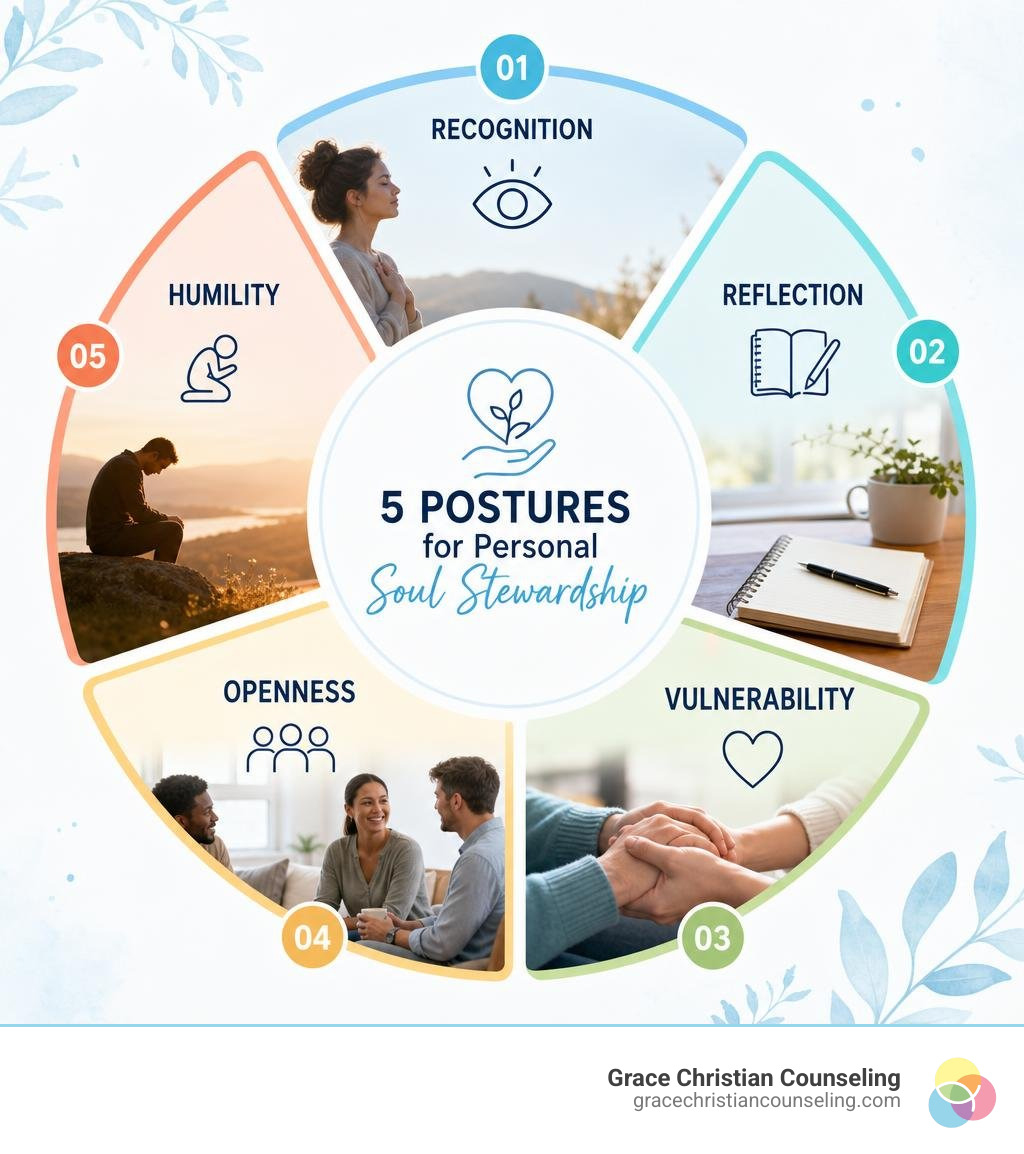
While professional counseling offers invaluable support, there are practical steps you can take every day to steward your own soul. Caring for your soul requires cultivating specific heart postures that invite God’s grace into your daily life:
- Posture of Recognition: Pay attention to your inner world. Acknowledge your physical fatigue, your emotional triggers, and your spiritual state instead of pushing through them.
- Posture of Reflection: Take time to slow down and process your thoughts. Practices like handwritten journaling are incredibly effective; writing by hand activates the brain’s reticular activation system, helping you process emotions better than typing on a digital screen.
- Posture of Vulnerability: Allow yourself to be honest with God and trusted friends. This includes practicing biblical lament, which is the sacred, structured act of crying out to God, sharing your complaints, and reaffirming your trust in Him.
- Posture of Openness: Welcome the feedback, encouragement, and support of safe people in your community.
- Posture of Humility: Recognize your human limitations. You cannot carry every burden alone, and asking for help is a sign of spiritual strength, not weakness.
By integrating these daily habits, you open your heart to receive God’s healing, a process discussed more in How Is Your Soul? A Guide to Caring for Your Soul. Over time, these practices help you trust God with the painful pieces of your history, which you can read more about in Biblical Healing: Trusting God with Your Past Hurts.
If you are wondering whether biblical soul care is right for you, you do not need to become an expert before reaching out for help. What matters most is finding a safe, clinically excellent, Christ-centered space where your story can be heard with compassion and care. At Grace Christian Counseling, our team is here to help you take the next step toward healing at a pace that feels supportive, honest, and grounded in biblical hope.
Frequently Asked Questions About Biblical Soul Care
What is the difference between lay soul care and professional Christian counseling?
Lay soul care is typically provided by pastors, small group leaders, or church mentors within the local church community. It focuses on mutual encouragement, prayer, and basic discipleship. Professional Christian counseling is provided by state-licensed mental health professionals, such as Licensed Associate Professional Counselors (LAPC) or Licensed Social Workers (LSW). These professionals have extensive clinical training, allowing them to treat diagnosed mental health conditions, process complex trauma, and integrate evidence-based therapies with biblical truth.
Can biblical soul care help with clinical issues like severe trauma or OCD?
Yes, but clinical issues like severe trauma, OCD, or clinical depression require a highly integrated approach. Because we are embodied souls, these struggles often involve deep biological and neurological patterns in our nervous systems. While lay soul care provides vital community support and spiritual encouragement, it should be paired with professional, trauma-informed Christian counseling to ensure you receive safe, clinically sound care that respects both your biology and your faith.
Do I need to be in crisis to benefit from biblical soul care?
No. Biblical soul care can help when you are facing a major crisis, but it is also valuable when you feel spiritually dry, emotionally overwhelmed, relationally stuck, or unsure how to move forward. Many clients reach out before things become urgent because they want a safe, Christ-centered space to process what is happening in their hearts, relationships, and daily lives.
What happens in a Christian counseling session?
A Christian counseling session gives you space to share your story honestly with a trained counselor who takes both your faith and your mental health seriously. Depending on your needs, sessions may include clinical assessment, practical coping tools, trauma-informed care, prayer, Scripture reflection, and conversations about how your beliefs, emotions, body, and relationships are connected.
Taking the Next Step Toward Whole-Person Healing
True healing is never a quick, simple process; it is a patient, sacred journey of inviting God into the broken, quiet places of our lives. Through the practice of biblical soul care, we do not have to hide our struggles, ignore our emotions, or pretend we have it all together. Instead, we can take off our masks, heal our wounds, remove the toxic lies we have believed, and replace them with God’s life-giving truth.
At Grace Christian Counseling, we are honored to walk alongside you on this journey. We provide compassionate, professional, and Christ-centered counseling services across Pennsylvania, West Virginia, Georgia, and Florida, with dedicated physical locations in Penn Hills, Sewickley, Uniontown, Pleasant Hills, Bethel Park, Ligonier, Belle Vernon, Punxsutawney, North Huntingdon, and Mt. Lebanon. Our licensed therapists are ready to support you, whether you prefer to meet in person in Western Pennsylvania or connect with us through our secure virtual online counseling platform.
If you are ready to take the next step toward whole-person healing, please Schedule a Consultation with our team today. We are here to listen, to pray, and to walk with you toward the peace and freedom God has for your soul.
This guide is for educational and spiritual encouragement and is not a substitute for personalized professional counseling. If you are in crisis, please reach out for immediate help.
Finding Hope With Christian Support for Depression and Anxiety


