
When Your Marriage Is Struggling: How Biblical Counseling Can Prevent Divorce
Biblical counseling for divorce prevention can give struggling couples a wise, compassionate place to slow down, tell the truth, and seek help before making life-altering decisions. It is not a magic formula, and it should never be used to pressure someone to remain unsafe. But for many couples, Christ-centered counseling can uncover what is happening beneath the conflict and open a path toward repentance, repair, and renewed hope.
How biblical counseling may help prevent divorce:
- Addresses root causes: Identifies heart-level patterns such as hiding, blame-shifting, fear, resentment, or disconnection.
- Provides a Scripture-based framework: Uses God’s Word as the foundation for wisdom, humility, forgiveness, and lasting change.
- Equips couples with practical skills: Teaches communication, conflict repair, and trust-building practices grounded in biblical principles.
- Engages healthy support: When appropriate, connects couples with pastors, mentors, church community, or additional professional care.
- Supports one willing spouse: Counseling can still help one spouse respond with clarity, wisdom, and emotional steadiness, even if the other spouse is not ready to participate.
More pain is experienced in marriage than in almost any other area of life. That is not a pessimistic statement; it is simply honest. Two imperfect people, shaped by different families and histories, trying to build a life together will inevitably face hard seasons.
For many couples in Western Pennsylvania and beyond, those hard seasons turn into long stretches of silence, resentment, or quiet desperation. Some reach the brink of separation before ever seeking help. Many couples also wait longer than they realize before reaching out. Research by relationship expert Dr. John Gottman suggests that couples often live with significant relationship distress for an average of about six years before seeking professional help. By that point, unhealthy interaction patterns have often become deeply ingrained, making early intervention especially valuable.
The good news is that there is a path forward. Studies on religion, relationship commitment, and premarital preparation suggest that faith community and structured counseling can strengthen marriages, though no statistic can predict the outcome of any individual couple.
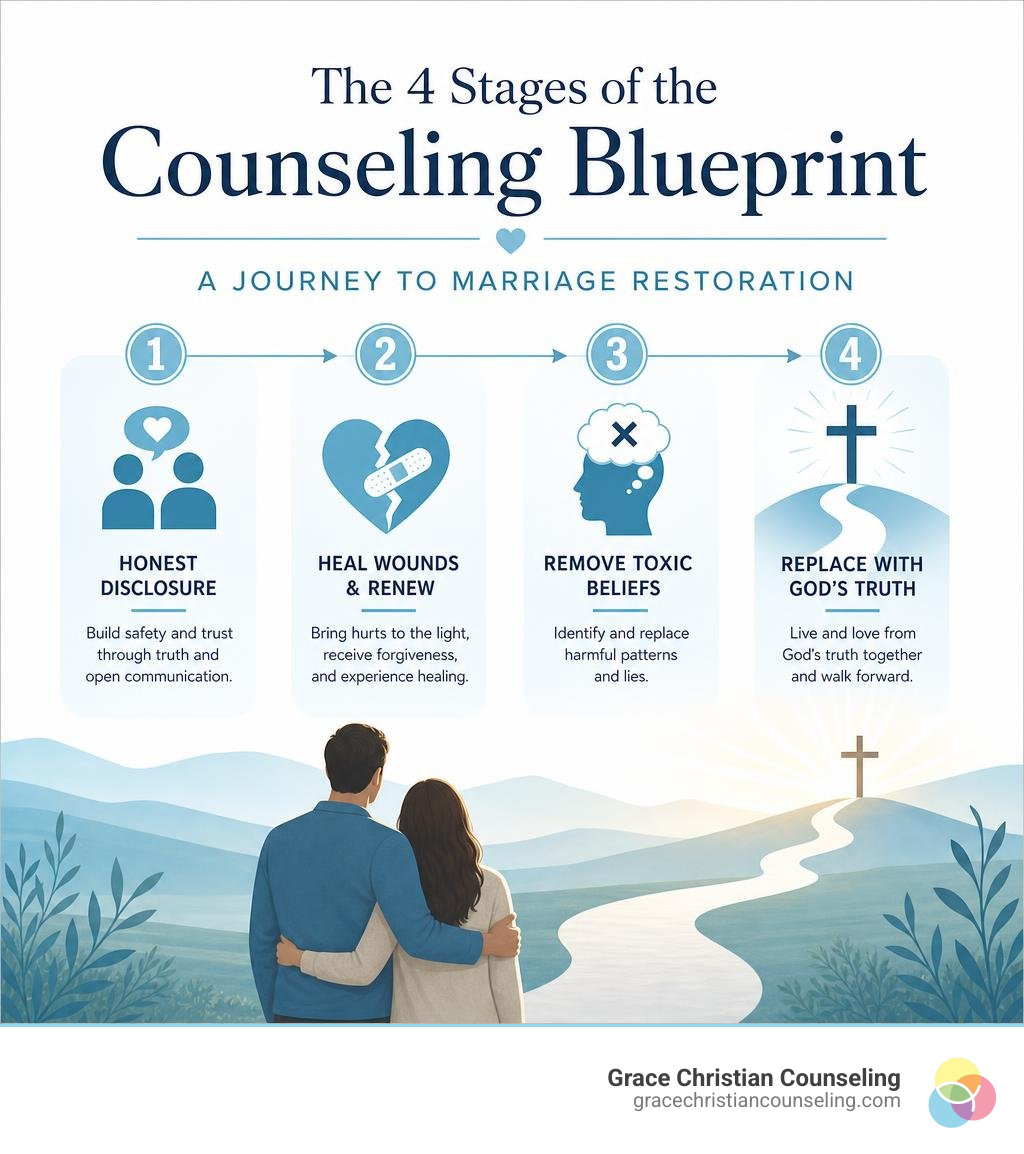
At Grace Christian Counseling, our licensed counselors work with couples through what we call the Counseling Blueprint. This four-stage journey helps clients move from honest self-disclosure, through healing wounds and removing toxic beliefs, to replacing lies with God’s truth.
In practice, no two treatment plans look exactly alike. Our counselors begin by understanding each couple’s communication patterns, relationship history, spiritual life, and any concerns involving trauma, addiction, infidelity, or emotional safety before determining the most appropriate path forward.
In real sessions, that often means slowing down arguments, identifying the fear or hurt underneath them, and helping each spouse speak more honestly without attacking or withdrawing. It is not a quick fix. But it can become a real path forward. Whether you are just starting to notice warning signs or you are already wondering if your marriage can survive, this guide is for you.
The Covenant of Marriage: God’s Design and the Reality of Brokenness
To understand why marriages fracture, we must first look at how they were designed to function. Marriage is more than a social contract or a convenient arrangement for mutual happiness. Scripture presents it as a sacred covenant that deserves care, protection, and humility.
In the creation account, God establishes the blueprint for human relationship. Genesis 2:24 describes a husband and wife becoming “one flesh.” Jesus later reaffirms this covenantal vision in Matthew 19:4-6.
At the same time, every marriage is lived out in a broken world. Couples struggle under the weight of financial stress, emotional distance, betrayal, grief, trauma histories, and unmet expectations. A biblical view of marriage must hold together both the seriousness of covenant and the tenderness needed for people who are deeply hurting.
The Sacred Permanence of the Marriage Covenant
The concept of covenant is central to understanding why Christians take marriage preservation seriously. Unlike a contract, which is based primarily on mutual performance, a covenant is a solemn promise made before God. It is modeled after Christ’s faithful, covenant-keeping love for His church.
When Scripture speaks about God’s grief over divorce in Malachi 2:16, it is not minimizing the pain of spouses who have been harmed. It is showing that divorce is never casual or trivial. It tears at a bond God designed for faithfulness, safety, and love.
This is why many couples benefit from removing divorce threats from everyday arguments. When divorce is used as a weapon, fear often replaces honesty. When both spouses are safe and willing to work, counseling can help them face conflict without using separation as a threat.
The Spiritual and Emotional Consequences of Divorce
Divorce is rarely a clean emotional break. It can bring grief, loneliness, financial strain, disrupted family rhythms, and spiritual confusion. Children may also feel the impact of divided households, conflict, or the loss of stability.
At the same time, it is important to say this carefully: the consequences of divorce should never be used to shame a spouse who has been abused, abandoned, betrayed, or placed in danger. Biblical counseling should help people tell the truth about both the value of marriage and the reality of harm.
That balance is one reason early support matters. Couples who seek help before patterns harden often have more room to repair trust, rebuild communication, and address heart-level issues with wisdom.
How Biblical Counseling Divorce Prevention Addresses Root Causes of Conflict
When a marriage is in trouble, couples often focus on surface-level symptoms such as chores, finances, parenting, intimacy, or in-laws. Those issues matter, but they are often connected to deeper fears, desires, assumptions, and wounds. Biblical counseling helps couples look beneath the presenting argument with honesty and compassion.
James 4:1-2 teaches that conflict often flows from desires battling within the heart. Biblical counseling for divorce prevention helps couples ask better questions: What am I afraid of? What am I demanding? What story am I telling myself about my spouse? What would repentance, courage, or love look like here?

To explore how professional support can guide this kind of heart-level work, see Grace Christian Counseling’s guide on how Christian marriage counseling can help save relationships.
Applying the Counseling Blueprint to Marital Conflict
At Grace Christian Counseling, our licensed counselors use the Counseling Blueprint as a flexible framework, adapting each treatment plan to the couple’s history, strengths, current challenges, and counseling goals.
- Take Off the Mask: We build a safe, non-judgmental environment where couples can lower defensiveness and describe what is really happening.
- Heal the Wounds: We explore accumulated hurts, family-of-origin patterns, betrayals, disappointments, and emotional injuries.
- Remove the Toxins: We identify beliefs, lies, and destructive patterns such as control, contempt, avoidance, secrecy, or silent withdrawal.
- Replace with Truth: We help couples practice more accurate, biblical ways of seeing God, themselves, one another, and the marriage.
One pattern our counselors often watch for early is what can be called the “pursue-withdraw cycle.” One spouse feels unheard and pushes harder to talk, while the other feels overwhelmed and pulls away. Both may believe they are protecting the relationship, but the cycle itself becomes the problem.
In session, our clinicians slow the conversation down rather than letting the same argument replay unchecked. They help each spouse separate observable facts from assumptions, interpretations, and fears. This often reveals that recurring arguments about money, intimacy, parenting, or household responsibilities are being driven by deeper issues such as rejection, shame, fear of failure, or unresolved hurt.
Couples also leave with practical between-session steps. These may include structured listening exercises, Scripture reflection, conflict de-escalation strategies, or intentional connection routines. At the next session, the counselor reviews what helped, what became difficult, and where old patterns resurfaced. Our counselors often find that the argument couples describe in the first session is only the doorway to deeper issues involving fear, shame, unresolved hurt, or unmet attachment needs.
The Role of Premarital Preparation in Biblical Counseling Divorce Prevention
One of the most effective times to strengthen a marriage is before the wedding day. Premarital counseling gives couples a place to talk honestly about expectations, finances, family backgrounds, conflict styles, intimacy, faith, and future decisions.
Research on relationship education has consistently found measurable benefits from premarital counseling. A meta-analysis published in the Journal of Family Psychology found that couples who participated in premarital programs improved relationship quality by approximately 30%, particularly in communication and conflict-management skills. While no program guarantees a lasting marriage, preparation gives couples practical tools before destructive patterns become established.
Grace Christian Counseling explains this preventive approach in why every Christian couple needs counseling before the wedding.
Equipping Couples with Scripture-Based Communication and Forgiveness Skills
Healthy communication is not merely a personality trait. It is a skill that can be practiced, repaired, and reshaped over time. Biblical counseling helps couples learn to speak truthfully without cruelty and listen without immediately defending themselves.
Decades of marital research have also identified communication behaviors that predict long-term relationship outcomes. Dr. John Gottman’s research found that couples in stable marriages maintain roughly a 5-to-1 ratio of positive interactions to negative interactions during conflict. While no relationship achieves this perfectly, increasing encouragement, validation, and repair attempts can significantly improve relational stability.
Ephesians 4:29 gives a helpful framework for words that build up rather than tear down. In counseling, that may look like using a softer start to difficult conversations, naming feelings without judging motives, and asking clarifying questions before reacting.
Forgiveness is also handled carefully. Biblical forgiveness does not mean pretending harm did not happen or rebuilding trust without evidence of change. In healthy counseling, forgiveness, repentance, safety, accountability, and trust repair are treated as connected but distinct parts of the healing process.
Navigating Deep Pain: Ordinary Struggles, Serious Harm, and Safety
In any marriage, there will be seasons of friction and disappointment. However, couples and counselors must distinguish ordinary marital struggles from serious covenant-breaking situations. This distinction matters because the right kind of help depends on the level of harm, danger, and repentance involved.
| Ordinary Marital Struggles | Serious Harm / Covenant-Breaking Situations |
|---|---|
| Differences in personality or communication styles | Physical violence or credible threats of harm |
| Financial disagreements or budget mismatches | Ongoing, unrepentant sexual immorality |
| Unmet emotional expectations or patterns of neglect | Severe coercion, intimidation, gaslighting, or emotional abuse |
| Friction regarding in-laws or household responsibilities | Abandonment, chronic deception, or refusal to seek help |
This table is not meant to diagnose every situation. It is a starting point for discernment. If you are seeing severe warning signs, Grace Christian Counseling’s guide on signs you need couples counseling may help you decide what kind of support to seek.
Discerning Ordinary Marital Friction vs. Serious Harm
Ordinary marital friction is often rooted in selfishness, stress, misunderstanding, and communication breakdowns. While painful, these struggles are often responsive to repentance, skill-building, prayer, and consistent counseling work.
Serious harm is different. Abuse, credible threats, coercive control, repeated betrayal, or ongoing deception cannot be treated as ordinary conflict. In these situations, biblical counseling should not rush a harmed spouse toward quick reconciliation or ask them to carry responsibility for another person’s unrepentant sin.
Instead, wise care begins with truth, safety, and appropriate support. That may involve licensed counseling, pastoral care, family support, legal guidance, emergency resources, or a safety plan depending on the situation.
When Separation May Be Necessary: Safety, Abuse, and Pastoral Guidance
A common misconception is that biblical counseling demands couples stay together under the same roof regardless of danger. That is not a safe or compassionate approach. Scripture’s call to honor marriage should never be twisted into a demand that someone remain in immediate harm.
When physical violence, severe emotional abuse, credible threats, or unrepentant destructive behavior is present, physical separation may be necessary. Separation can create space for safety, assessment, repentance, accountability, and wise next steps.
In these situations, Grace Christian Counseling encourages clients to work with appropriate support instead of navigating the crisis alone. That may include a licensed counselor, a pastor or elder, trusted family members, emergency services, or legal counsel when needed.
The goal is not to minimize marriage or treat separation casually. The goal is to protect the vulnerable, tell the truth about harm, and pursue the wisest path before God with care and sobriety.
The Path to Restoration: Prayer, Repentance, and the Holy Spirit
True restoration is not merely the result of better communication techniques. In Christian counseling, lasting repair involves the work of the Holy Spirit, honest confession, changed behavior, and the rebuilding of trust over time.
When a marriage has reached the brink of separation, human effort alone may feel exhausted. Couples often need a compassionate place to grieve, pray, tell the truth, and learn new ways of relating. Counseling can provide that structure while keeping both spiritual and emotional realities in view.

The Power of Repentance and Heart Change
Real change begins with personal repentance. This means moving away from blame-shifting and asking God to search our own hearts. It also means naming specific behaviors, taking responsibility, and pursuing change that can be seen over time.
1 John 1:9 reminds believers of God’s faithfulness to forgive and cleanse. In marriage counseling, that truth becomes deeply practical. Spouses learn to confess without excuses, receive grace without minimizing harm, and repair what has been broken where repair is possible.
Healing from betrayal or deep wounds is usually a long process. Trust should not be demanded simply because someone apologized. It is rebuilt through humility, consistency, accountability, and patient care.
How Biblical Counseling Restores Hope in the Midst of Sorrow
When a marriage is in crisis, the emotional pain can feel overwhelming. Spouses may wonder whether the pain will ever ease or whether the relationship can ever feel safe again.
Biblical counseling does not offer quick platitudes or ignore sorrow. Instead, it gives couples room to lament before God, name grief honestly, and seek help one step at a time.
Hope does not always mean a simple or immediate outcome. Sometimes hope means reconciliation. Sometimes it means clarity, safety, repentance, or the strength to make a wise decision with support.
Church-Wide Strategies and Support Systems for Marriage Preservation
No marriage was meant to survive in isolation. Healthy Christian community can provide encouragement, accountability, prayer, mentorship, and practical help when couples are under strain.
At the same time, churches must be careful not to offer simplistic answers to complex marital pain. Couples in ordinary conflict need support that strengthens humility and repair. Spouses in unsafe or destructive situations need protection, truth-telling, and wise care.
The Role of Mentorship, Small Groups, and Pastoral Care
An effective church-wide approach to marriage preservation often involves multi-generational mentorship. Titus 2 points to the value of older believers guiding younger believers in faithful living. In marriage care, this can look like mature couples walking alongside younger couples with humility and practical wisdom.
Small groups can also provide a place where couples stop pretending everything is fine. They can offer prayer, encouragement, meals, childcare, and trusted friendship during hard seasons. For some couples, that relational support makes it easier to seek counseling before the crisis deepens.
Pastoral care also has an important role, especially when spiritual questions, church accountability, or covenant concerns are involved. However, pastors and mentors should know when to involve licensed counselors or crisis resources. The strongest care often happens when spiritual support and professional counseling work together appropriately.
Balancing Compassion for Hurting Spouses with Biblical Standards
Churches often struggle to balance the biblical seriousness of marriage with compassion for spouses in deeply painful situations. Both matter. A church that minimizes marriage loses something important, but a church that minimizes harm can wound people further.
When a spouse is suffering because of a partner’s unrepentant sin, the church should respond with pastoral care, protection, and appropriate accountability. Matthew 18 offers a framework for confronting sin with the aim of repentance and restoration. That process should be handled with wisdom, especially when abuse, coercion, or danger is involved.
Grace and truth belong together. The goal is not to force an outcome, but to care for people faithfully, protect the vulnerable, and seek repentance and healing where possible.
Frequently Asked Questions
Can biblical counseling help if only one spouse is willing to attend?
Yes. While it is ideal for both spouses to participate, counseling for one willing spouse can still bring clarity, support, and healthier responses to the marriage.
One spouse cannot control or spiritually transform the other. But that spouse can receive wise counsel, grow in steadiness, set appropriate boundaries, and learn how to respond without escalating destructive patterns.
For some marriages, one person’s growth changes the relational dynamic in meaningful ways. For others, counseling helps the willing spouse discern what is safe, wise, and faithful when the other spouse remains resistant.
What are the biblical grounds for divorce and remarriage?
Christians have long agreed that God’s design for marriage is lifelong faithfulness. They have also wrestled carefully with Scripture’s teaching about situations where the covenant has been gravely violated.
Many evangelical pastors and theologians identify sexual immorality and abandonment by an unbelieving spouse as biblical grounds for divorce, based on passages such as Matthew 19:9 and 1 Corinthians 7. Some also understand severe abuse, coercive control, or extreme neglect as forms of abandonment or covenant-breaking harm.
Because these situations are weighty and often complex, this article should not be treated as a final ruling on any individual marriage. A harmed spouse should seek wise pastoral care, licensed counseling, and appropriate safety or legal support when needed.
How does biblical counseling differ from secular marriage therapy?
Biblical counseling is rooted in Scripture, prayer, repentance, and dependence on the Holy Spirit. It asks not only, “How can we communicate better?” but also, “How is God inviting us to grow in truth, love, humility, and wisdom?”
That does not mean biblical counseling ignores clinical insight or emotional pain. At Grace Christian Counseling, care is Christ-centered while also being trauma-informed, client-centered, and attentive to the realities of anxiety, depression, grief, betrayal, and relational wounds.
The goal is not simply to preserve the appearance of a marriage. The goal is faithful, wise, and safe care that helps people pursue truth, healing, repentance, and restoration where possible.
Taking the Next Step Toward Clarity and Hope
If your marriage is on the brink of separation, you do not have to navigate the pain alone. There may still be a path toward clarity, safety, repentance, repair, or restoration. Relationship researchers consistently find that couples who seek help earlier generally have more options for repair than those who wait until years of resentment have accumulated, making early intervention one of the strongest predictors of successful counseling.
At Grace Christian Counseling, our compassionate licensed counselors walk with couples throughout Western Pennsylvania, including Penn Hills, Sewickley, Uniontown, Pleasant Hills, and surrounding areas. We also offer secure online counseling for clients across Pennsylvania.
In counseling, you can expect more than general advice. Your counselor will help slow down painful conversations, identify patterns, clarify safety concerns, and give you practical steps to work on between sessions. Throughout the counseling process, progress is reviewed regularly so treatment can be adjusted as new patterns emerge or new goals become important. This individualized approach helps couples focus on lasting growth rather than simply resolving the conflict of the week.
By combining evidence-based clinical practices with the truth of God’s Word, we help couples address deep wounds, remove toxic beliefs, and rebuild healthier ways of relating. When restoration is possible, we walk toward it carefully. When safety or serious harm is involved, we help clients seek wise support and protection.
If you are ready to take the next step, we invite you to schedule a Christian marriage intensive or reach out to Grace Christian Counseling today.
This guide is for educational and spiritual encouragement and is not a substitute for personalized professional counseling. If you are in crisis or immediate danger, please contact emergency services or a local crisis resource right away.
Relationship Trauma Therapy Near Me: Find Hope & Healing


