

You May Be Carrying More Than Your Own Pain: Understanding Therapy For Generational Trauma
Therapy for generational trauma helps people heal emotional wounds that were passed down from parents, grandparents, and earlier ancestors, often without anyone realizing it was happening.
Here is a quick overview of what this guide covers:
- What it is: Generational trauma is the transmission of unresolved psychological pain from one generation to the next, through parenting, learned behaviors, family culture, and even biological changes.
- How it spreads: Through parenting styles, emotional patterns, family silence, and epigenetic changes that alter how the body responds to stress.
- Common signs: Chronic anxiety, hypervigilance, trust issues, emotional numbness, and recurring relationship problems.
- How therapy helps: Evidence-based approaches like EMDR, CBT, DBT, and multifamily therapy can break the cycle and build lasting resilience.
- Faith integration: At Grace Christian Counseling, we combine clinical expertise with biblical truth and the guidance of the Holy Spirit for whole-person healing.
The history of a family can be a beautiful thing. But sometimes, what gets passed down is not just traditions or values. It can be fear, silence, and pain.
As the American Psychological Association defines it, generational trauma involves the transmission of trauma’s psychological consequences, including effects of injury, poverty, or violence, from the generation that first experienced it to those that follow. In other words, you can carry wounds from events you never personally lived through.
This is more common than most people realize. The U.S. Department of Veterans Affairs reports that about 6 out of every 10 men and 5 out of every 10 women experience at least one trauma in their lives. When that trauma goes unresolved, it rarely stays contained to one person or one lifetime.
If you have ever felt like you were carrying emotional pain that did not quite belong to you, or noticed patterns in your family that seemed to repeat no matter how hard anyone tried to stop them, you are not alone. And healing is genuinely possible.
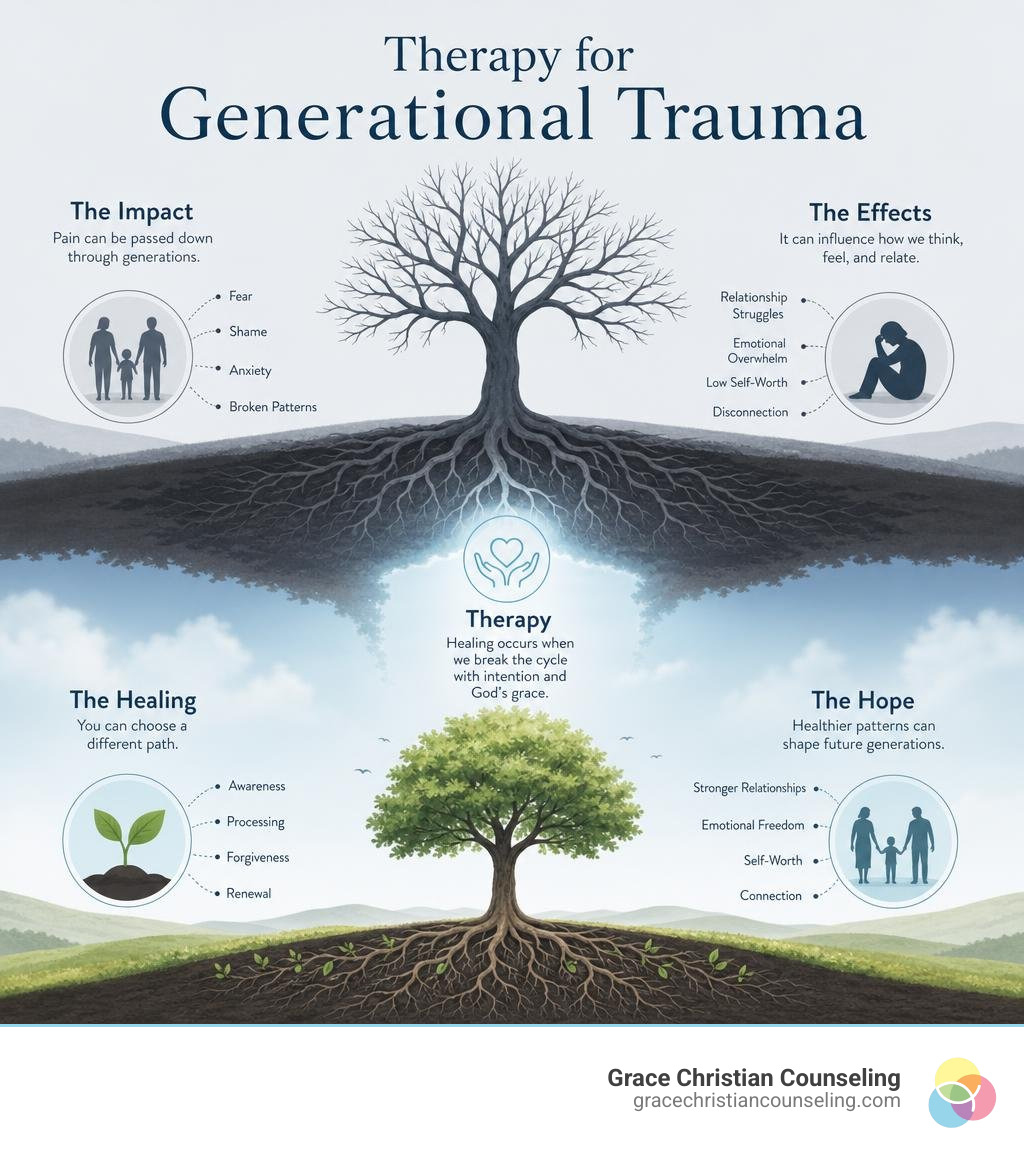
Across our work with individuals, couples, and families, we’ve found that people rarely begin counseling by saying, “I think I have generational trauma.” Instead, they often describe repeating relationship patterns they promised themselves they would never repeat, feeling responsible for everyone else’s emotions, struggling to trust even safe people, or reacting more intensely than a situation seems to warrant. As therapy unfolds, these recurring themes frequently reveal long-standing family survival patterns rather than personal weakness. Recognizing those patterns often becomes one of the first turning points in the healing process because it shifts the question from “What’s wrong with me?” to “What have I been carrying?”
Understanding Generational Trauma and Its Transmission
When we talk about Generational Trauma: What It Is and How To Break the Cycle, we are looking at a legacy that ripples through time. It is often referred to as intergenerational or transgenerational trauma. This phenomenon occurs when an overwhelmingly negative experience (such as war, systemic oppression, domestic violence, or severe neglect) causes emotional and psychological effects that are passed down to subsequent generations.
At its core, this type of trauma is not just about a single event; it is about the “echo” of that event. For example, a grandparent who survived a period of intense poverty might pass down a sense of constant scarcity and anxiety to their children. Those children, now parents themselves, might raise their own families with a baseline of fear, even if they are financially secure. In this way, the trauma lives on.
Historical trauma also plays a massive role. Communities that have faced collective tragedies, such as slavery, colonization, or forced migration, often carry a shared burden. This historical weight influences family narratives and cultural expectations, often dictating what is talked about and what is kept in the shadows. We often see this manifest in addressing childhood traumas to foster healing in adulthood; the secrets of the past often become the struggles of the present.
How Trauma Echoes Through Family Patterns
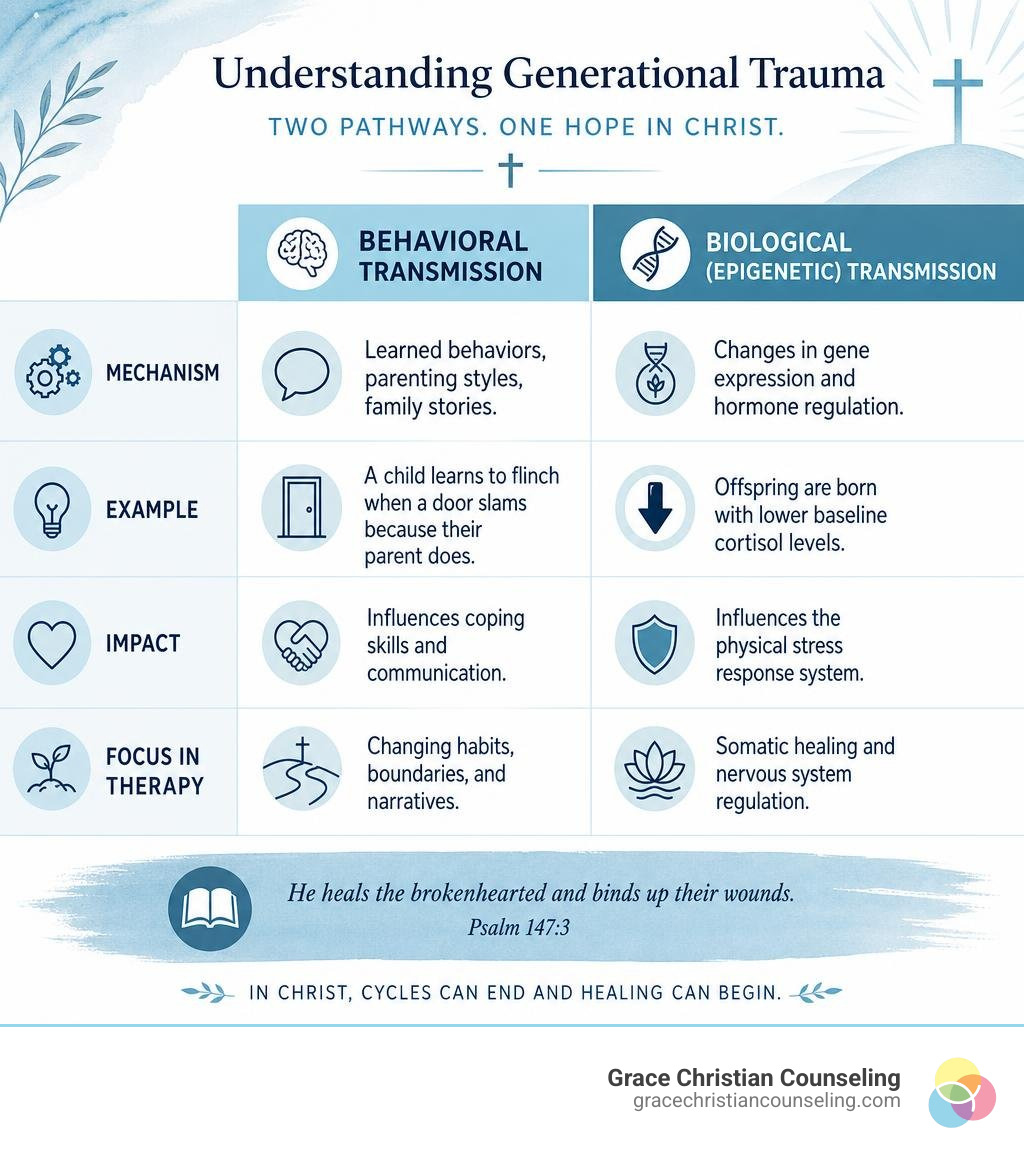
Trauma is frequently transmitted through the very relational dynamics that are supposed to provide safety. Our experts at Grace Christian Counseling often observe that parenting styles are the primary vehicle for this transmission. If a parent has unresolved PTSD, they may be emotionally less available or perceive their children more negatively.
A meta-analysis of 72 studies involving over 14,000 participants found that parents with PTSD often struggle with emotional regulation, which in turn leads to greater psychosocial difficulties for their children. This is not about blaming parents; it is about understanding that a person cannot give what they do not have. If a mother or father is trapped in a state of hypervigilance, their attachment quality with their child may be compromised.
Communication barriers often arise when families adopt a culture of silence. In many households in Western Pennsylvania and beyond, there is often an unspoken rule such as: “We don’t talk about that.” While intended to protect the next generation, this silence actually creates a vacuum that children fill with their own anxieties. These learned behaviors and family rules become like a blueprint for how the next generation handles stress.
Signs and Symptoms in Individuals and Families
Recognizing the signs of generational trauma is the first step toward breaking the cycle. It often looks like a persistent feeling of being “on edge” without a clear reason. Common symptoms include:
- Hypervigilance: A constant state of scanning for danger, even in safe environments like your home in Pittsburgh or Sewickley.
- Chronic Anxiety and Depression: Feeling a heavy weight of sadness or worry that seems to have been there since childhood.
- Trust Issues: Difficulty forming secure attachments or a deep-seated belief that others will eventually let you down.
- Emotional Numbness: A “shutting down” of feelings as a way to cope with overwhelming family stress.
- Physical Health Impacts: Research suggests that generational trauma can manifest as hypertension, autoimmune disorders, and chronic pain.
When families are struggling, they often repeat unhealthy relationship dynamics or experience unexplained guilt and shame. Learning the art of letting go of past traumas is essential for moving from a state of survival to a state of thriving.
The Science of Inherited Stress: Epigenetics and Neurobiology
Epigenetics is the study of how your behaviors and environment can cause changes that affect the way your genes work. Unlike genetic changes, epigenetic changes do not change your DNA sequence, but they do change how your body reads a DNA sequence. Think of it like a highlighter on a page; the text stays the same, but certain parts are emphasized.
One of the most fascinating aspects of Therapy For Generational Trauma is the growing body of research showing that severe trauma can affect stress regulation across generations. A peer-reviewed review in Frontiers in Psychiatry describes intergenerational trauma as moving through several connected pathways, including family relationships, psychological patterns, and neurobiological stress responses, and other possible epigenetic changes.
Rachel Yehuda, a pioneer in this field, conducted landmark research on Holocaust survivors and their offspring. Her studies found that children of survivors with PTSD exhibited altered cortisol levels, the body’s primary stress hormone. Even though these children did not experience the Holocaust themselves, their bodies were “primed” to respond to stress in a specific way. This biological imprint can increase vulnerability to anxiety and depression. For more detailed information on biological wellness and its connection to mental health, you can visit NuWellonline.com.
Neurobiological Changes in Offspring
The impact of trauma can even begin in the womb. Prenatal development is a critical window where maternal stress can influence the developing brain architecture of the child. When a mother experiences high levels of stress or PTSD during pregnancy, it can alter the “set point” of the child’s nervous system.
Research highlighted in Combatting intergenerational effects of psychotrauma with multifamily therapy shows that these neurobiological changes can lead to higher sensitivity to PTSD later in life. This means that some individuals may have a naturally higher stress reactivity, making them feel more overwhelmed by life’s challenges than their peers. Understanding this is vital because it shifts the conversation from “What is wrong with me?” to “What happened to my family, and how is my body responding to it?”
Evidence-Based Therapy For Generational Trauma
One principle consistently guides our approach: we do not begin by trying to change behaviors in isolation. Before introducing trauma-processing techniques such as EMDR or challenging long-standing beliefs through CBT, we first focus on establishing emotional safety, understanding family history, and identifying the coping strategies that once helped a person survive. In our clinical experience, lasting change is more likely when clients understand the purpose those survival patterns once served before learning healthier ways to respond. This gradual, collaborative process helps people replace inherited patterns with new skills that support healthier relationships, emotional regulation, and long-term resilience.
Healing is not just about willpower; it requires effective, evidence-based tools. At Grace Christian Counseling, we utilize a variety of effective therapy techniques for healing generational trauma. The goal is to move beyond just talking about the past and toward actually re-processing the trauma so it no longer controls the present.
- Cognitive Behavioral Therapy (CBT): Helps identify and change the negative thought patterns and “inherited scripts” that perpetuate distress.
- Dialectical Behavior Therapy (DBT): Provides skills for emotional regulation and distress tolerance, which are often missing in families with a history of trauma.
- Trauma-Informed Care: A framework that prioritizes emotional safety and recognizes that symptoms are often adaptive responses to past pain.
- Multifamily Therapy: An approach that brings families together to share experiences, reduce isolation, and build collective resilience.
The Role of EMDR and Somatic Therapy For Generational Trauma
Eye Movement Desensitization and Reprocessing (EMDR) is particularly powerful for addressing the deep-seated, subconscious roots of generational trauma. It uses bilateral stimulation (such as side-to-side eye movements or taps) to help the brain process traumatic memories that have been “stuck” in the nervous system.
In Therapy For Generational Trauma, we often focus on Phase 2 of EMDR, known as preparation. This involves Resource Development and Installation (RDI). During this phase, we help you identify and “install” positive internal resources (such as a sense of peace, strength, or protection) that may have been absent in your family history.
Somatic experiencing is another essential tool. Since trauma is stored in the body, we must involve the body in the healing process. This might involve noticing where you feel tension in your chest or stomach and using grounding techniques to calm the nervous system. You can learn more about how these methods intersect with faith by reading about how Christian therapy can help trauma.
Breaking the Cycle Through Multifamily Interventions
Trauma often thrives in isolation. Multifamily therapy interventions break this isolation by bringing families together in a supportive group setting. This approach focuses on:
- Mentalization: Helping parents understand their own mental states and those of their children, which improves empathy and connection.
- Reducing Shame: Realizing that other families face similar struggles helps lift the heavy burden of “family secrets.”
- Peer Support: Building a community of people who are all committed to breaking the cycle.
By building bridges to trauma recovery, families can create a new legacy of openness and emotional health.
Breaking the Cycle: Practical Steps and Warrior Genetics
While generational trauma involves the passing down of pain, it also involves the passing down of incredible strength. We often refer to this as “Warrior Genetics.” These are the adaptive inherited strengths that allowed your ancestors to survive in the first place.
If your great-grandparents survived a war or your parents overcame extreme hardship, they passed down a certain level of resilience and “grit” to you. In therapy, we don’t just look at the wounds; we look at the “warrior” inside you. Healing from generational trauma involves reclaiming these strengths while letting go of the maladaptive behaviors that no longer serve you.
Practical steps to begin breaking the cycle include:
- Awareness: Acknowledge that the patterns exist without judgment.
- Setting Boundaries: Learning to say “no” to unhealthy family dynamics to protect your own peace.
- Reparenting: Learning to give yourself the emotional care and validation you may not have received as a child.
- Breaking the Silence: Choosing to talk honestly about your feelings with trusted supports.

Identifying Inherited Strengths in Therapy
Our licensed counselors (including LPCs, LMFTs, LCSWs, and other qualified mental health professionals) work with you to identify the “gold” in your family history. Perhaps your family has a history of deep loyalty, creative problem-solving, or an unwavering faith. These are resources we can utilize.
Using specific EMDR protocols, we can help you connect with the sensory aspects of these strengths. We might invite you to identify a “warrior” figure—either a real ancestor or a symbolic representation—and use bilateral stimulation to strengthen your connection to those qualities. This process is part of unmasking trauma and finding the power of Christian counseling.
Integrating Faith and Clinical Practice for Lasting Healing
At Grace Christian Counseling, we believe that true wholeness involves the mind, body, and spirit. We provide Christian trauma counseling that blends evidence-based psychology with the timeless truths of Scripture.
We believe that God’s design for your life is one of healing and restoration. While your family history may be marked by pain, your future is held by a God who makes all things new. We often turn to Philippians 4:6-7 for comfort: “Do not be anxious about anything, but in every situation, by prayer and petition, with thanksgiving, present your requests to God. And the peace of God, which transcends all understanding, will guard your hearts and your minds in Christ Jesus.”
Our approach is collaborative; we move at your pace and integrate the guidance of the Holy Spirit throughout our sessions. Whether you are in Pittsburgh, Uniontown, or meeting with us online from across Pennsylvania, our goal is to help you find peace with God through faith-based healing.
Healing the Heart with the Word
The Bible is full of stories of generational struggle and divine redemption. By healing the heart with the Word, we find a roadmap for forgiveness, not as a way to condone what happened, but as a way to set ourselves free from the bitterness that keeps us tied to the past.
We provide a roadmap to wholeness that respects your unique story while pointing toward the ultimate Healer. This integration of clinical expertise and biblical wisdom ensures that you are not just managing symptoms, but experiencing deep, lasting transformation.
Frequently Asked Questions
Can generational trauma be fully cured?
While we may not use the word “cured” in the sense of a medical illness, generational trauma can absolutely be healed. The focus of Therapy For Generational Trauma is on breaking the cycle, building resilience, and ensuring that the pain stops with you. It is a journey of long-term growth. You can read more about the path of healing childhood trauma to see how others have found their way to freedom.
When should I seek professional Therapy For Generational Trauma?
You should consider seeking professional help if you notice persistent emotional distress, recurring unhealthy relationship patterns, or physical symptoms that have no clear medical cause. If you find yourself “falling apart inside” while trying to hold everything together, specialized programs can help. We also offer trauma therapy for healing from narcissistic abuse and other specific family wounds.
How does generational trauma affect my parenting?
As noted earlier, unresolved trauma can affect your emotional availability and how you perceive your children. It can lead to patterns of overprotection, emotional withdrawal, or inconsistency. However, through therapy, you can engage in attachment repair. By healing your own wounds, you become better equipped to provide the secure, loving environment your children need. This is a key part of overcoming emotional abuse and creating a new family legacy.
Breaking the Cycle and Building a New Legacy
You do not have to carry the weight of the past forever. At Grace Christian Counseling, we are honored to walk alongside you as you navigate the complexities of your family history. Whether you are seeking help for yourself, your marriage, or your children, our licensed counselors are here to provide compassionate, Christ-centered care.
We serve communities across Western Pennsylvania—including Pittsburgh, Uniontown, Sewickley, Penn Hills, Bethel Park, and North Huntingdon—as well as providing online counseling statewide in PA, West Virginia, Georgia, and Florida. By choosing healing from generational trauma, you are making a courageous decision that will benefit not only your life but the lives of generations to come.
If you are ready to begin your journey toward wholeness, please reach out to us today. Together, we can break the cycle and build a future defined by peace, resilience, and faith.
This guide is for educational and spiritual encouragement and is not a substitute for personalized professional counseling. If you are in crisis, please reach out for immediate help.
Narcissistic Abuse Cycle: Breaking the Patterns for True Recovery


