

When the Wound Is Hard to Name: What Narcissistic Abuse Therapy Can Do for You
Narcissistic abuse therapy is a specialized, trauma-informed approach to healing the psychological harm caused by relationships marked by manipulation, gaslighting, and coercive control. If you are trying to understand whether this kind of support is right for you, here is a quick overview:
What narcissistic abuse therapy involves:
- Stabilization; calming your nervous system and establishing a sense of safety
- Clarity; naming the abuse, understanding the patterns, and validating your experience
- Trauma processing; working through the emotional and psychological wounds using evidence-based methods like EMDR, somatic therapy, or Internal Family Systems (IFS)
- Integration; rebuilding your identity, self-trust, and ability to form healthy relationships
This kind of therapy differs from standard talk therapy because narcissistic abuse creates a specific pattern of injuries, including identity erosion, reality distortion, and complex trauma responses that require a targeted, sequenced approach to heal.
One of the most painful parts of recovering from a narcissistic relationship is not knowing whether what happened to you was even real. Research from the Journal of Interpersonal Violence found that 68% of survivors initially questioned whether they had experienced abuse at all. That doubt is not a sign of weakness. It is a direct result of how this kind of abuse works.
If you are living in Western Pennsylvania, or anywhere else in the state, you can access online counseling, and you are still feeling anxious, confused, or emotionally exhausted long after a painful relationship ended, you are not alone. At Grace Christian Counseling, we walk alongside survivors with both clinical skill and the compassion of Christ-centered care.
This guide will walk you through every step of the healing process, from understanding what happened to finding the right support.
Understanding Narcissistic Abuse and Its Impact on the Soul
To understand why recovery requires a distinct approach, we must first look at what narcissistic abuse actually is. Unlike physical abuse, which leaves visible marks, narcissistic abuse is a systematic chipping away of a person’s sense of reality, self-worth, and agency. It is a form of psychological and spiritual warfare that leaves the survivor feeling like a shell of their former self.
In many cases, the abuser suffers from Narcissistic Personality Disorder (NPD) or exhibits strong narcissistic traits, such as an extreme need for admiration, a profound lack of empathy, and a transactional view of human relationships. For those seeking specialized clinical resources, you can consult regional directories to locate local diagnostic specialists.
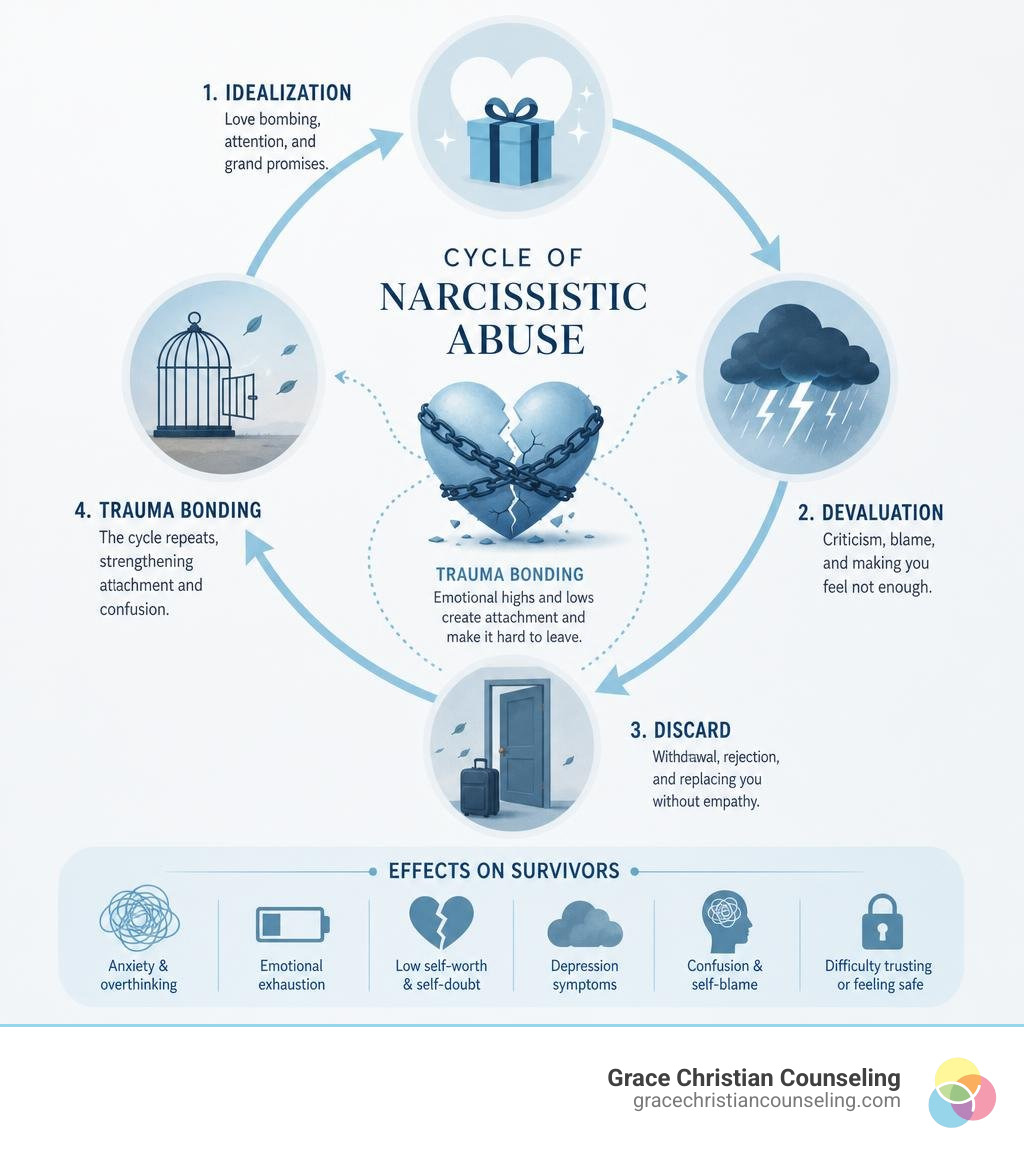
The cycle of this abuse typically follows a highly predictable, yet devastating, pattern:
- Love Bombing: The relationship begins with overwhelming affection, praise, and intense connection. The abuser places you on a pedestal, making you feel uniquely seen and cherished.
- Devaluation: Gradually, the dynamic shifts. The warmth is replaced by subtle criticisms, emotional withholding, and shifting goalposts. You find yourself working harder and harder to regain the warmth of the early days.
- The Discard: When you are emotionally depleted or begin to demand basic respect, the abuser may abruptly discard you, or push you to the point of leaving, treating you with cold indifference.
- Trauma Bonding: Throughout this cycle, the alternation between intense affection and emotional cruelty creates a powerful biological bond. This chemical roller coaster mimics addiction, making it incredibly difficult to walk away.
This cycle is precisely why so many survivors experience profound cognitive dissonance, struggling to reconcile the charming “Jekyll” they loved with the cruel “Hyde” who hurt them.
The Invisible Nature of Coercive Control
The core weapon of a narcissist is coercive control, which relies heavily on reality distortion. Gaslighting is not just a disagreement; it is a systematic effort to make you doubt your own memory, perception, and sanity. Over time, you stop trusting your own eyes and ears, relying instead on the abuser’s version of reality.
This dynamic is incredibly isolating. The abuser may use triangulation, pitting friends, family members, or coworkers against you, or use emotional blackmail to keep you compliant. The resulting damage to your self-esteem can make everyday decisions feel paralyzing. If you are trying to make sense of these invisible wounds, exploring specialized resources on Therapy For Overcoming Emotional Abuse can help you begin to untangle the web of manipulation and reclaim your voice.
A systematic review and meta-analysis on coercive control found that studies of coercive control and mental health consistently link these patterns with PTSD, Complex PTSD, depression, and other trauma-related outcomes. This matters clinically because narcissistic abuse is rarely one isolated incident. Survivors are often recovering from repeated reality distortion, isolation, intimidation, and emotional manipulation that shaped how safe they felt in their own body and relationships.
Signs and Symptoms of Complex Trauma
Because narcissistic abuse is often relational, repeated, and emotionally destabilizing, some survivors experience trauma-related symptoms that resemble Complex Post-Traumatic Stress Disorder (C-PTSD). Not every survivor will meet criteria for C-PTSD, but many report patterns such as persistent hypervigilance, emotional dysregulation, shame, self-blame, difficulty trusting others, and a disrupted sense of identity.
Research published in The Lancet explains that Complex PTSD includes the core PTSD symptom pattern along with three additional areas often called disturbances in self-organization:
- Disturbances in Affect Regulation: Experiencing intense emotional storms, sudden anxiety, or a chronic sense of numbness.
- Negative Self-Concept: Carrying deep-seated feelings of shame, worthlessness, and persistent self-blame.
- Disruptions in Relational Functioning: Finding it incredibly difficult to trust others, set boundaries, or feel safe in close connections.
The National Center for PTSD also notes that the International Trauma Questionnaire is the most-studied assessment tool for Complex PTSD. Clinically, this supports a careful distinction between saying a survivor “has C-PTSD” and saying they are showing symptoms that may need trauma-informed assessment. That distinction helps protect survivors from both minimizing their pain and over-pathologizing a normal response to prolonged relational harm.
In the clinical community, recognizing these differences is critical. For survivors looking for support, local trauma centers offer specialized insight into how these symptoms manifest in daily life. Survivors often find themselves living in a state of constant hypervigilance, walking on eggshells even when they are completely alone. This is not a personality trait; it is a physiological survival response. Your nervous system has been trained to anticipate danger at any moment.
Why Recovery Requires Specialized Narcissistic Abuse Therapy
Many survivors enter standard talk therapy hoping for relief, only to find themselves feeling misunderstood or even re-traumatized. This is because traditional therapeutic frameworks often assume that both parties in a relationship are acting in good faith and simply need better communication skills.

The Limitations of Standard Talk Therapy vs. Narcissistic Abuse Therapy
In a relationship characterized by narcissistic abuse, there is a fundamental imbalance of power and empathy. If a standard therapist suggests that “it takes two to tango” or encourages a survivor to “look at their own contribution to the communication breakdown,” it can deeply reinforce the abuser’s gaslighting. This “mutual communication myth” is a major red flag in clinical settings.
True narcissistic abuse therapy requires a specialist who understands coercive control, trauma bonding, and the specific mechanics of psychological abuse. Without this specific lens, generic therapy can lead to victim-blaming dynamics, leaving the survivor feeling more isolated than before.
Healing from these complex dynamics requires targeted, trauma-informed care. You can learn more about how specialized approaches target these unique wounds by reading about our clinical framework for Trauma Therapy For Healing From Narcissistic Abuse.
Rebuilding Self-Trust and Reclaiming Your Identity
The ultimate goal of specialized therapy is to help you quiet the critical voice of the abuser in your head and rebuild your relationship with yourself. This involves:
- Reducing Rumination: Breaking the mental loop of trying to figure out “why” the abuser did what they did, or how you could have fixed it.
- Setting Boundaries: Learning that “no” is a complete sentence and that boundaries are not selfish; they are a necessary form of self-respect.
- Reclaiming Identity: Reconnecting with the hobbies, values, and friendships that were stripped away during the relationship.
As Christian counselors, we believe this process of identity reconstruction is deeply spiritual. When a narcissist tries to destroy your sense of self, they are attacking the very person God created you to be. To explore this spiritual battle further, read our guide on When A Narcist Tries To Destroy A Christian.
During this phase, we often meditate on Scripture to anchor our healing. Philippians 4:6-7 reminds us: “Do not be anxious about anything, but in every situation, by prayer and petition, with thanksgiving, present your requests to God. And the peace of God, which transcends all understanding, will guard your hearts and your minds in Christ Jesus.” True peace comes from grounding your identity in Christ’s unchanging love, rather than the shifting demands of a manipulative person.
Evidence-Based Modalities for Healing Relational Trauma
At Grace Christian Counseling, our licensed counselors utilize evidence-based psychological modalities integrated with biblical wisdom. We do not offer quick fixes; we use proven clinical tools to help heal the nervous system and the soul.
The table below outlines the primary evidence-based modalities we use to address the different layers of relational trauma:
| Modality | Primary Focus | How It Helps Narcissistic Abuse Survivors |
|---|---|---|
| EMDR (Eye Movement Desensitization and Reprocessing) | Processing traumatic memories and reducing emotional charge | Clears the emotional distress of flashbacks and weakens the pull of the trauma bond |
| Somatic Experiencing | Releasing stored physical tension and trauma from the body | Calms hypervigilance, reduces the “walking on eggshells” feeling, and restores safety |
| Internal Family Systems (IFS) | Understanding and healing different “parts” of the self | Resolves internal conflict, calms the inner critic, and heals the people-pleasing “fawn” response |
| Trauma-Focused CBT (TF-CBT) | Restructuring distorted cognitive patterns and beliefs | Replaces internalized lies (“I am not enough”) with healthy, realistic truth |
A large systematic review and meta-analysis of psychological therapies for adult PTSD reviewed 114 randomized controlled trials with 8,171 participants and found robust evidence for trauma-focused CBT and EMDR. Another meta-analysis of EMDR randomized controlled trials included 26 trials, with 22 assessing PTSD symptoms and additional studies measuring depression, anxiety, and subjective distress. These findings do not mean every survivor needs the same method, but they do support using trauma-focused modalities rather than relying only on general supportive talk therapy.
Somatic Experiencing and EMDR in Narcissistic Abuse Therapy
Because trauma is stored in the body, simply talking about the abuse is rarely enough to heal. EMDR uses bilateral stimulation, such as guided eye movements or tapping, to help the brain reprocess traumatic memories. This takes the “sting” out of the memories, so they no longer trigger an immediate fight-or-flight response.
Somatic practices focus on helping you feel safe inside your own skin again. When you have spent years suppressing your emotions to stay safe in an abusive relationship, somatic therapy helps you reconnect with your body’s physical cues. For a deeper look at how these clinical tools are integrated into a faith-based framework, explore our page on Christian Trauma Counseling as well as our resources on Unmasking Trauma The Power Of Christian Trauma Counseling.
Internal Family Systems and Parts Work
Internal Family Systems (IFS) is an incredibly gentle and effective tool for resolving the inner conflict that survivors carry. Often, survivors find themselves split between different “parts” of themselves:
- A part that feels deep anger and wants to stay away from the abuser.
- A part that feels lonely and wants to break “no contact” to seek comfort.
- An inner critic part that constantly blames you for not leaving sooner.
IFS helps you access your core “Self” under the guidance of the Holy Spirit, allowing you to bring compassion and healing to these wounded parts. This is especially vital for healing the “fawning” or people-pleasing responses that often stem from childhood. If your adult relational patterns are connected to early family dynamics, you may find comfort in our articles on Healing Childhood Trauma and Addressing Childhood Traumas To Foster Healing In Adulthood.
The Step-by-Step Sequence of the Healing Journey
A recent systematic review and meta-analysis on phase-based psychological interventions for Complex PTSD found that treatments with more than one phase showed stronger effects on post-traumatic stress symptoms than single-phase approaches. The review specifically compared interventions that begin with stabilization and skills-building before moving into direct trauma-focused work, such as exposure or memory processing. This supports a careful, sequenced approach for many survivors, especially when symptoms include emotional dysregulation, shame, relational fear, or difficulty feeling safe in the body. Healing cannot be rushed; moving into intensive trauma processing before a client has enough safety, coping skills, and nervous-system stability can feel overwhelming rather than restorative.

Phase 1: Nervous System Stabilization and Safety
Before you can process what happened, you must establish physical and psychological safety. If you are still in daily contact with the abuser, or if your nervous system is in a constant state of red alert, your brain cannot process trauma.
In this first phase, our counselors focus on:
- Establishing Boundaries: Helping you implement a “no-contact” or “low-contact” rule to create physical space from the abuser.
- Grounding Tools: Teaching practical, somatic exercises to bring your nervous system back into its window of tolerance when you feel panicked or triggered.
- Psychoeducation: Helping you understand the mechanics of coercive control so you can stop blaming yourself for the trauma response.
Phase 2: Processing Trauma and Rebuilding Boundaries
Once your nervous system is relatively stable, we begin the deeper work of trauma processing. This is where we use EMDR, somatic experiencing, and IFS to clear the emotional charge of specific memories.
During this phase, survivors typically experience:
- Grief: Mourning the loss of the relationship, the person you thought they were, and the time and energy you poured into them.
- Anger: Reclaiming your healthy anger, which is a vital boundary-setting emotion that says, “What happened to me was wrong.”
- Spiritual Renewal: Rebuilding your relationship with God and learning to trust His voice over the critical voice of the abuser.
Whether you prefer meeting in person at one of our Western PA offices or utilizing our online counseling services throughout Pennsylvania, this structured sequence ensures you are supported every step of the way. For those seeking professional directories outside our immediate counseling network, local resources can help you explore care options.
Frequently Asked Questions About Narcissistic Abuse Therapy
How long does recovery from narcissistic abuse typically take?
While every individual’s journey is unique, narcissistic abuse recovery timelines often range from one to several years, with deeper integration and identity rebuilding sometimes continuing into years one to three or beyond. This timeline can vary depending on the duration of the relationship, the level of isolation experienced, the strength of the trauma bond, and how consistently you can maintain safety and distance from the abuser. Healing is not linear, and pacing yourself with self-compassion is a vital part of the process.
Can I do narcissistic abuse therapy online in Pennsylvania?
Yes, absolutely. Grace Christian Counseling offers highly secure, convenient virtual counseling options for residents across Pennsylvania, West Virginia, Georgia, and Florida. Our licensed LSWs and LAPCs provide the exact same high-quality, trauma-informed care online as they do in our physical offices in Western PA, allowing you to heal from the comfort and privacy of your own home.
How does Christian counseling differ from secular therapy for abuse?
Secular therapy offers wonderful clinical tools, but it often stops at psychological coping mechanisms. Christian counseling integrates these evidence-based techniques with the healing power of the Holy Spirit, biblical truth, and prayer. We believe that true transformation requires healing both the mind and the soul, anchoring your worth in Christ rather than human validation.
Reclaiming Safety, Self-Trust, and Hope
Recovering from the devastating effects of a narcissistic relationship can feel like trying to find your way out of a thick fog. But with the right, specialized support, the fog will clear. You can rebuild your confidence, learn to trust your instincts again, and form healthy, mutually respectful relationships.
At Grace Christian Counseling, we are honored to offer a safe, warm, and highly professional space for your healing journey. With physical offices across Western Pennsylvania, including Penn Hills, Pleasant Hills, Bethel Park, Sewickley, Mt. Lebanon, and Uniontown, as well as comprehensive virtual options, we are here to support you.
If you are ready to take the first step toward reclaiming your life, we invite you to Begin your healing journey with our therapy for overcoming emotional abuse. Let us walk with you as you step out of the shadows of abuse and into the light of God’s peace and restoration.
This guide is for educational and spiritual encouragement and is not a substitute for personalized professional counseling. If you are in crisis, please reach out for immediate help.
Narcissistic Abuse Cycle: Breaking the Patterns for True Recovery


