

When Worry Won’t Let Go: What the Bible Actually Says
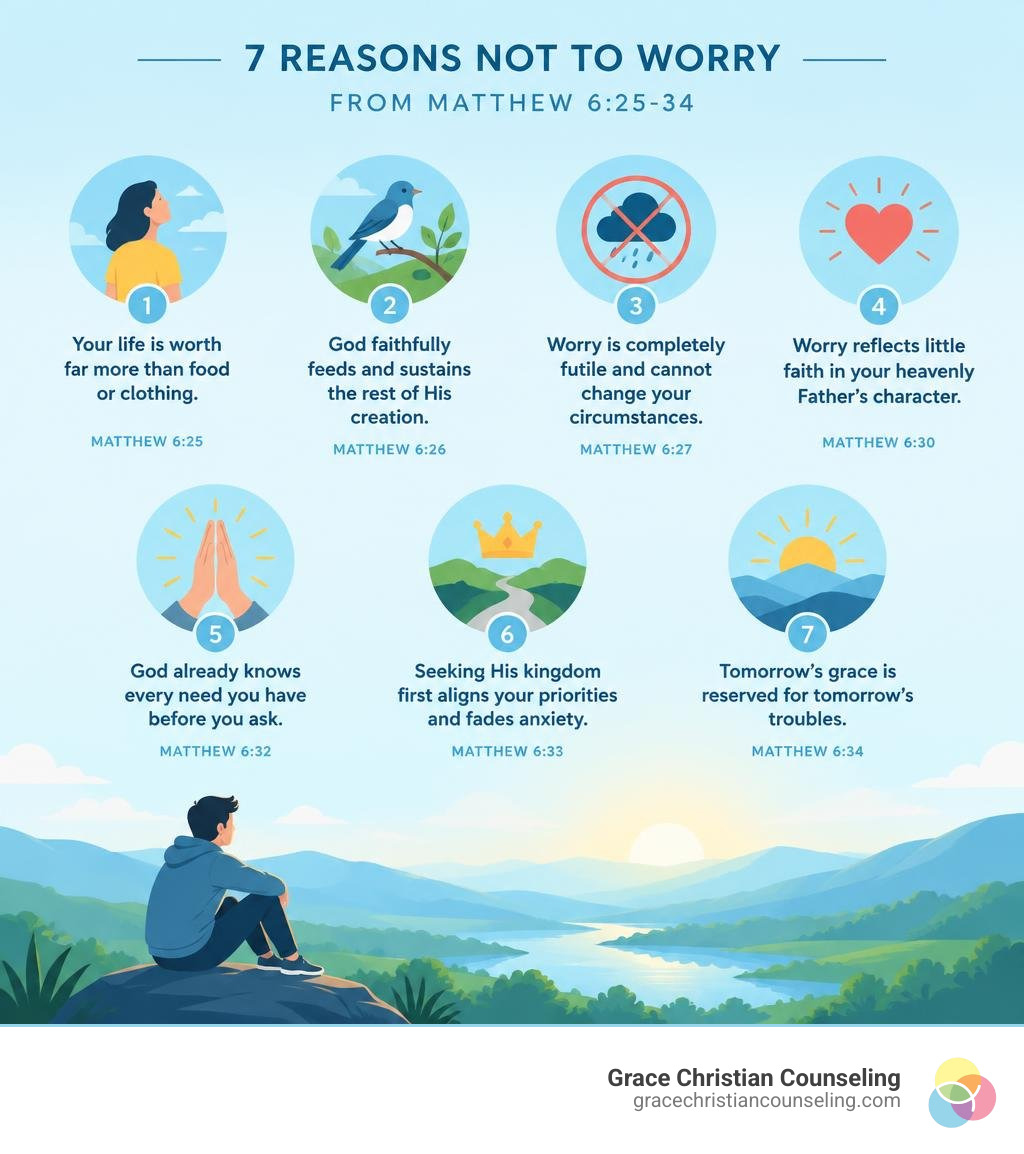
The 7 reasons not to worry in the bible come primarily from Matthew 6:25-34, where Jesus walks His followers through a calm, compassionate case for releasing anxiety and trusting God’s provision. Here is a quick summary:
- Your life is worth far more than food or clothing (Matthew 6:25).
- God faithfully feeds and sustains the rest of His creation (Matthew 6:26).
- Worry is completely futile and cannot change your circumstances (Matthew 6:27).
- Worry reflects little faith in your heavenly Father’s character (Matthew 6:30).
- God already knows every need you have before you ask (Matthew 6:31–32).
- Seeking His kingdom first aligns your priorities and fades anxiety (Matthew 6:33).
- Tomorrow’s grace is reserved for tomorrow’s troubles (Matthew 6:34).
Worry is one of the most common struggles we see at Grace Christian Counseling, and it touches people from every background. Parents lie awake replaying worst-case scenarios. Teenagers spiral over grades, friendships, and the future. Couples feel crushed under financial pressure. And many people in Western PA communities, and across Pennsylvania, carry these burdens quietly, not sure where to turn.
What makes worry so exhausting is that it feels productive. It feels like doing something. But as one source puts it well, worry is like a hamster running five miles a day on a wheel, expending enormous energy while never leaving the cage.
The Bible does not brush past this struggle. Jesus addressed it directly, gently, and with real reasons, not just a command to stop. That is what makes Matthew 6:25-34 so powerful and so worth sitting with.
Understanding Worry: Healthy Concern vs. Overwhelming Anxiety
To address worry effectively, we must first understand what it actually is. In our practice, we often meet individuals who feel incredibly guilty just for feeling anxious. They believe that experiencing any form of anxiety means they are failing spiritually. However, a crucial distinction exists between normal, healthy concern and paralyzing, chronic worry.
In the original Greek text of the New Testament, the word often translated as worry or anxiety is merimna. This word literally means “a divided mind” or “to draw in different directions.” When you worry, your mind is fractured; it is pulled away from the present moment and dragged into a hypothetical, chaotic future. This mental division is what causes that tight, heavy knot in your stomach and leaves you feeling completely drained.
To help clarify this distinction, consider this comparison:
| Legitimate Concern | Persistent or Overwhelming Worry |
|---|---|
| Focuses on the present moment and what can be done today | Focuses on hypothetical future scenarios you cannot control |
| Motivates constructive, healthy action | Paralyzes you, leaving you stuck in a loop of overthinking |
| Accompanied by basic trust in God’s ultimate sovereignty | Assumes you must carry the entire weight of the outcome alone |
| Preserves inner peace even during difficult challenges | Erases peace and breeds a sense of constant dread |
| Encourages you to seek wisdom and practical support | Isolates you, making you feel entirely on your own |
When worry becomes persistent, it can pull our attention toward circumstances we cannot control and make it difficult to remain grounded in the present. From a Christian perspective, this can become an invitation to bring our fears honestly before God, while also taking practical steps to address concerns that are within our control. We attempt to control things that are entirely outside of our human power, such as other people’s opinions, future economic shifts, or our exact lifespans.
Through cognitive reframing, a common practice in evidence-based therapy, we can learn to recognize these anxious thought patterns as they arise. Instead of letting our minds divide and spiral, we can pause, acknowledge our limitations, and redirect our focus to the truth of Scripture. For those who want to explore this dynamic further, we recommend reading our guide on How to Deal with Anxiety as a Christian. Additionally, professional resources and clinical insights can be explored through NuWellonline.com.
The Divine Antidote: 7 Reasons Not to Worry in the Bible
When Jesus delivered His Sermon on the Mount, He did not simply issue a cold moral decree telling His listeners to stop being anxious. He knew that the human heart does not respond well to empty commands. Instead, He offered a warm, deeply logical, and pastoral defense of why worry is unnecessary.

By looking closely at Matthew 6:25-34, we discover a beautifully structured argument designed to untie the knots of anxiety in our minds. Jesus invites us to look at the physical world around us, using simple elements of creation to teach us profound truths about the character of our heavenly Father.
As we explore the Seven Reasons Not to Worry (Matthew 6:25-34), we find a practical framework for shifting our focus from fear to faith. Let us walk through these seven reasons together, examining how each one speaks directly to our modern struggles.
1. Your Life is Far More Valuable Than Food and Clothing (The First of 7 Reasons Not to Worry in the Bible)
In Matthew 6:25, Jesus says, “Therefore I tell you, do not worry about your life, what you will eat or drink; or about your body, what you will wear. Is not life more than food, and the body more than clothes?”
This first reason speaks directly to our inherent worth. God is the creator of your incredibly complex life and physical body. If He was willing and able to perform the massive miracle of creating you in His image, it stands to reason that He is also willing and able to provide the lesser things required to sustain you, such as food, water, and clothing.
Often, our anxiety makes us focus so on the immediate details of survival or comfort that we lose sight of the grander picture. We begin to believe that our value is tied directly to what we produce, what we wear, or how well we secure our own lives. But biblical truth reminds us that our value is established by God Himself. When you begin to spiral over physical or material concerns, you can find solid ground by reviewing our Scripture-Based Anxiety Relief: A Christian Guide to help anchor your mind in your true identity in Christ.
2. God Faithfully Sustains the Rest of His Creation (The Second of 7 Reasons Not to Worry in the Bible)
For His second point, Jesus invites us to look at nature. In Matthew 6:26, He says, “Look at the birds of the air; they do not sow or reap or store away in barns, and yet your heavenly Father feeds them. Are you not much more valuable than they?”
Think about the sheer scale of God’s daily provision. Ornithologists estimate there are roughly 400 billion birds on the planet. None of these birds wake up in the morning and experience a panic attack about where they will find their next meal. They do not build massive storehouses or fret over economic recessions. Yet, day after day, they are fed and sustained by the quiet, consistent hand of God.
As noted in the theological insights on 7 Reasons Not to Worry, birds and wildflowers act as quiet, consistent preachers of God’s grace. If God is so deeply committed to caring for creatures that do not bear His image and cannot worship Him, how much more will He care for you, His beloved child? Looking at creation is a physical, practical way to remind your overthinking mind that the Creator of the universe is actively involved in the details of your life.
3. Worry is Completely Futile and Cannot Change Your Circumstances
In Matthew 6:27, Jesus asks a very practical, almost humorous question: “Can any one of you by worrying add a single hour to your life?”
The obvious answer is an absolute no. Worrying has never paid a single bill; it has never healed a disease; and it has never resolved a difficult relationship. In fact, worry does the exact opposite of what we want. It drains our mental energy, fractures our focus, and takes a severe physical toll on our health.
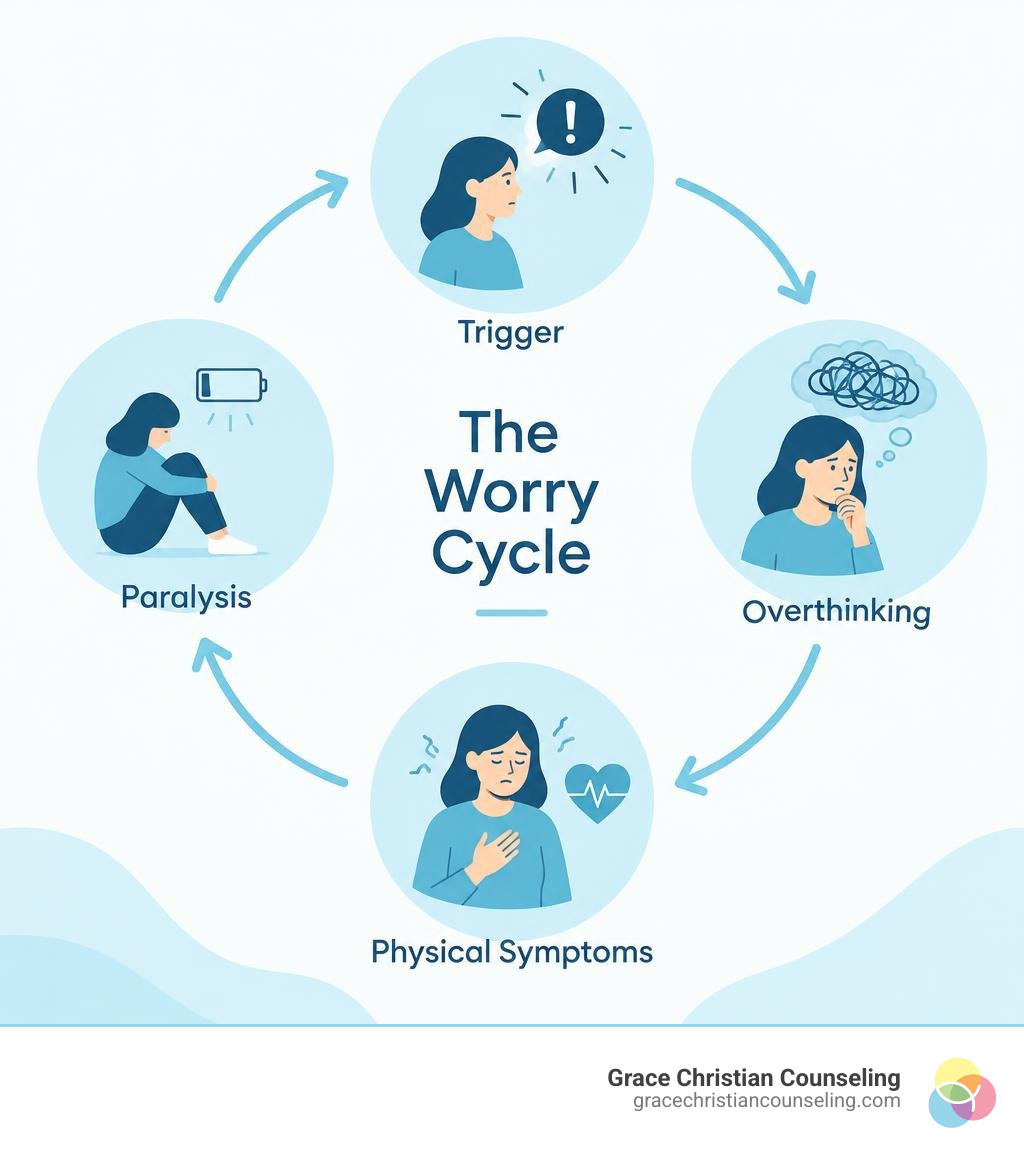
Consider the hamster wheel analogy. A hamster can run five to six miles a day on its wheel, totaling thousands of miles over its lifetime, yet it never actually leaves its cage. It exerts massive amounts of energy for absolutely zero progress. Worry is our mental hamster wheel.
Persistent anxiety can affect both emotional and physical well-being. For example, people with generalized anxiety disorder may experience fatigue, difficulty concentrating, sleep problems, muscle tension, headaches, stomachaches, or other physical symptoms alongside excessive worry. If worry is persistent, difficult to control, or interfering with everyday life, professional support can help determine whether something more than everyday stress may be occurring. The National Institute of Mental Health provides additional information about generalized anxiety disorder and its symptoms. When you feel trapped on the hamster wheel of anxiety, meditating on truths like those found in 10 Healing Scriptures for Mental Health Recovery can help interrupt the cycle and bring calming perspective to your body and mind.
Jesus Invites Us to Trust Our Heavenly Father’s Character
In Matthew 6:30, Jesus gently but directly challenges His disciples: “If that is how God clothes the grass of the field, which is here today and tomorrow is thrown into the fire, will he not much more clothe you, you of little faith?”
Here, Jesus directs His followers away from consuming worry and toward greater trust in their heavenly Father’s care. For Christians, worry can certainly become a spiritual struggle involving trust, but experiencing anxiety does not automatically mean that someone lacks faith. Anxiety can also arise in response to stress, trauma, health concerns, life circumstances, or an anxiety disorder.
This perspective is explored in depth in the resources on Biblical Reasons Not to Worry. For Christians, worry can become a spiritual struggle when fear begins to crowd out trust in God’s care. At the same time, clinical anxiety should not be reduced to a faith problem. Someone may need prayer, Scripture, practical coping tools, and professional mental health support at the same time. These forms of care can work together rather than compete with one another.
5. God Already Knows Your Every Need Before You Ask
In Matthew 6:31-32, Jesus says, “So do not worry, saying, ‘What shall we eat?’ or ‘What shall we drink?’ or ‘What shall we wear?’ For the pagans run after all these things, and your heavenly Father knows that you need them.”
One of the most comforting aspects of God’s character is His intimate, sovereign knowledge of our lives. You never have to worry about “informing” God of your struggles or catching Him by surprise. He is not a distant, distracted ruler who needs to be reminded of your existence. He is a loving, attentive Father who is already fully aware of every detail, bill, and concern weighing on your heart.
Instead of letting your needs fuel a cycle of isolation and panic, the Bible invites you to transform those concerns into active, trust-filled communication. As the Apostle Paul famously wrote in Philippians 4:6-7, we are called to shape our worries into prayers, presenting our requests to God with thanksgiving. When we do this, we are promised a peace that transcends all human understanding, acting as a protective guard over our hearts and minds.
6. Seeking God’s Kingdom First Aligns Your Priorities and Fades Anxiety
In Matthew 6:33, Jesus offers a powerful pivot: “But seek first his kingdom and his righteousness, and all these things will be given to you as well.”
Anxiety thrives when our priorities are disorganized. When we put our career, our social status, our financial security, or our personal comfort at the very center of our lives, we will naturally live in a state of constant fear. Why? Because all of those things are inherently fragile and can be lost in an instant.
When we choose to place God’s kingdom and His righteous character at the center of our lives, our perspective undergoes a massive shift. We begin to care more about eternal values, spiritual growth, and loving others than we do about accumulating temporary status symbols. As we align our daily goals with God’s eternal purposes, our immediate, material anxieties naturally begin to fade. To learn more about how to practically realign your focus and quiet your mind, explore our insights on Overcoming Anxiety and Fear.
Tomorrow’s Grace is Reserved for Tomorrow’s Troubles
Jesus concludes His brilliant teaching on worry in Matthew 6:34 with a very practical piece of daily advice: “Therefore do not worry about tomorrow, for tomorrow will worry about itself. Each day has enough trouble of its own.”
Worrying about the future is like trying to overdraw a checking account. God promises to provide a daily deposit of sustaining grace, but that grace is strictly sufficient for today’s challenges. When you try to mentally live out next week’s, next month’s, or next year’s hypothetical problems today, you are trying to carry tomorrow’s burdens without tomorrow’s grace. No wonder you feel completely overwhelmed!
Living one day at a time is a powerful spiritual and psychological discipline. God met the Israelites in the wilderness by sending fresh manna every single day; they were not allowed to store it up for the future. In the same way, we must learn to rely on God’s fresh, daily mercies. When your mind tries to drag you into the uncertainties of tomorrow, you can actively practice casting those cares onto Him, resting in the promise of 1 Peter 5:7 because He cares for you deeply.
Bridging Faith and Psychology: The Counseling Blueprint for Anxiety Relief
At Grace Christian Counseling, we firmly believe that faith and evidence-based psychology are not in conflict; rather, they work beautifully together to bring about holistic healing. While the spiritual principles of Scripture provide our ultimate foundation, clinical counseling tools help us practically apply those truths to our daily lives, relationships, and physical bodies.

Our licensed counselors, including our caring LAPCs and LSWs, guide clients through a structured, compassionate healing journey known as our Counseling Blueprint. This four-stage model is designed to address patterns of worry while integrating clinical care with your Christian faith:
- Take Off the Mask: We begin by building a safe, non-judgmental, and trusting relationship. You don’t have to pretend to have it all together here. We invite you to bring your honest fears, physical symptoms, and doubts into the light.
- Heal the Wounds: Together, we explore the deeper emotional and relational hurts that may be fueling your anxiety. This might involve looking at past trauma, family dynamics, or seasons of intense stress.
- Remove the Toxins: We help you identify the unhelpful beliefs, cognitive distortions, and lingering lies that keep you trapped in a cycle of overthinking.
- Replace with Truth: Finally, we work to install accurate, empowering, and biblically grounded perspectives about yourself, others, and the world, helping you walk forward in freedom and confidence.
Whether you are seeking support for your teenager struggling with school anxiety, navigating a difficult season of family conflict, or dealing with chronic panic attacks, our team is here for you. We are proud to serve Western PA communities with convenient, in-person counseling in locations like Pittsburgh, North Huntingdon, Penn Hills, Uniontown, Bethel Park, Sewickley, and Mt. Lebanon. We also offer online counseling services across Pennsylvania, West Virginia, Florida, and Georgia, ensuring you can access professional, Christ-centered care from the comfort of your own home.
Frequently Asked Questions About Worry and the Bible
Is worry considered a sin in the Bible?
The Bible repeatedly calls believers away from consuming worry and toward trust in God, prayer, wisdom, and dependence on His care. At the same time, experiencing anxiety is not automatically evidence of sin or weak faith. Anxiety can be a normal response to stress, and some people experience clinical anxiety disorders involving persistent symptoms that interfere with daily life. Christians can respond to worry spiritually through prayer and Scripture while also seeking appropriate practical, pastoral, or professional support.
What is the difference between clinical anxiety and situational worry?
Situational worry is a normal human response to stressors such as a job interview, difficult conversation, financial concern, or upcoming exam. It often decreases as the situation changes or resolves. An anxiety disorder involves more than simply feeling worried. For example, generalized anxiety disorder involves excessive anxiety or worry that is difficult to control and persists for months, along with symptoms that may include restlessness, fatigue, difficulty concentrating, irritability, muscle tension, or sleep problems. A qualified healthcare or mental health professional can assess whether persistent anxiety may meet criteria for an anxiety disorder.
How can I practically cast my anxiety on God daily?
Casting your anxiety on God, as commanded in 1 Peter 5:7, is an active, intentional discipline. The Greek word for “cast” is epiripto, which means to forcefully throw something off of yourself onto another. You can practice this daily by:
- Keeping a prayer journal where you physically write down your specific worries and hand them over to God.
- Pausing when an anxious thought arises, acknowledging that you cannot control the outcome, and speaking a verse of Scripture out loud.
- Incorporating daily gratitude into your routine, listing specific ways God has shown His faithfulness to you in the past.
Finding Peace When Worry Takes Over
Worry can easily make your life feel chaotic, dividing your mind and robbing you of the peace God desires for you. But as we have seen through the 7 reasons not to worry in the Bible, you do not have to carry the heavy burden of the future on your own. Your heavenly Father values you deeply, knows your every need, and promises to provide the exact grace you need to face each day.
If you are tired of running on the hamster wheel of overthinking and want support learning healthier ways to respond to anxiety, you do not have to walk this path alone. At Grace Christian Counseling, we are dedicated to helping individuals and families across Western PA and statewide virtually find hope and healing.
To take your first step toward peace and connect with one of our licensed, Christ-centered counselors, we invite you to explore our services and learn more about Overcoming Anxiety through Christian Counseling today.
This guide is for educational and spiritual encouragement and is not a substitute for personalized professional counseling. If you are in crisis, please reach out for immediate help.


