

Christian Counseling for Anxiety Can Care for Your Faith and Your Health
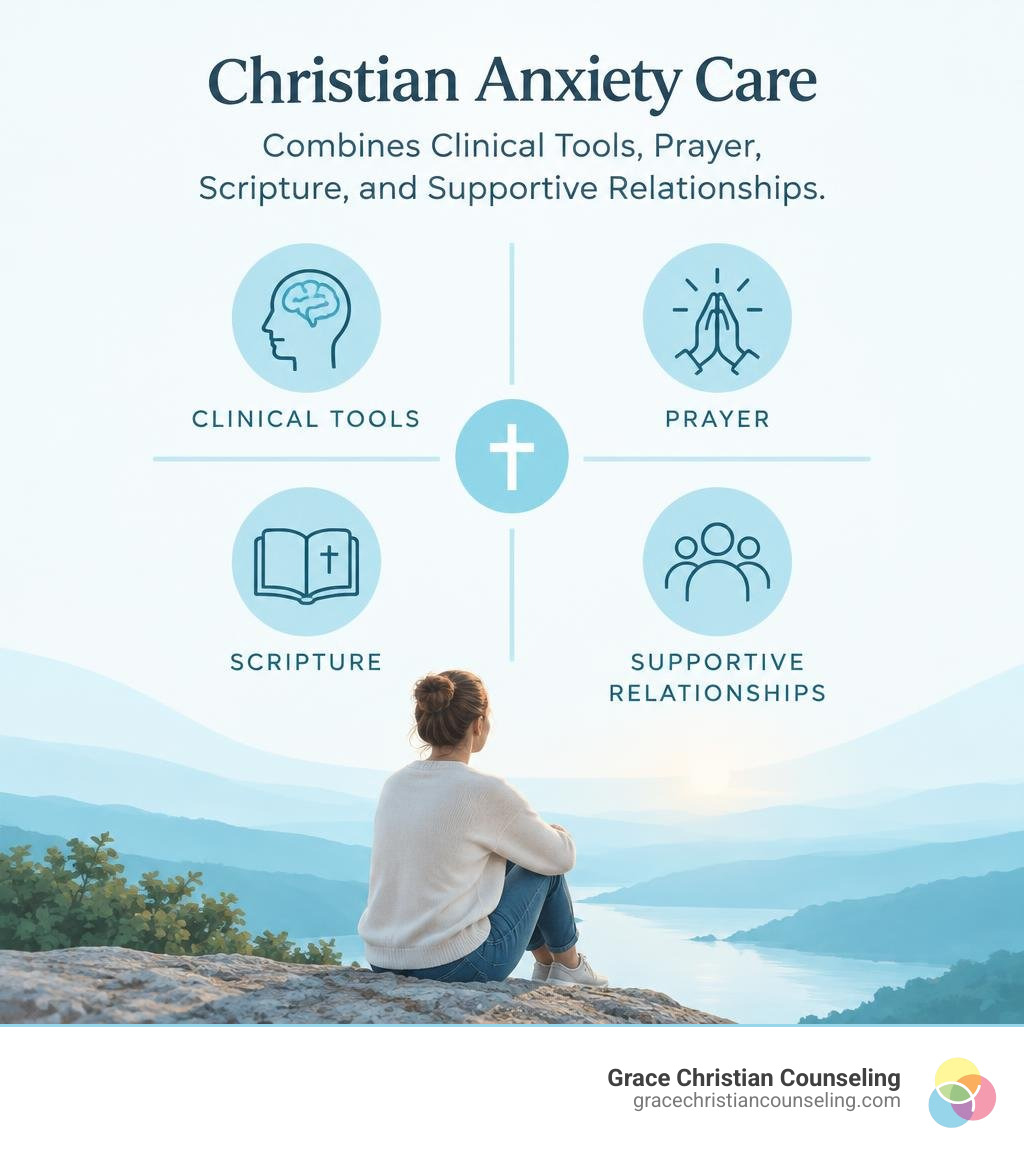
Christian counseling for anxiety brings together practical therapy and Christian faith. If worry or panic is disrupting your life, a counselor can help you understand what is happening, learn ways to respond, and make room for prayer and Scripture. You do not have to treat anxiety as a failure of faith.
At Grace Christian Counseling, we offer Christ-centered, evidence-based care for individuals, couples, and families. Our approach brings CBT and trauma-informed care together with biblical truth and the guidance of the Holy Spirit.
Our Counseling Blueprint has four stages: Take Off the Mask builds trust, Heal the Wounds explores emotional and relational hurts, Remove the Toxins identifies unhelpful beliefs, and Replace with Truth builds more accurate, God-grounded views of yourself, others, and the world.
In our clinical experience, anxiety does not always look like obvious fear or panic. Clients may come to counseling feeling exhausted, overwhelmed by decisions, unable to quiet their thoughts, increasingly avoidant, or frustrated that prayer alone has not made the anxiety disappear. We have found that creating space to explore both the emotional and spiritual sides of these struggles can help clients feel understood without treating anxiety as either purely clinical or purely a matter of faith. We serve Western Pennsylvania, including Pittsburgh, North Huntingdon, Penn Hills, Uniontown, Bethel Park, Sewickley, Mt. Lebanon, and nearby communities. Online counseling is also available throughout, PA, WV, OH, GA, and FL.
Understanding the Roots: The Three-Strand Braid of Anxiety
When severe worry strikes, well-meaning believers often wonder if they simply lack enough trust in God. Yet Scripture presents a far richer, more compassionate view of human suffering. In Romans 8:20-23, we read that all of creation groans under the weight of the fall. The brokenness of this world touches every dimension of our existence; our physical bodies, our relational environments, and our internal spiritual lives. Learning how to deal with anxiety as a Christian begins by recognizing that anxiety rarely springs from a single source.
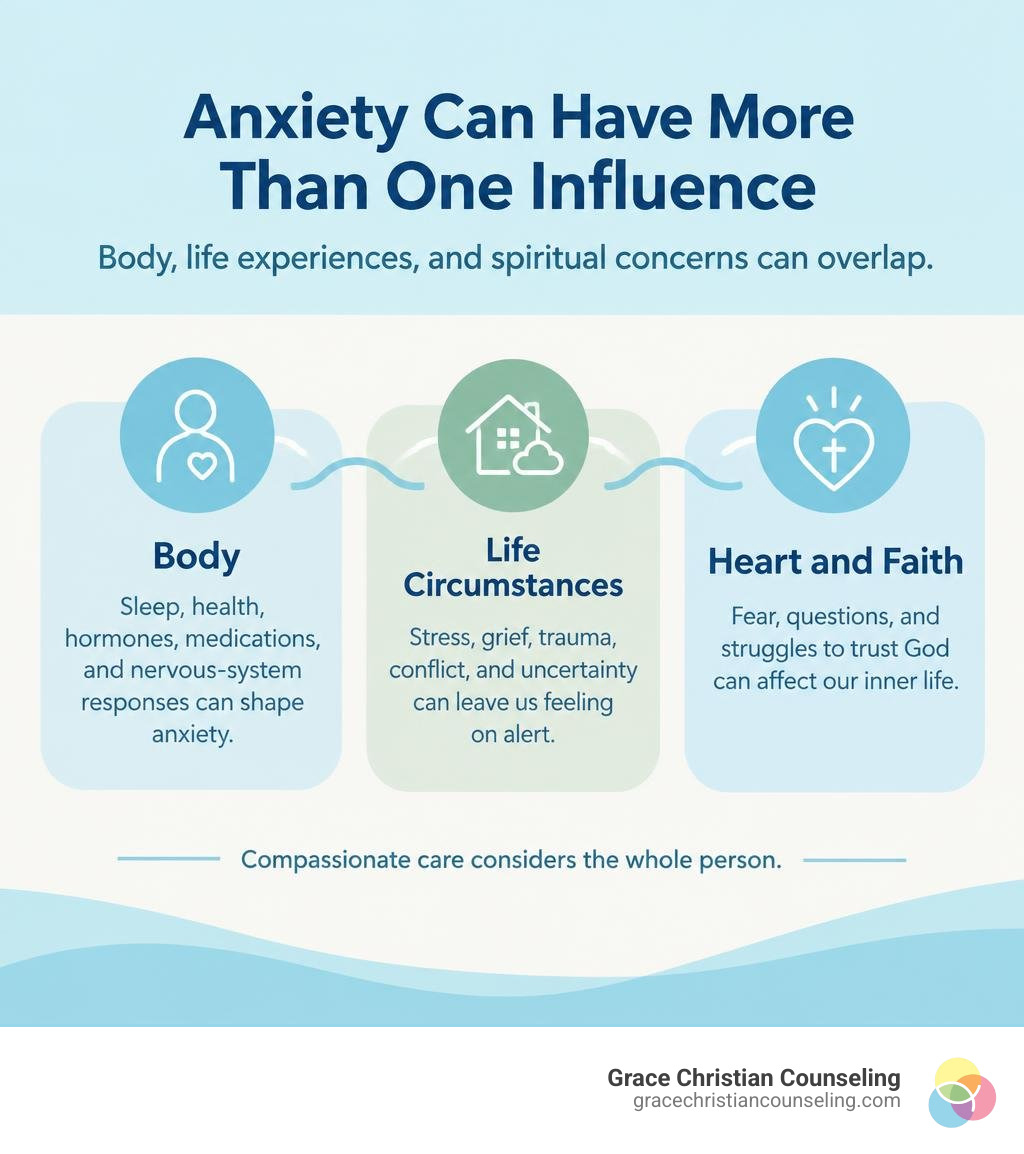
Instead, anxiety functions like a three-strand braid where biological, environmental, and spiritual factors intertwine:
- The Physical Body (Biology and Health): Our physical health can influence how we experience anxiety. Genetics, brain and body processes, sleep, hormonal changes, certain medical conditions, medications, and other biological factors may contribute to anxiety symptoms.
- The Fallen World (Trauma and Environmental Stress): We live in a broken world where relational trauma, grief, financial stress, illness, conflict, and unexpected crises can affect emotional well-being. Past experiences and ongoing stress can sometimes leave us feeling more alert to potential danger, even when we want to feel at peace.
- The Human Heart (Spiritual Distress and Spiritual Warfare): As spiritual beings, our fears, desires, questions about the future, and struggles to trust God can also affect how we experience anxiety. Christian counseling creates room to explore these spiritual concerns without assuming that every experience of anxiety is caused by a spiritual problem.
Because these three strands wrap tightly together, effective healing must address the whole person. Reducing anxiety purely to a spiritual lack ignores the body, while treating it purely as a chemical equation overlooks the heart.
From a clinical standpoint, symptoms often present unexpectedly. Rather than obvious nervousness, you might experience deep fatigue, gastrointestinal distress, unexplained irritability, concentration difficulties, physical muscle tension, or silent functional impairment. Outward appearances rarely tell the complete story, which is why a thorough clinical assessment by a licensed counselor (such as an LAPC or LSW) provides necessary clarity.
Situational Worry vs. Clinical Anxiety Disorders
Almost everyone faces situational worry when navigating job changes, relational friction, or medical test results. Everyday worry is usually temporary, proportional to an identifiable stressor, and resolves once the circumstance passes.
Clinical anxiety disorders involve greater frequency, intensity, and duration. A clinical condition impairs daily functioning, causing persistent disruption in work, relationships, or home routines. As detailed in our anxiety guide, clinical conditions such as Generalized Anxiety Disorder (GAD) or Panic Disorder create intense distress that does not simply fade with a good night’s rest. When panic attacks produce sudden surges of racing heart rates, trembling, shortness of breath, and feelings of impending doom, the nervous system requires intentional clinical and pastoral care.
Anxiety disorders are also among the most common mental health conditions in the United States. According to the National Institute of Mental Health, an estimated 19.1% of U.S. adults experienced an anxiety disorder within the past year, while 31.1% experience one at some point in their lives. These numbers help illustrate why anxiety deserves compassionate clinical attention rather than being dismissed as simply worrying too much or not trusting God enough.
Discerning Anxiety in Children and Teens
Parenting an anxious child or teenager requires careful observation. Young people naturally experience developmental fears, such as separation concerns in early childhood or social acceptance worries during middle school. However, when those fears become pervasive, parents should seek deeper discernment.
Warning signs that point beyond normal developmental phases include:
- Persistent school avoidance, sudden academic drop-offs, or frequent visits to the nurse’s office with stomachaches and headaches.
- Emotional withdrawal, sudden mood swings, or severe irritability masking underlying panic.
- Repetitive reassurance-seeking that fails to soothe their distress.
- Significant changes in sleep patterns, appetite, or involvement in extracurricular activities.
Loving parents can provide emotional safety by validating their child’s inner struggle without feeding the fear, opening the door for specialized adolescent counseling when needed.
How Christian Counseling for Anxiety Blends Clinical Care and Biblical Truth
Some believers hesitate to seek therapy because they worry modern clinical psychology contradicts Christian doctrine. Yet, through common grace, God allows humanity to discover profound truths about neuroscience, cognitive patterns, and nervous system regulation. Christian counseling for anxiety brings these evidence-based clinical practices into alignment with the living truth of Scripture under the gentle guidance of the Holy Spirit.
We never have to choose between clinical excellence and deep biblical devotion. Healing occurs as God works through medical knowledge, thoughtful therapy, prayer, and community.
Clinical Modalities: CBT, Trauma-Informed Care, and Coordinated Medical Support
Our clinical team employs proven therapeutic modalities designed to bring relief to both mind and body:
- Cognitive Behavioral Therapy (CBT): CBT helps you identify distorted cognitive scripts, catastrophizing thoughts, and negative automatic reactions, systematically realigning them with reality. As Philippians 4:8 invites us to dwell on what is true, noble, and right, CBT provides practical tools to capture every runaway thought.
- Trauma-Informed Care: Trauma alters how the brain evaluates safety. Trauma-informed approaches gently process unresolved distress, helping you resolve past wounds without re-traumatization.
- Coordinated Medical Support: For some people, medication can be an appropriate part of anxiety treatment alongside counseling. A qualified medical provider can evaluate symptoms, discuss potential benefits and side effects, and determine whether medication may be helpful based on the person’s individual needs and health history. Seeking medical care is not a failure of faith, and counseling can work alongside appropriate medical treatment as part of comprehensive Christian support for depression and anxiety.
Understanding Christian Counseling for Anxiety and Nervous System Regulation

God designed the human body with a remarkable ability to respond to stress and return toward a calmer state. Anxiety can involve very real physical sensations, including a racing heart, muscle tension, trembling, sweating, shortness of breath, or feeling on edge, which is one reason grounding and breathing exercises can be useful tools alongside counseling.
You can integrate clinical grounding techniques directly with spiritual meditation:
- Slow, Intentional Breathing: Taking a few slow, comfortable breaths can give you something concrete to focus on when anxiety feels overwhelming. You might pair your breathing with the words of Psalm 46:10: Inhale (Be still), Exhale (and know that I am God).
- The 5-4-3-2-1 Grounding Method: Notice five things you can see, four you can physically feel, three you can hear, two you can smell, and one you can taste. This cognitive exercise pulls your brain out of future-oriented worry and grounds you in God’s present reality.
- Breath Prayers and Contemplative Reading: Focusing on short passages of Scripture while slowing your respiratory rhythm helps anchor racing thoughts, offering profound scripture-based anxiety relief.
The Path to Peace: Holistic Rhythms and the Four-Stage Healing Blueprint
Sustained emotional health requires tending to the natural rhythms of life. God instituted the Sabbath because human beings are finite creatures who require rest. Restoring a healthy circadian rhythm through consistent sleep hygiene, engaging in gentle daily movement, eating nourishing whole foods, and setting healthy digital boundaries give your nervous system the physical margin it needs to regulate.

Alongside healthy daily rhythms, our counselors guide you through a comprehensive pathway to lasting renewal.
The Four-Stage Counseling Blueprint
Grace Christian Counseling utilizes a structured, four-stage healing journey known as the Counseling Blueprint:
- Take Off the Mask: Healing begins in genuine safety. In this first stage, we build authentic rapport and trust, creating a space where you can share your hidden struggles, fears, and vulnerabilities without fear of judgment.
- Heal the Wounds: Anxiety is frequently connected to past emotional hurts, relational ruptures, or unresolved grief. We explore these underlying wounds with gentle, trauma-informed care, allowing Christ’s comfort to enter painful memories.
- Remove the Toxins: Unhealthy core beliefs, perfectionistic expectations, deep-seated shame, and lingering lies create continuous mental strain. We help you identify and dismantle these cognitive toxins.
- Replace with Truth: Finally, we install God’s eternal truth and practical, empowering perspectives about yourself, others, and the world. Grounded in your true identity in Christ, you develop enduring emotional resilience and cognitive clarity.
Cultivating a Holy Imagination and Eternal Hope
Anxiety constantly feeds our minds catastrophic scenarios of what could go wrong. We counter this by developing a “holy imagination” rooted in biblical hope. The Scriptures remind us that our present suffering is not the end of the story. In Revelation 21:4, God promises a future New Heavens and New Earth where tears, panic, sorrow, and pain will cease forever.
Holding fast to this eternal perspective does not diminish our present struggles; instead, it anchors our souls during the storm, providing rich biblical principles to help you cast your cares and beat anxiety.
Walking Together: Equipping Families and Communities for Support
No one is meant to carry debilitating fear in isolation. The church community and family network play a critical role in providing emotional containment, relational warmth, and practical assistance as we work toward overcoming anxiety and fear together.
Helpful vs. Unhelpful Responses to an Anxious Loved One
When someone you love is experiencing intense anxiety, standard conversational habits can inadvertently increase their distress. Learning how to respond with empathy transforms relationships:
| Unhelpful Response (Dismissive / Cliché) | Helpful Response (Supportive / Validating) |
|---|---|
| “You just need to pray more and stop worrying.” | “I can see how overwhelming this feels right now. I am right here with you.” |
| “Everything happens for a reason; you’ll get over it.” | “This is really hard, but you are not alone. How can I best support you today?” |
| “Look on the bright side, others have it much worse.” | “Your feelings make sense given what you’re facing. Let’s take a slow breath together.” |
| “Why are you making such a big deal out of nothing?” | “I want to understand what you’re experiencing. Take all the time you need to talk.” |
When to Seek Professional Christian Counseling for Anxiety
While supportive friendships and pastoral encouragement are vital, certain symptoms indicate that professional mental health therapy is necessary. You should consider reaching out to a licensed counselor when:
- Anxiety or panic symptoms persist for several weeks and interfere with work, school, sleep, or family responsibilities.
- You experience frequent panic attacks, debilitating avoidance behaviors, or severe physical symptoms like chest tightness and chronic insomnia.
- You struggle with high-functioning anxiety; appearing completely composed on the outside while enduring exhausting turmoil internally. For residents navigating these demands, exploring Christian counseling for high-functioning anxiety in PA offers targeted, professional care.
Alongside licensed clinical counseling (such as care provided by an LAPC or LSW), many families also benefit from dedicated pastoral support. Grace Christian Counseling recommends NuWell, a pastoral counseling resource that can walk alongside your church community as you pursue spiritual encouragement in addition to professional mental health therapy.
Frequently Asked Questions About Faith and Anxiety
Is taking medication for anxiety a sign of weak faith?
No; taking prescribed psychiatric medication is not a failure of faith. The human brain is a physical organ subject to the physical limitations of a fallen world. Just as a believer with asthma uses an inhaler to breathe clearly, an individual with severe anxiety may utilize medication to balance neurochemistry. Medication can reduce overwhelming physical symptoms so you can engage effectively in spiritual disciplines, therapy, and daily life.
How does Christian counseling differ from secular therapy?
Christian counseling utilizes the same evidence-based clinical techniques found in secular therapy (such as CBT and trauma therapies), but frames them within a biblical worldview. A Christian counselor acknowledges the reality of the soul, the presence of the Holy Spirit, the power of prayer, and the authority of Scripture. You receive professional psychological care without having your core faith values sidelined or dismissed.
What should I do in the middle of a panic attack?
During a panic attack, remind yourself that intense anxiety can create frightening physical sensations and that the wave of panic can pass. If you recognize the symptoms as part of a previously evaluated pattern of panic, try planting your feet on the floor, relaxing your shoulders, and slowing your breathing rather than fighting the sensations. You might remind yourself: My body is sounding an alarm. I can stay here, breathe, and let this moment pass. God is with me. If symptoms are new, unusually severe, or could represent a medical emergency, seek appropriate medical care rather than assuming they are caused by anxiety.
Conclusion
Anxiety is treatable, and finding peace is possible when you receive compassionate, well-rounded support. At Grace Christian Counseling, we provide Christ-centered, evidence-based counseling for individuals, couples, and families across Western Pennsylvania. Our team utilizes CBT, trauma-informed care, and the guidance of the Holy Spirit to walk alongside you through every step of our four-stage Counseling Blueprint.
Whether you prefer in-person sessions at our Western PA offices; including Pittsburgh, North Huntingdon, Penn Hills, Uniontown, Bethel Park, Sewickley, and Mt. Lebanon; or convenient online counseling from the comfort of your home, our licensed professionals are ready to help. Discover true relief and begin overcoming anxiety through Christian counseling by reaching out to our team today.
This article was researched with AI and heavily edited by Bekah McCrorey for accuracy and relevance.
Bekah McCrorey is a counselor at Grace Christian Counseling. She holds a Master’s degree in Counseling from Dallas Theological Seminary and a Bachelor’s degree in Christian Ministry from Chesapeake Bible College and Seminary. She is a provisionally licensed counselor working under supervision toward full licensure as a Licensed Professional Counselor (LPC) in Pennsylvania.
With over 12 years of full-time ministry experience supporting individuals, families, ministry leaders, and churches nationally and internationally, Bekah brings a deep understanding of emotional and spiritual struggles. As a counselor, she uses a client-centered, trauma-informed, and evidence-based approach. She is Level 1 trained in Restoration Therapy and is passionate about helping clients navigate anxiety, depression, grief, trauma, life transitions, and relational difficulties while integrating emotional and spiritual well-being.
This guide is for educational and spiritual encouragement and is not a substitute for personalized professional counseling. If you are in crisis, please reach out for immediate help.


