

When Co-parenting with a Narcissist Feels Impossible
Co-parenting with a narcissist is one of the most exhausting challenges a parent can face. Every custody exchange, every text message, every schedule change can feel like a battle. If you’re in this situation, you already know that standard co-parenting advice, “just communicate,” “put the kids first,” “be flexible,” often does not work.
Here are the core survival strategies at a glance:
- Shift to parallel parenting when true co-parenting isn’t possible
- Keep all communication in writing using email or a co-parenting app
- Use the BIFF method (Brief, Informative, Friendly, Firm) in every message
- Document everything for potential court use
- Create a detailed, court-approved parenting plan that leaves no room for manipulation
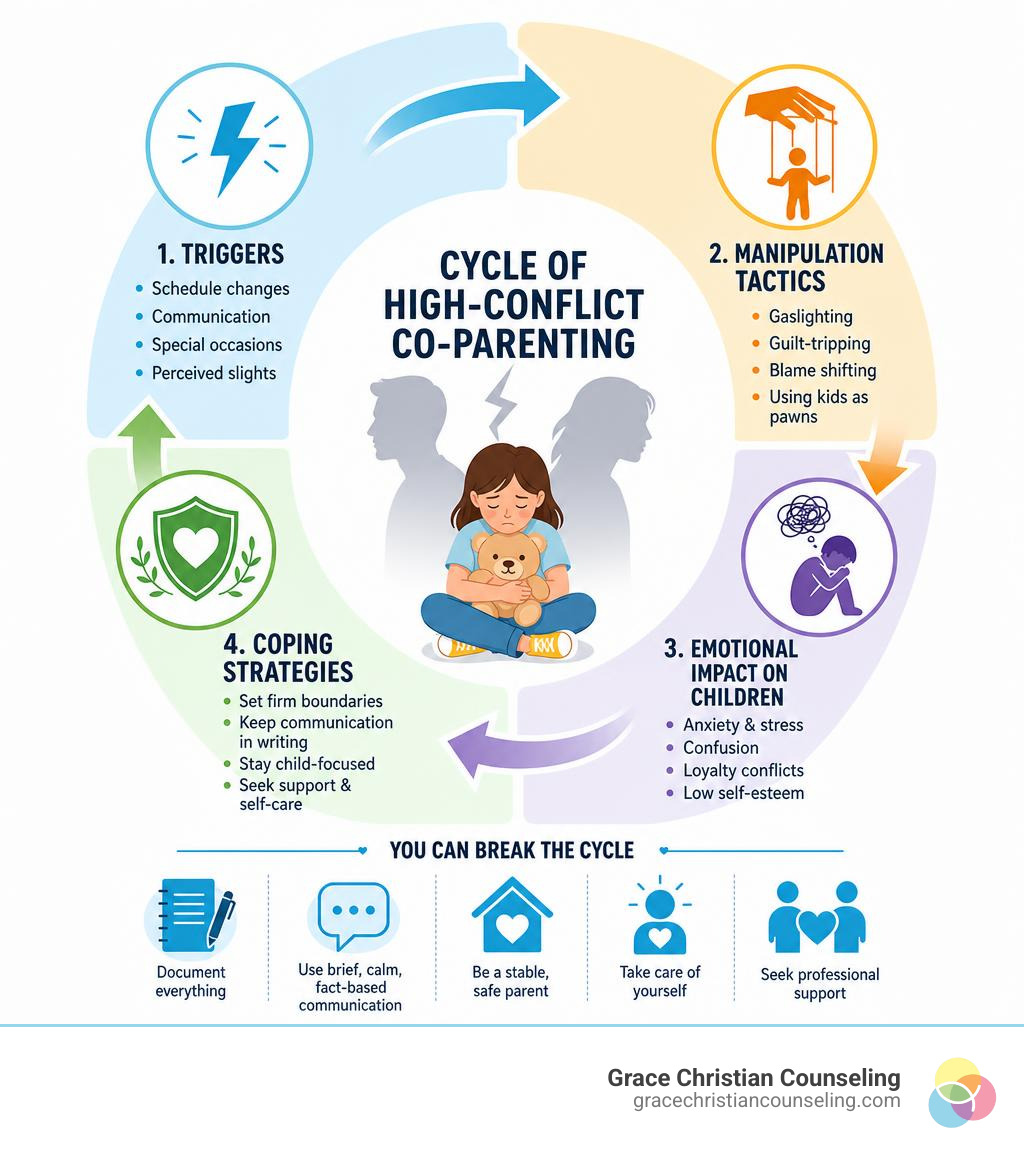
- Set firm, consistent boundaries and enforce them without explanation
- Protect your children by validating their feelings and being their stable, safe parent
- Get professional support for yourself and your kids
This guide walks through each of these strategies in detail, including legal steps, communication tools, and faith-centered emotional support to help you find stability and peace.
Co-parenting after a divorce or separation is rarely simple. But when your co-parent shows a pattern of manipulation, lack of empathy, constant conflict, or using your children as pawns, it moves into a different category entirely. Research suggests that between 0.5% and 5% of people in the U.S. may have Narcissistic Personality Disorder (NPD), but many more exhibit narcissistic behaviors, especially during and after a high-conflict separation.
The stress of this situation is real and it is not just emotional. It affects your nervous system, your ability to focus, your children’s sense of security, and sometimes your financial stability. You are not imagining it, and you are not alone.
This guide is written for parents who need practical, grounded strategies, not vague reassurances. We will cover what actually works, from communication techniques and legal protection to parallel parenting and trauma-informed self-care, all through a lens of faith and compassion.
Understanding the Reality of Co-parenting with a Narcissist
To navigate this difficult journey, we must first understand what we are truly dealing with. In our counseling offices across Pennsylvania, we often hear parents use the term “narcissist” to describe an ex-partner who is difficult, stubborn, or angry. While these traits are challenging, there is a distinct difference between clinical Narcissistic Personality Disorder (NPD) and situational high-conflict behavior.
According to the DSM-5, a clinical diagnosis of NPD requires a pervasive pattern of grandiosity, an intense need for admiration, and a profound lack of empathy, beginning by early adulthood and present in a variety of contexts. Only a qualified clinical professional can diagnose NPD, and statistics show that true clinical narcissism is relatively rare, affecting roughly 0.5% to 5% of the population.
However, during the painful breakdown of a marriage, many individuals exhibit situational narcissistic behaviors as a defense mechanism. Insecurity, fear, and anger can cause an ex-partner to act with extreme selfishness, entitlement, and hostility. Whether your ex has a clinical diagnosis or is simply exhibiting high-conflict behaviors, the impact on you and your children remains highly stressful. For more guidance on navigating these spiritual and psychological dynamics, you can read our resource on When a Narcissist Tries to Destroy a Christian.
Distinguishing NPD from High-Conflict Behaviors
When you are trying to manage your custody schedule in communities like Sewickley, Bethel Park, or Mt. Lebanon, knowing whether you are dealing with clinical NPD or situational anger helps you choose the right approach.
- Clinical NPD: These behavioral patterns are persistent, rigid, and occur across all areas of the person’s life, including work, friendships, and family. A true narcissist rarely possesses the self-awareness required to change, as their entire identity is built on avoiding feelings of shame or inadequacy.
- Situational High-Conflict Behavior: These behaviors are often localized to the divorce or custody dispute. The individual may show empathy and cooperative behavior in other areas of life, but they become highly defensive, manipulative, or hostile specifically toward you.
Understanding this distinction is liberating. It helps you realize that you do not need a formal diagnosis to change how you interact with them. You can learn more about managing high-conflict dynamics in our article on 7 Essential Tips for Co-parenting With a Narcissist | Psychology Today.
The Disadvantages of Labeling Your Ex in Court
While it is tempting to stand before a Pennsylvania family court judge and declare that your ex-spouse is a narcissist, doing so can actually damage your custody case. Family court judges and custody mediators hear the word “narcissist” constantly; using it without a clinical diagnosis can make you look high-conflict or uncooperative.
Instead of using clinical labels, focus entirely on documenting and describing specific, observable behaviors. Rather than saying, “My ex is a narcissist,” you might say, “My ex-partner has missed three consecutive scheduled drop-offs without notice and has refused to share the children’s medical records.” This factual approach allows the court to see the patterns of behavior clearly without dismissing your concerns as mere name-calling. For families navigating the legal system in our state, reviewing Pennsylvania: Co-parenting with a Narcissist After Divorce can provide valuable context on how local courts view these disputes.
Transitioning to Parallel Parenting and Setting Boundaries
When traditional co-parenting fails, parallel parenting becomes the healthiest alternative. Traditional co-parenting requires a high level of mutual respect, open communication, and shared decision-making. When one parent lacks empathy and seeks ongoing control, trying to co-parent is like trying to negotiate with someone whose only goal is to win.
Parallel parenting is a method where each parent operates independently within their own household during their custody time. Communication is kept to an absolute minimum, rules do not have to be identical in both homes, and direct contact between the parents is systematically avoided.
| Traditional Co-parenting | Parallel Parenting |
|---|---|
| Frequent, direct verbal communication | Communication is strictly written and limited |
| Consistent rules and routines across both homes | Different rules in each home, parents do not interfere |
| Flexibility with schedule changes and favors | Strict adherence to the court-ordered custody schedule |
| Joint attendance at school events and appointments | Separate attendance or alternating school/medical duties |
| Shared decision-making on minor issues | Sole decision-making or highly detailed, pre-arranged plans |
Why Traditional Co-parenting with a Narcissist Fails
Traditional co-parenting relies on the assumption that both parents can put their personal grievances aside to prioritize the children’s psychological well-being. A narcissistic parent, however, often views the children as extensions of themselves or as tools to gain leverage, validation, and control.
They may engage in counter-parenting, which is the practice of deliberately undermining your rules, schedules, and values simply to provoke an emotional reaction from you. When you try to reason with them, they experience it as an opportunity to engage in conflict, which feeds their need for control. Accepting that you cannot force them to be a cooperative co-parent is the first step toward finding peace.
Setting and Enforcing Unshakable Boundaries
Boundaries are not designed to change your ex-spouse’s behavior; they are designed to protect your peace and your children’s environment. When you set a boundary, you must state it clearly, directly, and without emotional explanation.
For example, instead of explaining why late-night phone calls upset you, you can state, “I will respond to child-related messages between 8:00 AM and 6:00 PM. Outside of these hours, I will only respond to immediate medical emergencies.” If they call you at 10:00 PM to argue about school clothes, you do not answer.
Additionally, keeping custody exchanges brief and public, such as exchanging the children at a public park in Penn Hills or North Huntingdon, or utilizing school drop-off and pickup times as the transition points, minimizes opportunities for verbal abuse. To explore healthier ways to navigate these relational dynamics, consider reading our guide on How to Resolve Family Conflict.
Communication and Legal Strategies for High-Conflict Custody
When communicating with a high-conflict co-parent, your goal is to become as uninteresting as a “gray rock.” The gray rock technique involves being entirely neutral, boring, and non-reactive. Narcissistic individuals thrive on emotional “supply,” whether that supply is praise or angry retaliation. By removing the emotion from your responses, you make yourself a very poor source of entertainment.

Two communication frameworks are highly effective in achieving this: the BIFF method and the JADE method.
- BIFF (Brief, Informative, Friendly, Firm): Keep your messages to two or three sentences. Provide only the necessary facts. Keep the tone polite but business-like, and make it clear that the matter is settled.
- JADE (Do Not Justify, Argue, Defend, Explain): When your ex-spouse attacks your parenting choices or makes false accusations, do not take the bait. You do not owe them an explanation for why you chose a certain bedtime or signed your child up for a local sports league during your custody time. Simply state the facts or do not reply at all.
How to Communicate Safely When Co-parenting with a Narcissist
All communication should occur in writing. Written communication creates a clear, timestamped paper trail that can be presented in court if necessary. It also gives you time to step away, regulate your nervous system, and draft a calm response rather than reacting impulsively.
We highly recommend using dedicated co-parenting applications, such as OurFamilyWizard or TalkingParents. These platforms keep a secure, unalterable record of all messages, calendar changes, and expense requests. Knowing that a judge or a custody evaluator can view these logs often moderates the narcissistic parent’s behavior. We also advise implementing a “24-hour rule” for non-urgent messages, allowing you to process your emotions before responding. For more strategies on managing this relational chaos, you can read Co-Parenting with a Narcissist: How to Handle the Chaos; Medium.
Preparing for Court and Mediation in Pennsylvania
If you are dealing with a high-conflict custody situation in Western Pennsylvania, you must prepare diligently for mediation and court hearings. Pennsylvania courts operate on the standard of “the best interests of the child,” and they look favorably on parents who are organized, calm, and focused on stability.
Work closely with an experienced family law attorney to draft an ironclad, highly detailed custody agreement. A vague agreement invites manipulation. Your plan should specify exact pickup and drop-off times, precise locations, holiday rotation schedules, and clear protocols for medical and educational decisions.
Keep a structured log of all custody violations, missed visits, and hostile communications. Having this data organized by date and time is far more persuasive to a judge than vague complaints of emotional abuse. In severe cases of parental alienation or manipulation, you may want to request the appointment of a Guardian Ad Litem (GAL) to represent your child’s best interests independently. For additional legal insights on structured parenting agreements, you can read 7 Strategies for Co-Parenting with a Narcissistic Ex.
Protecting Your Children and Your Emotional Well-Being
Growing up with a narcissistic parent can be highly confusing for children. They may experience cognitive dissonance, feeling caught between their love for a parent and that parent’s erratic, conditional, or manipulative behavior. As the healthy parent, your primary role is to provide a stable, loving, and emotionally safe environment.
Children do not need two perfect parents to grow up resilient; they need at least one emotionally healthy, consistent parent who validates their reality and loves them unconditionally.
Insulating Your Kids from Parental Alienation
A narcissistic co-parent may attempt to alienate your children from you by speaking poorly of you, sharing age-inappropriate details about the divorce, or positioning themselves as the “fun, victimized” parent while labeling you as the “strict, uncaring” one.
While this is incredibly painful, the worst thing you can do is counter-alienate by speaking poorly of your ex-spouse in return. This places the child in a loyalty bind and increases their anxiety. Instead, focus on validating their feelings without badmouthing the other parent.
If your child says, “Mom/Dad says you don’t care about us,” you can respond calmly, “I am so sorry you had to hear that. I love you very much, and my door is always open to you.” Teach them critical thinking skills by encouraging them to trust their own experiences. If you feel your family could benefit from professional guidance during this transition, we encourage you to seek out Co-Parenting Counseling, Coparenting Therapy Near Me to find local, specialized support.
Somatic Regulation and Healing for the Targeted Parent
Co-parenting with a high-conflict ex-spouse takes a heavy toll on your physical and nervous systems. Many parents experience intense anxiety, a racing heart, or a feeling of “freezing” when they see a text notification or prepare for a custody handoff. This is a physiological trauma response.
To heal and remain present for your children, you must practice somatic regulation. This includes deep, diaphragmatic breathing, grounding exercises, and somatic anchoring before transitions. It is also essential to work with a professional who understands the unique, complex nature of narcissistic abuse recovery.

At Grace Christian Counseling, our licensed counselors, including Licensed Associate Professional Counselors (LAPC) and Licensed Social Workers (LSW), offer compassionate, clinical care integrated with Biblical truth. We provide specialized support, including Trauma Therapy for Healing from Narcissistic Abuse, to help you process this pain, regulate your nervous system, and rebuild your life. You can also explore additional somatic regulation resources to support your healing journey.
Frequently Asked Questions About High-Conflict Parenting
Can a Narcissistic Co-parent Ever Change?
It is highly unlikely that a true narcissist will change their fundamental personality structure. Because a core feature of narcissism is a lack of self-awareness and an inability to accept personal responsibility, they rarely seek therapy in good faith.
Instead of spending your valuable energy trying to change them, appease them, or convince them to see your point of view, focus entirely on what you can control: your boundaries, your responses, and the peaceful environment you create in your own home.
What Should I Do If My Ex Makes False Accusations?
If your ex-spouse makes false accusations of neglect, abuse, or poor parenting, remain calm and rely on your documentation. Do not respond with angry messages, as this can be used against you in court to paint you as unstable.
Keep detailed, objective records of all interactions, school attendance, medical appointments, and communications. Share these accusations immediately with your family law attorney, and allow your evidence to speak for itself in court.
When Should I Seek Full Custody in Pennsylvania?
In Pennsylvania, courts prefer to maintain shared legal and physical custody whenever possible. However, if your co-parent’s behavior escalates to physical abuse, severe neglect, substance abuse, or extreme parental alienation that severely damages the child’s mental health, you may have grounds to seek sole custody.
You will need extensive, documented evidence of these patterns to meet the legal threshold required for a judge to modify custody significantly.
Conclusion
Co-parenting with a high-conflict ex-spouse is a long, challenging road, but you do not have to walk it alone. By shifting to parallel parenting, setting clear boundaries, and protecting your nervous system, you can insulate your children from conflict and build a peaceful, thriving life.
As Scripture reminds us in Philippians 4:6-7:
“Do not be anxious about anything, but in every situation, by prayer and petition, with thanksgiving, present your requests to God. And the peace of God, which transcends all understanding, will guard your hearts and your minds in Christ Jesus.”
At Grace Christian Counseling, we are dedicated to supporting families across Western Pennsylvania and statewide through our virtual services. Whether you reside in Pittsburgh, Penn Hills, Sewickley, Mt. Lebanon, Bethel Park, North Huntingdon, Uniontown, or surrounding communities, our licensed counselors (LAPC, LSW) are here to offer Christ-centered, trauma-informed care.
If you are ready to heal from the emotional toll of a high-conflict divorce and build a stable foundation for your children, we invite you to take the next step. Contact us today to learn more about our services, including Trauma Therapy for Healing from Narcissistic Abuse, and find the support you need to move forward in hope and peace.
This article was researched with AI and heavily edited by Stephen Luther for accuracy and relevance.
Stephen Luther is the Executive Director and Founder of Grace Christian Counseling, Grace Recovery Services, WPA Counseling, NuWell Online Counseling and Coaching, and NuWell Health. He holds a Master’s degree in Education from the University of Georgia and a Master’s degree in Marriage and Family Therapy from Duquesne University. He is a licensed professional counselor in Pennsylvania.
Since 1997, Steve has been helping children, adolescents, and adults overcome a wide range of emotional and relational challenges. He specializes in working with hurting families, including those with foster, adopted, or traumatized children. Steve uses Attachment-Based Therapy, Splankna Healing, and Therapeutic Parent Coaching to support healing and restoration.
This guide is for educational and spiritual encouragement and is not a substitute for personalized professional counseling. If you are in crisis, please reach out for immediate help.


