

Understanding Complex PTSD and Narcissistic Abuse
Complex Post-Traumatic Stress Disorder (CPTSD) describes a pattern of trauma symptoms that can affect not only how you respond to reminders of what happened, but also how you see yourself, manage emotions, and connect with other people. It is often associated with prolonged or repeated trauma, especially experiences such as childhood abuse, domestic violence, captivity, or other situations where a person felt trapped or unable to escape. The ICD-11 recognizes CPTSD as a distinct trauma-related diagnosis, although no single type of traumatic experience automatically leads to CPTSD. The National Center for PTSD provides a helpful overview of how CPTSD differs from PTSD and how the diagnosis has evolved.
CPTSD recovery biblical counseling addresses this deep suffering by integrating evidence-based trauma stabilization and nervous system care with scriptural soul care, honest lament, and identity renewal in Christ. Licensed counselors help survivors establish safety, process grief, dismantle toxic shame, and anchor their worth in God’s unchanging love rather than in the words of an abuser.
In narcissistic systems, relational betrayal, emotional manipulation, and coercive control erode a person’s sense of safety. Gaslighting causes individuals to doubt their own perceptions, memories, and sanity. Chronic relational distress keeps the nervous system in a persistent state of fight, flight, freeze, or fawn.
The DSM-5-TR does not include CPTSD as a separate diagnosis, while the World Health Organization’s ICD-11 recognizes CPTSD as distinct from PTSD. In the ICD-11, CPTSD includes PTSD symptoms plus disturbances in self-organization involving emotion regulation, negative self-concept, and relationship functioning. C-PTSD encompasses the classic symptoms of PTSD, including intrusions, avoidance, and hypervigilance, alongside severe disturbances in self-organization. These include chronic emotional dysregulation, pervasive feelings of worthlessness, and profound relational difficulties. For those who endured severe early family dysfunction, exploring resources on healing childhood trauma can be an essential step toward understanding these long-term survival adaptations.
Research also shows that CPTSD is a meaningful clinical concern, particularly among people exposed to significant trauma. A 2025 systematic review and meta-analysis of 167 studies involving 138,681 participants estimated CPTSD in about 6.2% of samples overall and 12.4% of trauma-exposed samples. A separate U.S. population study also found evidence that PTSD and CPTSD appear as related but distinct patterns, with repeated childhood trauma more strongly associated with CPTSD. These numbers cannot tell us what any one survivor will experience, but they help show why clinicians pay attention to the additional struggles with emotions, identity, and relationships that can accompany complex trauma.
When abuse is psychological and spiritual, it creates deep somatic memories and somatic dysregulation. A comprehensive approach to healing from PTSD and narcissistic abuse requires honoring both the neurological reality of trauma and the spiritual care needed for the soul.
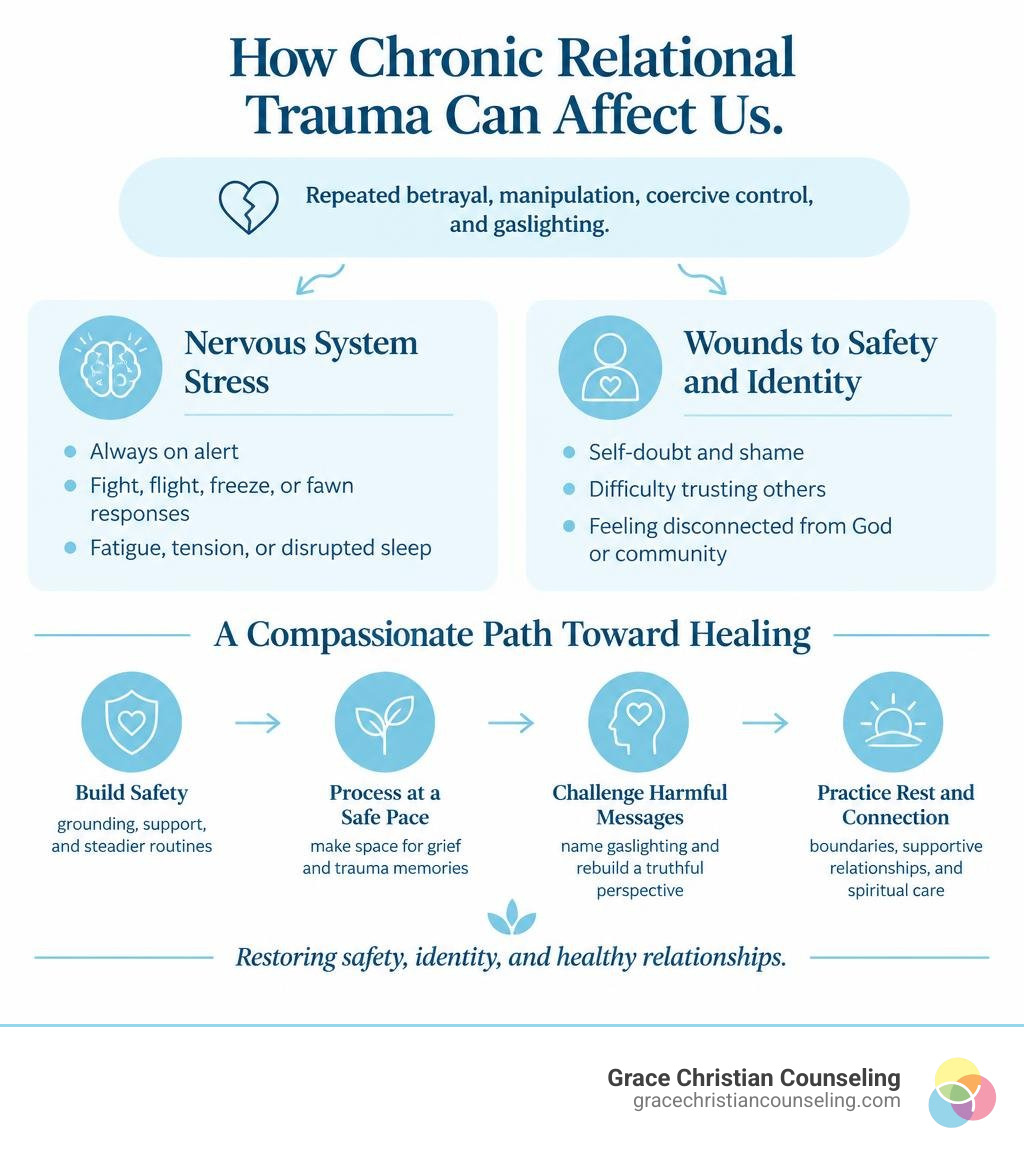
Differentiating Single-Incident PTSD from Chronic Complex Trauma
Standard PTSD often stems from isolated, time-limited events such as a car collision, natural disaster, or single violent assault. The nervous system becomes conditioned to associate specific sensory cues with that single terrifying moment.
In contrast, complex trauma involves developmental disruption. When a child or adult experiences prolonged entrapment, repeated domestic abuse, or sustained narcissistic mistreatment, the entire personality architecture is impacted.
The distinction between PTSD and CPTSD is based primarily on symptom pattern rather than simply whether the trauma was single-incident or prolonged:
- PTSD: In the ICD-11, PTSD includes re-experiencing the trauma in the present, avoidance of trauma reminders, and a persistent sense of current threat.
- CPTSD: CPTSD includes those same PTSD symptoms plus persistent difficulties in emotion regulation, a deeply negative self-concept, and problems sustaining close relationships.
- Trauma History: Repeated interpersonal trauma is more strongly associated with CPTSD, but trauma history alone does not determine the diagnosis. Some people develop PTSD after prolonged trauma, while others may develop CPTSD following a single event.
- Functional Impact: Both PTSD and CPTSD can significantly affect daily functioning, relationships, work, and emotional well-being. Assessment should focus on the individual’s symptoms and functioning rather than assuming one diagnosis is inherently mild or severe.
Survival strategies developed in abusive environments, such as hyper-independence, hypervigilance, and emotional disconnection, were once protective mechanisms. Over time, however, these survival strategies become painful barriers to healthy relationships and spiritual peace.
The Spiritual Impact of Prolonged Narcissistic Abuse
Narcissistic abuse rarely harms only the psychological faculties; it wounds the human spirit. Manipulative leaders, abusive parents, or narcissistic partners often twist biblical concepts of submission, forgiveness, and grace to enforce compliance. This spiritual manipulation distorts a survivor’s perception of God.
When authority figures are volatile, demanding, or conditionally affectionate, survivors may view God through that same broken lens. God is imagined as a harsh taskmaster waiting for failure, rather than a loving Heavenly Father. Internalized condemnation and false guilt take root, leading survivors to believe their suffering is punishment for personal sin.
This dynamic shatters spiritual safety. Survivors may struggle to pray, read Scripture, or attend church, because religious language has been weaponized against them. Recognizing these wounds as the consequence of coercive control is a vital step in experiencing genuine spiritual freedom.
Principles of CPTSD Recovery Biblical Counseling
Biblical counseling for complex trauma is grounded in the conviction that Scripture speaks directly to human suffering, while honoring the biological and psychological dimensions of our design. God formed us as integrated beings, embodied souls. Trauma impacts the brain, nervous system, and physical body just as it affects our beliefs, desires, and emotions.
Our licensed counselors, such as Licensed Associate Professional Counselors (LAPC) and Licensed Social Workers (LSW), integrate evidence-based clinical practices with rich biblical soul care. In clinical settings, we often observe that trauma and depression present unpredictably; rather than displaying overt sadness, survivors may struggle with profound fatigue, irritability, difficulty concentrating, unexplained physical tension, or quiet functional impairment. A comprehensive clinical assessment is essential to understand the individual’s history rather than relying on outward appearances.
By integrating faith and evidence, we create a compassionate space where nervous systems can settle, grief can be voiced without judgment, and the Holy Spirit can bring lasting healing to shattered hearts.
Evaluating Secular Trauma Models in CPTSD Recovery Biblical Counseling
Secular psychology has provided valuable frameworks for understanding trauma. In 1992, Dr. Judith Herman proposed a foundational tripartite model for trauma recovery:
- Establishing safety
- Remembrance and mourning
- Reconnection with ordinary life
Similarly, the landmark CDC-Kaiser ACE Study included more than 17,000 adults and found strong associations between adverse childhood experiences and later health and well-being risks. The study helped establish the importance of understanding how early adversity can affect health across the lifespan, while also showing why ACE scores should be interpreted at the population level rather than used by themselves to diagnose an individual.
From a biblical counseling perspective, these models offer helpful observational insights, yet they also carry limitations. For instance, the authors of the ACE study caution against using population-level research questionnaires as standalone individual diagnostic tools. Additionally, Judith Herman’s original proposal for C-PTSD lacked standardized clinical trial data at the time of its introduction, contributing to its exclusion from the DSM-IV and DSM-5, though it is now cataloged in the ICD-11.
Clinical trauma models offer valuable tools for understanding safety, grief, nervous system responses, relationships, and the lasting effects of painful experiences. Christian counseling can build on these insights while also addressing questions that matter deeply to believers: Where is God in my suffering? Who am I after what happened to me? How do I understand forgiveness, justice, hope, and restoration? Rather than separating clinical care from faith, biblical counseling can bring these parts of a person’s experience together, anchoring healing in God’s character, truth, and redemptive purposes. Biblical counseling expands this horizon: it anchors recovery in God’s sovereignty, redeems suffering through Romans 8:28-39, and restores the survivor to loving community and divine purpose.
Addressing the Dynamic Heart in CPTSD Recovery Biblical Counseling
To understand how complex trauma affects the whole person, biblical counselors look to the biblical concept of the “dynamic heart.” In Scripture, the heart is the comprehensive control center of human life, comprising three interrelated functions:
- Thoughts and Beliefs: How we make sense of and interpret our experiences, what we believe about ourselves/others/God, how we discern core assumptions and understand truth.
- Desires and Emotions: What we love, fear, grieve, long for, and feel in our emotions and our bodies.
- Choices and Actions: How we respond, establish behaviors, set boundaries, protect ourselves, and relate to others.
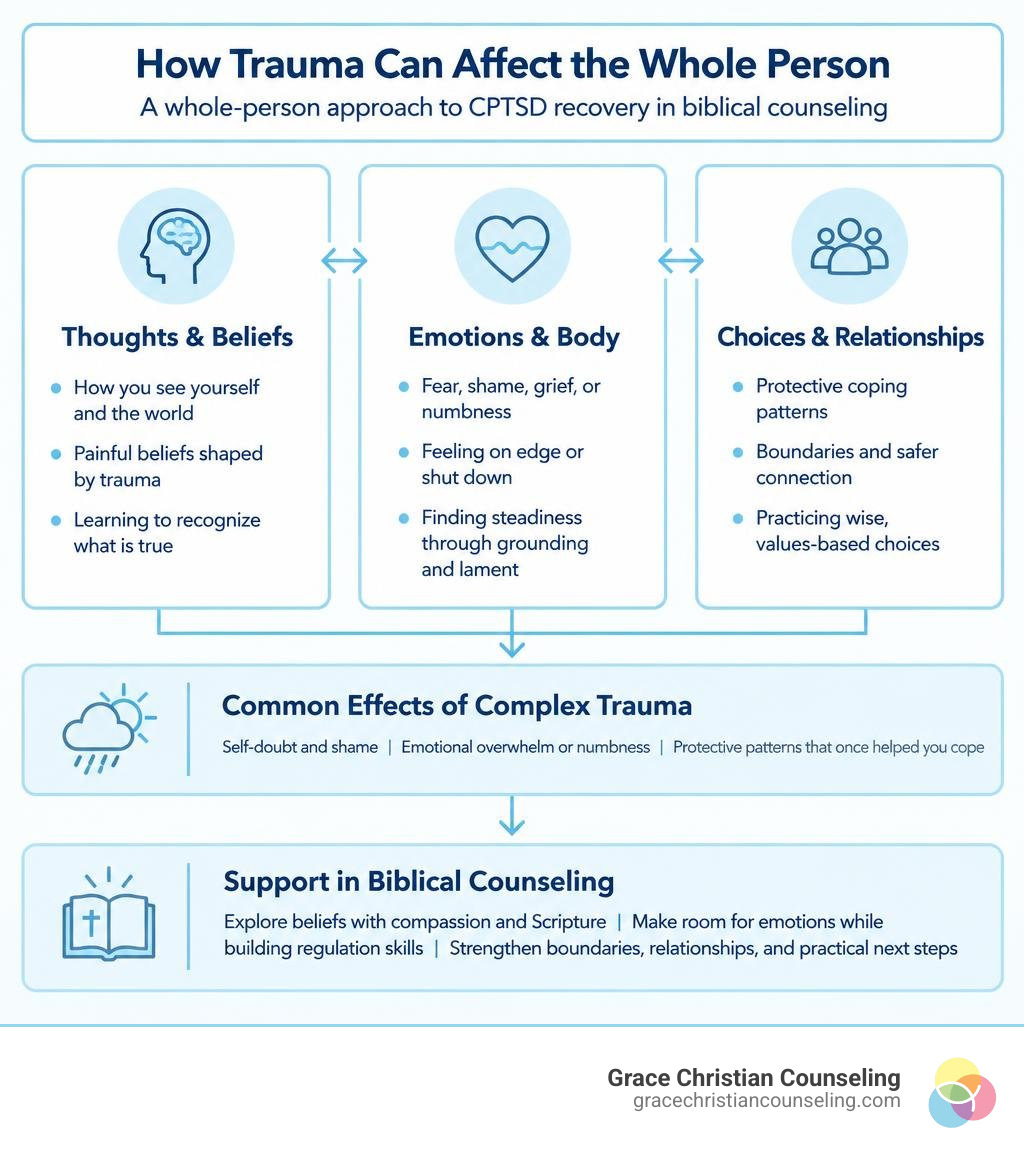
Complex trauma can affect all three areas. After gaslighting or abuse, you may begin believing things such as I am unlovable, It was my fault, or I am never safe. Emotionally, you may feel caught between fear, shame, anger, and numbness. In relationships, you may protect yourself through isolation, people-pleasing, over-functioning, or defensiveness.
Biblical counseling addresses these dimensions simultaneously. We help renew cognitive beliefs through Scripture, validate and soothe affective distress through lament and physiological grounding, and support healthy volitional choices through wise boundaries.
Central to this healing are the doctrines of:
- Justification: Freeing the survivor from false guilt and unearned shame through 2 Corinthians 5:21.
- Adoption: Assuring the survivor that they are a cherished child of God through Romans 8:15.
- Union with Christ: Securing an unshakable identity that abuse cannot destroy through Colossians 3:3-4.

The Psalms Framework: A Scriptural Journey from Agony to Peace
The Bible does not gloss over severe suffering; it provides language for deep pain. The Psalms of Ascent were sung by Hebrew pilgrims as they traveled to Jerusalem. Among these songs, Psalms 129 through 131 offer a beautiful, three-phase framework for complex trauma recovery:
| Psalm Stage | Clinical & Spiritual Focus | Core Action | Scripture Anchor |
|---|---|---|---|
| Psalm 129 | Naming Trauma & Validating Injustice | Unmasking the abuse; voicing pain; breaking toxic cords | “The plowers plowed upon my back; they made long their furrows.” |
| Psalm 130 | Crying from the Depths & Receiving Grace | Honest lament; releasing false guilt; resting in divine mercy | “Out of the depths I cry to you, O Lord!” |
| Psalm 131 | Calming the Soul & Cultivating Peace | Relinquishing hypervigilance; somatic and spiritual stillness | “I have calmed and quieted my soul, like a weaned child…” |
Psalm 129: Voicing the Agony and Naming the Trauma
Healing begins by telling the truth about what happened. In Psalm 129:1-3, the psalmist writes: “Greatly have they afflicted me from my youth… The plowers plowed upon my back; they made long their furrows.”
This verse does not minimize pain. It uses vivid imagery to acknowledge prolonged, severe affliction that started early in life. In biblical trauma counseling, we encourage survivors to name their pain without spiritualizing it away.
Psalm 129 also reminds us that “The Lord is righteous; he has cut the cords of the wicked”. God opposes oppression. He sees every act of cruelty, validates righteous anger over injustice, and initiates the process of trusting God with past hurts by breaking the power that past abuse holds over our present lives.
Psalm 130: Pleading from the Depths and Receiving Mercy
Once the reality of trauma has been spoken, survivors often face overwhelming grief, spiritual disorientation, and lingering self-blame. Psalm 130:1-2 gives voice to this profound vulnerability: “Out of the depths I cry to you, O Lord! O Lord, hear my voice!”
Trauma survivors often carry a deep sense of toxic guilt, feeling as though their abuse was somehow their fault. Psalm 130 redirects our eyes from introspection to the steadfast love of God: “If you, O Lord, should mark iniquities, O Lord, who could stand? But with you there is forgiveness, that you may be feared”.
Here, we bring our unanswered questions and raw emotions directly to God. We wait for the Lord with expectant hope, knowing that His covenantal redemption is plenteous and tender toward the brokenhearted.
Psalm 131: Resting the Soul Like a Weaned Child
The journey through honest naming and deep lament leads toward genuine soul rest. In Psalm 131:1-2, King David models a state of humble safety: “O Lord, my heart is not lifted up; my eyes are not raised too high; I do not occupy myself with things too great and too marvelous for me. But I have calmed and quieted my soul, like a weaned child with its mother; like a weaned child is my soul within me.”
A nursing infant clings to its mother out of biological urgency and distress. A weaned child, however, rests beside its mother simply to enjoy her presence, secure in the knowledge that care is assured.
For a trauma survivor, this represents the calming of chronic hypervigilance. As autonomic nervous system arousal decreases and God’s faithful presence is internalized, the soul learns to quiet down. Rest is no longer an intellectual concept; it becomes an embodied spiritual reality.
The Four-Stage Counseling Blueprint for Trauma Healing
At Grace Christian Counseling, we guide individuals through a structured four-stage healing framework known as the Counseling Blueprint. This approach provides safe milestones, ensuring that therapy moves at a pace that honors your nervous system and personal journey.
For individuals seeking specialized support, our team of licensed biblical trauma therapists in Western PA walks alongside you through each step of this therapeutic process.
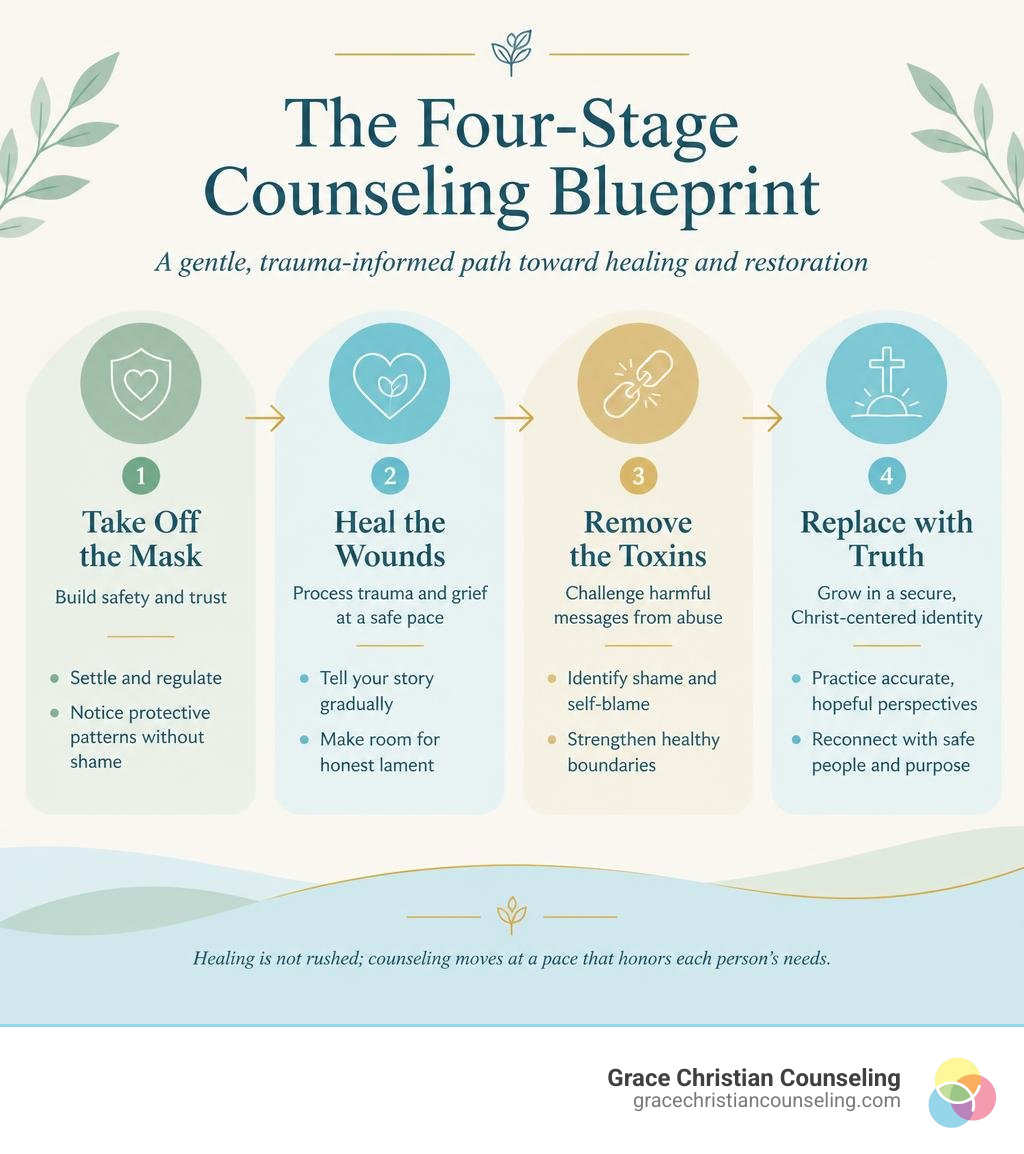
Stage 1: Take Off the Mask (Establishing Safety and Trust)
For some trauma survivors, early counseling includes building safety, trust, grounding skills, and strategies for managing distress before or alongside deeper trauma-focused work. Survivors of chronic relational abuse frequently wear emotional masks of perfectionism, hyper-compliance, or detachment to protect themselves from harm.
In this stage, counselors build a warm, non-judgmental therapeutic alliance. We work on:
- Learning somatic grounding and nervous system regulation techniques.
- Developing healthy daily routines and emotional self-regulation skills.
- Identifying survival adaptations without shame, honoring the ways you coped with past distress while gently evaluating their current helpfulness.
Stage 2: Heal the Wounds (Processing Trauma and Grief)
As treatment progresses, counseling may include carefully processing traumatic memories, grief, and relationship wounds at a pace that fits the client’s symptoms, coping abilities, and treatment goals. We do not rush this work, nor do we force clients to recount memories before they feel ready.
This phase includes:
- Reconstructing your life narrative at a manageable, regulated pace.
- Processing fragmented memories and bodily sensations associated with trauma triggers.
- Grieving compounded losses, missed developmental milestones, and relational betrayals through honest biblical lament.
Stage 3: Remove the Toxins (Dismantling Lies and Gaslighting)
Narcissistic abuse injects spiritual and psychological toxins into a person’s thinking. Perpetrators often manipulate circumstances to blame the victim, leaving lingering shame and distorted beliefs about self-worth.
In Stage 3, we focus on:
- Identifying core shame messages and irrational guilt.
- Untangling manipulative gaslighting narratives to restore confidence in reality.
- Breaking unhelpful relational cycles and establishing firm, God-honoring boundaries to protect your emotional well-being.
Stage 4: Replace with Truth (Anchoring Identity in Christ)
The final stage of the Counseling Blueprint focuses on long-term restoration, post-traumatic growth, and community reconnection.
During this stage, clients:
- Deeply internalize God’s truth regarding their adoption, value, and dignity in Christ.
- Re-engage with safe, healthy relationships and compassionate faith communities.
- Reclaim personal callings, creative passions, and vocational opportunities with renewed joy and peace.
Frequently Asked Questions about CPTSD and Faith-Based Recovery
How does CPTSD differ from standard PTSD in biblical counseling?
PTSD and CPTSD share core trauma symptoms, but CPTSD also involves ongoing difficulties with emotion regulation, self-concept, and relationships. CPTSD is more commonly associated with prolonged or repeated interpersonal trauma, although the type of trauma alone does not determine which diagnosis a person may develop.
Complex PTSD stems from chronic, repeated interpersonal violation or neglect, often occurring during childhood or within prolonged abusive relationships. In biblical counseling, C-PTSD requires addressing deeper relational trauma, pervasive toxic shame, autonomic dysregulation, and relational distrust, along with helping the individual rebuild their sense of safety and identity in Christ.
Can a person recover from CPTSD without compromising their Christian faith?
Yes. True trauma recovery and biblical faith work together. Evidence-based clinical tools, such as cognitive behavioral therapy, trauma narrative processing, and nervous system regulation, complement scriptural soul care.
Scripture acknowledges human embodiment, affirms the necessity of honest lament, and points to Christ as the ultimate source of healing and safety. Depression and trauma are treatable, and while recovery timelines vary from person to person, integrating clinical expertise with biblical truth supports deep, enduring restoration.
How can the local church support complex trauma survivors without causing harm?
The church can serve as a place of healing by cultivating trauma awareness, practicing patience, and avoiding simplistic spiritual platitudes like “just pray harder” or “choose joy.”
Church leaders and small groups support survivors best by:
- Offering consistent, safe, and unconditional community.
- Creating space for honest grief and lament rather than expecting instant emotional recovery.
- Respecting personal boundaries and recognizing that trust takes time to rebuild.
- Partnering with licensed professional Christian counselors when specialized care is needed.
Finding Hope and Restoration
Recovery from complex PTSD and narcissistic abuse is a journey of reclaiming your life, your nervous system, and your spiritual identity. While the road requires patience and intentional care, you do not have to walk it alone. God meets us in our deepest affliction, invites our rawest prayers, and leads our souls into quiet rest.
At Grace Christian Counseling, we provide Christ-centered, evidence-based counseling for individuals, couples, and families across Western Pennsylvania, with convenient offices in:
- Pittsburgh
- North Huntingdon
- Penn Hills
- Uniontown
- Bethel Park
- Sewickley
- Mt. Lebanon
- Pleasant Hills
- Belle Vernon
- Ligonier
- Punxsutawney
We also offer secure online Christian counseling in Pennsylvania and West Virginia for clients seeking virtual care.
If you are navigating the painful aftermath of complex trauma or emotional mistreatment, consider learning more about our specialized therapy for overcoming emotional abuse. Our team of licensed Christian counselors is here to walk alongside you with clinical skill, deep compassion, and unwavering hope.
For those seeking additional pastoral support alongside professional counseling, we recommend NuWell, a pastoral counseling resource that complements the clinical and biblical care we provide.
This guide is for educational and spiritual encouragement and is not a substitute for personalized professional counseling. If you are in crisis, please reach out for immediate help.


