

When Grief Hits Hard: Why So Many Turn to Scripture for Comfort
Biblical comfort for grief is something millions of people search for every day, and for good reason. Losing someone you love is one of the hardest experiences a person can face. Words often fall short. But Scripture doesn’t.
Here are the key Bible passages that offer real comfort during grief:
| Scripture | Theme |
|---|---|
| Psalm 34:18 | God is close to the brokenhearted |
| Matthew 5:4 | Those who mourn will be comforted |
| Revelation 21:4 | God will wipe away every tear |
| Isaiah 61:3 | God exchanges mourning for joy |
| 1 Thessalonians 4:13 | Christians grieve with hope, not despair |
| John 11:35 | Jesus wept, so can you |
Grief is not a sign of weak faith. It is a deeply human response to real loss, and God meets you right in the middle of it.
Grief touches every family eventually, and if you’ve recently lost someone you love, you may feel like your world has been turned upside down. During seasons of loss, many people naturally search for something to hold onto… something that offers comfort, hope, and meaning when life no longer makes sense. For many, that source of strength is their faith.
In fact, research published in Palliative Medicine found that the overwhelming majority of studies examining spirituality and bereavement reported positive connections between faith and healthy grief adjustment. This is especially relevant considering that about 70% of U.S. adults identify as spiritual in some way, according to the Pew Research Center. Studies have also found that practices such as prayer, reading Scripture, and participating in a supportive faith community are often associated with lower levels of depression, anxiety, and emotional distress.
While faith does not remove the pain of losing someone you love, it can provide a foundation to stand on when everything else feels uncertain. Many people find comfort in God’s promises, strength through prayer, and reassurance that they do not have to carry their grief alone. Combined with healthy support and counseling when needed, these spiritual resources can play an important role in the healing journey.
That is not a small thing.
We walk through what the Bible actually says about grief, which verses offer the most comfort, and how you can begin to bring your sorrow to God and find real peace. Whether you are grieving a death, a loss, or something harder to name, there is something here for you.
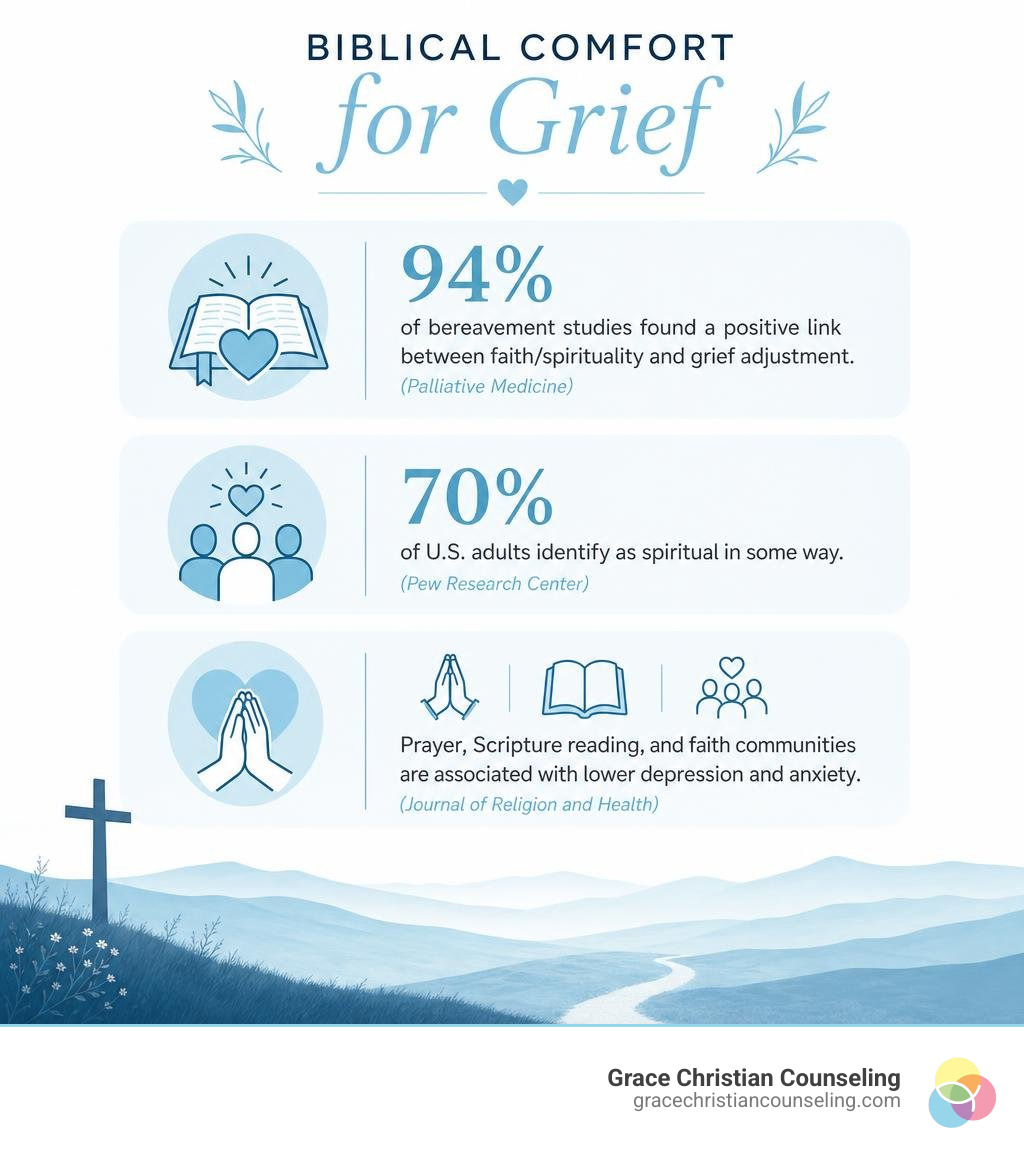
Finding Biblical Comfort for Grief in the Midst of Loss
When we lose someone we love, the world seems to stop, yet everything around us keeps moving. The chair at the kitchen table sits empty; the personal items remain untouched; the phone number stays in our contacts list. In these quiet, heavy moments, we often try to make sense of the pain.

Many people believe that to be a strong Christian, you must face loss with a dry eye and a constant smile, but this is a profound misunderstanding of Scripture. The Bible does not teach us to ignore our pain; rather, it invites us to express it. Mourning is a natural, healthy, and necessary response to living in a fallen world where death exists.
Grief is not a problem to be solved; it is a process to be lived. When we try to rush through our sorrow or treat it as a spiritual failure, we miss the comforting presence of God. In his famous book A Grief Observed, C.S. Lewis wrote honestly about the raw, disorienting nature of loss after his wife passed away, noting that grief feels remarkably like fear. He showed us that faith does not shield us from the physical and emotional weight of loss, but it gives us a safe place to land.
Scripture shows us that lament, which is the practice of crying out to God in our pain, is actually a deep form of worship. Roughly one-third of the Psalms are prayers of lament. The writers did not sanitize their prayers; they brought their anger, confusion, and deep sadness directly to the Lord. When we are honest with God about how much we hurt, we are practicing trust under pressure. We are saying, “Lord, I do not understand this, but I trust you enough to bring my broken heart to you.” For more guidance on walking through these difficult seasons, you can read our resource on Finding Hope in the Valley: A Guide to Faith-Based Grief Support.
Jesus, the Compassionate and Wonderful Grief Counselor
If you ever wonder how God feels about your tears, you only have to look at Jesus. In the Gospel of John, we find one of the most comforting accounts in all of Scripture: the death of Lazarus.
When Jesus arrived in Bethany, Lazarus had been in the tomb for four days. Jesus knew exactly what He was about to do; He knew He was going to raise Lazarus back to life in a matter of minutes. Yet, when He saw Mary weeping, the Bible tells us that Jesus was deeply moved in spirit and troubled. And then, in the shortest verse in the Bible, we read that “Jesus wept” as he was deeply grieved.
Why did He weep if He was about to fix the problem? He wept because He is compassionate. He wept because He hates what death does to the people He loves. He entered into the sorrow of the moment rather than standing at a distance.
Jesus provides beautifully individualized care to those who are hurting. Consider how He interacted with the two sisters:
- With Martha: He engaged her mind, speaking of theological truths and the resurrection, because she needed solid ground to stand on.
- With Mary: He did not offer a theological lecture; He simply wept with her, meeting her emotional vulnerability with His own presence.
Jesus does the same for you today. He does not offer a one-size-fits-all solution. He knows your unique personality, your specific pain, and exactly what you need to hear or feel in your darkest hours.
6 Key Scriptures That Offer True, Lasting Comfort
When our own words fail us, turning to the living Word of God can provide a steady anchor. The following passages are not mere platitudes; they are profound truths designed to soothe a shattered heart.
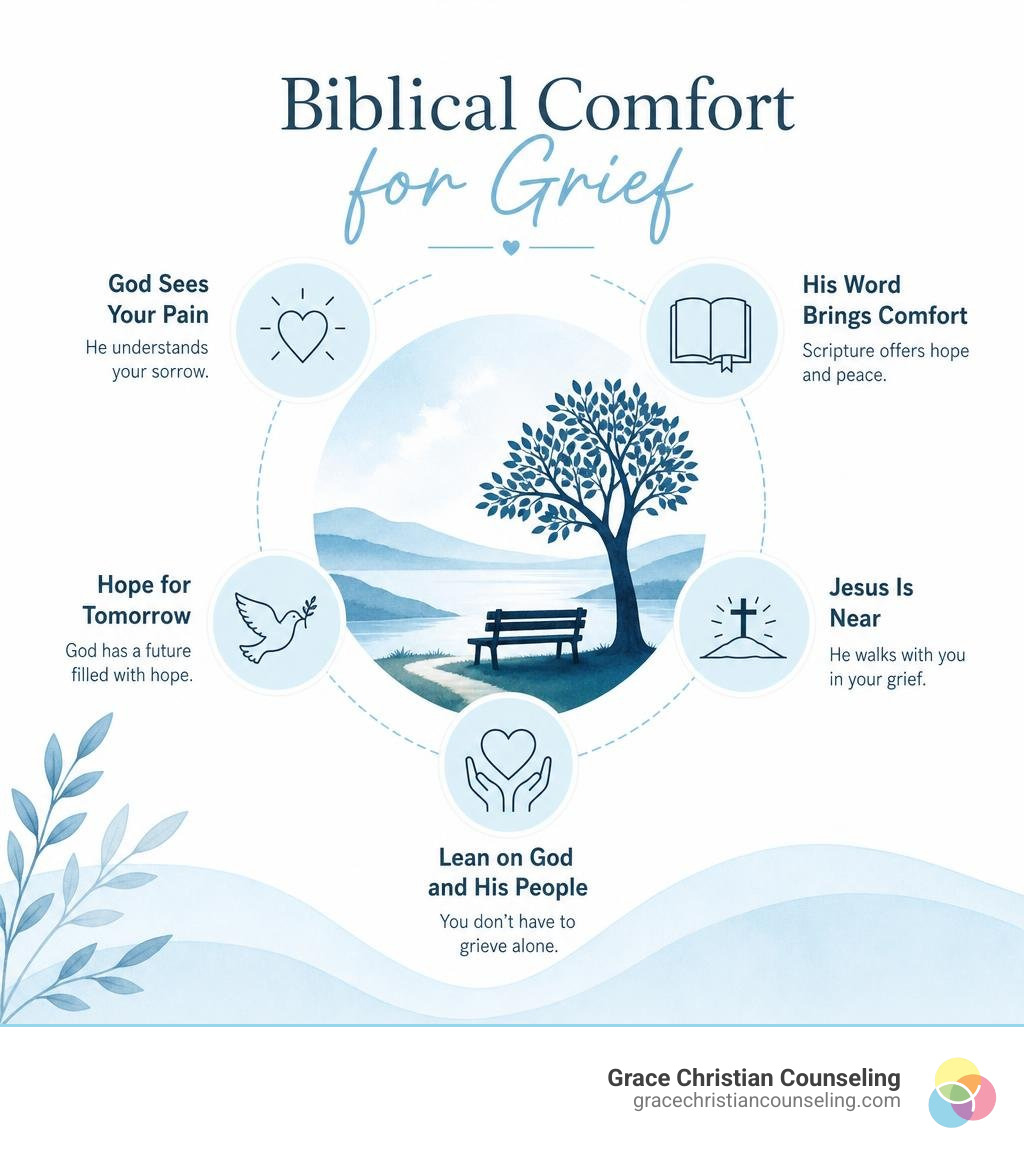
As you read these passages, we encourage you to slow down, meditate on each word, and let them sink into your soul. For a deeper look at how God uses His Word to restore us, you can explore our article on Healing the Heart with the Word. For a broader collection of comforting passages, you can also visit Top 20+ Comforting Bible Verses About Grief and Loss.
Finding Biblical Comfort for Grief in the Old Testament
The Old Testament is rich with raw, honest expressions of sorrow and God’s faithful responses to His people.
1. Psalm 34:18
“The Lord is close to the brokenhearted and saves those who are crushed in spirit.”
When we are grieving, we often feel completely isolated, as if we are walking through a frozen wasteland alone. But this verse promises the exact opposite: God is not distant when you are hurting. In fact, He draws closer. When your spirit feels entirely crushed under the weight of loss, He is there to hold you.
2. Isaiah 61:3
“…to bestow on them a crown of beauty instead of ashes, the oil of joy instead of mourning, and a garment of praise instead of a spirit of despair”
This beautiful prophecy speaks of a divine exchange. In ancient times, people poured ashes on their heads to show deep grief and shame. God promises that He will not leave us in the ashes. He will lovingly exchange our sorrow for beauty, our mourning for joy, and our heavy spirit of despair for a garment of praise. This does not mean our loss didn’t matter; it means God is a master of redemption. If you are struggling with your emotional well-being during this trial, you may find comfort in our list of Bible Verses for Mental Health.
Finding Biblical Comfort for Grief in the New Testament
The New Testament brings us the physical manifestation of God’s love through Christ and the ultimate promise of eternal restoration.
3. Matthew 5:4
“Blessed are those who mourn, for they will be comforted.”
In the Beatitudes, Jesus turns the world’s logic upside down. The world says that the happy and care-free are blessed. Jesus says that those who mourn are blessed. Why? Because their sorrow opens the door to experiencing the deep, tender comfort of God in a way that others may never know. Mourning allows us to receive the gentle touch of our Savior.
4. Revelation 21:4
“He will wipe every tear from their eyes. There will be no more death or mourning or crying or pain, for the old order of things has passed away.”
This is the ultimate hope of every believer. The pain you are feeling right now is real, but it is not permanent. A day is coming when God Himself will gently wipe away every tear from your face. Death, crying, and pain will be completely banished. We can endure the sorrow of today because we know how the story ends. To help you process these promises during times of emotional recovery, read our guide on 10 Healing Scriptures for Mental Health Recovery.
Grieving with Hope: How Believers Process Loss Differently
In his letter to the Thessalonians, the Apostle Paul wrote words that have comforted grieving families for thousands of years:
“Brothers and sisters, we do not want you to be uninformed about those who sleep in death, so that you do not grieve like the rest of mankind, who have no hope” (1 Thessalonians 4:13).
Notice that Paul does not tell us not to grieve. He does not say, “Dry your tears and get over it.” Instead, he draws a line between two very different types of grief: grieving with hope and grieving without hope.
Grieving without hope is a dark, endless tunnel. It believes that death is the absolute end, that the relationship is permanently severed, and that the physical body is gone forever. Grieving with hope, however, looks very different:
- We recognize death as an enemy, but a defeated one: Death was not part of God’s original design for humanity; it is an intruder. It is completely natural to feel angry and deeply saddened by it.
- We rely on the promise of the resurrection: Because Jesus rose from the dead, we know that those who die in Christ will also rise. Death is merely a temporary sleep.
- We look forward to physical reunion: The Bible teaches that we will not spend eternity as ghostly, disembodied spirits. We will have glorified, physical bodies; touchable, recognizable, and entirely free from pain, aging, and decay.
As discussed in How to Grieve in Hope After Losing a Loved One, our grief actually serves as a backdrop that makes the light of Christian hope shine even brighter. It tests and refines our faith, driving us deeper into the love of God.
Even in the most painful circumstances, such as losing a loved one under tragic or unexpected conditions, God’s grace remains sufficient. If you are walking through the unique, heavy path of a sudden loss, please know you do not have to carry it alone; you can find support in our article on Losing a Loved One Due to Suicide.
Practical Ways to Bring Your Sorrow to God and Find Peace
Knowing what the Bible says is a wonderful first step, but how do we actually live this out when the waves of grief are crashing over us? Here are some practical ways to bring your sorrow to God:
- Pray your honest feelings: You do not need to use polite, formal language with God. If you are angry, tell Him. If you are confused, ask Him your questions. He can handle your rawest emotions.
- Use the Psalms of lament: When you have no words of your own, open your Bible to the Psalms (such as Psalm 13 or Psalm 23) and pray those words back to God.
- Lean on your church community: God never intended for us to carry our burdens alone. Let your brothers and sisters in Christ cook for you, pray with you, cry with you, and simply sit with you in the quiet.
- Avoid unbiblical coping mechanisms: When the pain is intense, it is tempting to seek comfort in temporary escapes and unhealthy behaviors. Some people try to keep themselves constantly busy to avoid thinking about the loss; this often leads to emotional exhaustion and delayed healing. Others, in their desperation for answers, might turn to unbiblical spiritual practices like trying to contact the deceased. We must seek God’s peace alone, rather than looking to the voices of the past or worldly rituals that lead us away from Christ.
If you find that your grief is turning into a persistent, heavy darkness that you cannot seem to lift, please remember that seeking professional support is a healthy, faithful step. You can explore additional support and spiritual resources at NuWellonline.com or read our guide on Navigating Holiday Grief with Faith to help you manage the particularly difficult seasons of the year.
Frequently Asked Questions about Biblical Comfort for Grief
Grief brings up many difficult questions. Here are a few that we frequently hear from believers processing a loss.
Is it a lack of faith to feel deep sadness or anger when grieving?
Absolutely not. As we have seen, Jesus Himself wept at the grave of His friend, and He felt deep distress in the Garden of Gethsemane. Sadness is a normal, healthy human emotion. Anger is also a natural response to the injustice of death. God made us with the capacity to feel these things deeply. Bringing your raw emotions to God is actually an act of deep faith, as it shows you trust Him with your true self.
How does the promise of heaven comfort us when we miss a loved one’s physical presence?
While we know their soul is at peace with the Lord, the physical absence of a loved one is incredibly painful; we miss their laugh, their touch, and their daily presence in our lives. The promise of heaven comforts us because it includes the promise of physical resurrection. According to Philippians 3:20-21, Christ will transform our lowly bodies to be like His glorious, resurrected body. We are not just waiting for a vague, spiritual reunion; we are looking forward to a real reunion where we will see, hug, and live alongside our loved ones in Christ forever.
What are some healthy, faith-based ways to handle grief during the holidays?
The holidays can be incredibly difficult because they highlight the empty chair at the table. To handle this season with grace:
- Give yourself permission to feel: Do not force yourself to act happy if you are hurting.
- Incorporate their memory: Light a candle, share your favorite stories, or do an activity they loved to honor their place in your family.
- Start new traditions: If the old traditions are too painful, it is okay to adjust them or create new ones that fit your current season.
- Focus on the Incarnation: Christmas is about Emmanuel, “God with us,” who came into our messy, broken world to bring us hope.
For more practical suggestions, read our article on Ways to Handle the Loss of Loved Ones During Christmas.
Finding Peace and Hope in Christ
Grief is a long, winding journey, and there is no right or wrong timeline for healing. If you are walking through the valley of the shadow of death right now, please know that you do not have to walk it alone.
At Grace Christian Counseling, we provide compassionate, professional care that honors both your faith and your emotional needs. Our team of licensed counselors, including LSWs and LAPCs, is dedicated to helping you process your pain in a safe, non-judgmental environment. We blend evidence-based psychological practices with the timeless truths of Scripture to help you find real, lasting healing.
We proudly serve individuals, couples, and families across Western Pennsylvania, including the communities of Pittsburgh, North Huntingdon, Penn Hills, Uniontown, Bethel Park, Sewickley, and Mt. Lebanon. We also offer convenient online counseling virtually across the entire state of Pennsylvania and West Virginia.
If you are ready to take the next step toward healing, we invite you to reach out to us today. Let us walk alongside you on this journey. To learn more about our services or to schedule an appointment, visit our page on Grief Counseling.
This article was researched with AI and heavily edited by Bekah McCrorey for accuracy and relevance.
Bekah McCrorey is a counselor at Grace Christian Counseling. She holds a Master’s degree in Counseling from Dallas Theological Seminary and a Bachelor’s degree in Christian Ministry from Chesapeake Bible College and Seminary. She is a provisionally licensed counselor working under supervision toward full licensure as a Licensed Professional Counselor (LPC) in Pennsylvania.
With over 12 years of full-time ministry experience supporting individuals, families, ministry leaders, and churches nationally and internationally, Bekah brings a deep understanding of emotional and spiritual struggles. As a counselor, she uses a client-centered, trauma-informed, and evidence-based approach. She is Level 1 trained in Restoration Therapy and is passionate about helping clients navigate anxiety, depression, grief, trauma, life transitions, and relational difficulties while integrating emotional and spiritual well-being.
This guide is for educational and spiritual encouragement and is not a substitute for personalized professional counseling. If you are in crisis, please reach out for immediate help.
Navigating Grief


