

Why Your Relationship with God May Feel Harder Than It Should
Christ-centered attachment healing is a counseling approach that combines psychological attachment theory with Christian faith to help people heal the relational wounds that shape how they connect with God, themselves, and others.
Here is a quick summary of what it involves:
- What it is: A faith-integrated approach using insights from attachment science alongside biblical truth to address deep relational wounds formed in childhood.
- Who it helps: Christians struggling with anxiety, spiritual distance, fear of abandonment, or patterns of disconnection in relationships and prayer.
- How it works: By building a secure attachment to God as the foundation, clients begin to experience healing that reshapes how they relate to others.
- Where to start: Working with a licensed Christian counselor, participating in a structured program, or engaging in guided spiritual and therapeutic practices.
If you have ever wondered why prayer feels distant, why you brace for God’s disappointment, or why closeness in relationships triggers fear instead of peace, you are not alone. These are not signs of weak faith. They are often signs of attachment wounds, patterns formed long before you could put words to them.
Research suggests that roughly 60% of children develop secure attachment in early life, while the remaining 40% grow up with patterns that can quietly shape how they interpret God’s presence, especially in moments of silence or pain. As one framework for understanding this puts it, our earliest relationships form the emotional vocabulary we later use to “speak” to God.
The gap between what you believe about God and what you actually feel in your relationship with Him is real, and it is healable.
Understanding Christ-Centered Attachment Healing
At its core, christ-centered attachment healing is the beautiful integration of clinical attachment theory and relational theology. When we look at how God designed us, we see that we are hardwired for connection. Our brains, our nervous systems, and our spirits are built to seek safety in a loving protector.
Historically, attachment theory traces back to psychologists John Bowlby and Mary Ainsworth. They discovered that the responsiveness of our primary caregivers in infancy shapes our “attachment style”—the subconscious blueprint we use to navigate every relationship we will ever have. When a parent is consistently safe and responsive, we develop a secure attachment. If a parent is distant, unpredictable, or harsh, we develop protective strategies to survive.
The profound insight of Christian attachment therapy is that we do not leave this blueprint behind when we step into our spiritual lives. Instead, we often project the qualities of our early caregivers onto our Creator. This creates a painful gap between our doctrinal knowledge (what we know to be true in our heads) and our experiential knowledge (what we feel to be true in our hearts).
The Intersection of Faith and Psychology
For a long time, some corners of the church viewed psychology with suspicion, while secular therapy ignored the soul. We believe that true healing occurs where psychological science and biblical truth meet. Relational theology teaches us that God exists in a loving, eternal relationship as the Father, Son, and Holy Spirit, and He created us in His image to participate in that love.
When we integrate attachment science, we gain a rich emotional vocabulary to describe our spiritual struggles. We begin to see that spiritual dryness or chronic anxiety in prayer is not a sign of moral failure. Rather, it is a sign that our relational nervous system is trying to protect itself from perceived rejection. By utilizing evidence-based counseling tools, we can gently untangle these defensive patterns, allowing our spiritual growth to flourish. To explore how this integration brings wholeness, read more about Healing The Heart Through Christian Counseling.
Bridging Doctrinal Belief and Relational Experience
Have you ever sat in a church service, listened to a sermon about God’s unconditional grace, and felt completely empty inside? This is the classic head-heart gap. Cognitive assent—agreeing with a theological statement in your mind—is very different from experiencing that truth in your body and emotions.
When attachment wounds are active, we live in a state of chronic spiritual survival. We may read our Bibles and pray, yet feel a deep, lingering sense of isolation. By shifting our focus from merely collecting information about God to experiencing His actual, comforting presence, we can bridge this gap. We learn to move from a performance-based faith to an emotionally intimate relationship with our Savior. You can find practical encouragement on this journey in Healing The Heart With The Word.
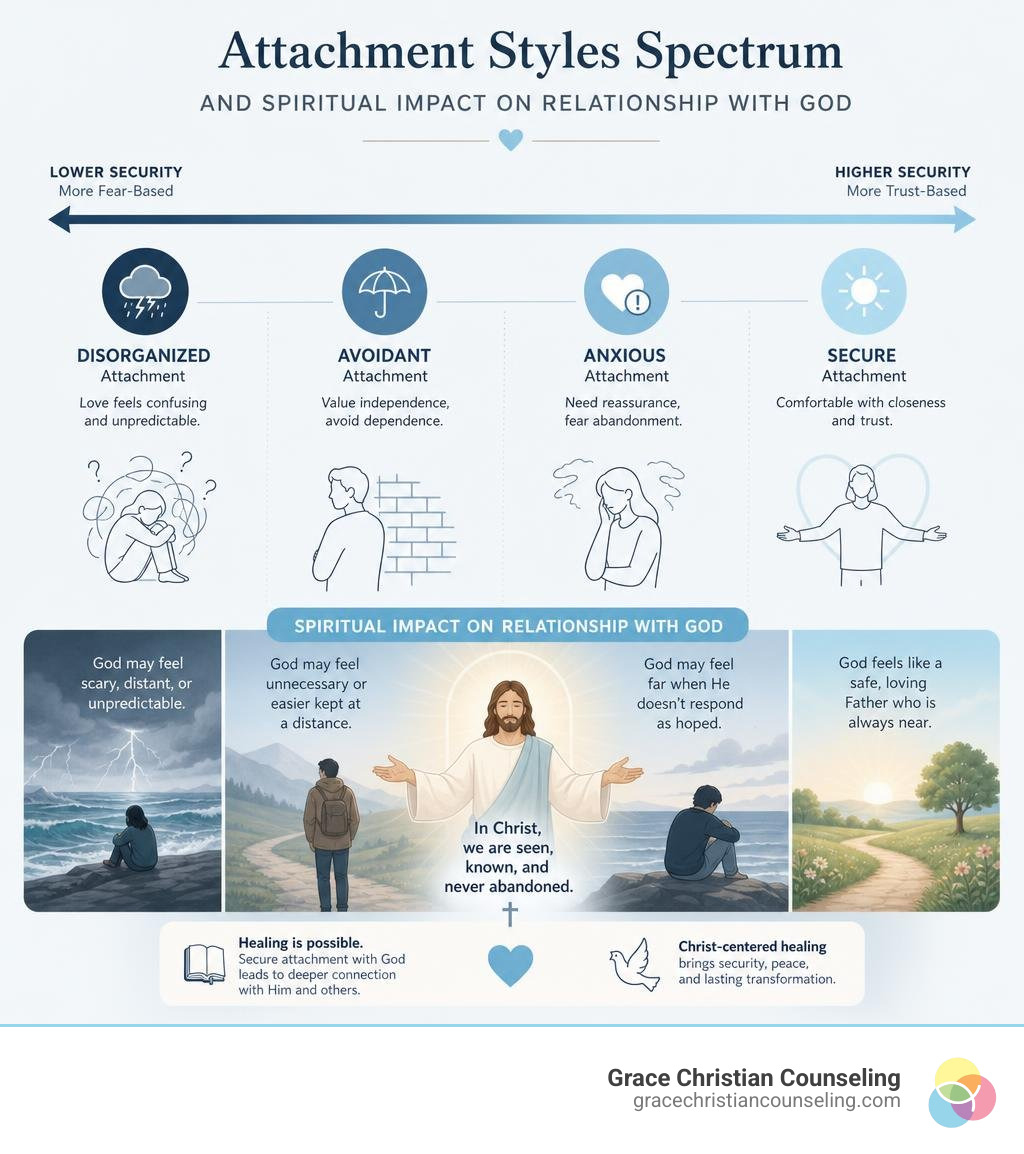
The Four Attachment Styles in Relational and Spiritual Life
To understand how these patterns manifest in our daily lives, we must look at the four primary attachment styles. These styles operate like a relational pair of glasses, coloring how we view our spouses, our friends, and our heavenly Father.
| Attachment Style | Human Relational Pattern | Spiritual Manifestation (Relationship with God) |
|---|---|---|
| Secure | Comfortable with intimacy; able to trust and be trusted; communicates openly. | Views God as safe, loving, and consistently present; rests in grace. |
| Anxious-Preoccupied | Fears abandonment; constantly seeks reassurance; over-functions in relationships. | Worries God is angry or about to leave; struggles with performance-driven faith. |
| Avoidant-Dismissive | Highly independent; shuts down during conflict; equates vulnerability with weakness. | Struggles to feel emotional warmth from God; prefers intellectual study over prayer. |
| Fearful-Avoidant (Disorganized) | Desires closeness but fears it; views others as both a source of comfort and danger. | Experiences deep fear of God; oscillates between seeking Him and running away. |
If you recognize yourself in the anxious style, you are not alone, and there is a direct path to finding peace. We invite you to explore The Ultimate Guide To Healing Your Anxious Attachment Style to learn more about navigating these specific waves of relational anxiety.
Secure and Insecure Patterns in Adult Faith
In the mid-20th century, Mary Ainsworth established the “Strange Situation Paradigm” to observe how infants reacted to separation and reunion with their mothers. Decades of subsequent research have shown that about 60% of children in non-clinical populations exhibit secure attachment, while roughly 20% display anxious-avoidant and 20% display anxious-ambivalent (anxious-preoccupied) patterns.
Crucially, longitudinal studies demonstrate a moderate to high degree of stability in these attachment patterns over time. An anxious-ambivalent child is statistically much more likely to struggle with anxious attachment in adult romantic relationships—and, by extension, in their relationship with God. Our early relational habits run deep, but thankfully, our brains and hearts can be re-patterned through the grace of God and clinical care.
How Insecurity Distorts Our View of God
When we carry insecure attachment patterns, we naturally project our relational fears onto the divine. For example, research shows that anger at God is very often accompanied by feelings of doubt about our relationship with Him, negative interpretations of why our prayers go unanswered, and fundamental questions about His goodness.
Furthermore, attachment style directly affects how we interpret ambiguous relationship scenarios. If our earthly relationships are shaky, we are far more likely to interpret ambiguous hypothetical events as reflecting hostile intentions from our partners. Spiritually, when God seems silent or when we experience a difficult season, an insecure attachment style will cause us to assume that God is punishing us, ignoring us, or simply does not care.
How Trauma and Childhood Wounds Shape Our View of God
Our attachment styles do not develop in a vacuum. They are forged in the fires of our early environments, heavily influenced by the presence of relational trauma, emotional neglect, or harsh parenting.

When a child grows up in an environment where love feels conditional, or where mistakes are met with intense shame, their nervous system learns that vulnerability is dangerous. If you are parenting children while healing from your own childhood, you can learn how to break these cycles in our guide on Grace Filled Healing For Attachment Wounds In Christian Parenting.
The Neurobiology of Relational Trauma
Trauma is not just a mental story; it is a physical reality lodged in the brain and body. When we experience chronic relational stress, our amygdala (the brain’s alarm system) becomes highly sensitized. This floods our system with stress hormones like cortisol, keeping us locked in survival states: fight, flight, freeze, or fawn.
Over time, this trauma rewires critical brain networks. The default mode network (associated with self-referential thoughts and processing emotions) and the central executive network (vital for cognitive control and problem-solving) exhibit altered activation patterns. This makes emotional regulation and processing social cues incredibly difficult. Our bodies encode these painful relational memories implicitly, meaning we react to present-day triggers with the same physiological panic we felt as children.
Healing from Harsh Christian Parenting
One of the most complex attachment wounds occurs when harsh, fear-based parenting is justified using Christian terminology. When obedience is demanded through the threat of spiritual rejection, a child associates God with terror and shame rather than safety.
Healing from this does not require you to reject your faith. Instead, it invites you to separate the flawed actions of earthly authority figures from the true character of a loving, patient God. By learning to set healthy boundaries and surrounding yourself with a safe, emotionally mature community, you can begin to rebuild your trust.
The Path to Restoration: Christ-Centered Attachment Healing in Action
The good news of the Gospel is that our early wounds do not have the final say. Because God is our ultimate secure attachment figure, He can reparent the wounded, hurting parts of our souls. He offers us a steady, unwavering love that is completely independent of our performance.
At Grace Christian Counseling, we guide our clients through this restoration process using our structured Counseling Blueprint. This evidence-based, faith-integrated framework helps you move from defensive protection to deep, secure connection. You can read an overview of how we blend clinical science and Scripture in A Roadmap To Wholeness Integrating Faith And Evidence.
What We Often See in Christ-Centered Attachment Counseling
In our counseling work with Christians healing attachment wounds, we often see a pattern where the client’s stated belief about God differs from their felt experience of Him. A person may sincerely believe that God is loving and near, yet their nervous system responds to prayer, silence, conflict, or correction as if rejection is coming. This is why Christ-centered attachment healing must address more than ideas; it also helps clients notice the body-level fear, shame, or withdrawal that can surface in relationships with God and others.
Across attachment-focused counseling conversations, common themes include fear of disappointing God, difficulty receiving comfort, over-functioning in relationships, avoiding emotional vulnerability, and interpreting silence as abandonment. While every client’s story is unique, these patterns often point to early relational templates that are being replayed spiritually. Naming those patterns gives clients a clearer path forward: they can begin practicing secure connection through honest prayer, safe relationships, trauma-informed care, and repeated experiences of grace that slowly teach the heart what the mind already believes.
Practical Steps for Christ-Centered Attachment Healing
Begin with small, repeatable practices that help your body experience the truth your mind already believes. Christ-centered attachment healing often includes noticing relational triggers, naming the fear underneath them, bringing that fear honestly to God in prayer, and practicing safe connection with trustworthy people. Over time, these simple rhythms help move healing from an idea into lived experience, teaching the nervous system that closeness can be safe, grace can be received, and love does not have to be earned.
We encourage our clients to use the self-compassion pause. When you notice your inner critic screaming, pause and ask: “How would Jesus respond to my pain right now?” Replace the harsh inner script with comforting biblical truths, such as Hebrews 13:5, which promises that He will never leave you nor forsake you. For additional pastoral counseling and virtual wellness resources and supportive tools, you can also explore NuWellonline.com.
Navigating the Counseling Blueprint
Our Counseling Blueprint is an intentional, four-stage journey of healing:
- Take Off the Mask: We begin by building a warm, non-judgmental alliance. You are safe to drop the exhausting act of “having it all together.”
- Heal the Wounds: Together, we gently explore the childhood and relational hurts that created your protective attachment patterns.
- Remove the Toxins: Guided by the Holy Spirit, we identify and dismantle the unhelpful beliefs, relational lies, and spiritual shame holding you captive.
- Replace with Truth: We install empowering, accurate perspectives about your worth in Christ, helping you experience God’s love as a reliable anchor for your soul, establishing His truth about yourself, others, and the world.
The Role of Community and Professional Support
While individual spiritual disciplines are vital, God designed us to heal in connection with others. We cannot fully restore our relational blueprints in isolation.
Whether through professional therapy or safe local church communities, finding a supportive network is essential to recalibrating your nervous system. To learn more about how we structure this specialized clinical care, visit our Attachment Therapy page.
Finding Professional Support for Christ-Centered Attachment Healing
If your attachment wounds are deeply rooted in trauma, willpower and private prayer may not feel like enough. That is completely normal. Working with a licensed professional who understands both the clinical nuances of attachment styles and the beauty of Christian theology can make all the difference.
Our team at Grace Christian Counseling includes compassionate, licensed clinicians such as Licensed Associate Professional Counselors (LAPC) and Licensed Social Workers (LSW). We utilize evidence-based trauma modalities like EMDR (Eye Movement Desensitization and Reprocessing) and somatic therapy to help resolve stuck relational memories directly in the nervous system. If you are ready to take this step, read our guide on All About Finding A Qualified Attachment Therapist.
Creating Safe Church Environments for Healing
Churches have a unique opportunity to act as spiritual hospitals. By hosting psychoeducational groups, leadership can help believers understand how father wounds and early family dynamics impact their present-day marriages, parenting, and ministry roles.
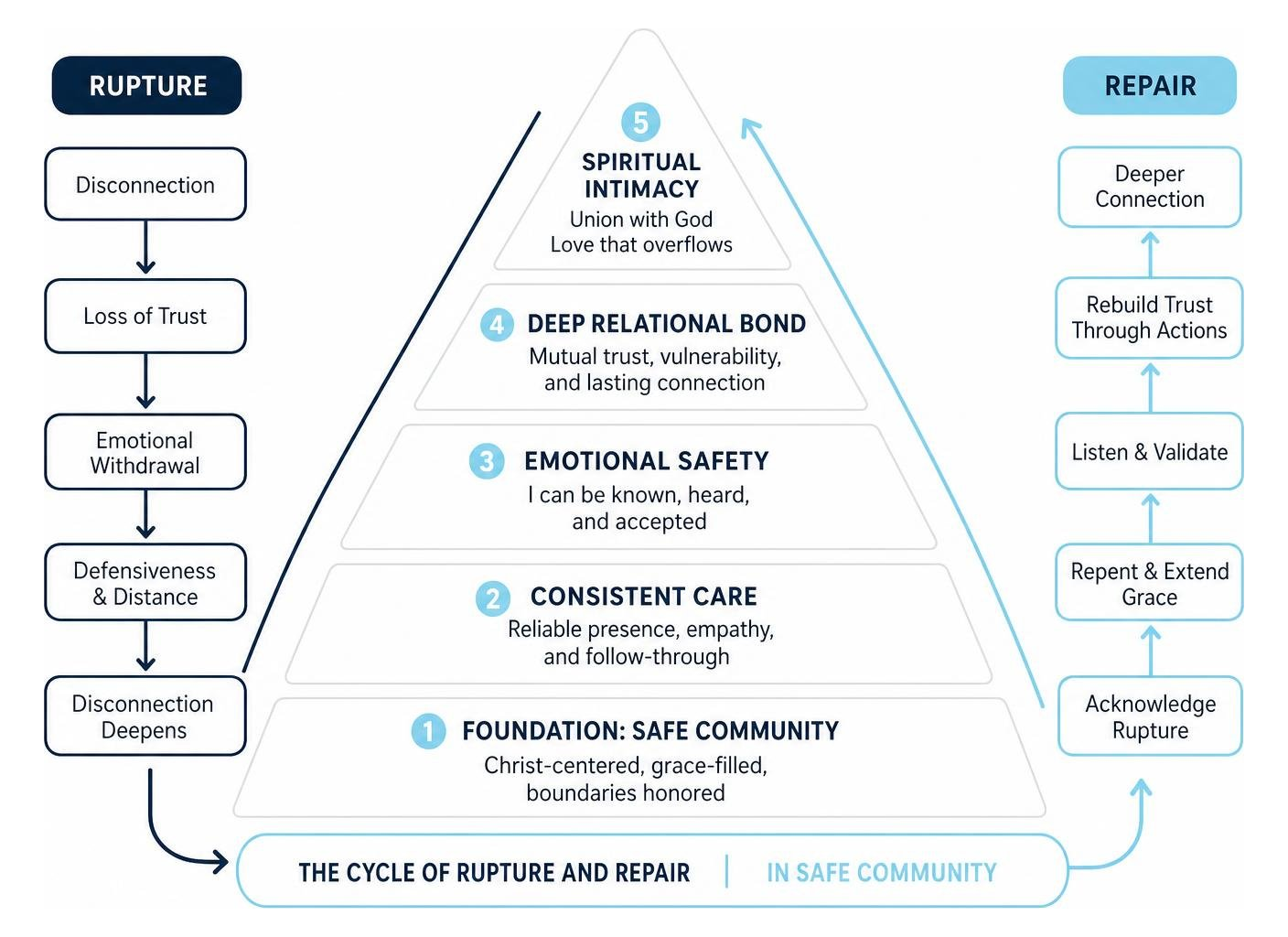
To build truly safe spaces, we must practice the relational rhythm of rupture and repair. No relationship is perfect, but healthy communities learn to handle conflict with humility. We often recommend utilizing the intimacy pyramid framework, which teaches that true relational closeness is built sequentially:
- Honesty: Committing to absolute truthfulness.
- Safety: Creating an environment free of threat or condemnation.
- Trust: Demonstrating consistent, predictable reliability over time.
- Vulnerability: Sharing our deepest fears and needs.
- Intimacy: Experiencing the joy of being fully known and fully loved.
Frequently Asked Questions About Attachment and Faith
Can a person’s attachment style with God change over time?
Yes, absolutely! In psychology, this is known as developing “earned security.” Because of the neuroplasticity of our brains, consistent corrective emotional experiences—both with safe human beings and through intimate, authentic encounters with God—can rewrite our relational wiring. Over time, practicing consistent spiritual disciplines and engaging in therapy will shift your default spiritual state from fear to peace.
How do I know if my spiritual struggles are actually attachment wounds?
If you experience chronic anxiety when you sit down to pray, find yourself constantly working to “earn” God’s favor, or feel a deep, paralyzing fear that He will abandon you when you make a mistake, these are classic indicators of attachment wounds. While intellectual doubts are normal, a persistent, physical feeling of unsafety or distance in your relationship with God usually points to a relational blueprint that needs gentle healing.
What is the difference between religious trauma and church hurt?
While both are deeply painful, they affect the nervous system differently. “Church hurt” typically refers to isolated relational offenses, such as a disagreement with a pastor or a hurtful comment from a fellow church member. “Religious trauma” is often more systemic, occurring when spiritual authority figures use fear, manipulation, or spiritual abuse over a prolonged period to control others. Healing from religious trauma requires a deeply trauma-informed, gentle approach to help your nervous system feel safe with God again.
Begin Healing Your Attachment Wounds with Christ-Centered Support
At Grace Christian Counseling, we are deeply committed to walking alongside you as you heal your heavenly bonds. We provide compassionate, evidence-based, and Christ-centered therapy designed to help you break free from the chains of relational anxiety, childhood wounds, and spiritual shame.
Our licensed counselors offer dedicated care across Western Pennsylvania, including communities like Pittsburgh, Penn Hills, Sewickley, Uniontown, Pleasant Hills, Bethel Park, Ligonier, Belle Vernon, Punxsutawney, North Huntingdon, and Mt. Lebanon. We also offer highly effective online counseling for clients throughout Pennsylvania, West Virginia, Florida, and Georgia.
You do not have to navigate this journey alone. If you are ready to experience the profound peace of a secure, restored relationship with God and those you love, we invite you to take the first step. Visit our Attachment Therapy page or contact us today to get matched with a counselor who truly understands.
This guide is for educational and spiritual encouragement and is not a substitute for personalized professional counseling. If you are in crisis, please reach out for immediate help.
Christian Boundary Setting: Counseling for Healthy Relationships


