

When Pain Feels Too Heavy to Carry Alone
Bethel Park Bible based trauma therapy offers a path forward for those whose wounds go deeper than words. It blends proven clinical care with the healing power of Scripture and faith in Christ. For many people, that combination creates space to address trauma honestly without separating emotional healing from spiritual hope.
If you’re looking for a quick answer, here’s what you need to know:
- What it is: Counseling that combines evidence-based methods (like CBT and EMDR) with biblical truth to heal trauma at its root
- Who it’s for: Individuals, couples, teens, and families in Bethel Park and across Western PA
- Where: In-person sessions at Bethel Park and other South Hills locations, plus online throughout Pennsylvania
- How to start: Contact us on and connect with our care team to get matched and scheduled with a counselor.
Trauma is more common than many people realize. According to the National Center for PTSD, about 60% of men and 50% of women experience at least one traumatic event in their lifetime. It may describe your neighbor, your coworker, your child, or maybe you. Trauma does not always fade with time. However, exposure to trauma does not mean a person will automatically develop PTSD. The National Center for PTSD explains that many people experience trauma and recover without developing the disorder, while others experience lasting symptoms that may benefit from professional support. However, experiencing trauma does not mean someone will automatically develop PTSD. It is also estimated that about 6% of the U.S. population will have PTSD at some point in their lives, meaning many people recover naturally while others experience symptoms that require additional support.
It can rewire how you think, how you feel in your body, and how you relate to the people you love most. Left unaddressed, it can quietly shape your relationships, your sense of self, and even your faith. Many people also minimize what they have experienced because their pain does not look like what they imagine “real trauma” to be.
Some clients come in believing their struggles are not serious enough to deserve help, especially when their experiences involve emotional neglect, chronic stress, relational wounds, or spiritual hurt rather than a single catastrophic event. Trauma recovery begins with understanding that the nervous system responds to experiences of threat, helplessness, and loss of safety, not just one specific type of event. At Grace Christian Counseling, we believe healing is possible through compassionate clinical care and the hope of Christ.
Bible-based trauma therapy gives you a safe place to name what happened and begin processing its impact. It also points you toward the truth of Scripture as you move toward restoration in your heart, mind, and spirit.
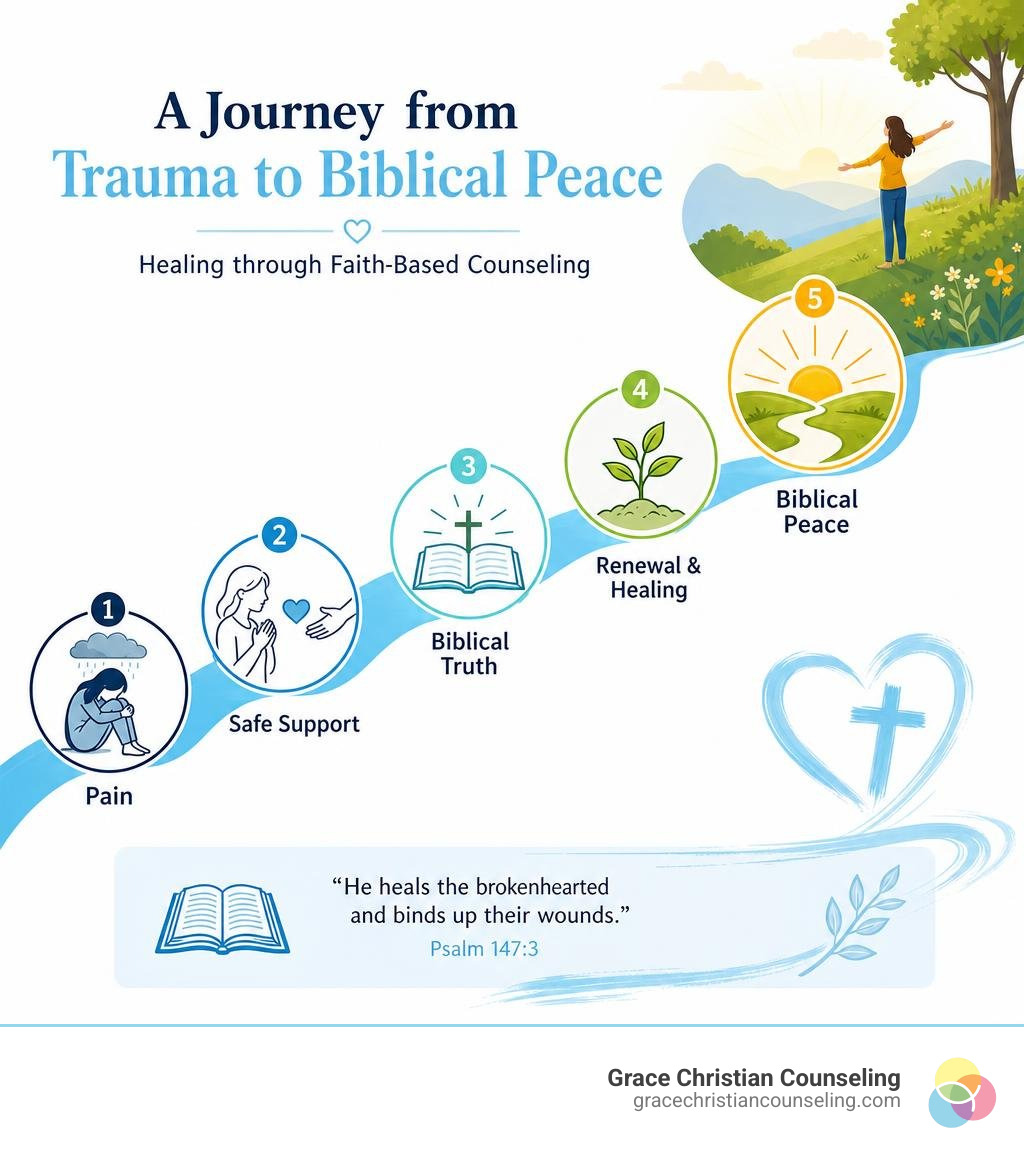
How to Find Healing with Bethel Park Bible Based Trauma Therapy
When we talk about Bethel Park Bible based trauma therapy, we aren’t just talking about a Sunday school lesson or a quick prayer at the end of a session. We are talking about a clinically thoughtful approach to mental health that views the human soul through the lens of its Creator. That means emotional symptoms, spiritual questions, and relational wounds are all taken seriously.
In many secular settings, trauma is treated strictly as a biological or psychological glitch. While the “hardware” of the brain is certainly involved, we believe that you are more than just a collection of neurons and synapses. You are a person made in the image of God, and your trauma may affect your ability to see yourself and Him clearly.
The difference between secular and Bible-based trauma counseling lies in the foundation. Secular therapy often focuses on self-actualization and coping mechanisms, which can have real value. Yet for many Christians, those tools can feel incomplete if they never address identity, sin, suffering, hope, and the presence of God.
At Grace Christian Counseling, Trauma Counseling is designed to get to the root of the pain. We believe that psychology is the study of God’s design for people, and psychological research can help us better understand how God created people emotionally, relationally, and spiritually. By integrating clinical insights with biblical truth, we address the “why” behind the pain, not just the “what.”
Our counselors in Bethel Park operate from a biblical worldview. This means we believe that Jesus is essential to understanding your identity and purpose. When trauma tells you that you are “broken beyond repair” or “abandoned,” Faith Based Trauma Healing Find Peace With God can help counter those lies with the truth of Scripture.
We don’t ignore the clinical side. Instead, we believe that clinical excellence is a way to honor God’s design for the human mind. This approach brings careful counseling practice and Christ-centered hope into the same room.
The Counseling Blueprint for Lasting Recovery

Healing from trauma is rarely a straight line. It’s a journey that requires a map. At Grace Christian Counseling, we use our proprietary Counseling Blueprint, a structured framework developed by our team to guide clients through the process of trauma recovery while allowing treatment to be individualized based on each person’s history, symptoms, goals, and faith journey.
This is not a one-size-fits-all checklist. It is a framework that allows us to walk alongside you in a structured, compassionate way. Your counselor adapts the process to your story, your symptoms, your pace, and your faith journey.
In our clinical experience, trauma recovery often involves helping clients rebuild three areas that trauma commonly disrupts: safety, trust, and a sense of identity. Many people come to counseling because of anxiety, relationship difficulties, emotional overwhelm, or trouble trusting others, then begin to see how past experiences have shaped their responses to stress, conflict, safety, and connection. Recognizing these patterns helps create a treatment plan that moves beyond surface coping and gives clients language for experiences they may have carried alone for years.
Practice Insights: What We Commonly See in Trauma Counseling
These observations help guide our approach: we begin by creating safety, understanding each person’s story, and identifying the specific ways trauma has affected their thoughts, emotions, relationships, and faith.
1. Take off the Mask
Many survivors of trauma become experts at “masking.” You might show up to work, serve at church, and care for your family while feeling completely hollow or terrified on the inside. Taking off the mask is the first step toward freedom.
In a safe, non-judgmental environment, we help you Unmasking Trauma The Power Of Christian Trauma Counseling so you can finally be honest about your pain. You don’t have to have it all together here. You can begin with the truth of where you are.
2. Heal the Wounds
Trauma creates deep emotional and spiritual wounds. If you leave a physical wound untreated, it becomes infected. The same is often true for the heart.
Whether you are dealing with Healing Childhood Trauma or a recent event, we work to clean out the “infection” of shame and fear. This involves processing memories in a way that reduces their power over your present life. Healing does not erase your story, but it can change how much control the story has over you.
3. Remove the Toxins
Trauma often leaves behind toxic beliefs. These are the narratives we tell ourselves, such as “It was my fault,” “I’m unsafe everywhere,” or “God has turned His back on me.” Over time, those beliefs can poison your relationships and your peace.
Our counselors help you identify these lies and begin Letting Go Of Past Traumas by recognizing they are not your truth. This process is careful and compassionate, not rushed or forced. As those beliefs lose power, there is more room for clarity, safety, and hope.
4. Replace with Truth
Once the toxins are removed, we do not leave the space empty. We fill it with the truth of God’s Word. We replace the lie of worthlessness with the truth of being fearfully and wonderfully made.
We also replace fear of the future with the promise that He will never leave you nor forsake you. This is where lasting transformation happens. Your mind is renewed by the Spirit and the truth as your story is brought into the light of God’s care.
Integrating Clinical Methods with Scriptural Truth

You might wonder, “How does a Bible-based counselor actually do therapy?” It is a meaningful blend of the spiritual and the scientific. We believe that because God created the brain, He also provided the means to help it heal.
A trauma-informed approach recognizes that healing cannot be rushed. Trauma is not simply a collection of negative thoughts someone can choose to replace. It often involves learned emotional and physiological responses that developed as a way to survive overwhelming experiences.
Effective trauma therapy creates safety first. Then it helps individuals gradually process painful memories, develop healthier coping skills, and rebuild trust in themselves, others, and God. This process honors both the complexity of trauma and the dignity of the person seeking help.
Cognitive Behavioral Therapy (CBT) is a staple in our practice. It involves identifying distorted thought patterns and replacing them with more accurate ones. From a Christian perspective, this reflects the clinical application of Romans 12:2: “Be transformed by the renewing of your mind.”
CBT is one of the most extensively researched forms of psychotherapy. The National Institute of Mental Health notes that CBT has been studied across many mental health conditions and has demonstrated effectiveness in helping people change unhelpful patterns of thinking and behavior. For trauma-related concerns, cognitive approaches can help individuals identify beliefs shaped by painful experiences and develop healthier ways of responding.
We help you align your thoughts with God’s perspective. If you want to learn more about CBT as an evidence-based approach, the American Psychological Association overview of CBT offers a helpful introduction. CBT can be especially helpful when trauma has shaped beliefs about safety, guilt, identity, or the future.
EMDR (Eye Movement Desensitization and Reprocessing) is another powerful tool we use, especially for those suffering from PTSD. Trauma can cause memories to get “stuck” in the emotional part of the brain, making them feel like they are happening right now. EMDR helps the brain process those memories so they no longer feel as overwhelming in the present.
Research supporting EMDR has led several professional organizations to recognize it as an evidence-based treatment for PTSD. The U.S. Department of Veterans Affairs and Department of Defense include EMDR among recommended trauma-focused therapies for PTSD, alongside approaches such as Cognitive Processing Therapy and Prolonged Exposure therapy.
The Department of Veterans Affairs and Department of Defense Clinical Practice Guideline for PTSD recommends trauma-focused psychotherapies, including EMDR, Cognitive Processing Therapy, and Prolonged Exposure, as some of the most effective treatments for PTSD. Research has consistently shown that trauma-focused therapies can significantly reduce PTSD symptoms for many individuals.
We use Effective Therapy Techniques For Healing Generational Trauma to help clients find relief from the physical and emotional charge of past events. For many people, this creates more space to respond rather than react. It can also support deeper spiritual reflection without forcing a client to bypass painful emotions.
Evidence-Based Techniques in Bethel Park Bible-Based Trauma Therapy
Beyond talk therapy, we often incorporate creative and somatic, or body-based, methods to aid in recovery. These tools can help clients process trauma when words alone are not enough. They also support the nervous system as clients learn to feel safer in the present.
- Art Therapy: Sometimes, words aren’t enough. Art therapy allows you to express the “un-speakable” parts of your trauma, providing a different pathway for insight and healing.
- Mindfulness and Grounding: Trauma often pulls us out of the present moment. Grounding exercises help you stay connected to the here and now, reminding your nervous system that you are safe.
- The Power of Connection: We believe The Power Of Connection Building Bridges To Trauma Recovery is vital. Isolation is trauma’s best friend, while community and a strong therapeutic alliance support healing.
Addressing PTSD Symptoms through Bethel Park Bible Based Trauma Therapy
Post-Traumatic Stress Disorder (PTSD) is not only experienced by combat veterans. It can happen after a car accident, a medical crisis, a betrayal, abuse, or other deeply distressing experiences. Common symptoms may include:
- Intrusive Memories: Flashbacks or nightmares that make you relive the event.
- Avoidance: Staying away from places, people, or even thoughts that remind you of the trauma.
- Heightened Arousal: Feeling “on edge,” being easily startled, or having trouble sleeping.
- Abandonment Issues: Trauma, especially childhood trauma, can lead to a deep fear of being left behind. We offer Relationship Trauma Therapy Near Me to help you rebuild trust in others and in God.
For those who have survived high-control environments or narcissistic relationships, we provide specialized Trauma Therapy For Healing From Narcissistic Abuse. This type of trauma often involves gaslighting, which makes you doubt your own reality. Our counselors help you regain your voice, rebuild your sense of truth, and reconnect with the dignity God has given you.
Specialized Care for Spiritual and Relational Wounds
One of the most painful forms of trauma is church hurt or spiritual abuse. When the place that was supposed to be a sanctuary becomes a place of harm, the damage is profound. It can shatter your view of God and make the Bible feel like a weapon rather than a comfort.
We understand that How Christian Therapy Can Help Trauma must involve a very gentle, patient approach to spiritual matters. We help you navigate spiritual pain in a way that does not rush trust, faith, or forgiveness. The goal is to find freedom in Christ, separate from the actions of those who may have misrepresented Him.
Furthermore, we recognize that trauma is often passed down through families. Healing From Generational Trauma involves looking at the patterns of your parents and grandparents to see how their unhealed wounds might be affecting you today. By Addressing Childhood Traumas To Foster Healing In Adulthood, we help you break the cycle so that destructive patterns do not have to continue with you.
Frequently Asked Questions about Bible-Based Trauma Care
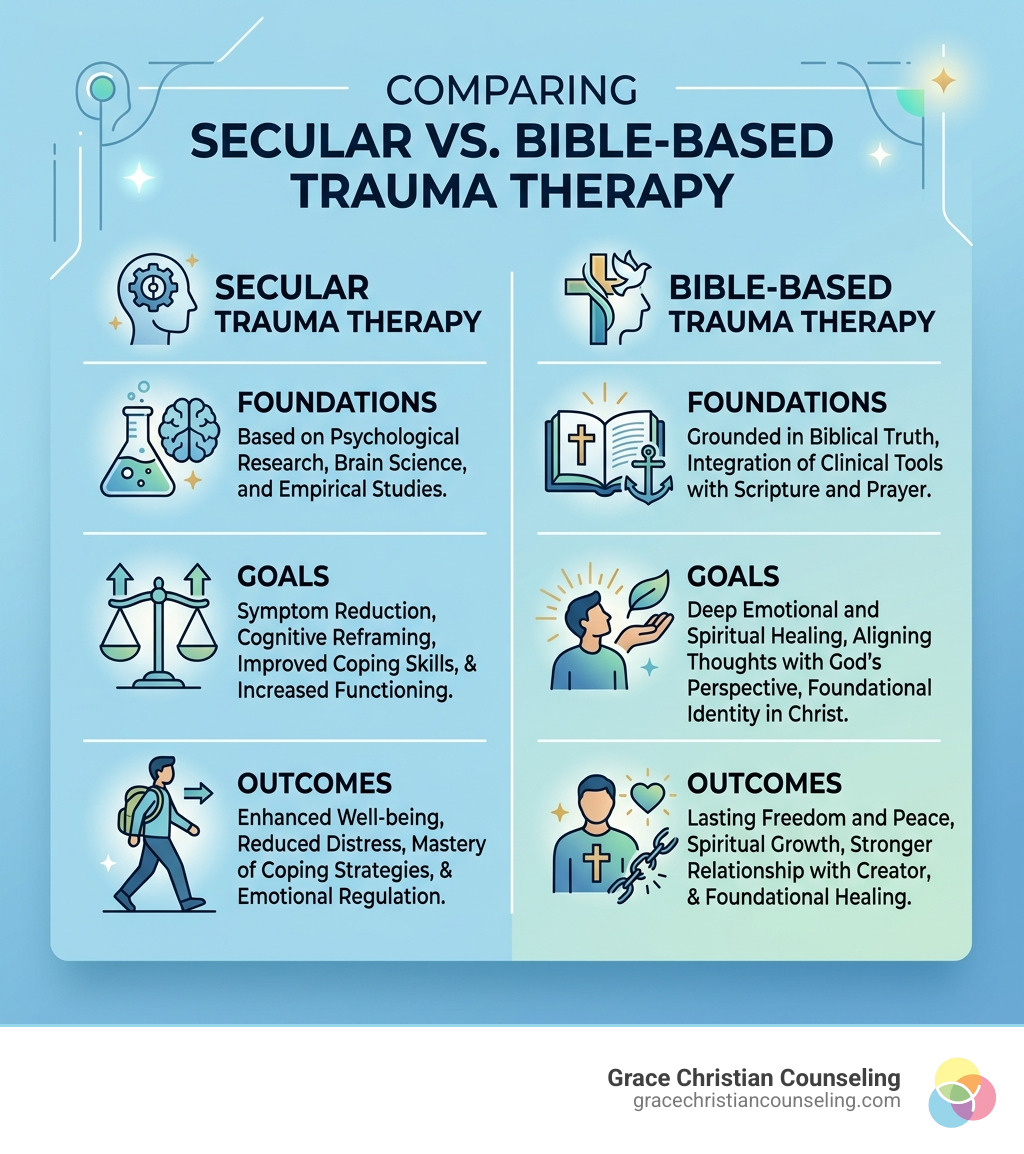
What is the difference between secular and Bible-based trauma therapy?
Secular therapy is often limited to the horizontal dimension: the relationship between you, your brain, and your environment. While helpful, it can miss the vertical dimension of your relationship with God. Bethel Park Bible based trauma therapy integrates both.
We use the best clinical tools available while acknowledging that ultimate healing and identity come from our Creator. We do not just want you to function better. We want you to thrive in the life God intended for you.
How do I know if I need trauma-specific counseling?
If you find yourself stuck in the past, if your reactions to present events seem disproportionately large, or if you feel a persistent sense of numbness or fear, you may be experiencing the effects of trauma. Even if you do not have a major event in your history, chronic neglect, bullying, betrayal, or spiritual harm can still have a significant impact. If your current coping mechanisms, such as withdrawal, anger, or over-working, are not working anymore, it may be time to reach out.
Are sessions available in-person in Bethel Park or online?
Yes. We believe that counseling should be accessible. We offer in-person sessions at several locations, including Bethel Park, often hosted at New Song Community Church.
For those who cannot make it in person or live elsewhere in Pennsylvania, our online counseling platform provides the same high-quality, Christ-centered care from the comfort and privacy of your home. Most sessions last about 50 minutes, though we can adjust based on your specific needs. Our care team can help you determine which option best fits your situation.
Conclusion: Your Journey Toward Restoration
In our experience, meaningful trauma recovery often happens through a combination of professional support, healthy relationships, and personal spiritual growth. Clients do not need to choose between clinical care and faith. Evidence-based therapy can provide tools for healing while a relationship with God offers hope, identity, and meaning throughout the process.
Our role as counselors is to walk alongside each person with compassion, humility, and respect for their unique story. Whether you are dealing with the echoes of childhood abuse, the sharp pain of a recent loss, or the confusing fog of spiritual trauma, there is a path forward. You do not have to carry it alone.
At Grace Christian Counseling, we are honored to serve the Bethel Park community. Our team of licensed professionals is passionate about combining clinical expertise with a deep love for Jesus. We provide a safe, sacred space where you can unpack your pain and begin the work of restoration.
We serve Western Pennsylvania with locations in Bethel Park, Mt. Lebanon, North Huntingdon, and beyond. If you are ready to take that first step, we are ready to walk with you. You can reach out today and let our care team help you find the right counselor.
How to Get Started:
- Visit our Bethel Park page: Bethel Park Christian Counseling
- Explore our Pittsburgh services: Pittsburgh Christian Counseling
- Contact Us Online: Connect with Grace Christian Counseling
Let faith be the beacon that lights your path. With God, every step leads closer to the peace and healing you were meant to have. We look forward to hearing from you.
This guide is for educational and spiritual encouragement and is not a substitute for personalized professional counseling. If you are in crisis, please reach out for immediate help.
How Faith and Therapy Meet in Bethel Park


