

When Worry Won’t Let Go: What the Bible Says About Anxiety
Bible based anxiety help is rooted in Scripture’s consistent message that God invites us to bring every fear, worry, and overwhelming thought directly to Him, and that He meets us there with a peace that goes beyond what we can understand.
Here is a quick overview of what that looks like in practice:
- Recognize the difference between healthy concern and runaway worry. (Matthew 6:25-34)
- Bring it to God through honest prayer with thanksgiving. (Philippians 4:6-7)
- Redirect your thoughts to what is true, good, and trustworthy. (Philippians 4:8)
- Examine your heart to see what your anxiety may be revealing about your deepest values. (Matthew 6:21)
- Seek support through community, Scripture, and, when needed, a trained Christian counselor. (Galatians 6:2 and Proverbs 11:14)
Anxiety does not ask permission. It shows up at 2 a.m. It hijacks a perfectly good afternoon. It can quietly drain your energy, disrupt your sleep, and make even ordinary days feel heavy. You are not alone in this.
Anxiety is more common than many people realize. According to the National Institute of Mental Health (NIMH), about 19.1% of U.S. adults experience an anxiety disorder in a given year, and 31.1% experience one at some point in their lives. For some, anxiety also creates serious difficulty in daily life, affecting sleep, relationships, work, concentration, and the ability to enjoy ordinary responsibilities. Anxiety disorders are among the most common mental health concerns in the United States, and Christians are not immune. Symptoms can show up in visible and hidden ways, including disrupted sleep, fatigue, irritability, concentration difficulties, and physical tension. If anxiety is interfering with daily life, a thorough clinical assessment can be an important step toward wise, compassionate care.
The good news is that Scripture does not ignore this struggle. From the Sermon on the Mount to the letters of Paul, the Bible speaks directly and honestly about fear, worry, and the path toward genuine peace. And at Grace Christian Counseling, we believe that path is best walked when biblical truth and clinical wisdom work together.
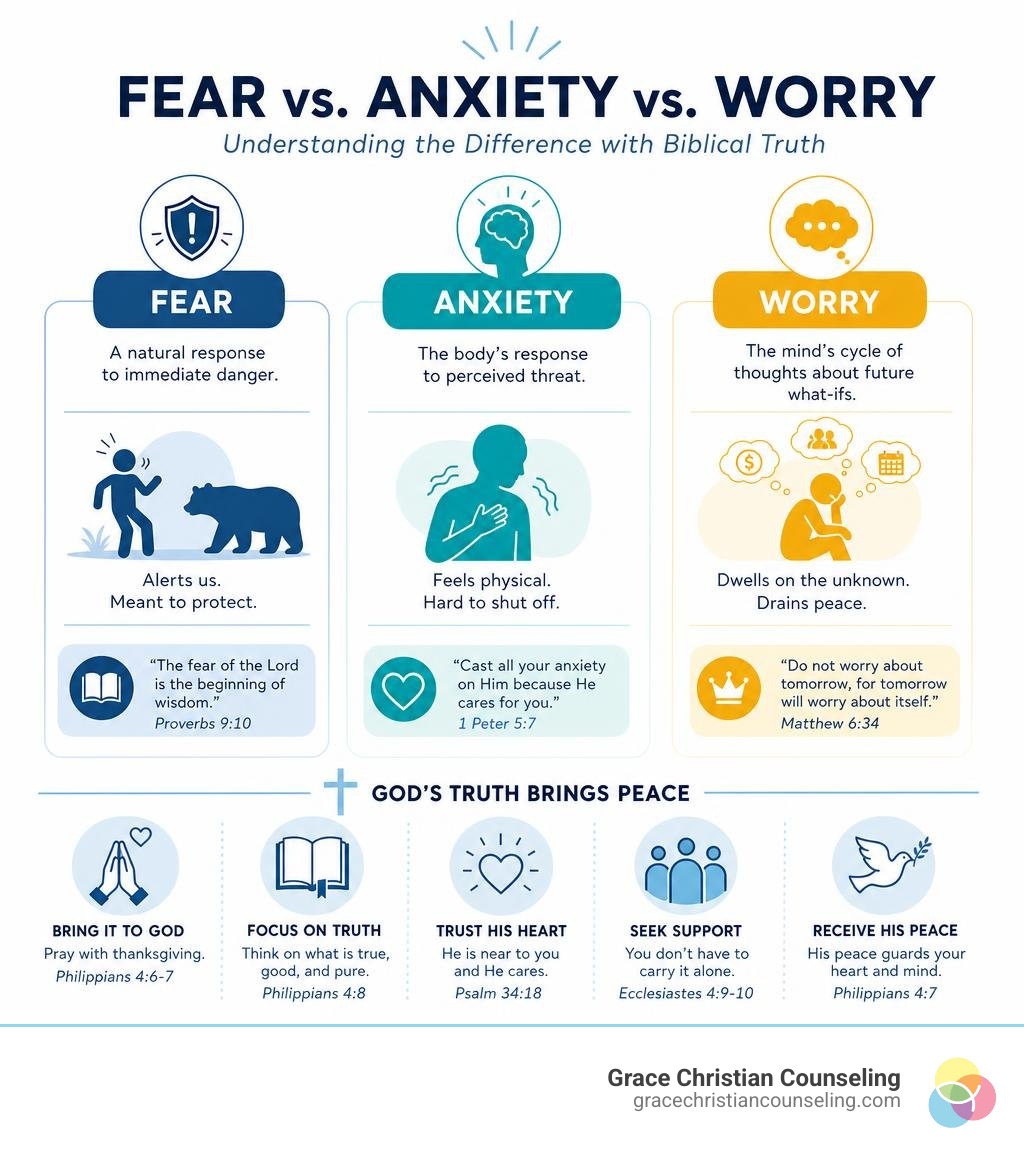
Understanding the Root Causes of Anxiety and Worry in Scripture
To find lasting relief, we must first understand what we are dealing with. Scripture draws a clear distinction between a natural, God-given warning system and the kind of worry that paralyzes us. Fear is a natural emotional alert to immediate danger; anxiety is our physical body’s response to that perceived threat; and worry is the cognitive thought process that dwells on and expands the fear.
To dig deeper into this distinction, we can look at the etymology of these words. The English word “anxiety” traces back through Latin concepts connected with distress and constriction, including roots related to choking or tightness. This is exactly what worry does to our joy; it chokes out our peace.
In the Greek New Testament, the word often translated as worry or anxiety is merimnao, which literally means “a divided mind.” When we worry, our minds are pulled in different directions, leaving us feeling fractured and unstable. This division of heart often points to a deeper struggle, serving as a diagnostic tool that reveals what we are holding onto too tightly.
When we experience persistent worry, it often acts as a window into our hearts, showing us what we currently value or fear losing. It might be our financial security, our reputation, or the safety of our family. While these are good and legitimate cares, they become sources of deep anxiety when we begin to build our ultimate security on them. By recognizing this, we can begin to seek Scripture-Based Anxiety Relief: A Christian Guide to help reorient our hearts toward God’s eternal promises.
How Jesus Addressed Fear and Worry in the Gospels
During His earthly ministry, Jesus spent a significant amount of time addressing the anxieties of everyday life. He did not dismiss the real needs of His followers; instead, He placed those needs in the context of a loving, sovereign Father. In the Sermon on the Mount, found in Matthew 6:25-34, Jesus commanded His disciples multiple times not to be anxious.
He pointed to the natural world to illustrate His point, asking His followers to look at the birds of the air and the lilies of the field. The birds do not store up food in barns, yet their heavenly Father feeds them. The lilies do not spin wool, yet they are clothed in beauty that surpasses the glory of Solomon. Jesus used these simple examples to show that if God cares so meticulously for nature, He will certainly care for us, His children.
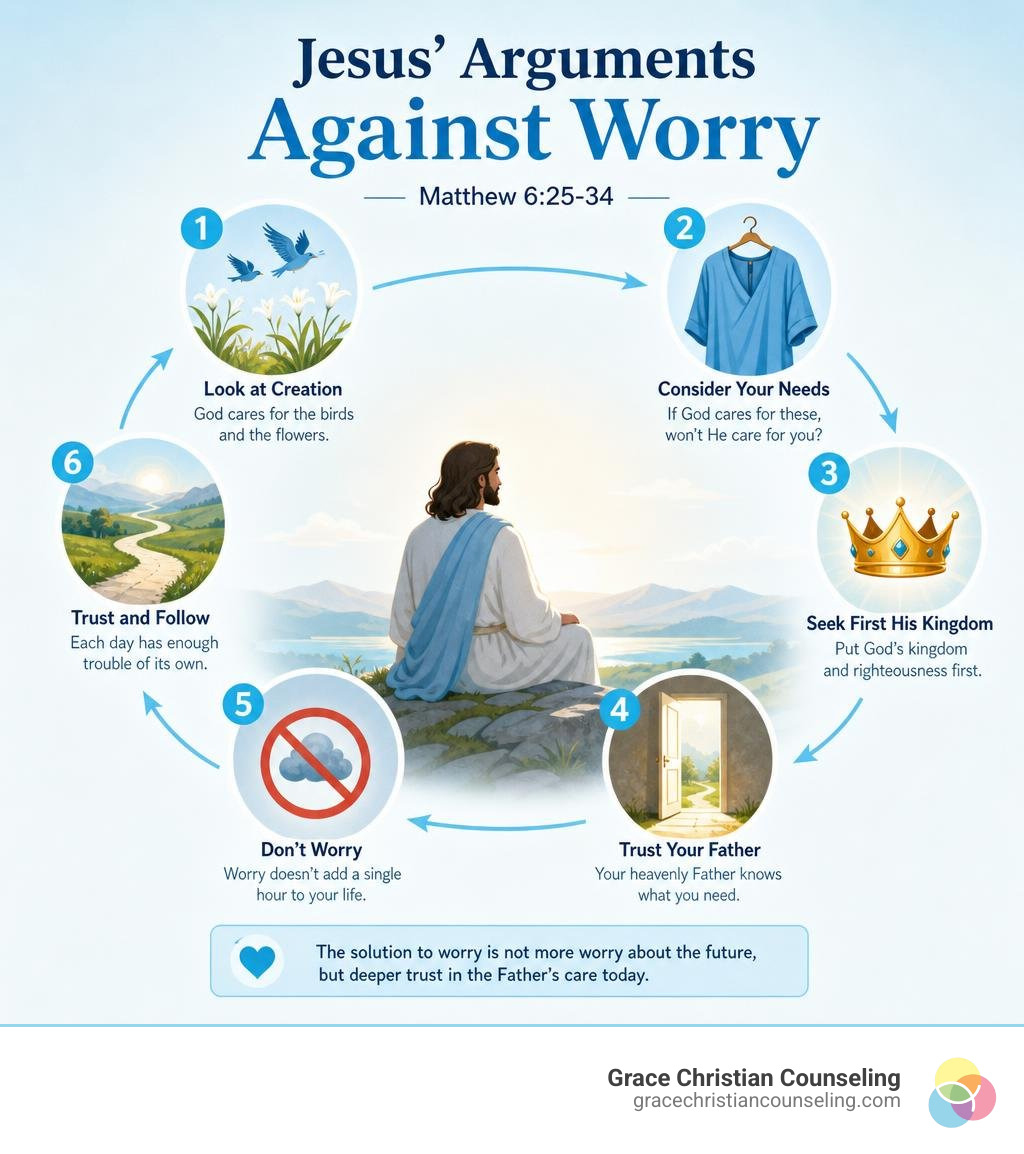
Jesus provided logical, structured arguments to help us dismantle our anxious thoughts. He reminded us that worry is completely ineffective, asking, “Which of you by being anxious can add a single hour to his span of life?” He exposed worry as a form of practical unbelief, showing that when we live in constant dread, we are acting as if we do not have a Father who knows our needs.
By studying these teachings, we learn How to Deal with Anxiety as a Christian by actively preaching these truths to our own hearts. Instead of allowing our emotions to dictate our reality, we can use Jesus’ words to remind ourselves of God’s past faithfulness and His promised future grace.
Practical Steps for Accessing Bible Based Anxiety Help Daily
Overcoming daily anxiety is not about a one-time decision; it is about establishing healthy, faith-filled rhythms. Just as our bodies need daily food and rest, our minds need daily spiritual grounding.

One of the most helpful concepts we can practice is “staying in our box.” This means focusing strictly on the responsibilities and challenges of the current day, rather than projecting our minds into tomorrow’s potential storms. Jesus summarized this beautifully when He said that tomorrow will be anxious for itself, and that sufficient for the day is its own trouble. When we try to solve tomorrow’s problems today, we are trying to run tomorrow’s challenges on today’s grace, which is a recipe for exhaustion.
To build these daily habits, we can use structured resources and biblical reflections. You can explore Overcoming Anxiety and Fear to find practical ways to ground your thoughts when you feel overwhelmed. Additionally, keeping a list of 10 Comforting Bible Verses for Depression and Anxiety nearby can provide immediate comfort when anxious thoughts begin to spiral.
Finding Peace Through Prayer and Bible Based Anxiety Help
The Apostle Paul provided a clear, step-by-step model for managing anxiety in his letter to the Philippians. In Philippians 4:6-7, he wrote, “do not be anxious about anything, but in everything by prayer and supplication with thanksgiving let your requests be made known to God.”
The inclusion of “thanksgiving” is the active ingredient in this passag. When we pray with gratitude, we are not just asking God for help; we are actively remembering His past faithfulness. This shift in focus changes our perspective, helping us realize that the God who came through for us in the past will not abandon us today.
When we practice this kind of prayer, God promises that His peace, which surpasses all human understanding, will guard our hearts and minds in Christ Jesus, as Paul writes in Philippians 4:6-7. The Greek word translated “guard” is phroureo, a term associated with keeping watch or guarding. God’s peace acts like an offensive line, shielding our minds from the chaotic thoughts that try to invade. To help reinforce this mental shield, you can study Mind Over Matter: Encouraging Scriptures for Mental Strength to keep your thoughts anchored in truth.
Redirecting Your Focus by Serving Others
Anxiety is inherently inward-focused; it turns our attention completely onto ourselves, our fears, and our comfort. While these feelings are very real, staying locked in this self-focused loop can keep us feeling isolated and paralyzed.
One of the most effective biblical strategies for breaking this cycle is to redirect our energy outward through acts of compassion and service. As explored in the article The Root of Anxiety and How to Fight It, actively serving others helps quiet our inner chaos. By focusing on the needs of those around us, we find renewed purpose and interrupt the toxic, spiraling thought patterns that feed our anxiety.
This does not mean we ignore our own struggles; rather, it means we choose to engage with our community even when we feel weak. Whether it is volunteering at a local food pantry in Western Pennsylvania, writing an encouraging note to a friend, or helping a neighbor, outward service reminds us that we are part of a larger body and that God can use us to bring hope to others.
Integrating Faith and Clinical Wisdom for Anxiety Relief
At Grace Christian Counseling, we believe that true healing involves the whole person, addressing our physical, psychological, and spiritual needs. God has designed our bodies and minds with incredible complexity, and sometimes, finding relief requires combining biblical truth with evidence-based clinical practices.

One clinical approach that aligns beautifully with Scripture is Acceptance and Commitment Therapy, commonly known as ACT. Rather than trying to fight or suppress every anxious thought, ACT teaches us to accept our emotions as passing experiences, while committing to actions that align with our deepest values. This parallels the biblical concept of “taking every thought captive,” allowing us to observe our thoughts without letting them control our behavior.
Professional help can make a meaningful difference when anxiety becomes difficult to manage on your own. In one NIMH-funded study of more than 1,000 adults receiving care for anxiety, about 64% of people receiving a coordinated treatment approach showed a meaningful improvement after 12 months, compared with about 45% receiving usual care. Treatment included options such as cognitive behavioral therapy (CBT) and medication, depending on the person’s needs and preferences. This does not mean everyone with anxiety needs medication or therapy. It simply shows that seeking professional support can be an effective and appropriate part of caring for your mental health while continuing to rely on Scripture, prayer, and your faith community.
Another key component is replacing secular mindfulness with the biblical practice of watchfulness. While mindfulness often focuses on a passive awareness of the present moment, watchfulness is an active, spiritual attentiveness. It involves staying alert to God’s presence, meditating on His character, and guarding our hearts against unhelpful beliefs. If you live in Western PA, you can read more about how this integration works by visiting Uniontown Anxiety Relief Rooted in the Word.
When To Seek Professional Bible Based Anxiety Help
It is important to recognize when everyday worry has developed into a more serious clinical struggle. When anxiety begins to interfere with your ability to work, sleep, care for your family, or participate in daily life, it is time to seek professional support. Severe symptoms like panic attacks, chronic insomnia, or persistent physical tension are real medical and psychological challenges that deserve compassionate, professional care.
Seeking counseling is not a sign of weak faith; in fact, it is a courageous step of stewardship over the life and mind God has given you. Our licensed counselors are trained to help you navigate these complex struggles. We provide a safe, non-judgmental space where you can explore your challenges and find practical coping tools.
If anxiety is making daily life harder, Christian anxiety counseling at Grace pairs proven approaches like CBT, ERP, and EMDR with your faith, in person or online.
Frequently Asked Questions about Biblical Anxiety Relief
Is anxiety considered a sin in the Bible?
Anxiety itself is a natural human response to a broken, unpredictable world, and experiencing it is not a sign of spiritual failure. Even the biblical prophets, the apostles, and Jesus Himself in the Garden of Gethsemane experienced deep emotional weight and distress.
However, the Bible gently warns us against letting worry take root and control our lives. The sin of worry occurs when we allow our fears to make us double-minded, turning our trust away from God and trying to carry the burden of the future on our own. When this happens, God does not meet us with condemnation; instead, He invites us to bring our weakness to Him, reminding us in 1 Peter 5:7 to “cast” our cares on Him, which literally means to forcefully throw them off because He cares for us.
How does understanding God’s sovereignty reduce daily worry?
Worry is almost always tied to our demand for control over the future. When we realize that we cannot control our health, our finances, or our external circumstances, we naturally feel anxious.
Understanding God’s absolute sovereignty changes this dynamic by reminding us that while we are not in control, someone who loves us is. Believing that God is meticulously involved in the details of our daily lives allows us to rest in His wisdom. We do not need to have all the answers or know how every situation will turn out, because we know the One who holds tomorrow.
Can a Christian take medication for anxiety while relying on Scripture?
Yes, a Christian can absolutely use medical interventions, including prescription medication, while fully relying on Scripture. Our physical bodies, including our brains and nervous systems, are subject to the physical brokenness of our world, and chemical imbalances or nervous system dysregulation can cause intense feelings of panic and anxiety that prayer alone may not immediately resolve.
Just as a Christian would take medication for diabetes or a heart condition, taking medication to help regulate your nervous system is a valid medical tool. Medication is not a spiritual cure, but it can help lower your physical anxiety symptoms to a level where you can engage more effectively with Scripture, prayer, and professional counseling.
Walking the Path to Peace Together
If you are tired of carrying the heavy weight of worry on your own, please know that you do not have to walk this path in isolation. At Grace Christian Counseling, we are dedicated to helping individuals, couples, and families across Western Pennsylvania and statewide virtually find genuine healing.
Our approach is guided by our Counseling Blueprint, a compassionate, four-stage journey designed to help you reclaim your peace:
- Take Off the Mask: We begin by building a genuine, trusting relationship where you can be completely honest about your struggles.
- Heal the Wounds: Together, we explore the emotional, physical, and relational hurts that may be fueling your anxiety.
- Remove the Toxins: We help you identify the unhelpful beliefs, coping mechanisms, and lingering lies that keep you feeling stuck.
- Replace with Truth: Finally, we work to install empowering, accurate perspectives about yourself, others, and the world based on God’s unchanging truth.
Whether you prefer in-person sessions in Western PA communities like Pittsburgh, North Huntingdon, Penn Hills, Uniontown, Bethel Park, Sewickley, or Mt. Lebanon, or you prefer the convenience of online counseling throughout Pennsylvania, West Virginia, Georgia, and Florida, we are here to support you.
If you are ready to take the next step toward a calmer, more peaceful life, we invite you to reach out to us today. Learn more about our approach and connect with a licensed counselor by visiting our Christian Counseling Services page.
This guide is for educational and spiritual encouragement and is not a substitute for personalized professional counseling. If you are in crisis, please reach out for immediate help.
Christian Depression Counseling


