

You Don’t Have to Keep Questioning Your Own Reality
If you are looking for narcissistic abuse recovery therapy near me, here is a quick summary of what to know and where to start:
How to find narcissistic abuse recovery therapy near you:
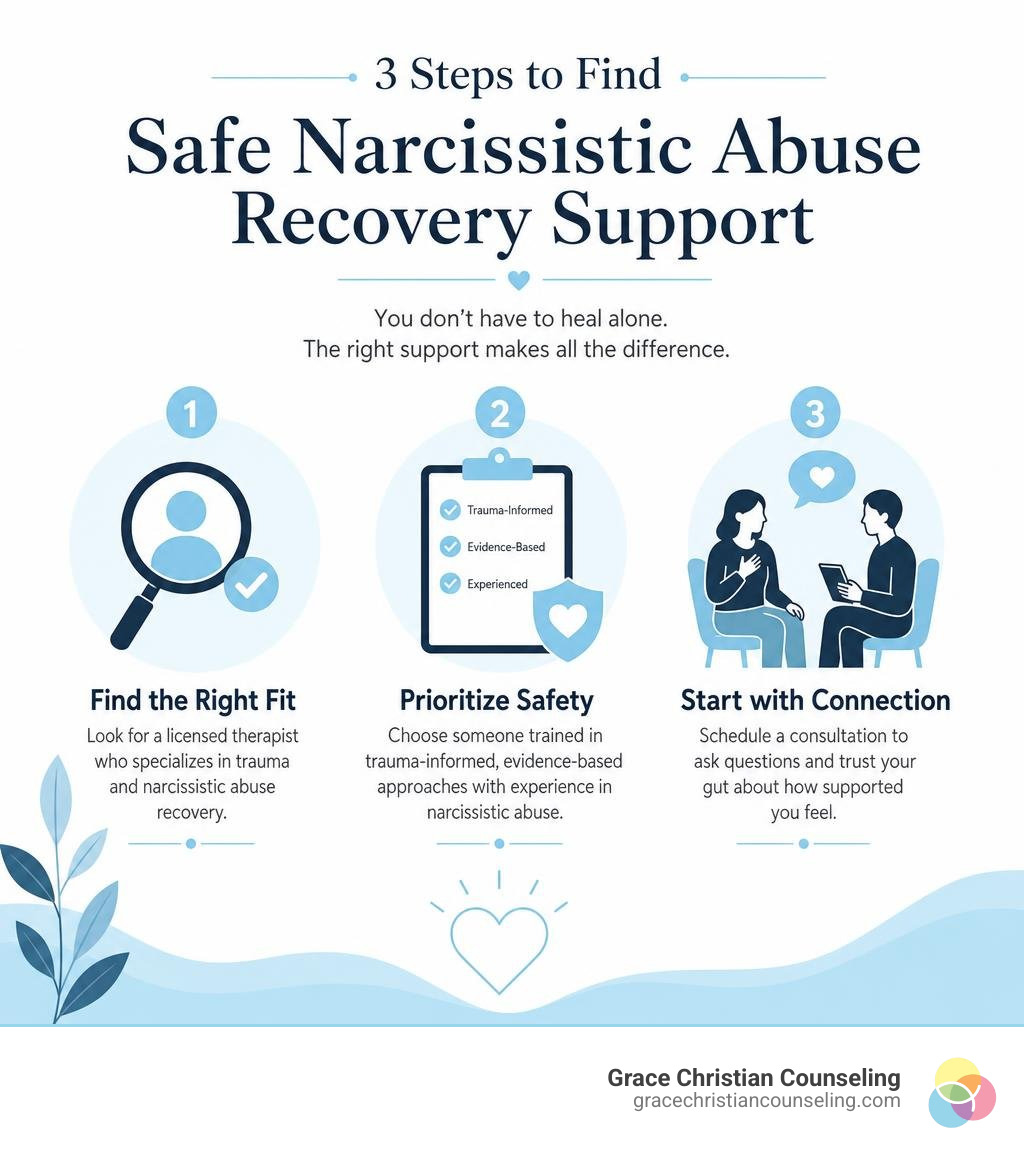
- Search for a licensed counselor (LPC, LAPC, LSW, LCSW, LMFT, etc.) who specializes in trauma and relational abuse, not just general therapy.
- Look for therapists trained in trauma-informed modalities such as EMDR, CBT, or Internal Family Systems (IFS).
- Ask specifically about experience with narcissistic abuse, trauma bonding, and Complex PTSD.
- Consider both in-person options in Western Pennsylvania (Pittsburgh, North Huntingdon, Penn Hills, and surrounding areas) and online counseling, which is equally effective for many survivors.
- Schedule a free consultation to assess whether the therapist’s approach feels safe and validating.
At Grace Christian Counseling, we offer Christ-centered, evidence-based counseling for survivors of narcissistic and relational abuse, both in-person across Western Pennsylvania and online.
There were moments that felt real and even wonderful. Then there were moments that left you feeling small, confused, and ashamed. And now you lie awake at night replaying conversations, asking yourself: Was I the problem? Were my feelings even reasonable?
That cycle of self-doubt is not a personal failing. It is one of the most recognized signs of narcissistic abuse, and it is exactly why recovery is so difficult without the right support.
Narcissistic abuse does not always leave visible marks. It works slowly, eroding your sense of reality, your confidence, and your trust in your own judgment. Prolonged interpersonal trauma can contribute to symptoms such as hypervigilance, shame, difficulty regulating emotions, negative beliefs about yourself, and relationship difficulties. Complex PTSD (C-PTSD) is recognized as a diagnosis in the ICD-11, although it is not a separate diagnosis in the DSM-5-TR used widely in the United States. The National Center for PTSD explains that repeated interpersonal trauma is associated with complex trauma responses, but a qualified clinician should assess your individual symptoms rather than assuming a particular diagnosis.
Recovery is possible, and it begins with finding a therapist who truly understands what you have been through.
Understanding Narcissistic and Financial Abuse in Relationships
Relational trauma can develop gradually, sometimes making unhealthy or abusive patterns difficult to recognize at first. In our clinical experience, clients may describe repeated criticism, manipulation, emotional withdrawal, gaslighting, financial control, or other behaviors that have left them questioning themselves and their perceptions. These patterns go beyond ordinary relationship disagreements when they become part of an ongoing dynamic of intimidation, manipulation, or power and control. Recognizing what has been happening can be an important step toward rebuilding clarity, safety, and self-trust.
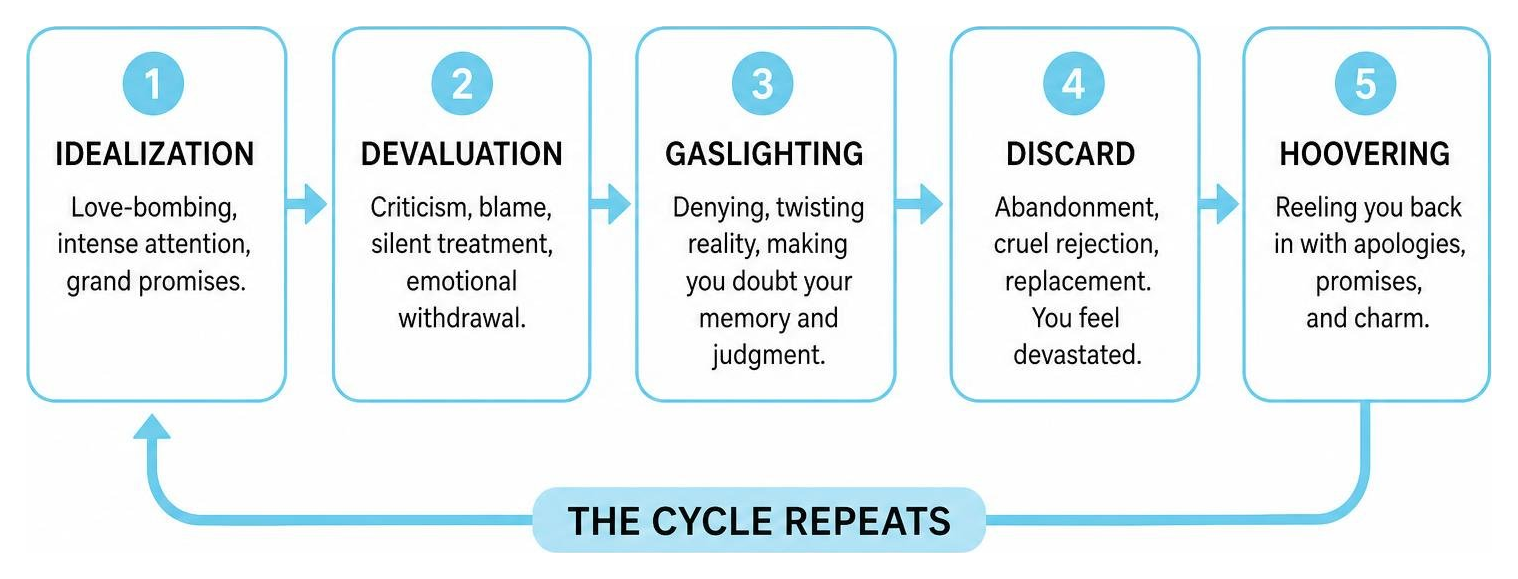
The process typically starts with love-bombing, which is an intense rush of affection, praise, and grand promises designed to make you feel incredibly safe and valued. Once your defenses are down, the dynamic shifts into devaluation, where you are suddenly met with harsh criticism, the silent treatment, and emotional withdrawal. This is often accompanied by gaslighting, a manipulation tactic that forces you to question your own memory, perception, and sanity. Eventually, the partner may initiate a cruel discard, abandoning you when they find a new source of validation, only to try and pull you back later.
When emotional manipulation is combined with financial exploitation, the level of coercive control increases significantly. Financial abuse involves a partner controlling your access to money, withholding assets, or exploiting your economic resources to keep you dependent. We often help clients realize that this financial entrapment is designed to prevent them from leaving or seeking professional help. To understand the full scope of these patterns, you can read our Detailed Guide to the Narcissistic Abuse Cycle.
The Cycle of Narcissistic Manipulation
The cycle of manipulation relies on keeping you off-balance so that you are constantly striving to regain the abuser’s approval. During the idealization phase, the partner mirrors your hopes and dreams, making you feel uniquely cherished. However, this phase is unsustainable and quickly gives way to subtle put-downs and the painful weaponization of your private insecurities.
When conflicts arise, the abuser will often use projection, accusing you of the very behaviors, selfishness, or anger that they are demonstrating. They may also use triangulation, bringing a third person into the dynamic, such as a family member or friend, to make you feel isolated and unreasonable. This continuous loop of highs and lows creates a powerful psychological bond that is incredibly difficult to break on your own.
Recognizing Financial Abuse and Coercive Control
Financial abuse is a highly effective tool of coercive control because it directly limits your physical and practical freedom. This can manifest as a partner hiding joint family assets, preventing you from working, or strictly monitoring every penny you spend. In more severe cases, we see survivors dealing with identity theft, where an abuser runs up massive debts in the victim’s name to ruin their financial independence.
Financial abuse is not uncommon in abusive relationships. The National Domestic Violence Hotline reports that financial abuse occurs in 99% of domestic violence cases and describes behaviors such as preventing a partner from working, restricting access to bank accounts, closely controlling spending, or damaging a partner’s credit. In 2022, nearly 1 in 3 survivors who contacted The Hotline reported financial abuse.
This economic exploitation is designed to make you feel entirely helpless and unable to survive without the relationship. You might find yourself apologizing for basic survival needs or feeling intense guilt whenever you attempt to protect your financial security. If you are struggling to break free from these patterns, we encourage you to explore our resources on Therapy for Overcoming Emotional Abuse.
The Psychological and Somatic Toll of Relational Trauma
Chronic stress and trauma can affect both emotional and physical well-being. Some people develop trauma-related symptoms such as hypervigilance, sleep difficulties, difficulty concentrating, irritability, or physical reactions to reminders of what they experienced. These responses can vary considerably from person to person. Over time, this prolonged stress manifests as physical exhaustion, chronic pain, digestive issues, and severe brain fog.
Survivors often experience a complex form of trauma known as Complex PTSD (C-PTSD), which stems from repeated, long-term interpersonal abuse. This condition is characterized by chronic self-doubt, intense hypervigilance, and persistent feelings of shame and helplessness. To learn more about how we address these deep-seated challenges, you can read about our approach to Trauma Therapy for Healing from Narcissistic Abuse.
The Reality of Complex PTSD and Misdiagnosis
Symptoms following prolonged relational trauma can overlap with symptoms seen in several mental health conditions, which is one reason careful assessment matters. Anxiety, hypervigilance, emotional dysregulation, shame, relationship difficulties, and changes in self-concept may occur following trauma, but similar symptoms can also appear in other conditions.
A trauma-informed clinician can consider a person’s symptoms, history, current circumstances, and functioning rather than assuming that every symptom is caused by trauma or that a previous diagnosis is necessarily incorrect. Complex PTSD (C-PTSD) is recognized in the ICD-11 and includes PTSD symptoms along with significant difficulties involving emotion regulation, self-concept, and relationships. It is not a separate diagnosis in the DSM-5-TR, which is commonly used in the United States.
This confusion is often worsened by a psychological process called projective identification. In this dynamic, the abusive partner projects their own disowned shame, rage, and instability onto you, manipulating you into reactively lashing out. The abuser then points to your reaction as proof that you are the unstable or abusive one in the relationship. This reactive abuse leaves you feeling deeply guilty, making specialized clinical assessment essential for sorting out what is truly happening.

How Trauma Bonds Affect the Nervous System
A trauma bond is a powerful psychological and physiological attachment that develops due to intermittent reinforcement. People can develop powerful attachments within abusive relationships, particularly when affection, fear, conflict, and reconciliation become intertwined. These patterns can make leaving or emotionally separating from the relationship extremely difficult, but they should not be reduced to a simple dopamine-driven ‘addiction.
Living with chronic fear, unpredictability, or relational stress can affect emotional and physical well-being. Some survivors may experience hypervigilance, sleep difficulties, irritability, difficulty concentrating, panic, fatigue, or physical stress symptoms. Trauma responses vary considerably, however, and not every survivor develops the same symptoms or a trauma-related disorder. Treatment should therefore be tailored to each person’s experiences, symptoms, safety, and goals. Depending on individual needs, treatment may include trauma-focused psychotherapy, coping and emotion-regulation skills, or other evidence-based approaches. There is no single treatment that every survivor of relational trauma needs.
Why Specialized Therapy is Essential for Recovery
Many survivors spend years reading books, watching videos, and listening to podcasts to make sense of their experience. While gaining cognitive insight is incredibly important, intellectual understanding alone is often not enough to heal the deeper somatic and emotional wounds. True recovery requires a structured, safe therapeutic relationship with a professional who understands the unique nuances of coercive control.
At Grace Christian Counseling, we know that healing from relational trauma requires specialized, trauma-informed care. We utilize evidence-based modalities designed to target both the cognitive lies you have internalized and the physiological stress stored in your body. If you are ready to begin this journey, we invite you to explore our services for Relationship Trauma Therapy Near Me.
Why Trauma-Informed Counseling Matters in Narcissistic Abuse Recovery Therapy Near Me
Finding a therapist who understands trauma, coercive control, and abusive relationship dynamics can be especially important during recovery. When abuse is treated only as a mutual communication problem, important differences in power, control, intimidation, or safety can be overlooked. For some survivors, immediately approaching the situation as an ordinary couples conflict may therefore be inappropriate, particularly when coercion or fear is still present.
Trauma-informed counseling takes a different approach. Rather than assuming that one method fits every survivor, care emphasizes safety, trust, collaboration, empowerment, and individual choice. Therapy may include helping clients understand abusive patterns, strengthen boundaries, rebuild self-trust, address trauma-related symptoms, and determine which evidence-based treatments are appropriate for their individual needs. To learn more about how we protect and guide survivors, visit our page on Therapy for Overcoming Emotional Abuse.
Evidence-Based Modalities for Relational Trauma
Effective recovery therapy integrates a variety of clinically proven, trauma-informed modalities to address the whole person. Some of the most helpful approaches we utilize and recommend include:
- EMDR Therapy: Eye Movement Desensitization and Reprocessing helps your brain safely reprocess traumatic memories, reducing the emotional and physical distress associated with past abuse.
- Internal Family Systems (IFS): This approach helps you identify and heal the wounded, anxious, or self-critical “parts” of yourself that developed as survival mechanisms during the relationship.
- Gestalt Techniques: These creative, experiential exercises allow you to process unresolved grief, express unvoiced anger, and safely release stored emotional tension.
- Emotionally Focused Therapy (EFT): Used individually or in safe family dynamics, EFT helps you understand your attachment patterns and rebuild secure, healthy connections with yourself and others.
Finding the Right Narcissistic Abuse Recovery Therapy Near Me
When you are ready to take the courageous step of seeking professional support, finding a local therapist who truly understands your situation is vital. Whether you prefer meeting face-to-face in Western Pennsylvania or appreciate the convenience of online counseling, the right counselor will provide a safe, non-judgmental space. We believe in blending professional clinical expertise with the hope and healing found in Christ-centered care.
To help you decide which format best fits your current healing journey, we have put together a comparison of our local in-person therapy and statewide online counseling options:
| Feature | Local In-Person Therapy (Western PA) | Online Christian Counseling |
|---|---|---|
| Primary Benefit | Face-to-face connection in a dedicated, safe physical space. | Maximum convenience, flexibility, and comfort from your own home. |
| Availability | Available at our physical offices throughout Western Pennsylvania. | Available statewide in Pennsylvania, West Virginia, Georgia, and Florida. |
| Somatic Work | Excellent for in-person somatic exercises and grounding techniques. | Highly effective for guided somatic work and virtual EMDR sessions. |
| Privacy Level | Complete physical separation from your home environment. | Secure, confidential, HIPAA-compliant virtual platform. |
How to Choose the Best Narcissistic Abuse Recovery Therapy Near Me in Pennsylvania
If you live in Pennsylvania, finding a local therapist who is familiar with your community can make a significant difference in your comfort level. We are proud to offer dedicated, in-person counseling services across Western Pennsylvania, including Pittsburgh, Penn Hills, Uniontown, Pleasant Hills, Bethel Park, Ligonier, Belle Vernon, Punxsutawney, North Huntingdon, Mt. Lebanon, and Sewickley.
For those seeking specialized local directories, you can explore professional listings for Narcissistic Personality (NPD) Therapists in Pennsylvania. If you reside in specific areas, you can also look into localized professional listings to find therapists and psychologists in Penn Hills, PA or Uniontown, PA.
Evaluating Credentials and Specialized Training
As you search for a qualified professional, it is important to understand the credentials of the person you are trusting with your recovery. Look for licensed professionals such as a Licensed Professional Counselor (LPC), a Licensed Associate Professional Counselor (LAPC), or a Licensed Clinical Social Worker (LCSW). These individuals have completed rigorous graduate education and supervised clinical hours, ensuring they have the necessary training to handle complex trauma.
When interviewing a potential therapist, do not hesitate to ask about their specific experience with relational trauma, coercive control, and narcissism. You want to ensure they have practical clinical experience working with survivors and are trained in trauma-focused modalities. This specialized knowledge is what prevents the accidental invalidation that so many survivors unfortunately experience in general therapy.
The Counseling Blueprint: Our Phased Approach to Healing
At Grace Christian Counseling, we believe that true, lasting recovery is a journey that must address your spiritual, emotional, and psychological well-being. To guide you through this process, we use a structured, four-stage framework called the Counseling Blueprint. This approach ensures you are never rushed through your trauma, allowing you to build a firm foundation of safety before moving into deeper emotional work.
We blend evidence-based clinical psychology with the timeless truths of Scripture to help you reclaim your identity and peace. To see how this structured journey is organized, you can read our Step-by-Step Guide to Narcissistic Abuse Therapy.
Stage 1 and 2: Take Off the Mask and Heal the Wounds
The first stage of our blueprint, Take Off the Mask, is entirely about building genuine rapport, safety, and trust. After years of hiding your pain and walking on eggshells, we provide a safe space where you can drop your guard and speak your truth without fear of judgment. We validate your experiences, helping you understand that the confusion and self-doubt you feel are normal responses to an abusive dynamic.
Once safety is established, we move into Heal the Wounds, where we gently explore the emotional and relational hurts left by the abuser. We address the physical symptoms of trauma, utilizing somatic techniques and EMDR to help calm your overactive nervous system. During this stage, we find great comfort in bringing our anxieties to God, reflecting on the peace promised in Philippians 4:6-7, which reassures us that His peace guards our hearts and minds.
Stage 3 and 4: Remove the Toxins and Replace with Truth
In the third stage, Remove the Toxins, we work together to identify and dismantle the unhelpful beliefs and lingering lies you internalized during the relationship. Narcissistic abuse often leaves you believing that you are worthless, selfish, or entirely responsible for the abuser’s anger. We help you systematically untangle these toxic messages, separating the abuser’s projections from your true character.
Finally, in Replace with Truth, we focus on installing empowering, accurate perspectives about yourself, others, and the world. We help you rebuild your identity in Christ, anchoring your self-worth in God’s unconditional love rather than the shifting approval of a toxic person. As you step into this final stage of empowerment, you may find encouragement in our article, When a Narcissist Tries to Destroy a Christian.
Frequently Asked Questions About Narcissistic Abuse Recovery
When survivors begin looking for narcissistic abuse recovery therapy near me, they often have many questions about what the healing process looks like. It is completely normal to feel uncertain or hesitant about starting therapy. Below, we have answered some of the most common questions we hear from clients as they take their first steps toward recovery.
How long does recovery from narcissistic abuse typically take?
The recovery timeline is highly individual and depends heavily on the duration and severity of the abuse, as well as your personal history. There is no standard timeline for recovering from emotional or relational abuse. The process can vary depending on factors such as the duration and severity of what you experienced, whether you are still in contact with the person, your current safety and support system, and the symptoms you are working through.
In our experience, some clients begin to feel relief simply from having their experiences understood and gaining language for patterns that have left them confused or questioning themselves. Deeper trauma recovery, however, usually unfolds gradually and looks different for each person. Therapy work involving trauma, identity, boundaries, relationship patterns, or long-standing emotional wounds may take more time. Rather than measuring recovery against a fixed timeline, you and your counselor can regularly evaluate your progress, goals, and changing needs.
Can therapy help if I am still in contact with the abuser?
Yes, absolutely. You do not need to have completely left the relationship or cut off all contact to benefit from therapy. Many survivors must maintain ongoing contact due to co-parenting, shared business assets, or complex family dynamics.
In therapy, we will help you establish firm emotional boundaries and learn practical strategies, such as parallel parenting, to protect your mental health. We focus on helping you stay grounded and reducing your emotional reactivity, allowing you to maintain your peace of mind even when you must engage with the abuser.
What should I expect during my first therapy session?
Your initial session is focused on building a safe therapeutic alliance and helping you feel heard and validated. We will conduct a gentle initial assessment of your current situation, prioritize safety planning if necessary, and discuss your personal goals for recovery. You will never be forced to share details of your trauma before you feel ready; we work entirely at a pace that feels comfortable and secure for you.
Take the Next Step Toward Clarity and Peace
Recovering from the psychological and financial toll of narcissistic abuse is a challenging journey, but you do not have to walk this path alone. At Grace Christian Counseling, we are dedicated to providing compassionate, Christ-centered care that blends evidence-based clinical psychology with biblical truth. Our licensed counselors are here to support you whether you prefer in-person sessions in Western Pennsylvania or the flexibility of online therapy.
If you are ready to stop questioning your reality and begin rebuilding your confidence, self-trust, and peace, we encourage you to take the next step. You can explore additional pastoral counseling as well as other health and wellness resources at NuWellonline.com. Let us walk alongside you as you heal your wounds and step into the beautiful life God has planned for you. Learn more about taking your life back by visiting our guide on Therapy for Overcoming Emotional Abuse.
This guide is for educational and spiritual encouragement and is not a substitute for personalized professional counseling. If you are in crisis, please reach out for immediate help.


