

Why So Many Christians Struggle with Boundaries (And What to Do About It)
Christian boundary setting counseling helps believers develop healthy emotional, spiritual, and relational boundaries while addressing the guilt, fear, and relationship patterns that often make saying “no” feel unfaithful.
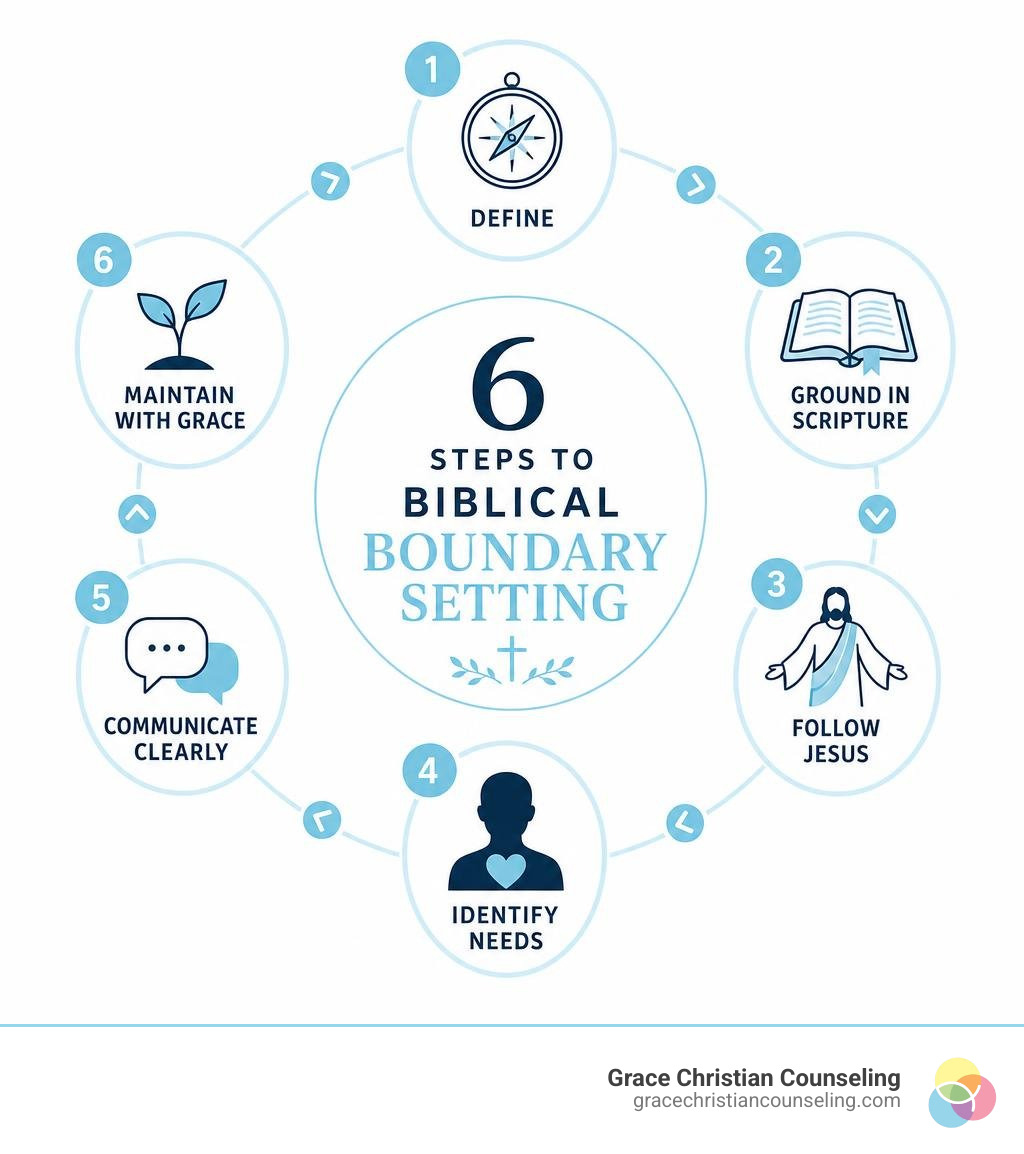
Here is a quick overview of what biblical boundary setting involves:
- Understand what boundaries are. Boundaries are guidelines that tell you and others what is okay and what is not okay in a relationship.
- Ground them in Scripture. Setting limits is not selfish; it is an act of stewardship rooted in God’s design.
- Follow Jesus’ example. Jesus regularly withdrew to pray, said no to inappropriate demands, and prioritized his Father’s will over people’s expectations.
- Identify your needs and values. Self-awareness is the first step. Notice when you feel resentful, drained, or afraid, because those feelings often signal a boundary is needed.
- Communicate clearly and kindly. Use calm, specific language that reflects both grace and truth.
- Get support. A licensed Christian counselor can help you work through the guilt, fear, and relational patterns that make boundaries feel impossible.
If you have ever said yes when every part of you wanted to say no, you are not alone. Many Christians struggle to set healthy boundaries because they fear conflict, feel responsible for others’ emotions, or worry that saying “no” is unloving. A 2023 Barna Group study found that 54% of practicing Christians reported experiencing at least one relational or emotional challenge affecting their relationships. While the study did not specifically examine boundary-setting, it highlights how common relational struggles are among believers and why learning healthy patterns of communication, responsibility, and emotional awareness matters.
That tension is real. And it is exhausting. When you keep giving from an empty place, the result is not more love; it is resentment, burnout, and spiritual disconnection. Mental health professionals also recognize that healthy boundaries are an important part of emotional well-being. The American Psychological Association explains that boundaries help people communicate their needs, protect their time and energy, and create healthier patterns in relationships. Learning to set appropriate limits is not a rejection of love or compassion; it is part of building relationships that are respectful, sustainable, and emotionally healthy.
Parents carrying these patterns across home, work, church, and extended family may also benefit from counseling designed for parents who need space to address their own well-being.
The good news is that boundaries and love are not opposites. In fact, the Bible points toward both. The challenge is learning how to hold them together, and that is exactly what this guide is here to help you do.
Reconciling Love and Limits: A Biblical Framework for Boundaries
At Grace Christian Counseling, many clients who seek help with boundaries do not initially describe their struggle as a boundary issue. They often come in feeling overwhelmed, resentful, anxious, or exhausted. As counseling explores these concerns, boundary patterns frequently emerge as an underlying factor.
To build a healthy relational life, we must first address a common misconception; the idea that setting limits is inherently unchristian. Many of us grew up believing that to follow Christ means accepting unlimited demands, sacrificing our well-being at every turn, and never saying no. However, when we look closely at Scripture, we discover a beautiful balance between loving others and honoring our human limitations.

The Bible teaches that we are finite creatures. We have limited time, energy, and emotional capacity. Trying to live as if we have no limits is not holy; it is an act of pride that ignores how God designed us. When we overextend ourselves to the point of exhaustion, we are no longer serving out of love; we are serving out of obligation, fear, or a desire for control.
A central passage that helps us understand this balance is found in Paul’s letter to the Galatians. In Galatians 6:2-5, we are given two distinct instructions that seem contradictory at first glance. Verse 2 tells us to “bear one another’s burdens,” while verse 5 states that “each will have to bear his own load.”
In the original Greek, these verses use two different words for what is being carried. The “burden” in verse 2 refers to an overwhelming weight, like a heavy boulder, that a person cannot carry alone; this is where we are called to step in and offer sacrificial help. The “load” in verse 5, however, refers to a soldier’s daily pack; this represents our individual responsibilities, daily duties, and personal choices.
Healthy boundaries help us distinguish between a boulder and a backpack. If we try to carry someone else’s daily backpack, we enable their irresponsibility and exhaust ourselves. If we refuse to help someone lift an overwhelming boulder, we fail to show Christ-like love. As discussed in Boundaries in Counseling on YouTube, setting biblically sound limits is not about self-protection; it is about pleasing God and stewarding our lives so we can fulfill our unique callings.
How Jesus Modeled Healthy Boundaries in His Ministry
If we want to know what holy boundaries look like in action, we only need to look at the life of Jesus. Though he was the Savior of the world, he did not meet every demand, heal every sick person, or please every crowd. He accepted his physical limits as part of his incarnation, and he modeled how to live a balanced, God-honoring life.
First, Jesus prioritized rest and intimacy with his Father over the constant demands of the crowd. In Luke 5:16, we read that “he would withdraw to desolate places and pray.” He did not wait until everyone was satisfied to take a break; he walked away from pressing needs because he knew his spiritual health depended on connection with God.
Second, Jesus was comfortable saying no to inappropriate demands. In Mark 1:35-39, after a long night of healing people in Capernaum, his disciples found him praying and told him that everyone was looking for him. Instead of returning to heal more people, Jesus said, “Let us go on to the next towns, that I may preach there also, for that is why I came out.” He said no to a good thing (healing more people in Capernaum) to say yes to his primary mission.
Jesus also set clear expectations for those he helped. He did not let people manipulate or control him. When people approached him with entitlement, he spoke the truth in love; sometimes challenging them to take responsibility for their own lives. For those in ministry or caregiving roles, understanding this pattern is essential. Biblically speaking, we cannot serve as effectively if we do not follow Christ’s pattern of regular rest, clear priorities, and intentional limits.
When the pressure of caring for someone else is affecting your own emotional or spiritual health, counseling for the emotional strain of caregiving can provide a focused next step.
Overcoming the Guilt of Saying No with Christian Boundary Setting Counseling
Even when we understand the biblical basis for limits, the actual practice of setting them can trigger intense feelings of guilt, fear, and anxiety. This is where christian boundary setting counseling becomes invaluable.

In our counseling practice, we often work with individuals who feel trapped by a deep fear of rejection. They worry that if they speak up, express a need, or say no, they will damage their relationships or be viewed as unchristian. This fear often stems from childhood dynamics, family expectations, or past relational trauma. Over time, it can lead to codependency, a pattern where we feel responsible for other people’s happiness and emotional states. When fear of rejection extends beyond boundaries into conversations, gatherings, or visibility, counseling for social fear and rejection sensitivity may help.
For some individuals, difficulty setting boundaries develops within relationships marked by manipulation, control, or emotional abuse. According to the CDC’s National Intimate Partner and Sexual Violence Survey, approximately 47% of women and 47% of men in the United States have experienced psychological aggression by an intimate partner during their lifetime. While not every boundary struggle involves abuse, recognizing unhealthy relational patterns can be an important step toward healing and establishing safer relationships.
Through professional counseling, we utilize evidence-based clinical strategies, such as Cognitive Behavioral Therapy (CBT) and trauma-informed care, to help you identify and challenge these deeply rooted patterns. When you learn how to process these complex emotions, you can begin to heal from the pain of past relational hurts.
Research on assertiveness also supports the importance of learning how to communicate needs clearly and respectfully. A review published in Clinical Psychology: Science and Practice explains that assertiveness is connected with improved psychological functioning and has important clinical applications. Because healthy boundaries require the ability to express needs while respecting others, developing assertive communication skills is often an important part of relational growth.
For those navigating deep wounds within their home, our guide on How to Resolve Family Conflict offers practical steps to restore peace. Additionally, we often explore how past experiences shape our current relational struggles, a process we discuss in detail in The Power of Connection Building Bridges to Trauma Recovery.
Why We Struggle: Misinterpreting Scripture and Fearing Conflict
Many Christians struggle with boundaries because they have internalized a distorted view of meekness and love. They believe that peace-making means peace-keeping at all costs, which often leads to enabling toxic behavior.
This struggle is often driven by the “fear of man,” where we care more about pleasing others than honoring God. In Proverbs 25:28, the writer warns, “A man without self-control is like a city broken into and left without walls.” Without personal boundaries, we leave our hearts open to resentment, anger, and spiritual decay.
Furthermore, Jesus taught us to let our communication be direct and honest, saying “yes” when we mean yes, and “no” when we mean no (Matthew 5:37). When we say yes out of fear or obligation, we are not operating in love; we are operating in deceit. True grace does not enable sin; it holds space for truth, responsibility, and genuine growth.
The Role of Christian Boundary Setting Counseling in Healing Relational Hurts
Christian boundary setting counseling gives clients a structured place to understand why limits feel unsafe, practice healthier communication, and separate biblical responsibility from fear-driven people-pleasing.
Our core approach is the Counseling Blueprint, a four-stage healing journey designed to help you transform your relationships:
- Take Off the Mask: We build genuine rapport and trust, allowing you to share your struggles honestly without fear of judgment.
- Heal the Wounds: We explore the emotional, relational, and historical hurts that have made boundary-setting feel unsafe or difficult.
- Remove the Toxins: We identify unhelpful beliefs, people-pleasing tendencies, and lingering lies about your worth and responsibility.
- Replace with Truth: We install empowering, accurate perspectives about yourself, others, and God’s design for relationships.
Whether you are seeking help for yourself or looking for support for your children, our team is equipped to walk with you. You can learn more about our specialized family services by reading about Christian Family Counseling Pittsburgh PA Parenting Teen Therapy.
One of the first things our counselors often notice is that people rarely come to counseling asking to “learn boundaries.” Instead, they come because they feel exhausted, anxious, resentful, or overwhelmed by relationships that never seem to improve. As we explore their story together, it often becomes clear that the deeper issue is not a lack of love, but a long-standing pattern of feeling responsible for other people’s emotions, decisions, or reactions.
For West Virginia readers who recognize these patterns and want individualized support, explore Christian counseling for codependent relationship patterns.
Rather than encouraging clients to become more guarded, we help them practice healthy limits in small, realistic ways between sessions. That may include delaying an immediate response to a difficult request, identifying when guilt is appropriate versus when it is misplaced, or practicing one clear, respectful conversation before the next appointment. Reviewing those experiences together allows us to adjust the approach based on what actually happened in the client’s relationships.
From Our Counseling Experience: What Boundary Work Often Looks Like
In our counseling work with Christian individuals, couples, and families, boundary struggles often show up as more than difficulty saying “no.” Clients may describe feeling spiritually guilty for disappointing others, emotionally responsible for keeping everyone calm, or afraid that honest limits will be interpreted as rejection. Over time, these patterns can create resentment, anxiety, burnout, and confusion about where biblical love ends and unhealthy responsibility begins.
A common counseling scenario might involve a client who consistently says yes to family, church, or caregiving requests even when they are exhausted. At first, the problem may sound like time management or stress. But as we explore the client’s story, we may discover deeper beliefs such as, “If I disappoint someone, I am being selfish,” or “A good Christian should always be available.” These beliefs can be shaped by family dynamics, past criticism, ministry pressure, or earlier relational wounds.
In Christian boundary setting counseling, we help clients slow down and examine those beliefs through both a clinical and biblical lens. Cognitive Behavioral Therapy can help identify the thoughts that intensify guilt or fear, while trauma-informed care helps clients understand why certain conversations feel unsafe. From there, clients can practice small, realistic boundary steps, such as delaying an automatic yes, naming one personal limit, or preparing a calm script before a difficult conversation.
The goal is not to become distant, harsh, or self-protective. The goal is to help clients relate from truth instead of fear. As they learn to separate their God-given responsibilities from other people’s emotions, choices, and reactions, they often begin to experience more peace, clearer communication, and healthier relationships.
Practical Steps to Establish and Communicate Your Limits
Learning to set boundaries is a practical skill that requires self-awareness, clear values, and intentional communication. It begins by noticing your internal signals; feelings of resentment, irritation, or emotional exhaustion are often indicators that a boundary has been crossed.
For educators whose care for students follows them home, counseling designed around the realities of teaching can help translate healthy limits into the school day.
One pattern counselors often observe is that people assume a boundary has failed if someone reacts negatively. However, another person’s disappointment or frustration is not necessarily evidence that the boundary was wrong. Healthy boundaries are measured by whether they align with your values, reflect appropriate responsibility, and are communicated with honesty and respect. In many relationships, adjusting to new boundaries takes time and may involve temporary discomfort before healthier patterns develop.
Once you identify where a limit is needed, the next step is communicating it clearly. We recommend using “I-statements” to take ownership of your needs without sounding accusatory. Another effective tool is the compliment-boundary-compliment pattern, which cushions the limit with warm affirmation.
The table below compares healthy boundary communication with unhealthy, passive-aggressive, or aggressive approaches:
| Communication Style | Example Response | Underlying Heart Attitude |
|---|---|---|
| Passive-Aggressive | “I’ll plan the entire church event by myself again. It’s not like I have a family or a life.” | Resentment, martyrdom, and fear of direct conflict. |
| Aggressive | “You always take advantage of me! You are so selfish for even asking me to do this!” | Anger, blame, and a desire to control the other person. |
| Healthy / Assertive | “I love our church and want to see this event succeed, but I cannot take on the planning alone this year. I can help with setup if we find a lead coordinator.” | Clarity, respect, and stewardship of personal limitations. |
Scriptural Wisdom for Communicating with Grace and Truth
When we communicate our limits, we must strive to reflect the character of Christ. In Ephesians 4:15, we are instructed to “speak the truth in love,” growing up in every way into Him. Truth without love is harsh; love without truth is enabling. We need both.
Similarly, Colossians 4:6 reminds us to let our speech always be gracious, seasoned with salt, so that we may know how we ought to answer each person. Setting a boundary does not require a cold, defensive tone. You can be firm in your “no” while remaining warm, compassionate, and consistent in your love.
Practical Scenarios and Scripts for Christian Boundary Setting Counseling
To help you put these principles into practice, here are a few scripts for common relational challenges:
- Saying No to Church Volunteering: “Thank you so much for thinking of me for this ministry role. I love our church, but after praying through my current commitments, I realize I do not have the capacity to take this on right now. I will be praying for the right person to step into this position.”
- Setting Limits with In-Laws: “We love spending time with you and value your presence in our lives. However, we need to have our family evenings to rest and connect. We would love to host you for dinner next Tuesday, but we cannot accommodate unannounced visits during the week.”
- Setting Boundaries in Marriage: “I love you and want our marriage to thrive, but when we raise our voices during arguments, I feel overwhelmed and unsafe. I want to talk about this, but I need us to take a 15-minute break to calm down before we continue the conversation.”
Clergy spouses who feel that every invitation carries extra spiritual weight can explore support for clergy spouses navigating church expectations, identity, and healthy limits.
In our experience, the first boundary conversation rarely goes perfectly. Family members, coworkers, or even fellow church members may initially resist because the relationship has operated the same way for years. Our counselors prepare clients for that possibility ahead of time so they are not surprised or discouraged if someone reacts with disappointment or frustration. We focus on helping clients remain calm, consistent, and respectful rather than measuring success solely by the other person’s response.
If you are looking to strengthen your marital relationship, you can find more guidance in our article on How to Improve Communication in Marriage or explore our Christian Marriage Counseling services.
Frequently Asked Questions About Biblical Boundaries
Is setting boundaries selfish or unchristian?
No, setting boundaries is an act of biblical stewardship. God has entrusted you with a specific amount of time, energy, and spiritual gifts. Caring for your physical and emotional health is necessary so that you can love your neighbor as yourself; you cannot pour from an empty cup.
While Philippians 2:3-4 calls us to look to the interests of others, it does not call us to self-neglect. Honoring your God-given limits allows you to serve others from a place of joy and genuine love rather than empty obligation.
How do I handle backlash or anger when I set a boundary?
It is common for people to react negatively when you first establish limits, especially if they are used to you always saying yes. In Romans 12:18, Paul writes, “If possible, so far as it depends on you, live peaceably with all.”
You are responsible for setting boundaries with kindness and respect, but you are not responsible for the other person’s emotional reaction. Stay consistent, stick to your limit, and have a plan for escalation if they continue to violate your boundary.
When a boundary is connected to prolonged distance or no contact, counseling for the grief beneath family distance can help you hold the limit without ignoring loss, guilt, or uncertainty.
When should I seek professional Christian counseling for boundary issues?
You should consider professional support if you experience chronic relational conflict, persistent anxiety, feelings of depression, or severe burnout. If you find yourself trapped in a cycle of people-pleasing or struggle to speak up in your marriage, counseling can help.
For couples experiencing ongoing distress, our guide on the Signs You Need Couples Counseling can help you determine the best next steps for your relationship.
Building Christ-Centered Relationships with Healthy Boundaries
At Grace Christian Counseling, we believe that healthy boundaries are essential for cultivating deep, meaningful, and Christ-centered relationships. Our team of compassionate, licensed counselors, including LAPC and LSW professionals, is dedicated to helping individuals, couples, and families across Western Pennsylvania and statewide navigate relational challenges with grace and truth.
Whether you live in Pittsburgh, North Huntingdon, Penn Hills, Uniontown, Bethel Park, Sewickley, Mt. Lebanon, or surrounding communities, we offer both in-person and online sessions tailored to your unique needs. Through our Counseling Blueprint, we help you move from hidden pain and people-pleasing toward truth, healing, and healthier connection.
If you are ready to take the next step toward relational healing, we invite you to reach out to us today. Explore our Online Christian Counseling in PA to connect with a counselor who can support you on this journey.
This guide is for educational and spiritual encouragement and is not a substitute for personalized professional counseling. If you are in crisis, please reach out for immediate help.
Support for leaders carrying ministry pressure.
How to Resolve Conflict in Family: Finding a Path Back to Each Other


