

Why Faith Centered Mental Health Matters for Your Whole Person
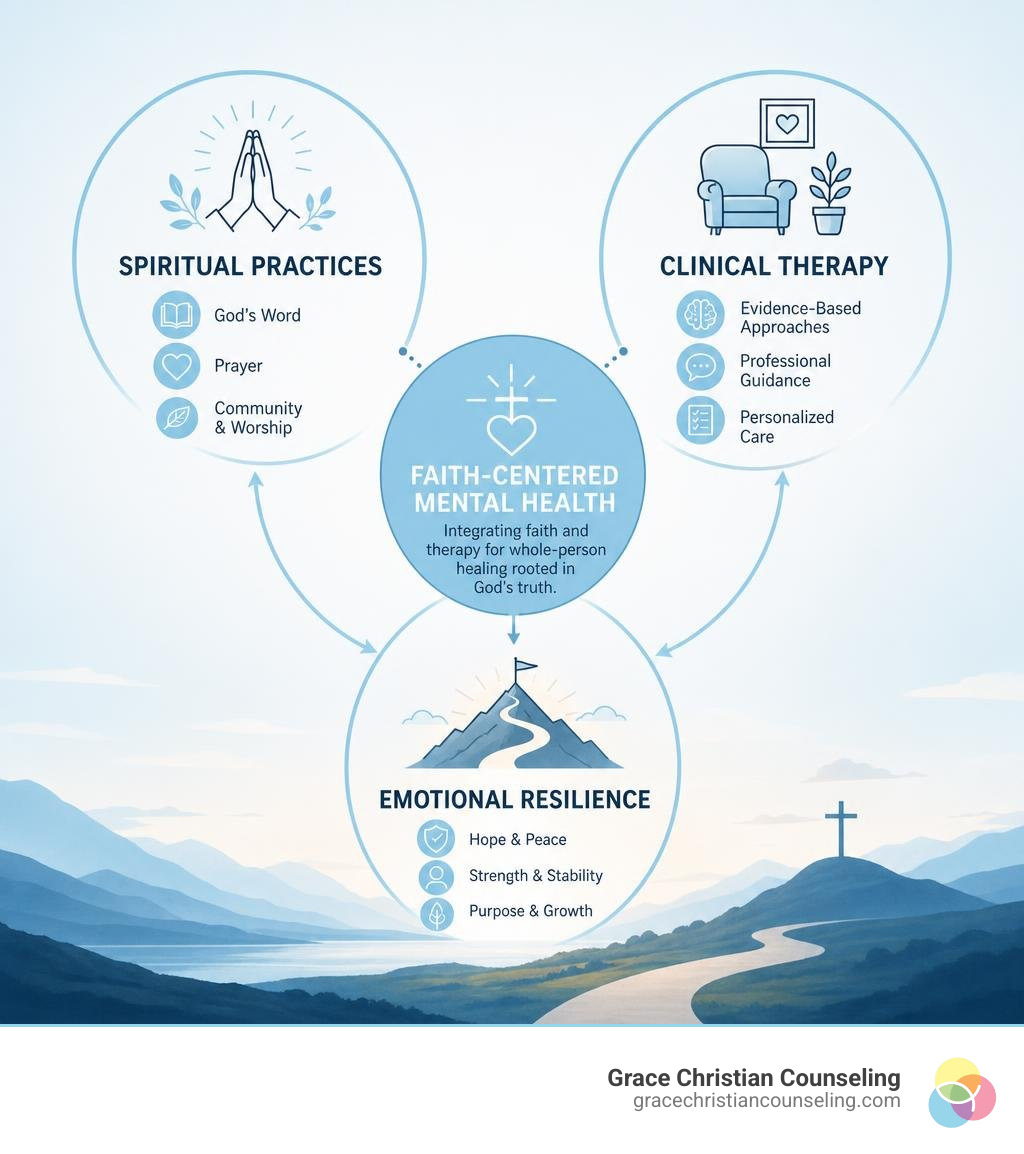
Faith centered mental health is an approach to emotional and psychological wellness that combines clinical therapy with biblical truth, spiritual practices, and the guidance of God’s Word.
Here is what it means in plain terms:
- It treats the whole person, not just symptoms, addressing mind, body, and spirit together
- It uses evidence-based methods like Cognitive Behavioral Therapy (CBT) alongside prayer and Scripture
- It is provided by licensed counselors who are also grounded in Christian faith
- It is open to anyone who wants their faith to be part of the healing process
- It reduces the false choice between “seeing a therapist” and “trusting God”
About 60% of adults say that faith or spirituality is an important factor in supporting their mental wellness. Yet many Christians still feel caught between two worlds: a church culture that sometimes treats mental health struggles as a lack of faith, and a secular therapy world that leaves their spiritual life out of the room entirely.
That gap is real, and it causes real harm. In our counseling work, we often meet people who have spent months or even years feeling stuck between spiritual guilt and emotional exhaustion. Some worry that needing therapy means they are not trusting God enough. Others have tried counseling before but felt uncomfortable bringing faith into the conversation. One of the most common things clients tell us after starting faith-centered counseling is relief. Relief that they no longer have to separate their emotional struggles from their spiritual life, and relief that healing does not require choosing between prayer and practical support.
The truth is that God cares about your emotional health. Even the prophet Elijah, one of the most faithful figures in Scripture, collapsed under the weight of burnout and despair. And what did God do first? He gave Elijah food, water, and rest before anything else. That says something important about how healing actually works.
At Grace Christian Counseling, we believe you do not have to choose between clinical care and your faith. Our licensed counselors serve individuals, couples, families, and teens across Western Pennsylvania and online, using an approach that holds both biblical wisdom and evidence-based practice together.
This guide will walk you through what faith centered mental health looks like, how it works, and how to take your next step toward wholeness.
Understanding Faith Centered Mental Health and How It Differs from Secular Therapy
When you walk into a traditional, secular counseling clinic, your therapist might be highly skilled in clinical psychology, but they may view your spiritual convictions as a mere hobby, a cultural background, or even an obstacle to your recovery. Secular settings can unintentionally marginalize or ignore faith, sometimes replacing it with a generic, undefined spirituality that directly contradicts Christian beliefs.
Conversely, relying solely on pastoral advice or “prayer-only” approaches can sometimes leave you feeling isolated if you are dealing with a more severe clinical issue. Well-meaning brothers and sisters in Christ might tell you to “just pray harder” or “repent of hidden sin” when you are actually suffering from a biological chemical imbalance or deep-seated trauma that might require extra support and professional treatment.

Faith centered mental health bridges this painful divide. It recognizes that our beliefs and convictions are deeply interconnected with our neurological, emotional, and social lives. Rather than separating the soul from the brain, we integrate them.
This integrated framework is supported by a growing body of clinical research. According to the American Psychiatric Association, APA research on faith and mental health partnerships demonstrates that collaborative relationships between professional mental health clinicians and faith communities significantly improve access to care, increase mental health literacy, reduce cultural stigma, and lead to better overall recovery outcomes.
The Core Pillars of Faith Centered Mental Health
A truly faith-integrated approach to clinical care rests on three core pillars:
- The Authority of Scripture: We believe God’s Word is a living, breathing guide to understanding who we are, why we suffer, and how we heal. It provides the ultimate foundation for our identity.
- The Power of Prayer: Prayer is not a magic wand to avoid pain, but a vital relational channel where we bring our authentic grief, fear, and hope to a loving Father.
- Spiritual Discernment: Guided by the Holy Spirit, we help you examine the deeper spiritual roots of your emotional patterns, distinguishing between a medical symptom, a cognitive distortion, and a spiritual crisis.
When we look to the Bible, we do not see a book that ignores emotional suffering. Instead, we find a rich history of God meeting people in their darkest hours. For a deeper look at how God’s Word speaks directly to our emotional struggles, you can explore our curated list of Bible Verses for Mental Health.
Clinical Excellence Meets Biblical Truth
Integrating faith into your healing journey does not mean we compromise on clinical quality. In fact, we view clinical excellence as a direct act of spiritual stewardship. God has gifted humanity with the knowledge and tools of modern science and psychology, and He also gives wisdom in using them to relieve suffering. This stewardship honors Him.
Our licensed counselors use evidence-based therapeutic modalities that naturally align with biblical truths. For example, Cognitive Behavioral Therapy (CBT) helps you identify and reframe negative, automatic thought patterns. This clinical practice perfectly mirrors the biblical command to take every thought captive and being transformed by the renewing of your mind.
One thing we regularly explain to clients is that faith integration is not about adding a Bible verse to the end of a therapy session. In practice, it may look like exploring how anxiety affects your relationship with God, identifying thought patterns that conflict with both clinical reality and biblical truth, or creating practical routines for sleep, rest, community, and prayer. The goal is not to over spiritualize symptoms or over “clinicalize” faith. It is to help people build habits that support emotional resilience and spiritual growth together.
The Science and Soul of Healing: Integrating Clinical Psychology with Scripture
One of the most exciting discoveries in modern neuroscience is the concept of neuroplasticity: the brain’s ability to reorganize itself by forming new neural connections throughout life. Your brain is highly adaptive, and the pathways you use most frequently become stronger over time. If your mind is constantly discipled by worry, trauma memories, and shame, those negative neural pathways become deeply grooved highways.
Scripture anticipated this scientific reality thousands of years ago. In Romans 12, the Apostle Paul commands us: “Do not be conformed to this world, but be transformed by the renewal of your mind”. Mind renewal is both a spiritual miracle and a biological process. When we intentionally practice scriptural meditation, emotional regulation, and gratitude, we are quite literally rewiring our physical brains. We are replacing pathways of fear with pathways of peace.
To explore how biblical truths can help you shift from a state of fear to a state of calm, take a look at our guide on Mind Over Matter and Faith Over Fear: Bible Quotes About Mental Health.
Overcoming Anxiety and Depression Through Faith Centered Mental Health
Anxiety and depression are not signs of a broken relationship with God; they are signs that we are human beings living in a fallen, highly stressful world. When anxiety strikes, your sympathetic nervous system goes into overdrive, triggering a fight-or-flight response. In Philippians 4, we are encouraged: “Do not be anxious about anything, but in everything by prayer and supplication with thanksgiving let your requests be made known to God”.
In a clinical setting, we combine this spiritual instruction with practical emotional regulation tools. We help you identify the cognitive distortions (unhelpful, exaggerated thought patterns) that fuel your anxiety, and then we help you ground your nervous system through slow breathing and physical stabilization. If you or a loved one are walking through these heavy valleys, you do not have to carry the burden alone. We offer specialized support through Overcoming Anxiety Through Christian Counseling and comprehensive Christian Support for Depression and Anxiety.
The Elijah Paradox: Physical Stewardship as Spiritual Worship
Many Christians fall into the trap of treating their bodies as secondary to their souls. However, the Bible presents a deeply embodied view of humanity. A classic example of this is found in the story of the prophet Elijah in 1 Kings 19. After a massive spiritual victory on Mount Carmel, Elijah was threatened by Queen Jezebel. Overwhelmed by fear, exhaustion, and isolation, Elijah ran into the wilderness, sat under a broom tree, and prayed that he might die. He was experiencing a profound, clinical-level crash.
Notice how God responded. He did not lecture Elijah about his lack of faith. He did not give him a theological pop quiz. First, God sent an angel to provide him with freshly baked bread and jarred water, and then He let him sleep. God repeated this physical intervention twice before He ever addressed Elijah’s spiritual perspective. Some call this the Elijah Paradox, meaning that sometimes the most spiritual thing you can do is take a nap, eat a nourishing meal, and drink some water.
Loving yourself well is not just emotional or spiritual work. It also means caring for your body through sleep, nutrition, and movement because these habits directly affect mental wellness through the nervous system and gut-brain connection. Adults are generally recommended to get 7–9 hours of sleep per night, and poor sleep is consistently linked with worse mental health outcomes (American Academy of Sleep Medicine). Research also shows movement matters: a 2024 review of 247 studies found that physical activity supports mental health by improving resilience, self-esteem, and overall wellbeing. Caring for your body is not separate from caring for your mind or faith. It is part of whole-person healing, and it is an act of spiritual worship.
The Counseling Blueprint: Our Four-Stage Journey to Wholeness
At Grace Christian Counseling, we do not believe in one-size-fits-all, superficial fixes. Real healing takes time, safety, and a structured approach. To guide our clients toward lasting restoration, we utilize a unique framework we call the Counseling Blueprint.

This blueprint is designed to build a strong therapeutic alliance, ensuring you feel completely safe, heard, and respected by our licensed counselors (such as LSWs and LAPCs) as we walk through four distinct stages of healing.
Taking Off the Mask and Healing the Wounds
- Stage 1: Take Off the Mask: In our daily lives, many of us wear masks of perfection, strength, or “having it all together” because we fear judgment. In this first stage, we focus on building genuine rapport and deep trust. We create a confidential, grace-filled space where you can safely drop the act and speak honestly about your pain, doubts, and struggles.
- Stage 2: Heal the Wounds: Once the mask is off, we can begin the gentle work of exploring your emotional and relational hurts. Whether you are dealing with childhood trauma, family conflicts, or the heavy fog of clinical depression, we help you identify where the pain started.
If you are currently struggling with persistent feelings of hopelessness or sadness, you can read more about our specific approach to these initial stages in our guide on Christian Counseling for Depression.
Removing Toxins and Replacing with Truth
- Stage 3: Remove the Toxins: Emotional wounds often leave behind toxic, unhelpful beliefs. You might find yourself believing lies like, “I am unlovable,” “I am a failure,” or “God has abandoned me.” In this stage, we work together to identify and pull up these toxic beliefs by their roots, using both cognitive behavioral tools and spiritual discernment.
- Stage 4: Replace with Truth: Finally, we do not leave your mind empty. We replace those old, destructive narratives with God’s empowering, accurate truth about who you are, how He sees you, and what your future holds. We install practical, resilient perspectives that help you walk in freedom.
To learn more about how this transformative process can relieve chronic worry, read our comprehensive resource on Scripture-Based Anxiety Relief: A Christian Guide.
The Role of Faith Communities in Reducing Stigma and Supporting Recovery
Faith communities and local churches are uniquely positioned to be the frontline safety net for those struggling with mental health challenges. When someone hits a point of crisis, they are far more likely to reach out to a trusted pastor, small group leader, or church friend before they ever call a professional clinic.
Unfortunately, just half of adults who belong to a religious community say that mental health is discussed openly and without stigma. This silence can prevent people from seeking life-saving care. Faith leaders have a beautiful opportunity to change this by speaking openly about mental health from the pulpit, sharing resources like the 988 Suicide & Crisis Lifeline, and building strong referral networks with local licensed professionals.
Bridging the Gap Between the Church and Professional Care
A healthy church community should never feel threatened by professional mental health care, and professional counselors should respect the vital role of pastoral care. When local churches and licensed therapists partner together, we create a seamless web of support.
Pastors can provide spiritual direction, prayer, and community belonging, while licensed therapists provide clinical assessment, trauma processing, and evidence-based treatment. This collaborative approach helps believers navigate their challenges without feeling like they have to choose between their local church and their mental health provider.
We have also seen that people often seek help later than they wish they had. Many clients arrive believing they should be able to handle everything on their own, only to discover that asking for support was not weakness but wisdom. Seeking counseling does not replace prayer, church involvement, or spiritual disciplines. For many people, counseling becomes one of the practical ways God provides care, perspective, and support during difficult seasons.
If you are trying to navigate how to balance your personal faith practices with professional care, our article on How to Deal with Anxiety as a Christian offers practical, balanced guidance.
Practical Spiritual Disciplines for Long-Term Mental Resilience
Long-term mental wellness is not just about resolving crises; it is about cultivating daily habits that keep your soul anchored. Spiritual disciplines are not religious chores to earn God’s favor; they are practical, life-giving rhythms designed to keep your mind and body in a state of peace.
- Prayer and Meditation: Taking quiet moments to slow your breathing, quiet your mind, and focus on God’s presence.
- The Practice of Lament: The Bible is full of prayers of lament (nearly a third of the Psalms are songs of grief). Lament is the spiritual practice of telling God exactly how much it hurts, without filtering your anger or sadness. It is a vital tool for processing grief.
- Gratitude: Intentionally naming the blessings in your life. Cultivating a habit of gratitude physically reshapes your brain’s neural pathways, making you more resilient to stress.
- Community Connection: We were never meant to heal in isolation. Regular, authentic fellowship with other believers provides emotional safety and practical support.
Cultivating Daily Grace-Filled Rhythms in Your Life
In our modern digital world, our minds are constantly pulled toward stressful news, social media comparison, endless notifications, and work demands that follow us home. Over time, that constant input can make it harder to rest, pray, think clearly, or stay emotionally grounded. Protecting your mental health means setting wise boundaries around your time and attention, not because the world is all bad, but because your soul needs space to breathe.
This means practicing the spiritual discipline of rest (Sabbath), setting firm boundaries around your work hours, and limiting your daily media consumption. That may look like limiting screen time, creating phone-free moments, taking breaks from draining content, protecting sleep, or choosing relationships and media that help you move toward peace instead of anxiety. Boundaries are not selfish; they are a practical way to steward the mind, body, and spirit God has given you. By choosing to step away from the noise and rest in God’s grace, you give your nervous system a chance to recover and heal.
Frequently Asked Questions About Faith-Based Mental Wellness
Is struggling with mental health a sign of weak faith?
Absolutely not. Despair, anxiety, and burnout are signs of being a human being living in a broken, stressful world, not signs of a spiritual deficit.
Some of the most faithful men and women in the Bible experienced severe emotional distress. Job cursed the day he was born, David filled his psalms with tears of depression, and the prophet Elijah collapsed in the wilderness and wished for death. God did not disqualify or shame any of them. He met them with profound grace, physical care, and quiet comfort.
How do clinical therapy and biblical principles work together?
They work together beautifully because all truth is God’s truth. Clinical psychology provides us with a scientific understanding of how our brains, nervous systems, and behaviors function. Biblical principles provide us with the ultimate truth about our identity, purpose, and relationship with our Creator.
When we use Cognitive Behavioral Therapy (CBT) to identify and reframe negative thoughts, we are clinically practicing the biblical command to renew our minds. When we use somatic therapy to calm a racing heart, we are honoring the body God created.
For a deeper look at how this integration works in practice, check out our resource on Faith-Based Therapy for Overcoming Depression.
How can I find a qualified faith-integrated counselor in Pennsylvania?
When looking for a counselor, it is crucial to ensure they hold professional, state-recognized licensing credentials (such as an LAPC or LSW) alongside a deep commitment to biblical truth.
At Grace Christian Counseling, we provide professional, Christ-centered care both in-person at our various local offices in Western Pennsylvania (including communities like Pittsburgh, Penn Hills, Sewickley, Uniontown, Pleasant Hills, Bethel Park, Ligonier, Belle Vernon, Punxsutawney, North Huntingdon, and Mt. Lebanon) and virtually statewide across PA.
If you are looking for local support in the Pittsburgh area, you can learn more about our local team and services by visiting Christian Mental Health Counseling Pittsburgh.
Taking Your Next Step Toward Soul Care
Your emotional, physical, and spiritual health are deeply intertwined. You do not have to walk through the fog of anxiety, depression, trauma, or relationship strain alone, and you do not have to leave your faith at the door to get professional help.
At Grace Christian Counseling, we are committed to walking alongside you with compassion, clinical excellence, and biblical wisdom. Whether you prefer to meet with a licensed counselor in person at one of our Western Pennsylvania locations or connect with us through secure, convenient online sessions from anywhere in PA, we are here to support your journey to wholeness.
You do not have to settle for a life of quiet exhaustion. Let us help you take off the mask, heal your wounds, remove the toxins, and replace them with God’s life-giving truth.
Start your healing journey today by reaching out to our team, and take your first step toward true soul care and lasting mental wellness.
This guide is for educational and spiritual encouragement and is not a substitute for personalized professional counseling. If you are in crisis, please reach out for immediate help.
How to Access Faith Centered Anxiety Help Across Western PA
Primary keyword Christian counseling for pastors and ministry leaders in Pennsylvania


